
Jeddah · Saudi Arabia
AlUla: How the Desert Became a Contemporary Art Destination
A comprehensive guide to Saudi Arabia's desert art revolution, mapping the permanent and temporary masterworks of the AlUla oasis.
AlUla, located in the northwest desert of Saudi Arabia, is undergoing one of the most ambitious cultural transformations of the modern era. For thousands of years, this lush oasis valley served as a major trade and pilgrimage crossroads along the historic Incense Route, providing shelter to successive civilisations who carved their histories directly into the red sandstone cliffs. Today, the Royal Commission for AlUla is working to re-establish the region as a living museum, turning the desert sands into an expansive stage for international contemporary art, design, and architecture.
This transition is defined by a unique combination of temporary outdoor exhibitions, permanent land art commissions, and world-class institutional partnerships. From the ephemeral, site-specific installations of Desert X AlUla to the colossal, permanent interventions of Wadi AlFann, the region offers a physical experience of art that challenges traditional gallery spaces. For collectors, art lovers, and cultural travellers seeking to navigate this rapidly changing environment, the Exhibo online discovery platform serves as the ultimate companion, helping users track exhibition openings, gallery details, and major public projects across the country.
The rediscovery of an ancient cultural crossroads
The transformation of AlUla is not a sudden invention of the twenty-first century, but rather a continuation of its historical identity as a centre of creative transfer. As the capital of the ancient Dadan and Lihyan kingdoms, and later the southern outpost of the Nabataean Empire at Hegra, the valley has always been a place where different cultures met, shared ideas, and left permanent visual marks. The thousands of rock inscriptions and monumental tomb facades carved into the cliffs are evidence of a long-standing tradition of physical craftsmanship.
By placing modern installations directly alongside these ancient ruins, the current cultural programming establishes a direct dialogue across centuries of human creative activity. This approach encourages contemporary artists to learn from the desert, drawing inspiration from its dramatic topography, wind patterns, and geological structures. It moves the discussion away from treating the desert as an empty, barren space, viewing it instead as an active participant in shaping artistic thought.
For those planning to experience this unique intersection of history and contemporary art, keeping track of active exhibitions across remote desert sites requires clear information. Using curated directories like Exhibo simplifies the process, allowing travellers to coordinate their cultural excursions from urban art districts to the vast canyons of the northwest. By organizing details on opening hours, locations, and artist rosters, the platform helps collectors explore AlUla's creative environment at their own pace.
Desert X AlUla: Art without walls
The fourth edition of Desert X AlUla, which ran from 16 January to 28 February 2026, demonstrated the incredible potential of temporary, site-specific contemporary art in the desert. Organised in collaboration with the California-based Desert X biennial, this outdoor exhibition commissions local and international artists to create large-scale works that respond directly to the unique sandstone landscape.
The curatorial concept of "Space Without Measure"
The 2026 edition of the biennial was curated by Wejdan Reda and Zoé Whitley, under the artistic direction of Neville Wakefield and Raneem Farsi. The curators structured the exhibition around the theme "Space Without Measure / فضاء بلا قياس," drawing conceptual inspiration from the writings of the celebrated poet and philosopher Kahlil Gibran. This theme challenged artists to look beyond traditional physical measurements, exploring how we perceive distance, time, and scale in an infinite environment.
Whitley and Reda asked the participating artists to consider how the human body interacts with the immense scale of the desert canyons. The curatorial team selected eleven artists whose practices encompass sound, sculpture, ecology, and participatory performance. By choosing works that require visitors to listen, walk, and touch, the curators created an exhibition that felt deeply personal, despite the monumental scale of its surroundings.
This conceptual framework also addressed the temporary nature of the exhibition itself. In a region with a 7,000-year history of permanent rock carvings, the curators wanted to explore how temporary, fleeting interventions could leave lasting intellectual impressions. This approach allowed the exhibition to operate as a conceptual bridge, preparing the ground for the permanent, era-defining installations planned for the region's future cultural parks.
Landmark installations of the 2026 biennial
The artists selected for the 2026 edition responded to the desert environment with a diverse range of physical and sensory installations. Pioneering land artist Agnes Denes presented a major new work that interacted with the wind and light of the canyon, while Cuban-American artist Maria Magdalena Campos-Pons created a multi-layered sculpture that examined migration and memory. These international voices were joined by Sudanese modernist Ibrahim El-Salahi, who presented a series of meditative, sculptural forms.
Saudi artists played a central role in the exhibition, bringing local histories and personal memories to the canyon floor. Artist Sara Abdu created an evocative, sound-based installation that echoed through the sandstone crevices, while Mohammad Alfaraj and Basmah Felemban presented sculptural works that referenced regional folklore and ecological survival. The exhibition also featured rarely seen, historic works by the late Saudi painter Mohammed AlSaleem, introducing his pioneering modernism to a new generation of international visitors.
I remember standing in the canyon during the 2026 edition of Desert X, watching wind currents slowly blow sand over these sculptures. There was something deeply unsettling, yet beautiful, about seeing massive conceptual pieces exposed to the elements, knowing they would eventually disappear without leaving a single trace. This material honesty is what makes Land Art so powerful, forcing the viewer to confront the passage of time in real time.
The spatial friction of the outdoor exhibition
The physical layout of Desert X AlUla requires visitors to abandon the comfortable, passive viewing habits of the traditional museum. To view the artworks, visitors must walk along sandy paths, climb over rocky outcrops, and navigate the changing heat and wind of the valley. This physical effort alters how the art is received, turning a standard gallery visit into an active, sensory expedition.
The changing natural light of the desert also plays a central role in the appearance of the installations throughout the day. A sculpture that appears heavy and solid under the harsh midday sun can transform into a delicate, glowing form as the golden hour light reflects off the surrounding sandstone walls. This fluid relationship with the environment ensures that no two visitors experience the artwork in exactly the same way.
By removing the protective walls of the white-cube gallery, the exhibition forces a direct, physical confrontation between the delicate materials of contemporary art and the brutal forces of nature. This spatial friction is central to the biennial's identity, showing that contemporary art does not need a formal museum building to carry deep conceptual meaning. It establishes the desert itself as an active, living exhibition architecture.
Wadi AlFann: The valley of permanent monumental art
While Desert X offers temporary, fleeting experiences, Wadi AlFann (meaning "Valley of the Arts") is designed as a permanent home for monumental Land Art. Spanning a spectacular 65-square-kilometre desert canyon, this ambitious project commissions some of the world's most influential contemporary artists to create era-defining, permanent works that will remain integrated with the landscape for generations to come.
The scale and ambition of the valley
The creation of Wadi AlFann, led by Iwona Blazwick, Chair of the Royal Commission for AlUla's Public Art Expert Panel, represents a major development in the history of Land Art. The project aims to create a global destination for monumental art on a scale comparable to famous site-specific art centres like Marfa in Texas or Naoshima in Japan. By permanently placing these colossal works within the sandstone cliffs, the foundation is building a public collection that will grow and evolve over decades.
The first five commissions selected for the valley are being created by a cross-generational group of pioneering artists: Manal AlDowayan, Agnes Denes, Michael Heizer, Ahmed Mater, and James Turrell. These artists were chosen because of their long-standing engagement with scale, environment, and perception. Each artist was asked to spend time in AlUla, learning from the desert's unique topography and archaeological remains before finalizing their designs.
To support this massive undertaking, the physical infrastructure of the valley is being developed with a light touch, prioritizing environmental conservation. The access paths, viewing pavilions, and public walkways are constructed using locally sourced clay and stone to minimize visual disruption. This careful planning ensures that the colossal artworks do not overwhelm the natural ecosystem, allowing local camel herds and native desert species to move freely through the valley.
James Turrell and the geometry of light
James Turrell, a pioneer of the mid-century Light and Space movement, has conceived an extraordinarily ambitious commission for Wadi AlFann. Known for his "Skyspaces" and his monumental work at Roden Crater in Arizona, Turrell’s project in AlUla involves carving a series of sensory chambers directly into the canyon floor. These chambers are designed to manipulate natural light, colour, and human perception without the use of artificial illumination.
Visitors will descend into these subterranean spaces, where carefully engineered apertures in the ceilings will frame the desert sky above. By isolating the light of the sky against clean, geometric openings, Turrell creates an intense sensory experience where the sky appears to have a physical, liquid weight. The colours of the desert dawn and dusk are concentrated within the chambers, shifting from deep indigo to warm ochre in a silent, meditative progression.
Turrell's work in Wadi AlFann is a powerful exploration of the materiality of light, inviting viewers to sit in quiet contemplation and observe their own visual processing. In a desert environment known for its mirages and extreme light contrasts, his subterranean chambers offer a cool, quiet sanctuary where visitors can reconnect with the fundamental physics of sight. It is a work that bridges contemporary physics with ancient astronomical observations.
Regional masters: Manal AlDowayan and Ahmed Mater
The inclusion of major commissions by Saudi artists Manal AlDowayan and Ahmed Mater ensures that Wadi AlFann remains deeply connected to the cultural history of the Arabian Peninsula. AlDowayan’s contribution, titled "Oasis of Stories," is a massive, maze-like architectural sculpture inspired by the traditional mudbrick ruins of AlUla’s Old Town. The walls of this labyrinth are engraved with personal drawings and oral histories collected from the local AlUla community, preserving their stories within a permanent monument.
Ahmed Mater’s colossal installation, titled "Ashab Al-Lal," looks closely at the mythic and scientific history of the desert mirage. Visitors descend through a dark, tunnelled ramp into a subterranean chamber, where a complex arrangement of mirrors projects their collective images above ground, creating a shimmering apparition for desert walkers outside. Mater’s work draws inspiration from the great scientific and philosophical thinkers of the Islamic Golden Age, exploring the boundaries between reality and illusion.
By commissioning these regional masters to create works on the same scale as international land art pioneers, Wadi AlFann elevates Saudi contemporary art into a global dialogue. These installations are not merely decorative additions to the desert; they are complex research projects that document local memory, science, and folklore. They ensure that the valley functions as a place of active cultural production, rooted in the heritage of the land.
The AlUla Contemporary Art Museum and the Centre Pompidou partnership
In addition to its outdoor installations, the region is developing a major new physical institution: the AlUla Contemporary Art Museum. Designed by the celebrated Lebanese architect Lina Ghotmeh, this world-class museum is being developed in close advisory partnership with Paris’s Centre Pompidou, creating a new bridge for international cultural exchange.
Lina Ghotmeh’s sustainable architecture
Lina Ghotmeh’s design for the AlUla Contemporary Art Museum represents a major step forward for sustainable, bioclimatic museum architecture. The building is designed to integrate with the surrounding oasis, rather than imposing a sterile, foreign structure onto the land. Ghotmeh’s studio has prioritized using local earth-based materials, creating a series of organic, undulating forms that mirror the shapes of the sandstone cliffs and palm groves.
The museum utilizes sustainable cooling techniques and natural ventilation, reducing its reliance on energy-intensive air conditioning. This bioclimatic approach ensures that the indoor gallery spaces remain comfortable for visitors while protecting the delicate artworks from the extreme desert heat. The building is conceived as an ecological habitat as much as a gallery, with public gardens and quiet courtyards that encourage visitors to relax and reflect.
By choosing Ghotmeh, the Royal Commission for AlUla has aligned the museum’s physical structure with the ecological philosophy of its art programming. The building does not act as a barrier between the visitor and the desert; instead, its open pavilions and natural lighting systems allow the surrounding environment to flow through the gallery spaces, creating a unified sensory experience.
The "Arduna" exhibition as a conceptual blueprint
The curatorial vision of the future museum was revealed in a landmark pre-opening exhibition titled "Arduna" ("Our Land"), which ran from 1 February to 15 April 2026 as part of the AlUla Arts Festival. Co-curated by Candida Pestana and Ftoon AlThaedi from AlUla, alongside Anna Hiddleston and Noémie Fillon from the Centre Pompidou, the exhibition functioned as a conceptual blueprint for the upcoming institution.
Arduna featured over 80 artworks across multiple disciplines, combining significant loans from the Centre Pompidou's National Museum of Modern Art in Paris with pieces from the Royal Commission for AlUla’s growing collection. The exhibition brought together modern pioneers such as Pablo Picasso, Joan Mitchell, Wassily Kandinsky, and David Hockney, placing their works in direct conversation with leading contemporary regional artists like Manal AlDowayan, Ayman Zedani, and Etel Adnan.
The exhibition used the image of the oasis garden as a starting point to explore humanity's evolving relationship with the land and the threat of climate change. By showing how both modern and contemporary artists have represented nature, the curators created an exhibition that was highly relevant to the ecological challenges of 2026. This co-curated project demonstrated how the AlUla museum intends to bridge Western modern art history with contemporary Middle Eastern perspectives.
A museum of complete artist collections
The AlUla Contemporary Art Museum is adopting a unique, highly transparent acquisition strategy that sets it apart from traditional institutions. Instead of purchasing single, highlight paintings by popular artists, the museum is committed to collecting the entire body of work by selected regional and international creators. This comprehensive approach includes acquiring preliminary research, preparatory sketches, architectural models, and developmental notes alongside the final finished artworks.
This acquisition strategy offers visitors a rare, educational look into the complete creative evolution of an artist's practice over decades. It demystifies the artistic process, showing that masterworks do not appear out of nowhere, but are the result of years of research, experimentation, and failure. This focus on process aligns with AlUla's identity as a place of learning and contemplation, where visitors are encouraged to slow down and study the history of creativity.
The Centre Pompidou's advisory role is essential for supporting this ambitious program, providing international expertise in archival preservation, collection management, and curatorial training. Through this collaboration, local Saudi museum professionals are receiving world-class training, ensuring that the country’s cultural sector is supported by local expertise. This partnership ensures that the museum will operate as a respected, self-sustaining global institution.
Integrating modern art with ancient heritage
The success of AlUla’s contemporary art destination relies on a respectful, protective approach to its ancient archaeological heritage. The region is home to Hegra, Saudi Arabia's first UNESCO World Heritage Site, which contains over 110 beautifully preserved Nabataean tombs carved into monumental sandstone monoliths. It also includes the ancient archaeological sites of Dadan, the capital of the Lihyanite Kingdom, and Jabal Ikmah, an open-air library of historic inscriptions.
Contemporary artists commissioned to work in the region are asked to treat the entire desert as a living museum, where their modern interventions must respect the geological and historical layers of the land. This requirement has led to a highly thoughtful, low-impact style of Land Art, where installations are designed to sit within natural canyons without causing physical damage to the ancient sandstone or historic relics. This approach ensures that the contemporary art programming supports, rather than distracts from, the preservation of the archaeological sites.
By connecting these ancient sites with modern art installations, the region offers visitors a rare opportunity to explore the continuity of human creative practice. A visitor can spend the morning exploring the monumental, hand-carved tombs of Hegra and the afternoon walking through the contemporary, sensory chambers of James Turrell or the conceptual installations of Desert X. This direct connection highlights the shared human desire to leave a lasting creative mark on the physical world.
The socio-economic impact on the local community
The development of AlUla’s cultural sector is designed to provide direct, lasting socio-economic benefits to the local population, rather than existing as an isolated tourist development. The Royal Commission for AlUla has placed community engagement, education, and job creation at the centre of its master plan, ensuring that the local community remains the primary beneficiary of the creative economy.
The construction of major institutions like the AlUla Contemporary Art Museum and the development of Wadi AlFann have created hundreds of new jobs in construction, hospitality, and cultural tourism. Local residents are being trained as gallery guides, museum registrars, conservation technicians, and site managers, providing them with valuable skills for the future. Furthermore, the biennial exhibitions and festivals provide local artisans and fabricators with opportunities to collaborate with international artists, helping to preserve and modernise traditional regional crafts.
The commission also runs extensive educational programmes, including workshops, artist residencies, and public symposia that are open to local schools and creative professionals. These initiatives aim to inspire a new generation of Saudi artists, curators, and cultural writers, ensuring that the region's artistic growth is driven by local talent. By investing in the education and prosperity of its residents, AlUla is building a sustainable, community-minded creative sector that will support the region for generations to come.
Planning your contemporary art trip to AlUla
Visiting AlUla's outdoor art installations requires some preparation, as the vast, remote desert environment can make travel times and weather conditions unpredictable. The region is located approximately 1,100 kilometres northwest of Riyadh, and although it is accessible by car, most international visitors prefer to fly directly into AlUla International Airport.
To help you get the most out of your contemporary art tour, keep these practical travel tips in mind:
Coordinate with the Arts Festival: The best time to visit is during the annual AlUla Arts Festival, which typically runs from mid-January to mid-April. This period co-ordinates multiple exhibition openings, outdoor installations, and public performances, making it the most active time of the year.
Book Desert X and Museum Tickets in Advance: While admission to public installations and major exhibitions like Desert X is free of charge, visitors must reserve timed-entry slots online in advance to manage visitor numbers and protect the fragile desert terrain.
Hire a Local Guide or 4x4 Vehicle: Many of the remote land art installations in Wadi AlFann and the canyons are only accessible via unpaved desert tracks. Hiring a licensed local guide with a four-wheel-drive vehicle is highly recommended to navigate the sand dunes safely.
Prepare for Extreme Temperatures: The desert climate can fluctuate dramatically, with hot midday sun and very cold evening desert winds. Dress in light, protective layers, wear sturdy walking boots for sandy paths, and always carry sufficient water during your outdoor excursions.
By taking these simple steps, you can ensure a safe, comfortable, and deeply rewarding journey through one of the world's most spectacular natural art galleries.
Comparison of major art initiatives in AlUla
Each of the major cultural initiatives in AlUla has a distinct format, timing, and conceptual focus, catering to different interests and visitor lifestyles. The table below outlines what to expect from each key project.
Initiative | Timing / Duration | Key Artists | Venue Type | Cultural Focus |
Desert X AlUla | Biennial exhibition (typically 6 weeks, held in winter) | Agnes Denes, Sara Abdu, Héctor Zamora, Basmah Felemban | Temporary desert pavilions and sandstone canyons | Ephemeral, site-specific installations exploring space, scale, and human perception |
Wadi AlFann | Permanent, year-round public art destination | Manal AlDowayan, Ahmed Mater, James Turrell, Michael Heizer | 65-square-kilometre protected desert valley | Monumental, permanent architectural interventions integrated with the geology |
AlUla Contemporary Art Museum | Permanent institution (inaugurated in late 2027/2028) | Saudi, Middle Eastern, and international contemporary masters | Sustainable bioclimatic building designed by Lina Ghotmeh | Preserving complete artist archives and presenting co-curated exhibitions with Centre Pompidou |
Frequently asked questions
Is the Centre Pompidou in AlUla a replica of the museum in Paris?
No, the AlUla Contemporary Art Museum is a completely unique, independent institution designed by architect Lina Ghotmeh using sustainable, local building materials. The Centre Pompidou in Paris serves as the main advisory partner, providing international curatorial expertise, training local Saudi museum staff, and co-ordinating major loans from its national modern art collection for temporary exhibitions like "Arduna."
When is the best time of year to visit AlUla's art installations?
The optimal time to visit AlUla is during the cooler winter months, from October to March, when daytime temperatures are comfortable for outdoor walking. To experience the highest concentration of active art exhibitions, plan your visit during the AlUla Arts Festival, which runs from mid-January to mid-April.
Are the Land Art installations in Wadi AlFann finished?
The first five monumental commissions for Wadi AlFann, created by Manal AlDowayan, Ahmed Mater, James Turrell, Michael Heizer, and Agnes Denes, are being progressively completed and installed. While some parts of the valley are open to the public during seasonal festivals, visitors should check active listings on the Royal Commission’s platforms before planning their trip.
How can Exhibo help me navigate my contemporary art trip to AlUla?
Exhibo functions as a dedicated digital discovery platform and directory for contemporary art enthusiasts. By organizing up-to-date listings on exhibition dates, opening hours, gallery locations, and represented artists, Exhibo helps you plan your cultural journey from the urban art hubs of Riyadh to the remote desert installations of AlUla, ensuring you never miss a major opening.
Galleries mentioned

Museums mentioned
Exhibitions mentioned
Related reading
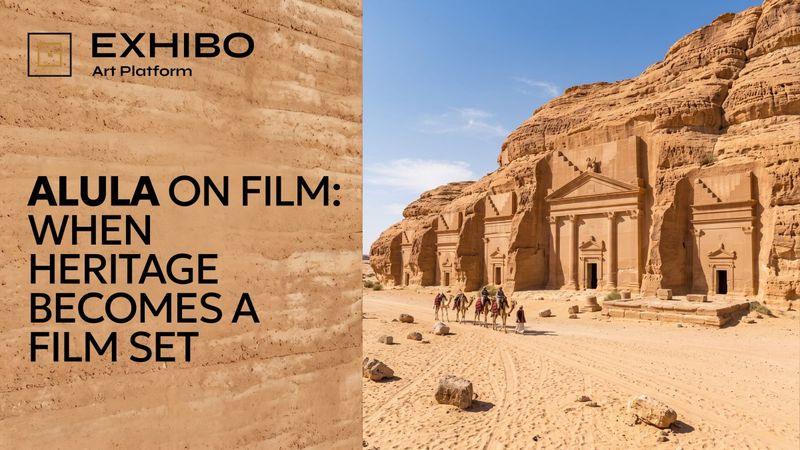
AlUla on Film: When Heritage Becomes a Film Set
Hollywood came to AlUla to build Iraq and Afghanistan. Saudi Arabia is using the same landscape to build AlUla itself — destination, museum, cultural stage — and the old stone is being asked to say something new.
Hollywood built Iraq and Afghanistan in AlUla; Saudi Arabia is building AlUla into itself. On carved kings, a warning old as scripture, a mirror the size of a building, and who gets to author a place.
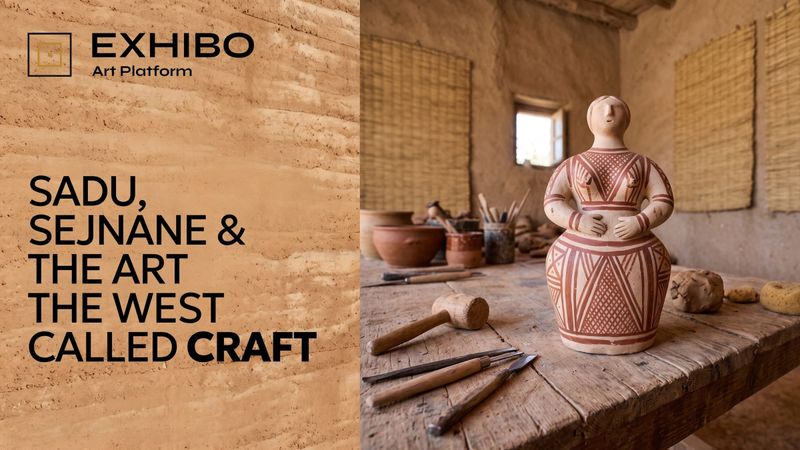
Women Makers: Sadu, Sejnane and the Art the West Called Craft
How the women of Sejnane and the Sadu tents made a world of geometric art the museum system had no shelf for — and how it is finally being called by its name.
Two women's traditions — the clay of Sejnane in Tunisia, the woven tents of the Arabian Peninsula — share no bloodline, only a rhyme: the same spare geometry, held and passed down by women, in whatever material their world gave them. This is the story of the visual knowledge the West filed under "craft," the makers it kept downstairs, and the contemporary artists now carrying it back up into the room where "art" is defined.
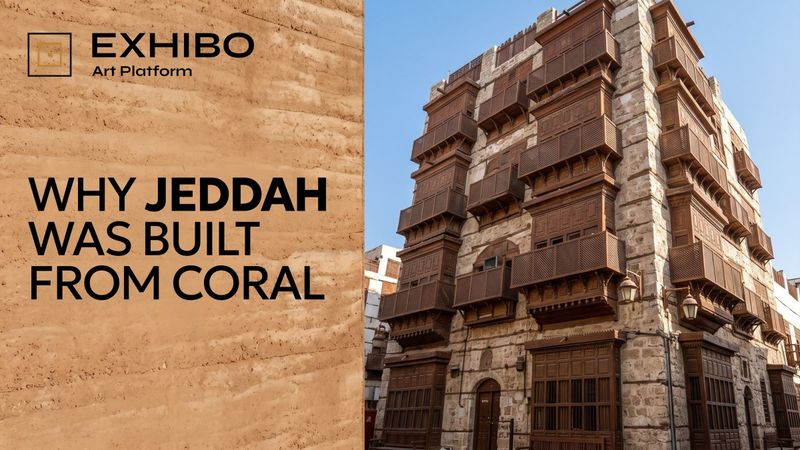
Why Jeddah Was Built From Coral
A treeless port with no stone quarried its whole city out of the reef offshore — then oil and concrete let it walk away from the sea that built it.
Jeddah's old town isn't decorated with coral. It's made of it — reef cut soft from the water and hardened into towers. The strange part is what happened when the city no longer needed the sea.