
Exhibo Editorial
Korean Art Traditions
Goryeo celadon, pensive bodhisattvas, buncheong ware and Joseon true-view painting across Korea's historical courts
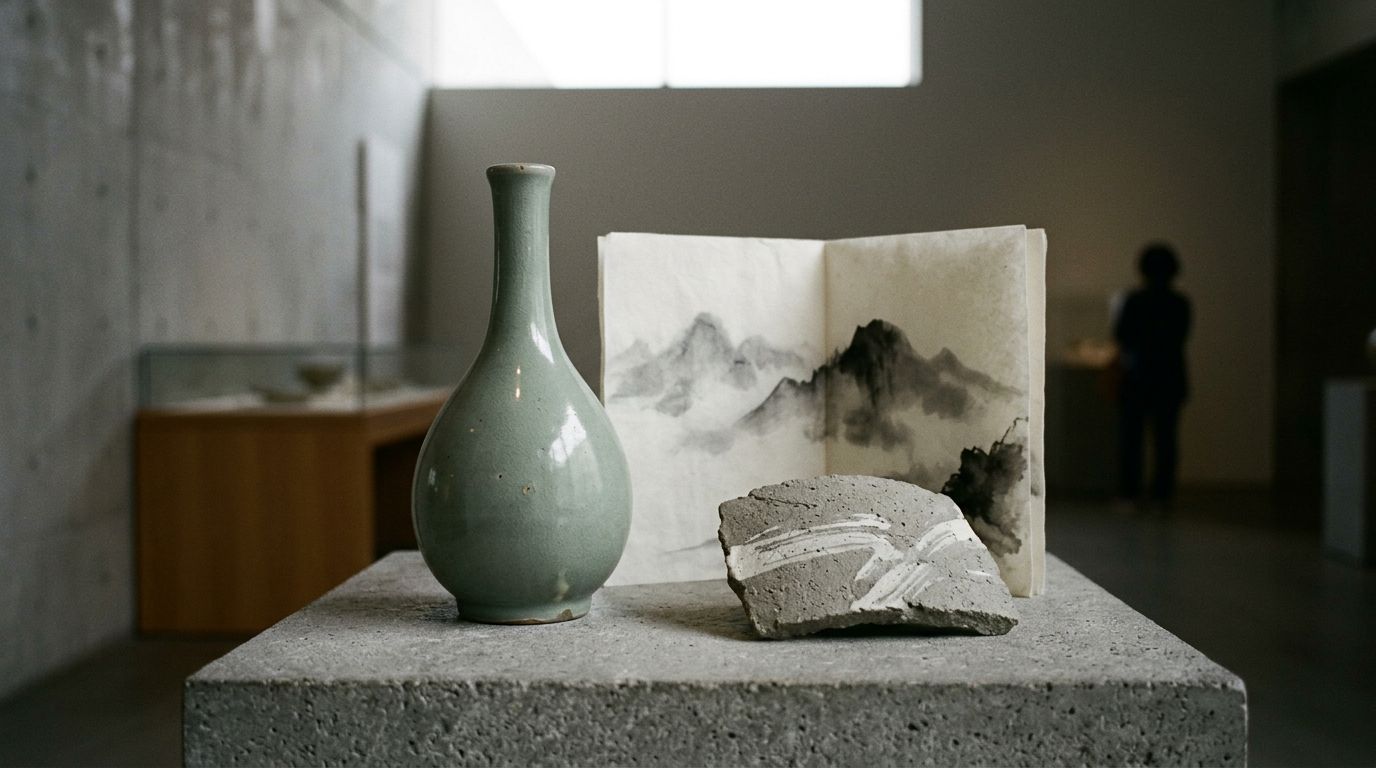
Korean art history covers the visual cultures made on the Korean peninsula under successive courts and communities: Three Kingdoms Buddhist sculpture, Unified Silla stone temples, Goryeo celadon, Joseon buncheong and white porcelain, and Joseon ink painting. Museums treat the phrase as a field label, not a single style. A gilt-bronze pensive bodhisattva, a grey-green maebyeong bottle, a slip-brushed flask and a misted mountain after rain share materials and habits of looking more than they share one look. Court kilns, temple workshops and literati brushes answer different patrons in the same centuries.
If you search “korean art history” today you meet encyclopaedia timelines, museum collection pages and short chronologies. Those results name dynasties and media. They seldom walk you through how sanggam inlay works on celadon clay, why buncheong slipped toward experiment after Goryeo polish, or how Jeong Seon’s “true-view” landscapes treat Korean mountains as a subject rather than Chinese poetic stock. This article fills that gap for readers who want historical traditions. It belongs to the World Art Traditions series. For a parallel East Asian survey, see Chinese art history or Japanese art history. Collection routes for the museums named below sit in the museums directory. Seoul’s contemporary galleries, art fairs and living studio scene belong to a separate city brief; the pages below stay with historical forms.
Conditions that produced Korean visual culture
Geography and politics set the workshop map. The peninsula sits between Chinese continental courts and the Japanese archipelago. Ideas, monks, pigments and kiln techniques crossed those waters. Korean makers absorbed Chinese models and then developed forms that Chinese and Japanese viewers recognised as local: inlaid celadon at scale, pensive bodhisattvas cast as independent icons, buncheong slip decoration, later “true-view” landscapes of Korean mountains.
Buddhism arrived via Chinese and Central Asian routes in the fourth century CE and became a primary engine of sculpture, temple architecture and ritual metalwork through the Three Kingdoms (c. 57 BCE–668 CE) and Unified Silla (668–935). Royal tombs of Silla at Gyeongju yield gold crowns and jewellery that show elite metal skill beside Buddhist patronage. Soyoung Lee’s Metropolitan Museum essay on Silla royal tombs stresses goldwork as a parallel high craft to temple sculpture in the same capital zone. Goguryeo tomb murals in the north preserve guardian animals and court scenes that later critics sometimes cite when they argue over the origin of National Treasure 78. Baekje workshops, facing the Yellow Sea, sat on the shipping routes that carried Buddhist icons toward Japan.
From the late fourteenth century the Joseon dynasty (1392–1910) elevated Neo-Confucian ideology. Temple commissions continued, yet white porcelain, ancestral rites and scholar painting climbed the prestige ladder that Buddhist gold and jade-green glaze once shared with the court. King Sejong’s reign (1418–1450) standardised hangeul and pushed Confucian text circulation; court painters illustrated meritorious subjects and examination culture in the same ideological climate. The Bureau of Painting trained professionals; yangban literati painted as moral practice. Those two labour systems produce different signatures on hanging scrolls and album leaves.
Kiln geography matters as much as dynasty charts. Goryeo celadon industries concentrated near the southwestern coast in Jeolla Province, at Gangjin and Buan above all. Joseon buncheong kilns spread across provinces with distinct decorative habits. Royal porcelain bunwon kilns near the capital Hanyang (today’s Seoul) centralised white ware for the court from the mid-fifteenth century. Clay beds, timber for fuel and coastal shipping decided which towns could sustain high firings. When you stand before a Korean object in a museum case, you are looking at a product of ore, clay, monastic networks or examination culture as much as at a “national style.”
War and salvage also shape what you see. Mongol pressure in the late Goryeo period, Japanese invasions of 1592–1598, colonial collecting in the early twentieth century, and modern restitution debates all moved objects off the peninsula and into foreign museums. Surviving masterpieces often travelled through dealers before they reached New York, London or Tokyo cases. Provenance notes on wall labels repay attention.
What “Korean art traditions” name in practice
Curators organise Korean galleries by period and medium. Three Kingdoms and Unified Silla galleries favour gilt bronze, stone sculpture and tomb gold. Goryeo rooms centre celadon and Buddhist painting. Joseon rooms split ceramics (buncheong, then porcelain) from painting (landscape, genre, portrait, documentary screens). Craft traditions such as lacquer, furniture and embroidery run beside those axes. The field label “Korean art” holds those strands without forcing one continuous look from 500 CE to 1900.
Three habits recur across media. First, selective adaptation: makers learn Chinese shapes, glazes or brush models, then adjust colour, proportion and motif for local patrons. Second, technical inventiveness inside limited materials. Sanggam inlay on celadon and white slip on buncheong both treat clay as a drawing surface under glaze. Third, formats built for intimate or ritual viewing. Handscrolls and album leaves reward close looking; temple sculpture addresses circumambulation and worship; ceramic bottles and bowls serve wine, food and altar use.
Dynastic labels (Three Kingdoms, Unified Silla, Goryeo, Joseon) organise museum walls because political change reorganised capitals, patronage and kiln networks. Medium labels cut across those periods. A Goryeo celadon bottle and a Goryeo Buddhist painting share a century but answer different workshops. Keep both axes in mind when you read a date line.
Buddhist sculpture from the Three Kingdoms to Unified Silla
Buddhist sculpture gives Korean art history its earliest monumental faces. From the sixth and seventh centuries, workshops cast gilt-bronze icons and carved stone for temples across Goguryeo, Baekje and Silla territories. Iconography travelled with sutras and monks from Chinese Northern Wei and related centres. Korean casters then developed a distinctive type: the pensive bodhisattva seated with one leg crossed, elbow on the knee, fingers near the cheek. In much of Asia that pose appears as a secondary figure. On the peninsula, makers produced large independent sculptures, often identified with Maitreya, the future Buddha.
Unified Silla patronage after 668 CE concentrates in and around Gyeongju. The artificial granite grotto of Seokguram on Mount Toham, begun in 751 under Kim Dae-seong and completed in 774, places a monumental seated Sakyamuni at the centre of a rotunda lined with relief deities, bodhisattvas and disciples. UNESCO lists Seokguram with Bulguksa Temple as a World Heritage property and calls the ensemble a masterpiece of East Asian Buddhist art. The Buddha’s right hand touches the earth in bhumisparsa mudra; the left rests in concentration. More than 360 stone slabs form the domed ceiling. Moisture damage and early-twentieth-century concrete domes complicate authenticity debates, yet the principal sculpture and most reliefs retain their original form.
Pensive Bodhisattvas in the National Museum of Korea
The National Museum of Korea holds two gilt-bronze pensive bodhisattvas designated National Treasures 78 and 83. Curators treat them, with Seokguram, as peak achievements of Korean Buddhist sculpture. National Treasure 78 (late sixth century; height about 83 cm in museum notes, with some technical reports listing about 81.5 cm) wears a tall crown with sun-and-moon motifs that travelled east along Silk Road routes from Sasanian crown design. The bronze shell is thin (about 3 to 8 mm), hollow, and stiffened with an iron cross inside. Fingers rest against the cheek with a controlled softness that is hard to cast at this scale. Scholars still dispute whether Silla, Baekje or Goguryeo workshops produced it; the museum publishes the debate without forcing a winner.
National Treasure 83 (early seventh century; about 93.5 cm) is the largest Korean gilt-bronze pensive bodhisattva known. Its three-mountain or lotus-style crown differs from 78’s sun-and-moon form. The upper torso stays bare except for a necklace. Formal kinship with the wooden pensive bodhisattva at Kōryū-ji in Kyoto supplies evidence for the transmission of Korean Buddhist sculpture to Asuka- and Hakuhō-period Japan. When you stand between these two bronzes in Seoul, you see casting skill, iconographic choice and contested attribution in one glance.
Seokguram as architecture and icon
Seokguram is sculpture and building at once. An antechamber, corridor and circular main chamber organise a path from guardians toward the central Buddha. High and low relief on the surrounding walls populate the space with a Buddhist cosmos. Bulguksa below the mountain, rebuilt over centuries with stone terraces and the twin pagodas Seokgatap and Dabotap facing the main hall, translates Buddhist cosmology into courtyards and bridges. Together the sites show how Unified Silla rulers materialised doctrine in granite and timber. Conservation history matters here: Japanese colonial-era rebuilding (1913–1915) and a second concrete dome in the 1960s protect the grotto while altering its original earth-covered form. UNESCO’s statement of outstanding universal value records that tension. Visit the site as a living conservation problem as well as a masterpiece.
Goryeo celadon and the sanggam technique
During the Goryeo dynasty (918–1392), celadon (cheongja, green ware) became the peninsula’s principal high ceramic. Soyoung Lee’s Metropolitan Museum essay on Goryeo celadon ties the grey-green colour to iron in the clay body and to iron oxide, manganese oxide and quartz particles in the glaze, fired in a reducing atmosphere at temperatures around or below 1150°C. Early Goryeo potters learned kiln and glaze technology from Song Chinese celadon traditions on the southern coast. The Song envoy Xu Jing, who visited the Goryeo capital Gaeseong in 1123, compared Goryeo ceramics to China’s Yue and Ru kilns. Early bottles and bowls often echo Chinese shapes and motifs: lotuses, peonies, waterfowl.
By the mid-twelfth century, major celadon industries consolidated in Jeolla Province at Buan and Gangjin. Patrons and potters pushed toward native taste. The technical peak is sanggam inlay, rare in China at this polish. Potters etched motifs into the dry clay body, filled the cuts with white and/or black (or red-firing) slip, applied translucent celadon glaze and fired. Clean form, crisp contrast of white and black against green, and motifs such as cranes and clouds define the best pieces. Copper-red accents, iron painting and occasional gold repair appear on ambitious wares. Southern Song commentator Taiping Laoren praised Goryeo celadon’s jade colour as “the best under heaven,” a phrase Korean curators still cite when they stage major celadon exhibitions at the National Museum of Korea.
Form vocabulary widens beyond the bottle. Maebyeong plum bottles with broad shoulders and a narrow mouth held wine and other liquids. Openwork incense burners, sometimes with animal lids, served Buddhist and aristocratic interiors. Water droppers shaped as figures or animals show humour beside ritual gravity. Undecorated bowls rely on glaze colour alone. Mold-impressed and carved designs run alongside inlay; Lee’s essay lists the full range from plain green to iron-brown and copper-red. Gangjin remains a centre of celadon revival production today, so modern tourist wares sit a few kilometres from the archaeological kiln fields that made the medieval reputation.
Named vessels help you train the eye. The Metropolitan Museum’s Maebyeong (plum bottle) decorated with cranes and clouds (second half of the twelfth century; acc. no. 11.8.1) shows sparse inlaid cranes floating in a green “sky.” A later Met maebyeong (late thirteenth century) from the Buan Yucheon-ri kiln site carries larger cranes and clouds; lacquer mixed with powdered gold repairs the mouth. In Korea, National Treasure No. 68, a celadon maebyeong with inlaid clouds and cranes, belongs to the Kansong Art Museum; collector Chun Hyeong-pil bought it rather than let it leave the country during the colonial period, a purchase still told in Korean museum lore. The Art Institute of Chicago holds related plum vases with crane-and-cloud and children motifs that demonstrate the same sanggam logic. When you walk a Korean ceramics gallery, look first at glaze colour, then at whether decoration sits under the glaze as inlay, then at shoulder curve and foot.
Buncheong ware and Joseon white porcelain
The first two centuries of the Joseon dynasty produced two ceramic languages that answered Neo-Confucian taste and everyday demand. Buncheong ware grew from late Goryeo inlaid celadon habits. White porcelain rose as the elite ceramic of purity and restraint. Both belong in any serious account of korean art history; neither is a footnote to Chinese blue-and-white.
Buncheong lacked a period name in Joseon documents. South Korea’s first art historian, Go Yuseop, coined bunjang hoecheong sagi in the 1930s: “grey-green ceramics decorated with powder.” The Met’s buncheong essay describes a coarse grey body finished with white slip under a green-tinted glaze. Clay and glaze relate to celadon but receive less refining. Slip techniques adapt inlay into stamped patterns, sgraffito, brushed slip and iron painting. Regional habits diverge. Gyeongsang pieces favour regular stamped or inlaid patterns. Jeolla pieces lean toward freer incised or sgraffito drawing. Mount Gyeryong kilns in Chungcheong Province are known for iron-brown painting on white slip. Fifteenth-century buncheong often served government bureaus; dishes stamped Jangheung-go or Naeseom-si record official destinations. By the sixteenth century, slip-dipped or brush-slipped pieces offered cheaper alternatives to porcelain. Japanese invasions of 1592–1598 devastated kilns. When ceramic industries rebuilt in the seventeenth century, porcelain resumed; buncheong production on the peninsula stopped. Korean potters carried related skills to Japan, where tea-ceremony taste later prized the earthy irregularity Western modernists also admired.
Court porcelain and the turn to white
Joseon white porcelain (baekja) matched Neo-Confucian ideals of purity. Central bunwon kilns managed for the court operated near Hanyang by the 1460s and remained the manufacturing centre into the nineteenth century. Demand spread beyond the capital; regional kilns multiplied. Underglaze cobalt blue and iron decoration appear on some wares, yet many of the most admired pieces stay plain: soft white, restrained profile, quiet foot. Burial and ritual vessels sit beside tableware. If celadon is Goryeo’s signature ceramic colour, white is Joseon’s. Museum galleries often place buncheong and porcelain in adjacent cases so you can see the slip experiment and the court white as parallel answers to the same century.
Reading slip, stamp and brush
Train a short looking sequence for buncheong. Check body colour through thin glaze. Note whether white slip covers the whole form or sits in stamped and inlaid reserves. Ask whether iron paint or sgraffito lines behave like drawing. Irregularity is part of the aesthetic, not a flaw against celadon’s polish. For porcelain, watch translucency, kiln grit and the decision to leave a surface blank. Contemporary Korean and Japanese potters revive buncheong vocabularies; historical pieces remain the reference for those revivals.
Joseon painting: landscapes, genre scenes and court brushes
Joseon painting moves between Chinese classical models and Korean subjects. Early Joseon landscapists such as An Gyeon (active mid-fifteenth century) worked in a style that recalls Northern Song master Guo Xi: cloudlike mountains, dramatic solids and voids, contrasting ink tones. The Met’s Korean Renaissance essay notes how An Gyeon’s followers kept those Song-derived habits alive while Ming China itself painted the Xiao–Xiang theme less often. Themes such as the Eight Views of the Xiao and Xiang rivers therefore mark Korean court taste as much as Chinese nostalgia. Court painters also produced portraits of meritorious subjects and documentary screens of official gatherings, tying brushwork to Neo-Confucian career culture. A copy of a gathering scene often went home with each participant as a keepsake of examination success or bureaucratic reunion.
Artists of royal descent, including Yi Am (1507–1566) and Yi Jeong (1541–1622), both great-great-grandsons of King Sejong, added distinctive hands without forming a single school. Yi Am’s animal paintings and Yi Jeong’s landscapes show how royal pedigree could coexist with professional brush skill. The Bureau of Painting supplied court needs; literati amateurs painted for friends and for moral self-cultivation. Wall labels that name only “Joseon school” flatten that labour split.
From the eighteenth century, Jeong Seon (1676–1759), pen name Gyeomjae, redirected landscape toward Korean mountains and cities. Scholars call his approach jingyeong or “true-view” landscape: based on real places yet filtered through memory, ink drama and literati subjectivity. He painted Geumgangsan after travel in 1711 and returned often to Inwangsan near his Seochon neighbourhood in Hanyang. Genre painters such as Kim Hong-do (Danwon, 1745–after 1806) and Shin Yun-bok turned the brush toward markets, wrestling grounds, laundry places and elite leisure. Those album leaves give social historians visual evidence that landscape alone cannot supply. Shin’s scenes of gisaeng and night gatherings sit closer to pleasure-quarter observation; Kim’s albums range across labour and play. Together they widen what counts as high painting in late Joseon.
Jeong Seon and Clearing After Rain on Mount Inwang
Clearing After Rain on Mount Inwang (Inwangjesaekdo, 1751), ink on paper, about 79.2 × 138.2 cm, is designated National Treasure No. 216. Cultural Heritage Administration English records list the Leeum, Samsung Museum of Art address; some encyclopaedia and press accounts also name Ho-Am Art Museum management and a Lee Kun-hee bequest path toward the National Museum of Korea. Confirm the live holding institution on CHA or the museum CMS before travel or caption quotation. Jeong painted it in old age for his long-time friend Yi Byeong-yeon. Heavy repeated ink builds the wet rock wall after rain; mist fills the valley in reserved paper white. Peak and fog press against each other without relying on Chinese stock mountains. The painting shows how jingyeong differs from topographic record: the mountain is recognisable as Inwangsan, yet brush pressure and blank space stage a mood rather than a survey map. Among Jeong’s large surviving corpus, this sheet is the work most often used to teach true-view landscape.
Kim Hong-do and the genre album
Kim Hong-do’s album leaves of daily life, often grouped as genre scenes, show wrestlers, roofers, schoolrooms and roadside encounters with humour and clear contour. Institutional exhibitions of the Lee Kun-hee collection have highlighted works such as Sound of Autumn beside Jeong’s Inwangsan sheet, pairing landscape mastery with genre observation. Kim worked for the court yet looked outward to common labour and leisure. When you compare his albums with Jeong’s mountains, you see two late-Joseon answers to the question of what Korean painting should show: local terrain, or local people.
How Korean forms travelled and mutated
Korean traditions did not stay inside the peninsula. Gilt-bronze and iconographic models moved to Japan in the Asuka and Hakuhō periods; the Kōryū-ji pensive bodhisattva sits in that conversation with National Treasure 83. Celadon and later ceramics entered Japanese collections and tea culture. After 1592–1598, displaced Korean potters helped shape Japanese kiln regions; buncheong’s irregular slip aesthetic fed later Japanese taste for Korean-related tea bowls. Scholars of Japanese ceramics still track “Korean-style” clay bodies and kiln habits in Kyushu and elsewhere as afterlives of those forced and voluntary migrations. Twentieth-century Western collectors, often buying through Japanese dealers, filled Met, British Museum and other Asian galleries with celadon first, then buncheong and porcelain. Soyoung Lee and colleagues have documented how that collecting history skewed English-language knowledge toward ceramics and left sculpture and painting under-taught outside specialist courses.
Within East Asia, Korean painting absorbed Chinese brush orthodoxy and then asserted local subject matter. Jeong Seon’s true-view practice influenced later landscapists who treated Korean geography as worthy of high ink. Modern nationalist art histories in the twentieth century sometimes overstated uniqueness; careful scholarship restores Chinese and Japanese dialogues without dissolving Korean workshop choices. Cross-reading the Chinese art history and Japanese art history essays in this series helps keep those conversations visible.
Colonial-period archaeology, Japanese and Western museum purchases, and postwar National Treasure designations also reshape what counts as canonical. Objects that left Korea under unequal conditions still appear in global surveys. Recent large loans from Korean national and private collections, including National Museum of Korea tours to Washington, Chicago and London, put named masterpieces back into international view under Korean curatorial frames. Those tours reverse the older one-way traffic of celadon into Western museums without erasing the earlier collecting history.
Critics, collectors and contested frames
Older Western surveys sometimes filed Korean art under “Far Eastern” chapters that privileged Chinese antiquity and Japanese prints. Celadon colour and “naturalism” became shorthand. Britannica’s long encyclopaedia entry still stresses a naturalistic trend from the Three Kingdoms onward; useful as a starting map, thin on kiln process and Joseon painting debates. Museum essays by Soyoung Lee and National Museum of Korea curators push back by naming techniques, kiln sites and contested attributions. Exhibition catalogues from Leeum, Kansong and the Met’s Korean galleries now treat ceramics, Buddhist sculpture and painting as coequal strands rather than as a celadon-led story with painting as afterthought.
Inside Korea, colonial-era scholarship, nationalist rewriting and contemporary museum practice disagree about origins and value. Go Yuseop’s naming of buncheong created a category that Joseon documents did not use; the label now structures galleries worldwide. Attribution fights over National Treasure 78’s kingdom of origin show how thin provenance can remain even for celebrated bronzes. Seokguram’s concrete domes force critics to weigh preservation against authenticity: UNESCO’s statement records the 1913–1915 rebuild and the 1960s second dome as protective measures that also change the grotto’s original earth-covered form. Collectors such as Chun Hyeong-pil at Kansong enter the story as patriotic buyers as well as taste-makers; the NT 68 celadon purchase is still taught as a refusal of colonial export.
English-language teaching materials sometimes reduce Jeong Seon to a single National Treasure and skip An Gyeon’s Song-derived court style, or they treat Kim Hong-do as comic relief beside “serious” landscape. Genre albums deserve equal formal attention: contour, humour and social detail are pictorial decisions, not mere illustration. Japanese tea-ceremony writing on Korean bowls adds another critical layer that values irregularity and kiln chance; that taste shaped twentieth-century modernist praise for buncheong and related wares in ways Joseon documents never framed.
Living Seoul scenes, K-culture soft power and contemporary ceramic revivals sit adjacent to this history. They belong to other briefs. For historical traditions, read technique, patronage and location before you accept a nationalist or tourist summary.
What these traditions left behind
Korean art traditions leave a toolkit of looking. You can sort a ceramics case by glaze family (celadon, buncheong slip, white porcelain), decoration method (sanggam, stamp, iron paint, plain white) and kiln region. You can sort sculpture by icon type (pensive bodhisattva, seated Buddha, guardian) and material (gilt bronze, granite). You can sort Joseon painting by whether the mountain or market is Chinese literary stock or Korean place.
Institutions that hold the key works named above include the National Museum of Korea, Leeum Museum of Art, Kansong Art Museum, the Metropolitan Museum of Art, the Art Institute of Chicago and UNESCO-listed Seokguram–Bulguksa. Use the museums directory to find related collection pages. Return to the World Art Traditions hub for sibling regional surveys. Start with one object. Trace its clay join, bronze seam or ink wash before you reach for the dynasty chart.
| Period | Approx. dates | Signature media | Key sites / workshops | Named works or types to seek |
|---|---|---|---|---|
| Three Kingdoms | c. 57 BCE–668 CE | Gilt bronze, tomb gold, early Buddhist icons | Goguryeo / Baekje / Silla centres | Pensive Bodhisattvas, Nat. Treasures 78 & 83 (NMK) |
| Unified Silla | 668–935 | Granite temple sculpture, architecture | Gyeongju, Mount Toham | Seokguram Buddha; Bulguksa terraces & pagodas |
| Goryeo | 918–1392 | Celadon (cheongja), sanggam inlay | Gangjin & Buan (Jeolla) kilns; Gaeseong court | Crane-and-cloud maebyeong (Met; Kansong NT 68) |
| Early Joseon | 1392–c. 1600 | Buncheong slip ware; An Gyeon-style landscape; white porcelain begins | Provincial buncheong kilns; bunwon near Hanyang | Stamped bureau dishes; iron-painted Gyeryong wares |
| Mid–late Joseon | 17th–19th c. | White porcelain; true-view & genre painting | Court bunwon; Seoul–Inwangsan painters | Jeong Seon, Inwangjesaekdo (1751); Kim Hong-do genre albums |
| Cross-period afterlives | 20th–21st c. | Museum canon, National Treasures, ceramic revivals | NMK, Leeum, Kansong, Met, AIC | Go Yuseop’s buncheong category; overseas celadon collections |
FAQ
What is Korean art best known for?
Outside Korea, museum visitors most often meet Goryeo celadon and Joseon white porcelain first, because ceramics dominate early Western collecting. Inside Korean art history teaching, Buddhist sculpture (including the pensive bodhisattvas and Seokguram) and Joseon painting (true-view landscape and genre albums) share that prestige. Buncheong has risen in modern taste for its slip experiment and regional variety. No single medium owns the field.
How does Goryeo celadon differ from Chinese celadon?
Goryeo potters learned Song-period kiln and glaze methods, and early shapes look Chinese. Mid-twelfth-century sanggam inlay, refined at Gangjin and Buan, becomes a Korean hallmark: white and black slip designs locked under grey-green glaze, often as cranes, clouds and floral scrolls. Colour chemistry and reducing firings relate to Chinese celadon families, yet the density of high-quality inlaid green ware is a Goryeo specialism. Xu Jing’s 1123 comparison to Yue and Ru notes resemblance, not identity.
What is buncheong ware?
Buncheong is a Joseon stoneware group of the fifteenth and sixteenth centuries with a grey body, white slip decoration and greenish translucent glaze. Go Yuseop named the category in the 1930s. Techniques include stamped patterns, sgraffito, brushed or dipped slip and iron painting. It evolved from Goryeo inlaid celadon under new patronage and taste, then ended after the 1590s invasions as porcelain took over rebuilt industries.
Who is the most famous Korean painter in historical surveys?
Jeong Seon (Gyeomjae) is the name most often taught for Joseon landscape, thanks to true-view paintings of Korean mountains such as Clearing After Rain on Mount Inwang (1751). Kim Hong-do is the parallel name for genre painting of everyday life. Early Joseon landscapist An Gyeon matters for court style. “Most famous” depends on whether you privilege landscape, genre or Buddhist painting; Jeong and Kim dominate general surveys.
What are National Treasures 78 and 83?
They are two gilt-bronze pensive bodhisattvas in the National Museum of Korea from the late sixth and early seventh centuries. Both show the contemplative pose with fingers near the cheek. They rank with Seokguram among the most important Korean Buddhist sculptures. Kingdom attribution for No. 78 remains debated; No. 83’s kinship with Japan’s Kōryū-ji figure supports early transmission of Korean Buddhist sculpture abroad.
Is Korean art just a mix of Chinese and Japanese art?
Korean makers worked with Chinese models and later Japanese audiences, yet kiln practice, icon choice and painting subjects show local decisions: sanggam celadon, independent pensive bodhisattvas, buncheong slip play, Joseon white porcelain ideology and true-view landscapes of Korean peaks. Comparative reading with Chinese and Japanese traditions clarifies the shared toolkit and the divergences. Treating Korea as a residual category erases those workshop facts.
Where should I see Korean historical art in person?
In Korea, start with the National Museum of Korea in Seoul, Leeum, Kansong, and the Seokguram–Bulguksa complex at Gyeongju. Abroad, the Metropolitan Museum of Art and the Art Institute of Chicago publish strong Korean ceramics and essays; other major Asian collections hold celadon and Joseon porcelain. Check the museums directory for institutional pages before you travel. Seoul’s contemporary circuit is a different itinerary.
Related reading
Sharjah Biennial 17 Unveils Curatorial Vision and Opening Schedule
Angela Harutyunyan and Paula Nascimento frame the 2027 edition around archival residue and spatial memory
The seventeenth iteration of the Sharjah Biennial runs from January to June 2027, presenting a dual curatorial methodology that examines historical legacies and infrastructural critique across multiple emirate locations.
One Thousand and One Nights as a Visual Network
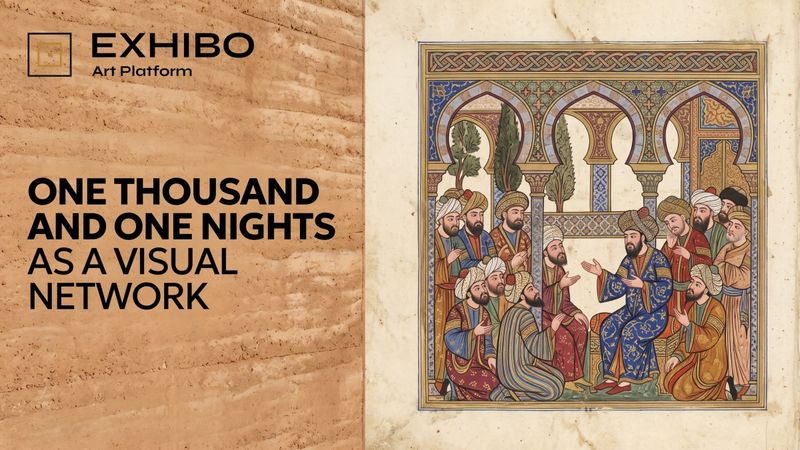
The book that taught Europe to picture the East arrived with no pictures at all. Three centuries of illustrators — Dutch, Egyptian, Persian, French, German, Iraqi — each gave it a face, and every face was a self-portrait.
Open Galland's Thousand and One Nights, the edition that conquered Europe, and there is nothing to look at: no genie, no lamp, not one illustration. The most visually imagined book in the world began blind — and because its text was never fixed either, no picture of it could ever be a copy.
Curating Tomorrow's Archive: Hamburger Kunsthalle Seeks Contemporary Collections Lead
A new permanent appointment will steer the museum's post-1960 holdings across paper, photography, and media formats.
The Hamburger Kunsthalle is inviting applications for a senior curatorial position focused on contemporary acquisitions, exhibition strategy, and digital collection management. Applications close October 2026 for a January 2027 start.