
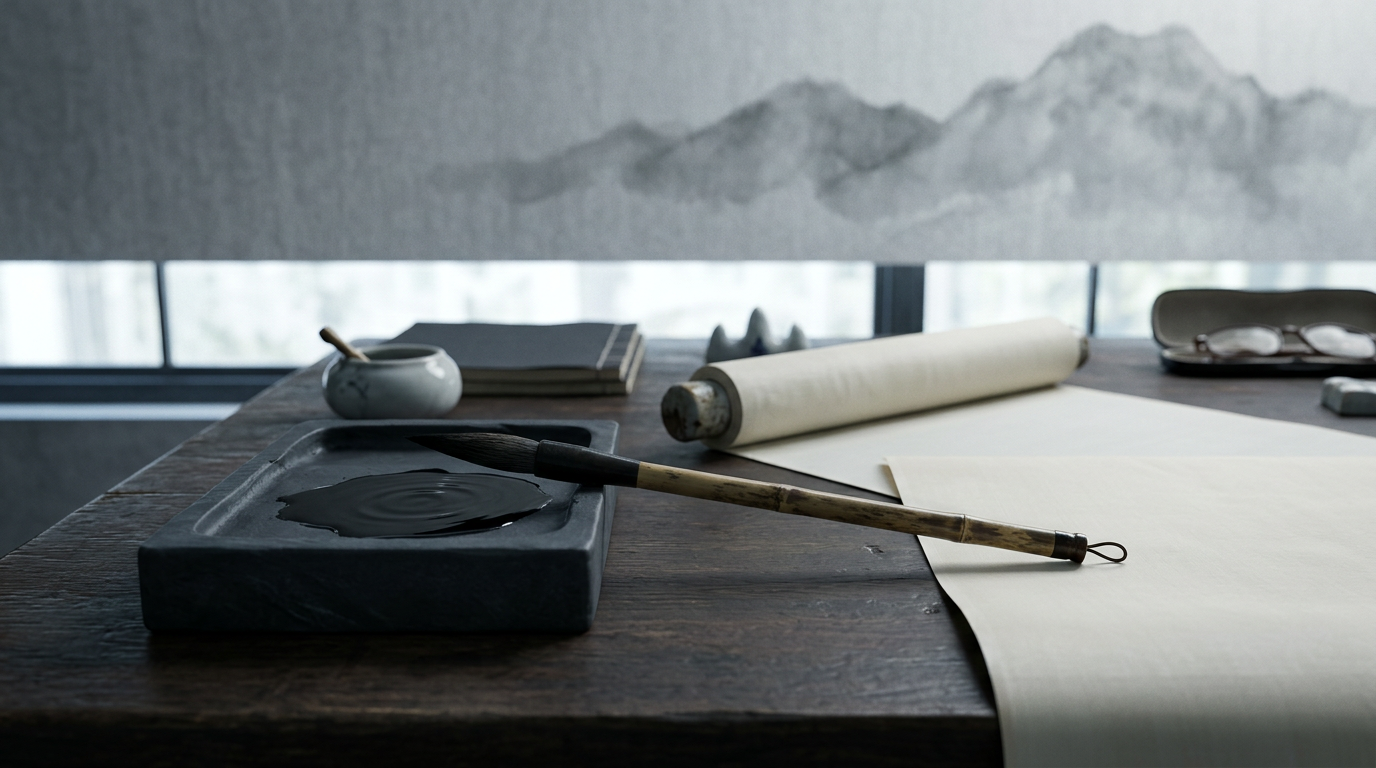
Exhibo Editorial
Chinese Art: A History
Bronzes, calligraphy, landscape painting, ceramics and the literati brush, from Shang ritual vessels to Qing porcelain
Chinese art covers the visual cultures made under Chinese courts and communities from Neolithic jade and pottery through imperial porcelain and ink painting. Museums and textbooks use the phrase as a field label, not as a single style. A Shang ritual ding, a Tang horse painting, a Song hanging-scroll mountain and a Ming blue-and-white bowl share tools, materials and habits of looking more than they share one look. Brush and ink on silk or paper sit beside cast bronze, carved jade and high-fired ceramic. The same elite that valued calligraphy also commissioned kilns and collected antiquities.
If you search "chinese art" today you meet Wikipedia surveys, museum collection pages and print shops. Those results name media and dynasties. They seldom walk you through how piece-mould bronze casting worked, why a calligrapher's hand became the measure of painting, or how a scholar-official used pines and rocks as moral speech. This article fills that gap for readers who want historical traditions rather than market tips or city scenes. It belongs to the World Art Traditions series. For a parallel East Asian survey, see the sibling Japanese art history (pending). Collection routes for the museums named below sit in the museums directory. Hong Kong's contemporary scene belongs elsewhere in the programme (J04); the pages below stay with historical forms.
What "Chinese art" names in practice
Curators and historians treat Chinese art as a set of linked media traditions organised by dynasty, region and social role. Ritual bronze and jade dominate early periods. Calligraphy and painting rise with the bureaucracy and the scholar class. Ceramics run in parallel from Neolithic earthenware to Jingdezhen porcelain exported across Asia and Europe. Buddhist cave temples and tomb sculpture form another strand. Court workshops and literati amateurs often worked in different materials and argued about value for centuries.
Three habits recur across media. First, reverence for antiquity: later makers copy, cite or reinvent older vessel shapes, brush models and painting styles. Second, the written character as a visual art. Calligraphy trains the hand that later paints bamboo, rock and tree. Third, formats built for intimate viewing. Handscrolls unroll section by section; album leaves flip; hanging scrolls hang for seasons then roll away. Western easel painting is a poor analogy for most of this corpus.
The phrase does not mean one continuous "Chinese style" from 1600 BCE to 1912. Dynastic labels (Shang, Zhou, Han, Tang, Song, Yuan, Ming, Qing) organise museum galleries because political change reorganised patronage, capital cities and workshop networks. Medium labels cut across those periods. A Song celadon and a Song landscape share a century but answer different patrons. Keep both axes in mind when you read a wall label.
Bronze ritual vessels and the early dynasties
Chinese bronze art begins with the Shang (ca. 1600–1046 BCE) and continues through the Zhou (1046–256 BCE). The Metropolitan Museum of Art's Heilbrunn essays treat this span as China's Bronze Age: copper-tin alloy used for weapons, chariot fittings and, above all, ritual vessels that held wine and food in ancestral ceremonies. The Yellow River valley, especially Henan, formed the political centre. Anyang served as Shang capital from about 1300 BCE. Piece-mould casting, unique in the ancient world at this scale, let workshops pour intricate relief decoration that lost-wax methods elsewhere could not match in flange and surface pattern.
Shang casters built ceramic piece moulds around a clay model, removed the sections, carved decoration into the mould interiors, reassembled them around a core and poured bronze into the gap. The method favoured sharp flanges, squared profiles and dense surface pattern. The taotie, a frontal zoomorphic mask with staring eyes, appears on ding (tripod food vessels), gu (wine beakers) and other types. Some vessels carry short inscriptions. Jade carving and bronze developed together as elite technologies. Iron only becomes common late in the Eastern Zhou.
Zhou conquest in 1046 BCE shifted the capital westward, then to Luoyang after 770 BCE. Western Zhou bronzes often carry longer dedicatory inscriptions that record gifts, appointments and lineage. Eastern Zhou fragmentation (Spring and Autumn, then Warring States) multiplies regional styles. Ritual authority frays; vessels still matter as status metal. Concurrent metalworking cultures, including the Sanxingdui finds in Sichuan, show that Shang Anyang was one centre among several. Large bronze figures and masks from Sanxingdui refuse the vessel-centred grammar of Henan Shang finds. When you stand before a Shang ding in a museum case, you are looking at a tool of ancestor ritual and a demonstration of controlled labour, ore and fire.
Qin unification in 221 BCE and the Han empire that followed redirect elite display toward tomb ceramics, lacquer and, later, monumental sculpture such as the Qin terracotta figures near Xi'an. Those life-size clay warriors belong to funerary programme rather than to the ink tradition this article tracks next, yet they show how imperial workshops could mobilise ceramic skill at architectural scale. Bronze never vanishes from temples and antiquarian collections, but painting and calligraphy climb the prestige ladder that ritual vessels once held alone.
Calligraphy: scripts, models and the brush
Calligraphy is the discipline that trains the Chinese brush. Maxwell Hearn's Metropolitan Museum essay on Chinese painting stresses that every literate person learned ideographs by copying standard forms, then studied historical scripts preserved on bronzes, stones and rubbings. Painting that counts as high art for scholar-amateurs borrows that same irreversible ink line. Colour often drops away because line already carries structure and energy. Mistakes cannot hide under opaque pigment the way oil paint can cover a false start.
Script history gives the vocabulary. Seal script (zhuanshu) relates to early bronze and stone forms and later to the red ownership seals stamped on paintings. Clerical script (lishu) regularises forms for Han bureaucracy. Running and cursive scripts (xingshu, caoshu) abbreviate strokes for speed and rhythm. Standard script (kaishu) balances individual strokes into a stable whole. A practised hand moves among these models. Personal style arrives as distillation and reinterpretation of those models.
Wang Xizhi (303–361 CE), active in the Eastern Jin, becomes the classical reference for running script. Tradition names him the Sage of Calligraphy. His most celebrated composition, the Preface to the Poems Composed at the Orchid Pavilion (Lanting Xu), survives through copies; the original is lost. Later emperors and scholars collected, copied and debated his models. By the Song dynasty, a good hand helped determine who entered government through examinations. Calligraphy, literary style and historical knowledge formed the scholar-official's toolkit.
Scripts on bronze, stone and paper
Early characters appear on Shang oracle bones and on bronze vessels around 1300 BCE. Those forms feed what later calligraphers call seal script. Han clerks produce clerical script for documents at scale. Stone stelae preserve admired hands so that rubbings can circulate models without the original brush. Paper and silk then carry the private letter, the poem draft and the album leaf. When a Qing collector stamps a red seal on a Song painting, that seal is itself a miniature calligraphic act tied to ownership history.
Museum labels often list multiple scripts on one handscroll: the painting, the artist's inscription, later colophons by owners and critics. Night-Shining White at the Met (see below) grew from a small horse image into a handscroll more than thirty-five feet long once seals and colophons were mounted. You "read" the painting partly by reading those later hands. Calligraphy supplies the shared grammar of both arts.
Copying as training and as art
Students copy model characters stroke by stroke. They copy famous manuscripts. They learn how a master thickened a turn or left a flying white gap where the brush ran dry. That pedagogy looks conservative from outside. Inside the tradition it is how skill and judgement form. Xie He's sixth principle (transmission by copying) treats imitation as a criterion of mastery, not as failure of originality. When Zhao Mengfu in the Yuan "writes" pines in a tenth-century manner, he cites an earlier moral vocabulary on purpose. The copy is an argument.
Japanese calligraphers later absorb Wang Xizhi and Tang models through diplomatic and Buddhist exchange. That story belongs with the sibling survey of Japanese art history. Here the point is narrower: Chinese painting that museums call "literati" assumes calligraphic literacy in maker and viewer.
Landscape painting from Tang through Song
By the late Tang dynasty, landscape (shanshui, "mountains and water") had become an independent genre. Cultivated men used mountain images to stage withdrawal from office, longing for nature, or metaphors of political order. Early Song painters push the monumental hanging scroll: a towering central peak, small travellers, detailed rock texture. Fan Kuan, Guo Xi and Li Tang, whose works the National Palace Museum in Taipei treats as national treasures, define that Northern Song formula. Visions of natural hierarchy become metaphors for a well-regulated state. Private retreat images proliferate among scholar-officials who paint old trees, bamboo and rocks with calligraphic brushwork after career setbacks.
Southern Song academy painters after the loss of the north refine a different mood: asymmetrical compositions, mist, intimate corners of lake and shore. Ma Lin and others at court work for imperial taste. Professional court painters and scholar-amateurs share reverence for past models but diverge in finish. Court silk often carries mineral colour and careful modelling. Scholar paper prefers abbreviated monochrome line.
Handscrolls such as Zhang Zeduan's Along the River During the Qingming Festival (Palace Museum, Beijing) expand landscape into urban genre: shops, bridges, boats and crowds along the Bian River at the Northern Song capital. The scroll is a social panorama as much as a view of hills. Later dynasties copy and reinvent it so often that "Qingming scroll" becomes a genre name in its own right.
Monumental Northern Song mountains
Fan Kuan's Travelers Among Mountains and Streams (National Palace Museum, Taipei) is the textbook monumental landscape. A central mountain fills the hanging scroll. Raindrop-like texture strokes build rock mass. A mule train in the foreground underlines human scale against geological height. Fan Kuan (ca. 950–after 1032) left Li Cheng's style, museum texts say, to take nature as teacher among the mountains of Shaanxi. Contemporaries praised him for communion with peaks. The painting carries his signature among the leaves near the path. Dong Qichang and later critics used such works to define what Northern Song "bone" and grandeur should look like.
Guo Xi's Early Spring (dated 1072, also National Palace Museum, Taipei) and Li Tang's Whispering Pines in Myriad Valleys (1124) complete the trio that Taiwan's Ministry of Culture listed as National Treasures in 2012. Light exposure on these silks follows strict rotation: rest periods of years between displays that last only weeks. Scarce viewing is now part of how the tradition reaches the public.
Academy taste and the handscroll city
After 1127 the Song court regroups in the south. Academy painters favour lyric partial views over full vertical mountains. The handscroll format, already old, becomes a narrative machine for city and river life. Zhang Zeduan's Qingming scroll (ink and colour on silk, 24.8 × 528.7 cm, Palace Museum, Beijing) moves from outskirts to Rainbow Bridge to city gate. Viewers unroll from right to left, meeting shop types, boat traffic and architecture as if walking the capital. Copies proliferate under Ming and Qing courts. The Song original returned to public ownership after a twentieth-century path that included Puyi's removal from the Forbidden City; it is shown only for short periods.
Landscape after the Song does not freeze. Yuan scholar-painters turn landscape into "mind landscape," citing old masters while declaring inner weather through brush. Ming and Qing painters argue orthodoxy versus eccentricity. The Song peak remains the reference even when later hands refuse its finish.
The literati tradition: scholar-amateur painting
Literati painting (wenrenhua) names the scholar-amateur ideal: officials and retired scholars who paint as self-cultivation rather than workshop livelihood. They prefer ink on paper, subjects that suit calligraphic strokes (bamboo, orchid, rock, old tree, spare landscape), and inscriptions that bind poem, painting and handwriting into one object. Zhao Mengfu in the Yuan insists on the verb "to write" rather than "to paint." Likeness without calligraphic force falls short of the standard. Style cites antique models; subject carries emblem (pine for endurance and the protection a gentleman offers; narcissus for loyalty). Works circulate among friends. Later owners add colophons. The painting keeps growing after the first brush lifts.
Scholar-amateurs measured their work against professional court and market painters who used colour, illusion and finish for hire. The boundary stayed porous. Emperors recruited scholar taste. Professionals adopted literati brush manners. The ideology still shaped collecting and criticism into the twentieth century. Su Shi in the Northern Song practised poetry, calligraphy and painting as linked arts and faced near-execution for verses read as protest. Indirection became a survival skill: a historical scene or a Confucian classic illustration could carry critique for a small circle.
Dong Qichang (1555–1636) in the late Ming theorises Northern and Southern schools of landscape, elevating the scholar lineage and shaping Qing orthodoxy. Twentieth-century historians such as James Cahill later questioned how clean that amateur/professional split ever was. The debate itself is part of the tradition's afterlife.
Zhao Mengfu and Yuan "writing"
Zhao Mengfu (1254–1322) served under the Mongol Yuan while carrying Song loyalist memory. His Twin Pines, Level Distance (Metropolitan Museum of Art, 1973.120.5, ca. 1310) places inscription over the landscape so that writing and painting share one field. Pines stay green in winter; outstretched boughs shelter lesser trees. Tenth-century recluse painters had already used the pine as moral character. Zhao's choice of antique manner after political withdrawal reads as a double portrait aimed at a friend. His calligraphy albums and horse paintings extend the same programme: brush skill as character, antique citation as speech.
Yuan landscape also includes the "Four Masters" (Huang Gongwang, Wu Zhen, Ni Zan, Wang Meng), whose dry brush, sparse trees and personal retreat imagery set templates for Ming collectors. Ni Zan's spare riverbanks refuse busy detail. Empty paper becomes structure.
Ming–Qing afterlives of the scholar brush
Ming painters such as Shen Zhou and Wen Zhengming of the Wu school consolidate amateur ideals in Suzhou. Later figures push eccentricity: Bada Shanren (Zhu Da), a Ming prince turned monk after the Qing conquest, paints abbreviated birds and landscapes with explosive ink. Shitao argues for the "single stroke" and personal method against dead imitation. Qing court painting under the Kangxi and Qianlong emperors runs a parallel track of Jesuit-influenced modelling and encyclopaedic collecting. Scholar taste and imperial workshop taste continue to argue in the same palaces where porcelain commissions also leave the kiln.
Literati values reshape how later viewers read earlier art. Seals and colophons on Tang and Song works are literati behaviour projected backward. When you open a handscroll in a study room simulation at a museum, you are rehearsing that social form.
Ceramics from celadon to blue-and-white
Chinese ceramics run from Neolithic painted pottery through Tang sancai tomb wares, Song celadon and white wares, Yuan blue-and-white, Ming imperial porcelain and Qing famille rose and enamel experiments. Jingdezhen in Jiangxi becomes the porcelain capital. Kaolin and high firing produce hard, resonant bodies that Europe later calls "china." Kiln names (Ru, Guan, Ge, Ding, Jun among Song traditions) organise connoisseurship by glaze colour, crackle and form.
Song celadons and related stonewares favour restrained glaze over busy painting. Ming Xuande (1426–35) and later reigns refine underglaze cobalt blue on white porcelain for court and export. Cobalt routes connect West Asian materials to Chinese kilns under the Yuan and Ming. Forms often cite bronze ritual shapes: the David Vases (British Museum, Percival David Collection), dated by inscription to 1351, model altar vases after bronze prototypes with elephant-head handles. Their dragon and phoenix bands and dated dedication prove sophisticated blue-and-white production at Jingdezhen before the Ming, overturning older assumptions that the style began only after 1368.
Export porcelain reaches Southeast Asia, the Middle East and, from the sixteenth century, Europe through Portuguese and Dutch trade. Armorial services and shape adaptations answer foreign orders. Inside China, imperial marks and palace taste set another standard. Apocryphal Xuande marks on later Qing pieces warn you that reign marks can be homage or marketing, not always manufacture date. Jessica Harrison-Hall's British Museum catalogues remain a reliable path into Ming chronology for objects you meet in London.
Ceramics and painting meet in shared patronage and shared antique citation. A porcelain vase shaped like a bronze hu quotes the same past that a literati painter quotes when he "writes" a tenth-century pine. The media differ. The habit of looking backward while making new work does not.
| Period (approx.) | Political frame | Signature media | Example sites / workshops | Characteristic forms |
|---|---|---|---|---|
| ca. 1600–1046 BCE | Shang | Ritual bronze, jade | Anyang, Zhengzhou | Ding, gu, taotie-decorated vessels |
| 1046–256 BCE | Zhou (Western then Eastern) | Inscribed bronzes, early iron late | Xi'an region, Luoyang | Long dedicatory inscriptions; regional styles |
| 221 BCE–220 CE | Qin–Han | Tomb ceramic, lacquer, early painting | Xi'an (terracotta), Han tombs | Tomb figures; silk painting beginnings |
| 618–907 | Tang | Court painting, sancai ceramic, Buddhist sculpture | Chang'an; cave temples | Horse painting; three-colour tomb wares |
| 960–1279 | Song | Monumental then lyric landscape; celadon | Kaifeng then Hangzhou; Ru/Guan kilns | Fan Kuan hanging scrolls; celadon bowls |
| 1271–1368 | Yuan | Literati landscape; early blue-and-white | Jingdezhen | Zhao Mengfu; David Vases (1351) |
| 1368–1644 | Ming | Imperial porcelain; Wu-school painting | Jingdezhen; Suzhou | Xuande blue-and-white; scholar albums |
| 1644–1912 | Qing | Porcelain enamel; orthodox and individualist painting | Jingdezhen; Beijing court | Famille rose; Bada Shanren; court ateliers |
Four works to read closely
Close looking beats dynasty lists. These four objects cover bronze-age afterlife in porcelain, Tang court painting, Song landscape and Yuan literati ink. All sit in public collections (display rotations vary).
Night-Shining White, attributed to Han Gan (active ca. 742–756), Metropolitan Museum of Art, 1977.78. Ink on paper, originally about a foot square (image about 30.8 × 34 cm), now mounted as a handscroll about 37 feet (11.4 m) long because later owners added seals and inscriptions. The horse, an imperial stallion under Xuanzong, is drawn with spare brush that still reads as coiled energy. Hearn notes that viewers recognised military strength and, by extension, the state; they also knew the story of an emperor who lost his throne after neglecting duty for favour. Zhao Mengfu's later horse subjects inherit that emblem language. In the gallery you track the animal first, then the chorus of seals that almost crowd it.
Travelers Among Mountains and Streams, Fan Kuan, National Palace Museum, Taipei. Hanging scroll, ink and colour on silk. Central peak, raindrop texture, mule train, silk-thin cascade. Signature among foliage. This is Northern Song monumental landscape at full volume. Compare it in memory (or on a rare joint display) with Guo Xi's Early Spring: softer atmospheric depth against Fan's crystalline rock.
Along the River During the Qingming Festival, Zhang Zeduan (active early twelfth century), Palace Museum, Beijing. Handscroll, ink and colour on silk, 24.8 × 528.7 cm. Capital life at Bianjing (Kaifeng) in sections from outskirts to bridge to gate. The Song original is a national treasure with a documented modern recovery path; later copies fill other museums. Unrolling logic matters: narrative time and walking time replace single-point perspective.
The David Vases, Jingdezhen, dated 1351, British Museum (Percival David Collection). Pair of blue-and-white porcelain altar vases with elephant-head handles, dragons, phoenixes and a long dedication naming Zhang Wenjin and a Daoist temple in Xingyuan. Earliest firmly dated blue-and-white of this ambition. Bronze shape memory meets cobalt painting. They fix Yuan porcelain chronology for every later Ming mark you meet in a case.
Twin Pines, Level Distance (Zhao Mengfu, Met 1973.120.5) can stand as a fifth if you want the literati thesis in one glance: inscription over landscape, pine emblem, antique manner as speech.
How traditions travelled and mutated
Chinese art does not stay inside political borders. Buddhist imagery moves along Silk Road routes into cave temples at Dunhuang and beyond. Ceramic exports reshape tables from Cairo to Amsterdam. Calligraphic and painting models enter Korea and Japan through monks, diplomats and imported books; Japanese ink painting and porcelain histories answer Chinese precedents while building local schools. The sibling Japanese art history page covers that reception. Inner Asian rule under the Yuan reconnects kiln technology with West Asian cobalt markets. Jesuit painters at the Qing court introduce linear perspective and modelling that Chinese workshops absorb in parts and refuse in others.
Mutation also happens at home. Each dynasty's collectors re-rank the past. Dong Qichang's Southern school canon elevates some Yuan masters and sidelines others. Qing emperors catalogue the imperial collection and stamp seals that become part of the object's surface history. Twentieth-century public museums in Beijing, Taipei, Shanghai and overseas cities turn private scroll culture into glass-case culture. You now view hanging scrolls under timed light instead of seasonal unrolling in a studio. The object is the same silk. The social script has changed.
Modern and contemporary Chinese art (ink experiment, Political Pop, installation) lies outside this fence. So does the Hong Kong gallery and fair circuit reserved for J04. Historical media still supply the vocabulary those later scenes quote, refuse or parody.
Critics then and now
Xie He, writing in the sixth century, set six principles for judging painting in the preface to his Record of the Classification of Old Painters: spirit resonance (qi yun); bone method (brush structure tied to the hand's character); correspondence to the object; suitability to type; division and planning (composition); transmission by copying. Later critics rearrange priorities, but spirit resonance and brushbone remain touchstones. Song literati elevate idea and calligraphy over likeness. Dong Qichang builds partisan genealogies. Qing individualists mock empty imitation even as they know the models by heart.
Modern art history in Europe and North America long treated Chinese painting through formalist or dynastic survey lenses. Scholars such as Wen Fong, James Cahill, Craig Clunas and Maxwell Hearn shifted attention toward social use, format, inscription and collecting. Clunas's Art in China stresses that "art" as a single Western category sits awkwardly on Chinese materials: calligraphy outranked painting for long stretches; craft hierarchies differ from European academy ranks. Museum education pages now teach viewers to read seals and colophons as content that belongs to the work.
Disputes remain. Attribution of unsigned Song landscapes is contested. Reign marks mislead. Copies of Wang Xizhi spark authenticity debates that have no surviving autograph to settle them. When two catalogues disagree, the honest wall label says so.
What this history leaves you ready to do
You can walk a Chinese gallery with five questions. What medium and format am I looking at (bronze vessel, hanging scroll, handscroll, porcelain)? Which social role made it (ritual workshop, court academy, scholar-amateur, export kiln)? Which antique model does it cite? Where do inscriptions and seals sit, and who added them? Which museum rotation rules explain why a famous silk is or is not on the wall today?
The World Art Traditions series places this survey beside Japan, Africa, Mesoamerica and other fields without forcing one hierarchy of "civilisations." The museums directory points to institutions that hold the bronzes, scrolls and porcelains named above. Start with one object. Read its brush or its mould lines before you reach for the dynasty chart.
FAQ
What are the main traditional types of Chinese art?
Museum surveys usually group ritual bronze and jade; calligraphy; painting (especially landscape and bird-and-flower); ceramics and porcelain; Buddhist sculpture and cave painting; lacquer and textiles. Painting and calligraphy share the brush. Ceramics and bronze share vessel typology across millennia. None of these types replaces the others; elite culture valued calligraphy at the top for long periods while courts spent fortunes on kilns and metal workshops.
What are Xie He's six principles of Chinese painting?
Xie He's sixth-century list covers spirit resonance, bone method (brush), correspondence to the object, suitability to type, composition (division and planning), and transmission by copying. Later critics treat spirit resonance and brushbone as primary. The list is a judgement framework for painters and viewers, not a step-by-step studio recipe. FAQ pages that reduce Chinese art to "three types" oversimplify; the six principles address quality inside painting, not a full media census.
What is the most famous work of Chinese art?
No single work owns that title. Popular answers include Fan Kuan's Travelers Among Mountains and Streams, Zhang Zeduan's Qingming scroll, the Qin terracotta army, and Wang Xizhi's lost Orchid Pavilion Preface through its copies. Fame depends on whether you ask a Chinese school curriculum, a European porcelain collector or a calligraphy historian. Named, located works beat vague "most famous" claims.
Who counts as a famous Chinese artist in historical terms?
For calligraphy, Wang Xizhi. For Tang painting, Han Gan (horses) and court figure painters. For Song landscape, Fan Kuan, Guo Xi, Li Tang and Zhang Zeduan. For literati painting, Su Shi as theory and practice, Zhao Mengfu, Ni Zan, Shen Zhou, Bada Shanren and Shitao. Emperors such as Huizong also painted and calligraphy-trained. Living contemporary names belong to other articles.
How does Chinese landscape painting differ from European landscape?
Chinese shanshui often rejects single vanishing-point perspective, fixed light source and oil colour modelling. Handscroll and hanging-scroll formats stage time and vertical monumentality. Calligraphic brushwork and poetic inscription are part of the image. Scholar landscapes may prioritise inner mood and antique citation over topographical portrait. European landscape traditions have their own histories; the comparison is a starting contrast, not a scorecard.
Why do Chinese paintings carry so many seals and inscriptions?
Ownership seals, artist signatures, poems and later colophons record transmission and response. A painting can accumulate centuries of commentary on its mounting. Collectors treated adding a seal as participation in the work's life. Conservators and historians now read that layer as primary evidence of reception history.
Where can I see major Chinese artworks in museums?
Palace Museum (Beijing) for the Qingming scroll and imperial holdings; National Palace Museum (Taipei) for Fan Kuan, Guo Xi and Li Tang; Metropolitan Museum of Art (New York) for Han Gan, Zhao Mengfu and broad dynastic coverage; British Museum (London) for the David Vases and Percival David ceramics; National Museum of Asian Art (Smithsonian) and Art Institute of Chicago for further deep collections. Check museums for directory entries and always confirm current display, because light-sensitive silks rotate.
Is porcelain the same thing as "china"?
In English, "china" became a common noun for porcelain because Chinese kilns dominated early global supply. Technically, porcelain is a high-fired, often translucent ceramic body; Chinese factories produced it at Jingdezhen and elsewhere centuries before European true porcelain. Not every Chinese ceramic is porcelain: earthenware, stoneware and celadon traditions matter on their own terms.
Related reading
Sharjah Biennial 17 Unveils Curatorial Vision and Opening Schedule
Angela Harutyunyan and Paula Nascimento frame the 2027 edition around archival residue and spatial memory
The seventeenth iteration of the Sharjah Biennial runs from January to June 2027, presenting a dual curatorial methodology that examines historical legacies and infrastructural critique across multiple emirate locations.
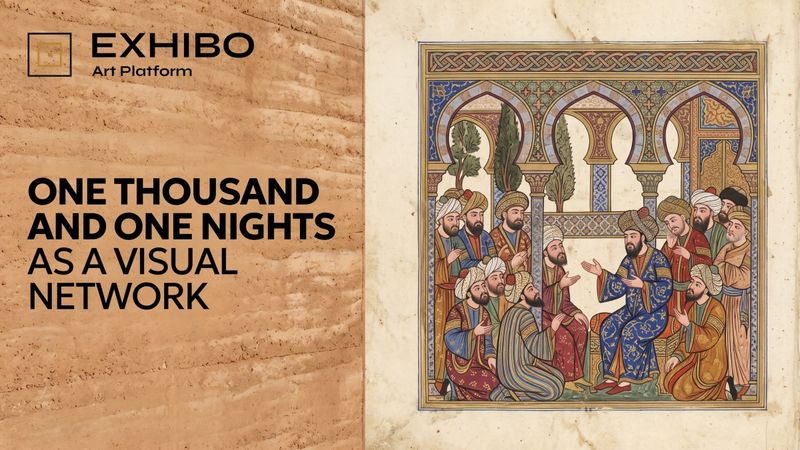
One Thousand and One Nights as a Visual Network
The book that taught Europe to picture the East arrived with no pictures at all. Three centuries of illustrators — Dutch, Egyptian, Persian, French, German, Iraqi — each gave it a face, and every face was a self-portrait.
Open Galland's Thousand and One Nights, the edition that conquered Europe, and there is nothing to look at: no genie, no lamp, not one illustration. The most visually imagined book in the world began blind — and because its text was never fixed either, no picture of it could ever be a copy.
Curating Tomorrow's Archive: Hamburger Kunsthalle Seeks Contemporary Collections Lead
A new permanent appointment will steer the museum's post-1960 holdings across paper, photography, and media formats.
The Hamburger Kunsthalle is inviting applications for a senior curatorial position focused on contemporary acquisitions, exhibition strategy, and digital collection management. Applications close October 2026 for a January 2027 start.