
Exhibo Editorial
How to Write an Artist Statement
A practical method for what, how and why texts that sit beside images, with length targets for applications, walls and websites
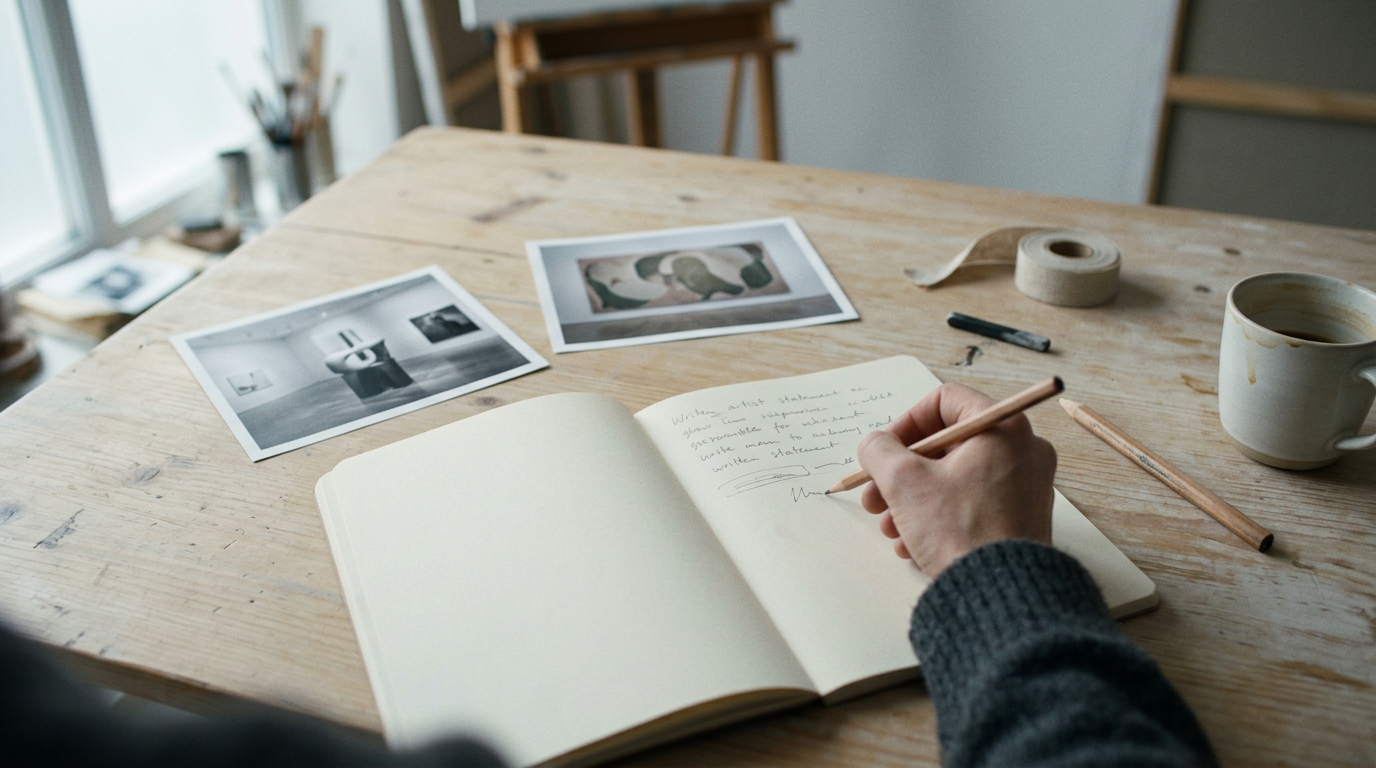
An artist statement is a short piece of writing, usually in the first person, that tells a reader what you make, how you make it, and why those choices matter. Mid-America Arts Alliance puts a useful default at about 150 words for a primary statement, and rarely more than 250; The Creative Independent’s guide lands most working statements between 100 and 300 words. Keep career facts out of it. Exhibition history, degrees and awards belong in a bio or CV. Write plain sentences that a smart non-specialist can follow while looking at your images. That is the whole job: orient the reader so the work reads more clearly, not so you sound impressive.
This article is the hub piece for writing about practice in the artist career guide. It covers why panels and curators still ask for statements, how statement, bio and CV divide labour, a draft-and-edit method you can reuse, length targets by context, edge cases (person, collaboration, wall text, funding forms), what professionals do when they read hundreds of applications, published cost bands for mentoring and editorial help, and when to stop polishing alone. The artist CV guide covers résumé conventions in depth. Approaching commercial spaces belongs in how to approach a gallery. Pricing work is fenced to how to price your art. Museum departments and public collections sit in the museums directory when you need institutional context for exhibition language.
Why Artist Statements Still Matter
Many artists treat the statement as a hurdle attached to forms. Artquest’s Rosalind Davis records the familiar resistance: leave interpretation to the viewer; refuse to be boxed in; write something the night before. Panels do not treat it as optional colour. a-n’s guidance on applying for opportunities asks artists to write as if the reader has never seen the practice, and to put the useful facts in the opening sentences because panels read many applications quickly. George Vasey, writing for Visual Arts South West after years on both sides of selection, gives the statement one job: contextualise the work for someone who does not know you. Press releases persuade. Reviews evaluate. Statements orientate.
That orientation saves time for people who decide with limited attention. Grant and residency readers skim. Website visitors skim. A curator who opens ten PDFs before lunch skims. Mid-America Arts Alliance notes that most people who encounter your writing will only fully read one or two paragraphs. Length and clarity are therefore not manners; they are how the text gets used. A muddy statement does not prove conceptual depth. It often proves that the writer has not yet decided what the work is doing.
Writing also clarifies the studio for you. MAAA calls the exercise a self-learning activity: putting words around the work forces a focus that images alone can leave fuzzy. The Creative Independent’s Sarah Hotchkiss describes the same habit as useful even when no deadline is due: stepping back every few months and translating nonverbal studio time into sentences for a specific audience. Davis adds a practical career claim. A clear statement helps conversations with peers, galleries and publics, and presents an organised profile. None of that requires manifesto tone. Accuracy about simple work beats fake complexity.
Statements travel with other documents. Residencies and open calls often ask for statement, bio, CV and images as a package. NYFA’s application guidance separates those roles carefully: the bio narrates selected career facts; the statement covers what you make, why and how; a project statement zooms further into one proposal. Mixing those jobs produces the common failure mode in which the first paragraph is autobiography and the jury never reaches the materials. Keep the fence clean so each document can be short.
Statement, Bio and CV: Three Different Jobs
Confusion between these three texts is the fastest way to waste word count. Singapore’s National Arts Council resource hub states the split in plain terms. A CV records education, experience and achievements in a clear, reverse-chronological list, ideally within about two A4 pages for many career uses. An artist bio is a one-paragraph, third-person career summary for publicity. An artist statement is a proclamation of what you believe about the work and a communication of intention, preferably about 150 to 200 words when you make a new body of work. Mid-America Arts Alliance’s bio guidance repeats the same map: CV for the full account of exhibitions and awards; résumé as a shorter, targeted version; statement in first person about process and influences; bio in third person about the person and the career.
Artquest’s artist-statement page is equally firm about what to leave out: career information, exhibition history and work history. Those belong in biography or CV. Hotchkiss lists further non-jobs for the statement: manifesto, art-history lecture, discovery story, short fiction, self-psychoanalysis, adjective string, grand theory of everything you have ever made, or list of accomplishments. If a sentence could sit on a CV line without change, cut it from the statement.
First person versus third person is the one convention that still splits advice. MAAA and Hotchkiss write statements in first person. Artquest’s public page prefers third person for many exhibition contexts (“Jane’s work” rather than “My work”), while Davis notes that residency and funding bids often expect first person. Vasey treats the choice as tone: first person reads intimate; third person reads more authoritative. The practical rule is to obey the brief. Keep a first-person master for applications that ask for your voice, and a third-person cut for wall text, press packs and contexts where the institution writes about you as an object of publicity. Do not invent a hybrid that switches person mid-paragraph.
Use this article as the statement hub. Build the list document with the artist CV guide, which follows College Art Association conventions for artist résumés (typically one to four pages for exhibition and grant use) versus full academic CVs. Third-person publicity lengths belong in how to write an artist bio. Portfolio assembly, photography of work, gallery approach and pricing sit in their own S10 siblings so this page can stay on the prose problem.
How to Draft: From Studio Talk to Usable Text
Most weak statements fail at the start, not at the polish stage. Writers sit in front of a blank page and reach for the phrases they have read on other people’s sites. Hotchkiss’s method delays sentences. Look at a body of work as a set. List visual and tonal adjectives without art jargon. Record a studio conversation with a friend (with permission) and mine the transcript. Write a casual letter about what you did that week. Ask what questions the work tries to answer. Davis suggests a timed fifteen-minute dump of everything you see in the work thematically, aesthetically and emotionally, then circling three strong words that actually fit. Vasey recommends soliciting descriptions from peers, keeping word lists in the studio, and interviewing yourself aloud. Raw talk produces material that formulaic “practice explores” openings never will.
Once you have raw language, fulfil three obligations that appear across museum-education-adjacent and career guides: what, how and why. State the medium. Hotchkiss notes how often statements omit even that. Explain why you care about the work without hedging that the art “hopes” or “tries” to affect a viewer. Describe process only when images cannot carry it, or when the method is genuinely unusual; collage is not unusual enough to need theatrical verbs. Artquest’s question list is a useful checklist beside that triad: media and why those media; themes and concerns; processes and their link to ideas; influences from outside the arts; what ties separate pieces into one practice; intention without a sales claim.
Build a short spine, then expand
Start with one tight paragraph of roughly 100 to 150 words that a stranger could read beside three images. MAAA treats that length as a strong all-purpose primary statement. NYFA’s residency notes often sit around 80 to 140 words for some calls, with NYFA itself frequently allowing about 250 words maximum: always read the form. Tufts’ artists’ writings guide recommends keeping three versions on file: a snapshot of 50 to 100 words, a working statement of 150 to 300 words, and a longer version up to about 500 words for websites, catalogues or briefs that explicitly allow space. Vasey’s short/long split is similar: 100 to 200 for short; up to 500 for long. National Arts Council’s 150 to 200 preference sits in the middle of that band.
A reliable short structure, adapted from Davis and from school career centres such as Tufts and SAIC summaries, runs in three moves. Opening lines name media and central concern. A middle stretch names materials or process and, if needed, one concrete example from the images you will attach. A closing stretch draws the threads without announcing greatness or listing shows. Longer statements may add a paragraph on current direction or a specific series. They should still fit on one page. MAAA’s building-block habit is practical: keep a primary paragraph, then add a second paragraph for a particular body of work when an application needs that mix-and-match.
Edit for voice, specificity and banned habits
Read the draft aloud. Hotchkiss treats that as non-negotiable: accuracy, description, compulsion and whether the text could describe someone else’s work. Look at the images while you edit so the claim matches the evidence. Cut theory unless it shapes day-to-day studio decisions. Cut extreme binaries (“both intimate and monumental”), false ranges of unrelated influences, and the muddled register Hotchkiss and others call International Art English: invented “spaces,” vague elevation, grammar that hides the subject. Artquest flags “my work explores…” as an overused opener. Vasey wants concrete sensory detail and process before floating claims. Davis asks for simple language that is neither dissertation nor marketing copy.
Person and audience come last, not first. Retune the master for the reader in front of you. A local group-show text can be warmer than a six-figure fellowship narrative. a-n asks for specificity when you explain why an opportunity matters: name the archive, facility or encounter you need, and link it to the practice. That tailoring belongs in the application answers and, lightly, in a temporary edit of the statement. It does not mean rewriting your entire practice for every form. Keep dated drafts. MAAA recommends archiving each version so you can reclaim a cut paragraph later and see how the practice has shifted.
Lengths, Versions and a Working Checklist
Length is the most common panic question, and the answer is always contingent on the brief. Museum education standards for gallery text are a useful comparison even when you are not writing a V&A label. The Victoria and Albert Museum’s gallery-text guidance keeps many standard object captions around 50 to 60 words because visitors stand, tire and came to look at objects. Getty education materials for interpretive text often allow roughly 30 to 140 words for object labels and up to about 200 for introductory statements. Your artist statement for an application is usually longer than a wall caption and shorter than an essay. Treat institutional brevity as a reminder that standing readers and sitting jurors both punish drift.
Keep a small set of controlled versions rather than one elastic paragraph you stretch until it snaps. The table below is a working file plan, not a universal law. Where a funder, school or gallery states a limit, that limit wins.
| Version or context | Typical length | Voice | Put in | Leave out | Failure mode |
|---|---|---|---|---|---|
| Snapshot / website blurb | 50–100 words | Usually first person | Medium, core concern, one process note | CV facts, series lists | Too vague to distinguish you |
| Primary / all-purpose statement | ~100–200 words (MAAA ~150) | First person unless brief says otherwise | What, how, why; current body of work | Awards, degrees, sales language | Jargon and “explores” openers |
| Application statement | Follow the form (often 100–300; some caps at 250–500) | As specified | Match images submitted; name media | Full career narrative | Mismatch with attached works |
| Long practice text | Up to ~500 words / one page | First or third as needed | Themes, process, one or two examples, current direction | Manifesto, theory dump | Readers skim after paragraph two |
| Project / proposal statement | Per brief (often 150–400) | Usually first person | Questions for this project; why this site or residency | Generic master pasted unchanged | Could apply to any opportunity |
| Exhibition / press third-person cut | ~100–200 words | Third person | Practice summary institutions can quote | “I” voice, soft hopes | Sounds like a bio; trim career lines |
| Wall or brochure extract | Often 50–100 words (museum labels frequently shorter) | Third person common | One idea visitors can use while looking | Dense citation, autobiography | Competes with curator’s label |
Beside the length table, keep a short production checklist. Gather current images first. Draft from talk and looking, not from other artists’ websites. Hit what, how and why. Cut CV content. Match the person the brief expects. Run a non-art reader past it. Spell-check with a human second pass; Hotchkiss and MAAA both insist no one copy-edits alone well. Date the file. Schedule a rewrite when the work shifts, not only when a portal opens.
Edge Cases: Person, Collaboration, Walls and Forms
Default advice assumes a solo visual artist writing English prose for a PDF upload. Real practices break that frame. Edge cases are where artists either overfit a template or abandon clarity.
Collaborative, collective and socially engaged practices need named roles. If the work is co-authored, say so in the opening lines and keep the “we” consistent. Do not hide a collective behind a singular studio myth when the images show many hands. For participatory projects, describe the structure of involvement without turning the statement into a facilitator’s CV. Process belongs here when the ethics of participation are part of what the viewer needs in order to read the work.
First person, third person and multilingual practice
Follow the application. When the brief is silent, first person remains the safest default for statements about living studio work in US and many UK funding contexts, while third person remains common for exhibition copy that will sit beside a curator’s text. Keep both cuts. Translating your own statement into another language is not the same as running it through an automatic tool and hoping. If you work across languages, decide which version is canonical for which audience, and have a fluent reader check tone. Access matters here too. Vasey notes artists using phonetic or easy-read versions, audio and audio description. Writing for access is part of professional practice, not an afterthought for the equality section of a form.
Artists who trained outside fine-art MFA cultures sometimes under-explain materials that insiders take for granted, or over-explain with classroom theory. Readers outside your discipline still need the medium named. Readers inside it still need specificity. The middle path is concrete description: what the object or event is made of, what recurs, what problem you return to. Performance, sound and time-based work should state duration and encounter conditions when images alone mislead. Digital and networked work should state what the viewer actually experiences (installation, stream, print-out, game build) so jurors do not guess the wrong category.
Early-career artists with short CVs sometimes overload the statement with biography to look established. Resist that urge. A precise account of three recent works beats a padded life story. Mid-career artists with sprawling practices face the opposite problem: one paragraph cannot cover twenty years. Name the current body of work that matches the images, and let the CV carry the archive. If an application allows a longer practice text, use the long version for range and keep the short statement aligned to the portfolio pages you actually attach.
Wall text, catalogue notes and funding portals
Do not paste a 400-word application statement onto a gallery wall. Museum education guidance exists because visitors read standing up. Offer the curator a short third-person paragraph and accept that institutional voice may rewrite it. Catalogue essays are another genre: they argue and cite; your statement still orients. For Arts Council England Project Grants and similar schemes, the statement is only one component beside public benefit, outcomes, budget and access. ACE-facing advisers repeatedly ask for plain certainty (“I will…”) rather than soft aims, and for bullet clarity in portal fields. Keep your artist statement available as a pasteable block, then answer the funder’s actual questions in the funder’s language. Do not smuggle a whole manifesto into a 1,500-character box.
AI drafting tools appear in career advice with a consistent warning. Davis notes that automated phrasing can flatten idiosyncrasy. Arts Council England has publicly reminded applicants that they remain accountable for what they submit. Use tools, if at all, to flag repetition after you have a human draft. Do not outsource the claim about why you make the work. Jurors who read all day recognise generic elevation quickly.
What Professionals Do When They Read Statements
Selection is industrial. Vasey has read thousands of statements as a curator and teacher. a-n tells applicants that panels move fast. The professional reader is not searching for a clever epigraph. They are checking whether the text and the images describe the same practice, whether the artist can be specific, and whether the proposal fits the opportunity without flattery.
Strong statements start in the concrete. Vasey’s teaching example from tutor Roxy Walsh (drop an unexpected, accurate detail into the opening rather than “my practice explores…”) is a symptom of reader fatigue, not a gimmick contest. Words should make a picture: materials, scale, tempo, smell if relevant, the social situation of the work. Mathew Parkin’s self-description as a “sodden artist” whose work is “armpit-like,” which Vasey cites, works because it is precise about tone. The same vividness can be dialled down for a conservative funding panel without returning to empty abstraction.
How institutional readers triage
Readers compare documents. If the CV shows twenty years of painting and the statement claims an installation practice with no images to match, trust collapses. If every sentence could describe three other applicants in the pile, the statement fails Hotchkiss’s “is it me?” test. If the text praises the work (“powerful,” “unique,” “important”), Artquest’s objectivity rule has been broken. Professionals also notice obedience to instructions: word limits, file names, anonymity rules, whether a project statement was requested separately. Those are not bureaucratic trivia. They signal whether working with you will be clear.
Museum and gallery educators, when they commission or edit artist texts for display, apply further constraints you can learn from even as an applicant. Getty’s interpretive guidance asks writers to begin with what a visitor can see and to avoid unsupported qualitative judgements (“the greatest of his time”). V&A gallery-text practice treats word counts as non-negotiable once design is set. Your application statement can be longer than a label, yet the same ethic helps: one or two essential points, active voice, no self-coronation. Gilda Williams’s How to Write About Contemporary Art (2014), which Vasey recommends, is the handbook many UK professionals still point to for cutting redundancy and matching tone to genre.
What they do not need from you
They do not need your full biography in the statement. They do not need a literature review. They do not need a promise that the work will heal the reader. They do not need a gallery-approach strategy or a price list; those conversations live elsewhere in this series. They need enough language to walk into the work without getting lost, and enough honesty to believe the next paragraph of the form.
Studio visits and interviews still matter after the PDF. A statement that you cannot speak aloud will fail the moment a curator asks you to expand a sentence. Practice saying the opening paragraph without reading it. If you stumble, the syntax is probably too dense for a tired panel as well. Davis’s point that writing helps you talk about the work runs in both directions: talk that works in the studio should survive on the page with only light tightening.
What Writing Help Costs
Most artists should write the first serious draft themselves. Paid help is for editing, structuring, access support and deadline triage, not for inventing a practice on the page. Costs vary by country, seniority and whether you buy a single critique or ongoing mentoring.
In the UK, public Artists’ Union England rate guidance for freelance visual artists (2024 published bands, with later updates on the union site) places new-graduate hourly work around the mid-£20s and more experienced freelance hours higher, with day rates from roughly the low £200s upward depending on experience band. AUE explicitly lists writing statements, proofreading and related preparation among activities that sit inside preparation fees for exhibitions. That does not mean you must hire another artist at full day rate to fix a paragraph. It does mean professional time spent on your text is real labour and should be budgeted like studio assistance.
Specialist artist-development practices advertise lower entry points for text support. One UK mentoring provider, for example, lists written critique of a short text or bio from about £40, hourly mentoring from about £55, and multi-session packages from about £300, with notes that Arts Council Access Support, DYCP and Project Grants can sometimes cover structuring and communication support for eligible applicants. Treat any single provider’s menu as an illustration, not a tariff. Compare two or three mentors, ask what deliverable you receive (annotated PDF, rewrite, call plus notes), and confirm whether the fee includes a second pass.
In the US, career offices and fellowship advisers more often point artists to peer editors, university writing centres and freelance grant writers. Published grant-writer rates in 2025–2026 industry blogs commonly cite roughly 50 to 150 dollars per hour, with flat fees for full proposals much higher than a statement edit alone. A statement polish should be scoped as a short editorial job, not priced like a federal grant package. NYFA and campus career centres remain low-cost places to test clarity before you spend.
Free and low-cost routes still do most of the work. Peer swaps, Artquest and a-n learning resources, university career workshops, and recording yourself in the studio cost time rather than fees. Access Support routes from major funders exist specifically so applicants who need communication assistance are not priced out of applying. Use them when you qualify. Do not confuse access support with paying someone to fabricate a practice you cannot stand behind in interview.
When to Get Help, and When to Stop
Stop expanding the statement when every new sentence restates the first paragraph with grander nouns. Stop when you are writing to impress an imaginary theorist instead of the person looking at your images. Stop when the deadline’s word count is met and a peer can paraphrase your practice after one read. Perfection is not available; Hotchkiss and MAAA both treat the statement as a living document you will revise as the work changes.
Ask for help when several trusted readers cannot tell what you make. Ask when English-language anxiety or access needs block you from submitting work that already exists in the studio. Ask when a high-stakes application (major fellowship, visa-related cultural funding, large commission) needs a structural edit and you can pay or draw Access Support. Ask a mentor when you suspect the statement is covering for an unresolved practice problem: if you cannot say what the work is in speech, more adjectives will not fix it. In that case, studio conversation comes before copy-editing.
Hire an editor or mentor to improve clarity, structure and match to brief. Do not hire them to supply a fashionable theme. Keep final approval yourself. When the text is stable, file the versions, update the CV through the sibling guide, and move to the parts of professional life this hub deliberately leaves alone: the portfolio sequence, the gallery email, the price list. Those have their own methods and their own failure modes. The statement’s success metric is narrower. A stranger looks at your work, reads your words, and understands the connection without needing you in the room.
FAQ
Search results for “how to write an artist statement” mix templates, generators and academic advice that contradict each other on person and length. Some pages sell one magic paragraph; others treat the statement as a mini thesis. The answers below follow museum-adjacent brevity, UK career resources (Artquest, a-n, VASW) and widely used US guides (Creative Independent, MAAA, NYFA, CAA document splits for CV versus résumé). They stay inside this hub’s fence: writing about the work, not approaching a gallery or setting a price. Always prefer the instructions on the form in front of you when a word limit or person is stated.
How long should an artist statement be?
Most working statements sit between 100 and 300 words. MAAA suggests about 150 as a strong primary length and generally under 250. Keep snapshot (50–100), standard and long (up to about 500 or one page) versions. Obey any stated limit.
Should I write in the first person or the third person?
Use the person the brief requests. First person is standard for many statements about your own studio work. Third person is common for exhibition and press copy. Artquest’s public page leans third for some exhibition uses; funding and residency forms often want first. Do not switch mid-text.
What is the difference between an artist statement and an artist bio?
The statement explains the work: media, process, concerns. The bio summarises the person and career in third person for publicity. NAC, MAAA and NYFA all keep them separate. Career facts in the statement waste the reader’s first minute.
What is the difference between a statement and a CV?
A CV or artist résumé lists exhibitions, education, awards and related professional activity, usually in reverse chronology. CAA publishes separate conventions for short artist résumés and full visual-artist CVs. The statement is prose about the work, not a narrative CV.
How do I start if I hate writing?
Talk first. Record a description to a friend, write a messy letter from the studio, or time a fifteen-minute visual inventory (Davis). Then extract what, how and why. Hotchkiss’s brainstorm-before-sentences method exists for this block.
Can I use the same statement for every application?
Keep a master, then tailor. Residencies and grants often need emphasis on facilities, sites or questions specific to that call (a-n; residency application guides). Paste-and-pray generic text is easy to spot when the project section asks why this opportunity.
Should my statement include prices or a gallery approach plan?
No. Pricing belongs in the pricing guide in this series. Approach strategy belongs in the gallery-approach guide. The statement orients readers to the work.
How often should I rewrite it?
Whenever the work in your portfolio changes enough that the old text misdescribes the images, and whenever a major application cycle begins. MAAA and Artquest both treat revision as normal professional maintenance, not as failure of the previous version.
Galleries mentioned
Museums mentioned
Artworks mentioned
Related reading
Monet's Monumental 'Iris' Commands €50m in Paris
A landmark auction results in a new domestic benchmark for Impressionist masterworks
Anselm Kiefer's Monumental Canvas Finally Leaves Storage with Bespoke Chipperfield Pavilion
A dedicated architectural intervention brings the artist's largest works into public view
Quebec Museum Unveils Dedicated Pavilion for Jean Paul Riopelle
A major architectural addition dedicates space to Canada's most celebrated modernist painter