
Stuttgart · Germany
Anselm Kiefer's Monumental Canvas Finally Leaves Storage with Bespoke Chipperfield Pavilion
A dedicated architectural intervention brings the artist's largest works into public view
A Monumental Canvas Finds Its Architectural Counterpart
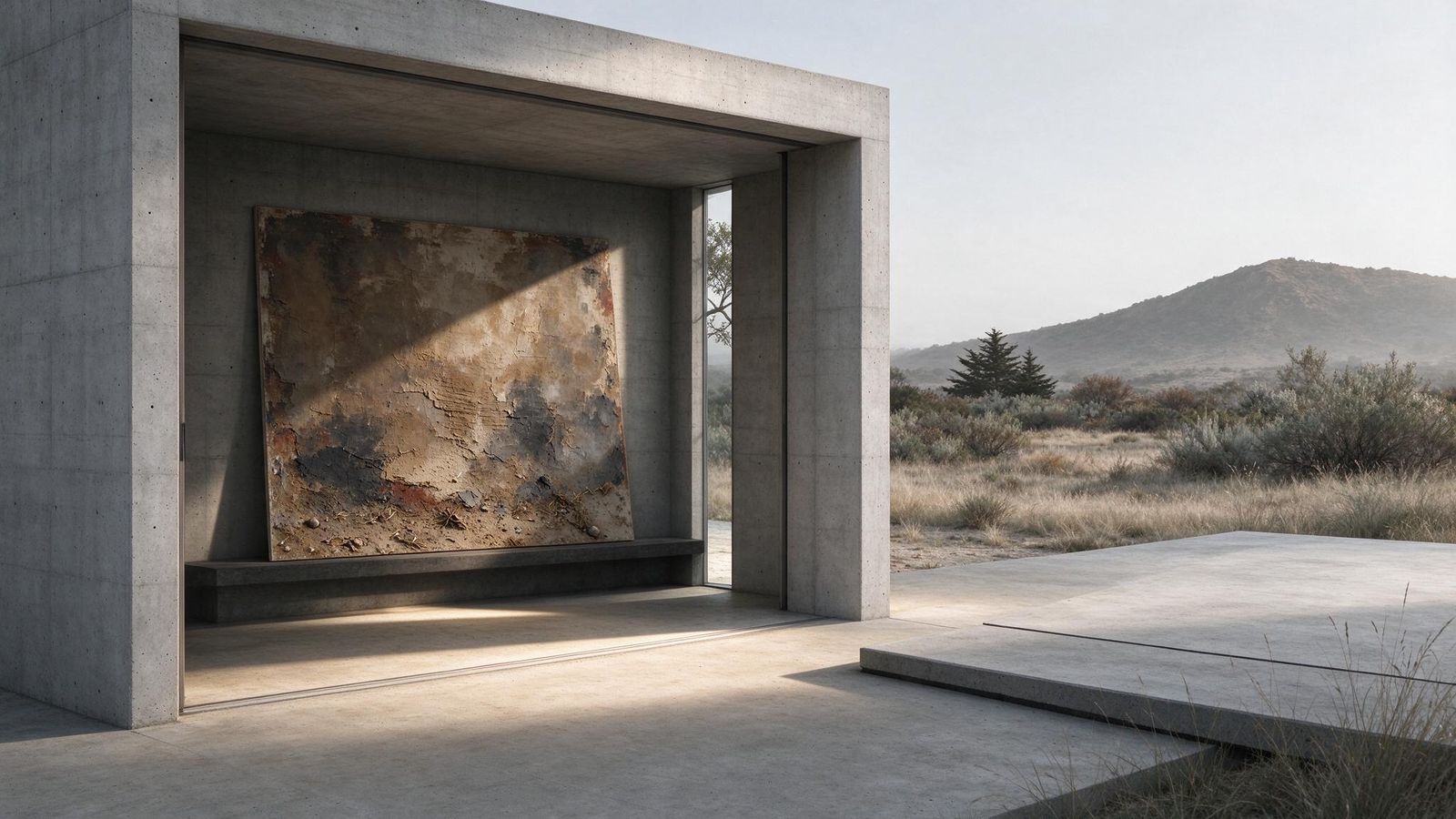
For nearly twenty years, Anselm Kiefer's Schwarze Flocken (Black Flakes, 2007) remained concealed within private archives. Acquired directly from the creator's studio by German industrialist Reinhold Würth in 2008, the monumental work measures 11.2 metres in height and 7.1 metres across. Its sheer physical presence rendered it fundamentally incompatible with standard gallery volumes within the wider Würth Collection. Rather than forcing the piece into compromised domestic settings, the family enterprise commissioned architect David Chipperfield in 2025 to construct a dedicated viewing environment. Following extensive collaboration with the painter himself, the freestanding structure finally opened to visitors on 13 October within the sculpture garden adjacent to Museum Würth 2 in Künzelsau, situated just outside Stuttgart.
Executed using oil paint, emulsion, shellac, soil, and wooden branches applied to a vast canvas, the piece derives its name from a verse by Romanian-born Jewish writer Paul Celan. Celan's parents perished in Nazi concentration camps, and Kiefer has repeatedly engaged with his literary legacy to interrogate German historical trauma and collective remembrance. The new setting deliberately cultivates a contemplative environment where viewers are encouraged to slow their pace and direct their gaze solely towards the artwork. As Maria Würth, executive vice-president for arts and culture at the group, noted, the architecture successfully frames a dialogue between three distinct creative forces: the builder, the painter, and the poet whose words originally inspired the composition. Such bespoke interventions reveal how contemporary collecting practices are evolving beyond mere acquisition toward comprehensive environmental stewardship.
Designing for Scale
Kiefer dictated the spatial parameters himself, establishing exact measurements for the chamber, the entrance aperture, and specific wall colours for the interior surfaces. His Berlin-based practice subsequently translated these directives into a 140-square-metre reinforced concrete volume. A covered entryway mediates between the external terrain and the interior gallery, while skylights filter daylight onto the surface. Bernhard Danigel, a design associate at the firm, explained that the primary objective involved crafting an architectural response entirely subservient to the single painting. The structure avoids asserting its own sculptural dominance, instead providing a quiet backdrop that allows the heavy materiality of the canvas to command attention. Such bespoke solutions highlight how contemporary architects are increasingly called upon to solve logistical problems inherent in post-war abstraction, particularly when artists prioritise raw texture and overwhelming scale over traditional pictorial formats.
This dedicated installation aligns with a broader institutional recalibration across the region. Approximately twenty kilometres away in Schwäbisch Hall, Kunsthalle Würth has reopened following a thirty-month refurbishment programme that increased its total exhibition footprint by six hundred square metres. The venue currently hosts Anselm Kiefer—All That Is the Case, running until 3 October 2027. Curated to mark the institution's silver jubilee, the survey presents over seventy pieces drawn from the private archive alongside twenty-one recent acquisitions loaned straight from the creator's workshop. Together, these developments signal a renewed commitment to housing large-scale contemporary works within purpose-designed cultural infrastructure, ensuring that ambitious artistic visions remain accessible rather than confined to archival silence.
Related reading

Vanessa Amoah Opoku: Synthesizing Realities
Reimagining surveillance technology through decolonial installation and collaborative scholarship

A Rare Market Appearance: Hilma af Klint's Geometric Masterwork Heads to Stockholm
A tightly guarded abstract canvas enters the secondary market, challenging established price benchmarks and highlighting sustained institutional momentum.

A Marketing Mismatch Over Impressionist Iconography
Why a Eurostar campaign overlooks a major London loan