
Exhibo Editorial
How to Clean a Painting (and When Not To)
Owner-level soft-brush dusting for stable oil paintings, and the hard line where only a paintings conservator should work
Call a paintings conservator before you touch anything beyond light dust. If you searched “how to clean an oil painting” because the surface looks dull, yellow, smoky or sticky, that problem sits past owner-level care. Surface cleaning that removes grime or varnish is irreversible. The Smithsonian Museum Conservation Institute and the Canadian Conservation Institute both treat it as specialist work: years of training, solubility tests, and a written decision to stop when the paint is too sensitive. Your safe job at home, and only on a painting with no loose or flaking paint, is dry dusting with a clean, soft, natural-hair artists’ brush so loose dust falls away from the face.
This guide stays on that fence. It covers why dust, nicotine and discoloured varnish are different problems, how to dust a stable oil painting without cloths or liquids, which tools belong in a private house and which do not, edge cases (acrylic, unvarnished modern paint, frames, smoke), what a studio does that YouTube will not show you, published cost bands with caveats, and when to hire someone through Icon or AIC instead of improvising. Lab restoration science lives in how paintings are restored. Training routes live in how to become an art conservator. For packing and transit after treatment, see the pending how to ship a painting guide. Start at the caring for art series hub; museum departments sit in the museums directory.
Call a Conservator Before You Clean
Most search results for cleaning oil paintings sell solvent recipes, mayonnaise myths, or hardware-shop “picture restorers.” Professional bodies refuse that path. The British Association of Paintings Conservator-Restorers (BAPCR) states plainly that owners should not attempt to repair or clean a painting themselves: the chance of more damage is high, and some of that damage cannot be undone. The Canadian Conservation Institute’s Note 10/1 on cleaning precautions exists to discourage wet, dry and solvent cleaning by untrained people, and to push prevention instead: glazing, sensible hanging, and careful handling.
A paintings conservator begins with examination, not with a wipe. AIC’s Guidelines for Practice put a written examination and a treatment proposal before any alteration. Icon’s Conservation Register and working-with-a-conservator guidance expect you to meet the practitioner with the object present, receive a proposal with dates and costs, and keep the treatment record with the painting afterwards. That process is the opposite of a Saturday afternoon with white spirit.
If the painting has monetary, sentimental or documentary value, treat a conservator visit as the first step, not the last resort after a failed DIY attempt. A dusty picture that still holds its paint is a problem of housekeeping. A picture with yellow varnish, nicotine film, flaking edges or a soft acrylic surface is a problem of conservation. Confusing those two categories is how owners abrade glazes, burnish matte paint, or dissolve original binder while chasing “brightness.”
The hiring path is short. Photograph front and reverse in ordinary light. Note where the picture hangs and what has already been applied to the surface. Search Icon’s Conservation Register or AIC’s Find a Conservator for easel paintings. Ask for an examination visit or a studio drop-off. Do not accept a fixed price by email from a thumbnail alone for anything beyond a provisional range. The written proposal is the document that protects both you and the object.
Why Dirt, Grime and Yellowing Are Different Problems
Owners often describe every dull surface as “dirty.” Conservators split that dullness into layers that behave differently under brush, water and solvent. Getting the diagnosis wrong is what makes household cleaning dangerous: the method that lifts loose dust can scrape insecure paint, and the solvent that softens aged varnish can also soften original oil or acrylic.
A traditional easel painting, as the Smithsonian MCI lays out, is a stack: support (canvas or panel), ground, paint, and often a coating. Dust sits loosely on the outermost surface. Grease, soot and tobacco smoke can bind into a varnish or into an unvarnished film. Natural resin varnish yellows and cracks as it ages. Overpaint and old retouching may sit on top of original, sometimes in a tougher medium than the paint beneath. Ultraviolet examination in a studio helps map varnish and later additions; your eye at home cannot reliably tell those layers apart.
Ageing also changes the paint itself. Oils continue to cross-link. Acrylic emulsions remain sensitive to water and mild solvents long after they feel dry to the touch. Nineteenth-century oils with certain additives can swell or wrinkle if solvents are misapplied; CCI flags that risk explicitly for nineteenth- to twenty-first-century work. Smithsonian MCI adds that some paintings simply cannot be cleaned: when no known agent will remove the obscuring film without extensive damage to the design layer, conservators leave the surface dirty. Their phrase is the useful rule: it is wiser to accept the underclean than the overclean.
Preventive habits matter more than periodic scrubbing. BAPCR advises hanging away from open windows, pet zones and dusty corridors, and cleaning the room around the painting so less dust arrives on the surface. Smithsonian MCI warns against hanging above heat sources: rising air carries dirt, heat softens paint and varnish, and fireplaces add soot. Direct sun fades fugitive colourants. High humidity invites mould; low, brittle paint. Those environment choices reduce how often anyone needs to clean at all. They belong with the rest of this caring for art cluster more than with a bottle of cleaner.
How to Dust a Stable Oil Painting at Home
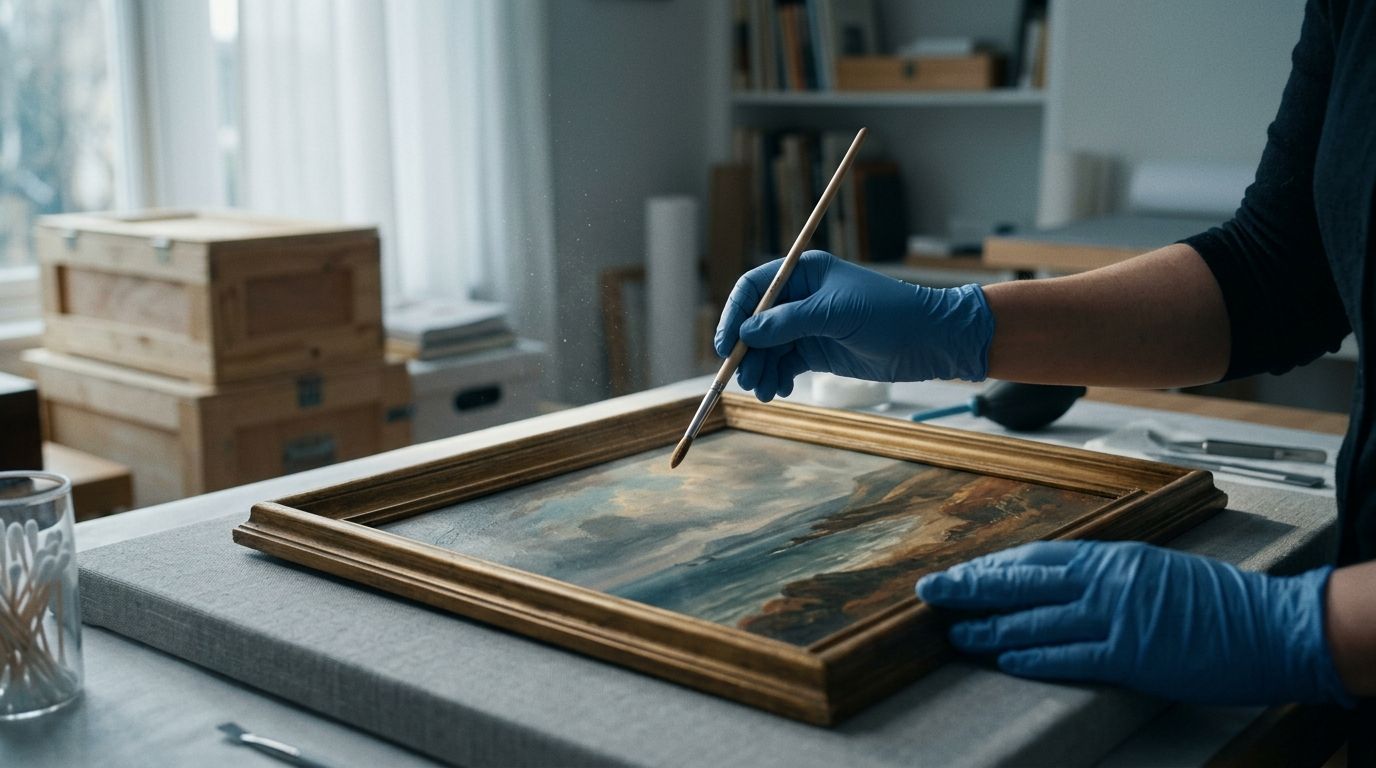
Owner-level cleaning, if you insist on the word, means dry dusting of a stable paint film. Smithsonian MCI permits it only when there are no signs of loose or flaking paint, and only with a clean, soft, natural-hair artists’ brush (about 3.5 cm to 5 cm tip). Position the painting on a clean padded surface, hold it upright at a forward angle so dust falls away from the face, and brush slowly in one direction, then again in the opposite direction. That is the whole method. No cloth. No moisture. No spray.
CCI’s Note 10/1 sharpens the risks even of that light touch. Some paintings develop micro-flaking: tiny, partly detached flakes that are hard to see and easy to sweep away. Larger flakes can hide in the image or in textured paint. Never use dry or moist dust cloths, stiff bristle brushes or feather dusters: threads catch on impasto, moisture drives later loss, and stiff or feather tools scratch. CCI also tells owners not to vacuum the painted surface or the frame, and not to use compressed canned air, which can dislodge insecure paint and deposit propellant. If Museums Galleries Scotland’s collections advice goes further and says never clean a painting surface even for dust, treat that as the institutional caution for staff without a conservator on site. For a private owner with a clearly stable, well-bound oil film, Smithsonian’s soft-brush protocol is the upper limit of what this article will teach.
BAPCR’s home-care leaflet adds a practical stop line of its own: if you notice a considerable build-up of surface dirt, seek professional advice rather than removing it yourself. Scratching, burnishing and dislodging lifting paint are the named risks. Glazing with a spacer so glass or acrylic does not touch the paint is their preferred long-term protection against dust and fingerprints.
Inspect before you brush
Work in good light. Look first for lifting, cupping, tenting or powdery paint. Rake a lamp across the surface from the side so raised edges cast shadows. Check the rebate where the frame meets the paint: that edge often fails first. Look at the reverse if you can do so without flexing the canvas: bulges between stretcher and cloth, insect frass, mould, or objects trapped against the reverse are BAPCR red flags. If anything looks insecure, stop. Bag loose flakes if they come away by accident, and take them to the conservator with photographs of where they sat.
Remove jewellery and watches before you handle the work. Smithsonian MCI asks for clean hands or cotton gloves, one painting at a time, carried from the sides of the frame or stretcher, never by the top member alone. Soft, sticky, unvarnished or powdery modern paint is a handling problem as much as a cleaning problem: fingerprint oils etch and attract more dirt. If the paint looks soft or matte and lean, do not brush at all. Smithsonian notes that brushing a matte, underbound surface can burnish it into a permanent glossy mark.
Brush technique and what to leave alone
Hold the brush near the base of the hair so the metal ferrule cannot nick the paint. Start at the top. Short, light strokes. Let gravity and the forward tilt of the painting do the work of carrying dust off the face. Do not scrub into recesses of thick impasto. Do not chase every speck in the corners of a carved frame with the same brush you use on the picture: gilding abrades easily, and wet-wiping gilded frames removes finishes.
Leave the reverse alone unless a conservator has shown you a safe method for that object. Dirt on stretcher bars and the reverse of the canvas is real, and some collection-care leaflets discuss low-suction vacuuming of the reverse with barriers. CCI’s public caution against vacuuming painted surfaces is the safer default for owners without training. A rigid backing board, fitted by a framer or conservator, reduces how much dirt reaches the reverse and dampens vibration. That is prevention, not cleaning.
If liquid splashes the paint, CCI’s emergency rule is specific: keep the painting face up so drips do not run; wick with the corner of absorbent paper or cloth; do not rub; call a conservator. Water on canvas can swell fibres, stress the paint, and leach components from acrylic films. Rubbing embeds the stain.
Materials and Specs for Owner-Level Care
The table below is an owner checklist, not a studio inventory. Anything that wets, dissolves or abrades the paint film is out of scope for home use. Commercial “painting cleaners” and picture-restoring preparations are explicitly rejected by CCI. Solvent choice, gels and varnish reduction belong in how paintings are restored, where the chemistry is discussed without recipes for amateurs.
| Item or action | Spec for private owners | Use it when | Do not use it when | Why it fails |
|---|---|---|---|---|
| Soft natural-hair artists’ brush | Clean; 3.5–5 cm tip; soft hair (e.g. goat/sable-type artists’ brush) | Stable oil or varnish film; no lifting paint | Flaking, powdery, soft acrylic, lean matte surfaces | Stiff hair scratches; dirty brushes grind grit into the film |
| Cotton or nitrile gloves | Clean, snug fit | Handling frames and stretchers | Soft, sticky or powdery unvarnished paint (minimise all contact) | Bare fingerprints etch and attract dirt |
| Padded clean surface | Soft, clean padding under the frame | Temporary support while dusting upright at a forward tilt | Placing weight on the canvas face or reverse | Pressure creates dents and later craquelure |
| Glazing with spacers | Glass or acrylic; ≥0.5 cm clear of highest paint point (CCI) | Dusty rooms; vulnerable or unvarnished surfaces | Impasto that would touch the glazing; seek a framer/conservator | Contact abrades paint; trapped moisture risks mould |
| Backing board | Rigid conservation-grade board on stretcher reverse (fitted by professional) | Canvas paintings on display or in storage | DIY screws through original stretcher without advice | Punctures, vibration and reverse dirt accumulate without it |
| Room cleaning | Vacuum floors; dust shelves away from the painting | Routine housekeeping | Blowing dust toward the picture with compressed air | Air currents redeposit grit on soft varnish |
| Water, soap, spit, oils, mayonnaise | Never on the paint film | None | All owner cleaning | Swells canvas, blanches varnish, leaves residues |
| White spirit, acetone, commercial “restorers” | Never for DIY | None | All owner cleaning | Softens or dissolves paint and varnish indiscriminately |
| Cloths, microfibre, feather dusters | Never on the paint | Frame glazing only (lightly damp cloth on glazing, not paint) | Paint, varnish, gilding | Threads snag impasto; feathers scratch; moisture drives loss |
| Household vacuum on the face | Never on paint or ornate frames (CCI) | None for owners on the face | Painted surface and fragile gilding | Suction lifts flakes; grit abrades |
Keep the kit small. One dedicated soft brush stored clean is enough. Wash it away from the painting if it picks up grit. Replace it when the hair clumps or sheds. Do not improvise with makeup brushes that shed synthetic fibre, or with “magic” sponges marketed for walls.
Edge Cases: Acrylic, Unvarnished Paint, Smoke and Frames
Oil on canvas with an aged varnish is the mental model most online guides assume. Real collections are messier. Edge cases are where owners do the most harm by copying an oil-varnish routine onto the wrong object.
Acrylic emulsion paint does not tolerate the mild organic solvents some people still pour on oils. CCI states that acrylics can lose water-soluble additives when wetted, and that mild solvents soften them. High temperatures make acrylics tacky so dirt embeds; low temperatures make them brittle. BAPCR flags modern and contemporary surfaces as particularly vulnerable to contact materials such as bubble wrap. If the painting is acrylic, unvarnished, mixed media, or still curing, skip home dusting unless a conservator has confirmed the surface is stable enough for a soft brush. Many recent works are safer behind glazing than under a householder’s hand.
Unvarnished oil, lean tempera-like films and matte contemporary paint burnish under brushing. Smithsonian’s burnishing warning is the stop signal: if the surface is matte and underbound, leave it. Fingerprints on exposed canvas grounds, common in twentieth-century work, are often permanent. Gloves and minimal handling matter more than cleaning.
Smoke, soot and kitchen grease are not household dust. They bond into coatings. Conservators may reduce them with tested aqueous systems or other methods chosen after solubility tests; that is studio work. Nicotine films yellow and cling. Fireplace soot darkens unprimed and unvarnished paint in particular. Moving the painting away from the source is the owner action. Scrubbing is not.
Water damage, mould and insect activity are emergency conditions, not cleaning projects. BAPCR lists mould, insects, blooming, exudation and active flaking among reasons to contact a conservator promptly. Bagging an infested object to isolate it, as some collection leaflets suggest, is containment. Bleach, household fungicides and DIY “mould wipes” on paint are not.
Frames need separate judgement. Ornate gilding scratches under ordinary dusting. Wet cleaning removes traditional gilding finishes. Clean glazing with a lightly dampened cloth while protecting the rebate so liquid cannot run onto the paint (CCI). If the frame is loose, the rebate bites the paint edge, or hanging wire digs into the reverse of the canvas, fix the framing with a professional before you worry about surface brightness. Smithsonian MCI’s hanging notes still apply: check hooks, wires and screw-eyes; do not let wire ends poke the reverse of the canvas into a bulge.
Panel paintings add another stop line. Wood moves across the grain when humidity swings. BAPCR notes that a change in convex or concave warp can precede splits, blisters and paint loss. Do not force a warped panel flat, and do not wet-clean a cupped surface in the hope that moisture will “relax” it. Climate stability and a conservator’s structural assessment come first. Canvas undulation from the same humidity swings is likewise a condition issue, not a polishing job: brushing a slack, flapping cloth risks abrasion along the stretcher bars where the paint already flexes hardest.
What Professionals Do Differently
A conservator’s “clean” is not a brighter version of your dusting. It is a documented campaign that may include consolidation of flaking paint before any surface work, reduction of grime on top of a varnish, thinning or removal of discoloured varnish, and sometimes the decision to leave a sensitive coating in place. Getty authors on solvent gels underline the point museum codes already make: cleaning is irreversible in practice. Dissolved varnish and dissolved original glaze do not return.
Studio sequence matters. Loose paint is secured first. Cleaning, if it happens, comes before filling, because colour matching requires a surface you can see. Retouching sits on fills, not on original. A new varnish may saturate and protect. Structural tears and panel splits interrupt that order when the support is failing. The live restoration article in the conservation series walks that sequence with materials chemistry and ethics. This care article only needs the contrast: professionals test, document and stop; amateurs wipe and hope.
Examination, tests and the decision to leave dirt
AIC expects examination and written records before treatment. Icon’s 2020 ethical guidance tells members to investigate no action first, to keep interventions detectable, and to leave treatments as reversible as possible. Ultraviolet light, raking light and microscopy map varnish, overpaint and cleavage. Solubility tests on tiny areas tell the conservator whether a coating will move without taking original paint. When paint and coating share solubility, mechanical reduction under magnification may replace free solvent. When no safe method exists, the conservator recommends leaving the surface as it is and improving the environment instead.
That restraint is the professional difference amateurs miss. Smithsonian MCI’s essay on whether a painting needs cleaning is explicit: improper cleaning can weaken ground adhesion so flaking appears later; excess water can shrink canvas fibres and stress the paint; mild solvents can soften acrylic. Delay and undercleaning are often the ethical choice. Brightness is not the success metric. Survival of original material is.
Surface cleaning versus varnish reduction
Conservators distinguish surface cleaning (reducing soot, grease and loose dirt sitting on a coating) from varnish and overpaint reduction. Sometimes grime on top of a varnish can be addressed with water-based systems without removing the varnish; Smithsonian MCI notes that possibility while insisting that permissible agents depend on both the accretion and the paint beneath. Varnish removal is a separate, higher-risk decision. It is never a kitchen-table project. Publishing solvent recipes here would invite the damage this fence exists to prevent. If you want the studio chemistry, materials table and ethics of reversibility, read how paintings are restored. If you want the career path into that studio, read how to become an art conservator.
Documentation travels with the object. Ask for before-and-after photographs, a list of materials, a map of fills, and a note of what was left untreated. AIC expects copies to go to the owner. Keep that file with the painting when you move or sell it. Future treatment is cheaper and safer when the next conservator does not have to rediscover the object by putting it at risk again.
What Painting Cleaning Costs
Invoices follow time, materials and risk, not the auction estimate. The Williamstown Art Conservation Center’s public line, repeated across private-practice interviews, is that cost tracks hours and materials required, not the market value of the object. Value may change how much documentation a client wants. It should not change the chemistry.
Published US illustrations are order-of-magnitude hints, not a 2026 tariff. Peter Himmelstein, a paintings conservator at Appelbaum & Himmelstein, has been quoted putting a small painting with an average amount of work in the region of 800 to 1,000 dollars, and a larger painting with serious damage in the region of 10,000 to 15,000 dollars (Art Business News, 2015; also summarised by Artwork Archive). Artwork Archive’s collection-cost overview has also cited oil-painting cleaning in a rough band of about 100 to 250 dollars per hour, with separate bands for paper and textile work. Treat those figures as dated interview illustrations. Examination fees, travel, imaging and framing sit on top. Some studios charge a consultation fee that is waived if treatment proceeds; others quote only after seeing reverse and face in person.
UK private practice follows the same time-based logic. Commercial restorer pages sometimes advertise simple surface cleaning from a few hundred pounds for a small picture and higher bands once varnish reduction, tears or mould enter the scope. Those marketing ranges are not Icon fee schedules. Icon’s guidance on working with independent conservators expects a written assessment with treatment options, implications, dates and estimated costs, and notes that estimates may change after full diagnostic examination. Ask for upper and lower limits if the work is uncertain. Compare more than one Accredited Conservator-Restorer for major campaigns.
Museum treatments are staff time, not a public price list. Multi-month and multi-year campaigns on major pictures are normal when analysis, structural work and retouching stack up. A private surface clean on a stable small canvas may finish in days of bench time once tests are done. A quote that arrives without examination of the reverse as well as the front is marketing, not conservation.
Insurance while the work is in studio is a separate conversation with your broker and the conservator. Himmelstein’s interview note is practical: owners often need cover for the object in transit and on site; low default cover from the studio may need raising for higher-value works. That is logistics, not a reason to DIY.
When to Stop and Who to Hire
Stop dusting the moment paint lifts, the surface burnishes, or dirt does not come away as loose dust. Stop before you open any bottle. Stop before you follow a video that wets a swab with a named solvent. BAPCR’s checklist of when to contact a conservator is the owner’s triage list: movement in the frame, bulges behind the stretcher, panel warp, canvas undulation, tears and dents, cracking or flaking paint, blooming or exudation, heavy surface dirt, insects, mould. Attend to structural damage promptly so loss does not spread.
Hire through directories that bind practitioners to codes. In the UK, use Icon’s Find a Conservator / Conservation Register and look for paintings (easel) specialism and Accredited Conservator-Restorer (ACR) status. BAPCR can also point you to professional members. In the United States, use AIC’s Find a Conservator and prefer Professional Associate or Fellow status in paintings. Ask whether the studio follows AIC, Icon or an equivalent code; ask for a written examination report and treatment proposal; ask what will be left untreated and why.
Bring clear photographs of front and reverse, note the hanging history (fireplace, kitchen, sun wall), and say what you have already done to the surface. Admit prior DIY attempts. Residues from oils, polishes and commercial cleaners change solubility and can force a more cautious, more expensive campaign.
If the painting must travel to the studio, do not wrap soft or sticky paint in bubble wrap against the face. BAPCR warns that modern surfaces can be permanently marked by contact materials. Use a conservator or art handler for vulnerable works; the pending shipping guide in this series will cover crates and transit in depth. For display after treatment, keep the picture off radiators and external walls where you can, maintain steady humidity where practical (BAPCR cites a museum guide band of roughly 40–60% RH with limited daily swing, and 18–24°C), and prefer glazing with spacers when the surface can accept it.
After treatment, resist the urge to “maintain” the new brightness with cloths or polish. A fresh varnish or a newly cleaned unvarnished surface still wants only the soft-brush protocol, and only once the conservator confirms the film is stable. Keep the treatment report with the object. If you later hang the work in a kitchen, over a fireplace, or in unfiltered sun, you will buy the same campaign again. Prevention is cheaper than a second studio visit, and it is the part of cleaning that owners control every day.
FAQ
Search results for “how to clean an oil painting” mix DIY myths, local studio ads and career questions. The answers below stay on owner care and hiring. Studio chemistry and ethics are in the live restoration guide. Preventive climate depth sits elsewhere in the caring-for-art and conservation clusters.
A qualified paintings conservator will still begin with the same two moves an owner should make: look at the reverse as well as the front, and refuse any treatment plan that arrives without examination. If a quote promises a full clean from a phone photograph alone, treat it as marketing. The questions that follow are the ones museums and professional bodies already answer in leaflets; they are restated here so the search page matches the fence this article keeps.
Can I clean an oil painting with water or white spirit?
No. Water can swell canvas, weaken grounds, blanch varnish and leach additives from acrylic paint. White spirit and other household solvents can soften or dissolve paint as well as varnish. CCI rejects commercial picture-cleaning preparations for the same reason: they are not used or recommended by professional paintings conservators. Dry soft-brush dusting on a stable surface is the owner limit.
How do I remove yellow varnish from an oil painting at home?
You do not. Discoloured varnish reduction is irreversible specialist work after solubility testing. Smithsonian MCI classifies varnish cleaning among the most demanding areas of painting conservation. Attempting it at home risks stripping original glazes. Commission a paintings conservator; read how paintings are restored for the studio process without DIY steps.
Is dusting a painting safe?
Only sometimes. Smithsonian MCI allows a clean soft natural-hair brush on paintings with no loose or flaking paint, held at a forward tilt so dust falls away. CCI warns that micro-flaking can be invisible and that cloths, feather dusters, vacuums and canned air are unsafe on the face. BAPCR advises professional help once dirt build-up is considerable. If you doubt the surface, do not dust.
How much does it cost to have a painting cleaned by a conservator?
Expect a written estimate after examination. Published US private-practice illustrations put modest work on a small painting around 800 to 1,000 dollars and serious damage on larger works in the low-to-mid tens of thousands, with hourly cleaning sometimes cited around 100 to 250 dollars. UK work is commonly quoted in hundreds of pounds for simple surface cleaning and higher once varnish or structural repair is required. Costs follow hours and materials, not market value.
What is the difference between cleaning and restoring a painting?
In studio language, surface cleaning reduces dirt and accretions; varnish reduction and retouching sit further along the treatment sequence and often fall under restoration in ICOM-CC’s sense of making a stable object readable again. Owners should not perform either beyond dry dusting. Conservators may clean without fully restoring, or may recommend no aesthetic treatment at all.
Should I clean the glass or the painting first?
Clean glazing, not paint. Use a lightly dampened cloth on the glass or acrylic only, keeping liquid out of the rebate so nothing runs onto the paint (CCI). If there is no glazing, do not invent a wet clean for the picture. Fit spacers and glazing through a framer or conservator when the paint surface can accept them.
How do I find a qualified paintings conservator?
Use Icon’s Conservation Register in the UK and AIC’s Find a Conservator in the US. Filter for easel paintings. Prefer Icon ACR or AIC Professional Associate/Fellow. Meet with the object present, require a written proposal, and keep the treatment report with the work. Career training into the profession is covered separately in how to become an art conservator.
What if my painting has flaking paint or mould?
Do not dust, wipe or apply fungicides. Isolate mouldy objects from other works where practical, limit handling, and contact a paintings conservator promptly. Flaking needs consolidation before any surface cleaning. Tears and structural damage should also be addressed soon so distortion does not set (CCI basic-care guidance). Packing for a studio visit belongs with professional advice and the pending shipping article in this series.
Galleries mentioned
Exhibitions mentioned

Artworks mentioned

Related reading
Olga de Amaral: Weaving the Infinite
A transatlantic survey tracing six decades of textile innovation across architecture and craft.
A Rare Market Appearance: Hilma af Klint's Geometric Masterwork Heads to Stockholm
A tightly guarded abstract canvas enters the secondary market, challenging established price benchmarks and highlighting sustained institutional momentum.

A Marketing Mismatch Over Impressionist Iconography
Why a Eurostar campaign overlooks a major London loan