
Venice · Italy
Koen Vanmechelen: Dissolving Boundaries Between Species in Venice
The Belgian artist discusses hybrid creatures, ancient mythology and the philosophy of interdependence behind his new sculptural project
A Sculptural Meditation on Interdependence
Koen Vanmechelen has spent decades probing the porous borders between disciplines, cultures and species. His latest undertaking, We Thought We Were Alone, now installed at Palazzo Rota Ivancich in Venice until 22 November, sharpens that inquiry into a pointed critique of human exceptionalism. Curated by James Putnam, the exhibition marks the Belgian artist's first solo sculpture presentation in the city and brings together more than forty new works that interrogate what it means to share a planet with countless other living beings.
The title itself operates on several registers. Vanmechelen describes a civilisation that has long positioned itself at the centre of the cosmos, neglecting the trees, grasses, birds and animals that surround it.
"We started to use but also to abuse them, and went too far," he reflects. In an era dominated by concrete and extraction, he sees a regression to something almost prehistoric — a hardening that breeds aggression. The antidote, he suggests, lies in recognising coexistence: "If you love yourself, you have to love the other."
Mythology as Living Material
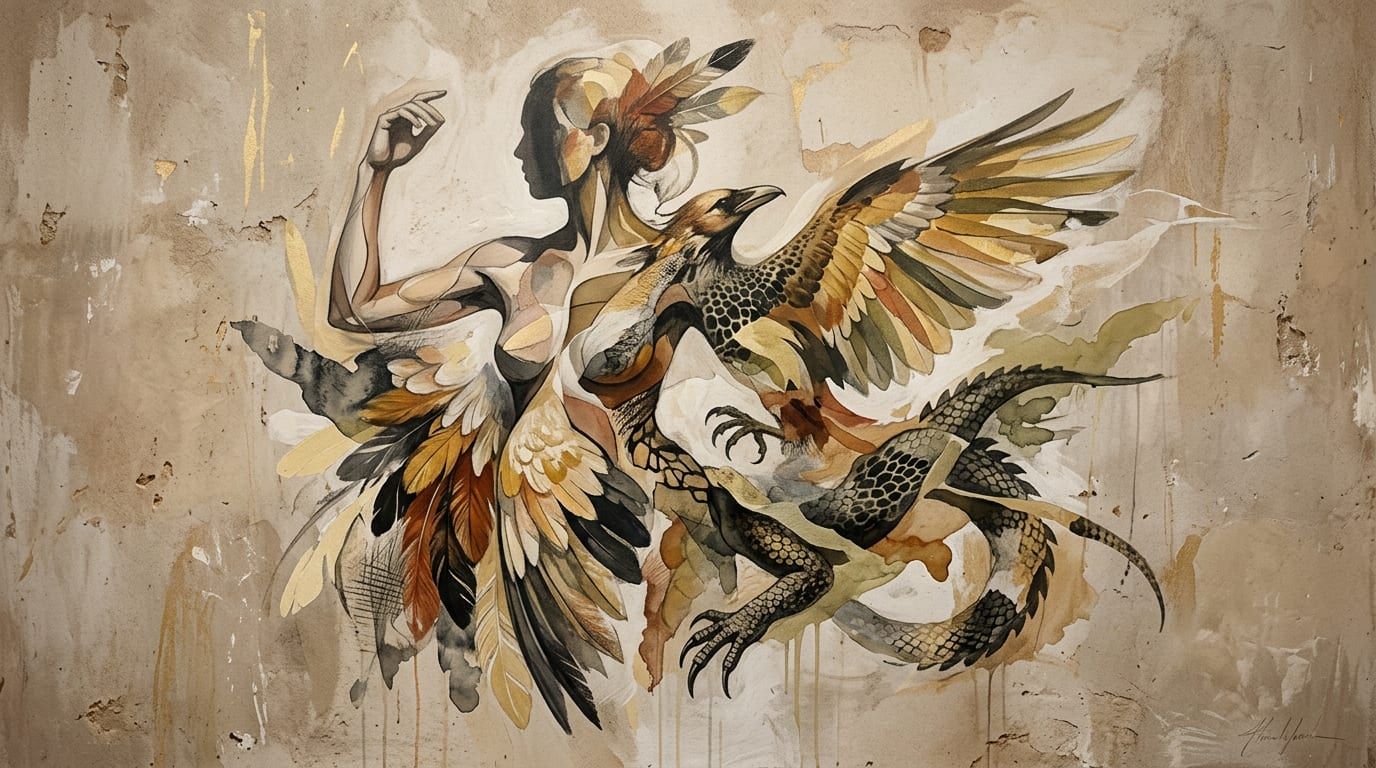
Venice provides a charged backdrop for this body of work, and Vanmechelen deliberately draws on Greek and Roman traditions to anchor his sculptures in the city's classical inheritance. Medusa proves a particularly fertile figure: snakes yield poison capable of killing, yet in controlled doses the same substance can serve as a cure. Evolutionarily, reptiles gave rise to birds; today, the majority of flu vaccines are cultivated using chicken eggs. These slippages between threat and remedy, animal and human, run throughout the exhibition.
In Will We Ever Exist, a polished egg-shaped mirror reflects not human faces but iguana heads. The Three Graces — classical emblems of beauty — are recast through a zoological lens.
"But it's still beautiful, because it's a living creature," Vanmechelen insists, pressing viewers to reconsider where they locate aesthetic and moral value.
Ethics of Taxidermy and Conservation
The artist is forthright about his use of taxidermied animals. He has never killed a creature for his practice. Instead, foundations and natural parks contact him when animals die, directing proceeds from any sale back into species protection. His own sanctuary, Labiomista near Ghent, houses tapirs and other at-risk animals; those that die naturally on the site may enter his studio. The compound also keeps chickens, camels and llamas — the latter the subject of an ongoing research project into their unusual immune systems, which hold potential for treatments targeting coronavirus and cancer.
"For me, animals are like a library," he says. "Without testing on them we can learn a lot, such as insights into genetics."
Science, Crossbreeding and Cosmopolitan Fossil
Collaboration with scientists — geneticists, quantum physicists, social researchers — is central to Vanmechelen's methodology. His long-running chicken crossbreeding programme demonstrated that increased genetic diversity correlates with stronger immunity and fertility, reinforcing his conviction that hybridity is essential to survival. A recent bronze work, Cosmopolitan Fossil, was unveiled at the Belgian embassy in Beijing, where he notes that environmental concerns and animal rights have gained considerable traction since his first Chinese exhibitions in the 1990s.
Yet he remains clear-eyed about global realities. With roughly a third of the world embroiled in conflict, he views art as a vital instrument for diagnosis and testimony.
"Art has a knowledge that can be spread," he argues. "That is the most beautiful present you can give as an artist."
We Thought We Were Alone runs at Palazzo Rota Ivancich, Venice, until 22 November.
Galleries mentioned
Related reading
A Defiant Stance on Global Participation at the Venice Biennale
Pietrangelo Buttafuoco justifies Russian inclusion amid sanctions and political backlash
The Biennale president addresses EU funding cuts and government boycotts while defending the institution's commitment to open cultural exchange.
Digital Horizons at the Venice Biennale's Collateral Shows
How independent pavilions are redefining technology-driven practice beyond the main competition
Three off-site presentations challenge prevailing cynicism around artificial intelligence and digital media through inventive installations and critical curation.
Women Makers: Sadu, Sejnane and the Art the West Called Craft
How the women of Sejnane and the Sadu tents made a world of geometric art the museum system had no shelf for — and how it is finally being called by its name.
Two women's traditions — the clay of Sejnane in Tunisia, the woven tents of the Arabian Peninsula — share no bloodline, only a rhyme: the same spare geometry, held and passed down by women, in whatever material their world gave them. This is the story of the visual knowledge the West filed under "craft," the makers it kept downstairs, and the contemporary artists now carrying it back up into the room where "art" is defined.