
Exhibo Editorial
The Dutch Golden Age
Seventeenth-century Dutch painting from republican trade and Calvinist homes to specialised genres, four close readings, and afterlife.
Dutch Golden Age painting is the flood of pictures made in the northern Netherlands across the seventeenth century, when a Protestant republic with global trade networks paid painters for portraits, landscapes, still lifes, genre scenes, and civic-guard group pictures rather than for altarpieces alone. Rembrandt van Rijn, Frans Hals, Johannes Vermeer, Jacob van Ruisdael, and dozens of specialists turned oil paint into a record of how Dutch cities wanted to see themselves: prosperous, watchful, and alert to light on cloth, brick, and weather.
The label “Golden Age” is a later shorthand for a period that began in wartime revolt and ended in financial and military crisis. Painters worked under Calvinist patronage rules, an open art market, and workshop specialisation that split subjects into saleable niches. This guide follows the conditions that produced that market, how to recognise the look, who drove it, four works worth reading at length, how the idiom spread and mutated, how critics used the word “golden,” and what the pictures left for later centuries. For European drama on a Catholic stage, see Baroque Art, Explained. Broader period context sits in the Periods of Art History series.
The conditions that produced Dutch Golden Age painting
Dutch Golden Age painting grew from politics as much as from talent. From 1568 the Seventeen Provinces fought Habsburg Spain in what became the Eighty Years’ War. The northern provinces, under William of Orange and his successors, formed the Republic of the Seven United Netherlands. Spain recognised that independence in the Peace of Westphalia in 1648. The Frick Collection’s short account of the period stresses the point: the century opened in revolt, then turned surplus income into a surge of picture buying across an unprecedented range of subjects and quality levels.
Religion reshaped the commission. Reformed churches stripped altarpieces and discouraged Catholic image programmes. Painters who once might have filled chapels turned to private houses, town halls, orphanages, and civic-guard headquarters. The National Gallery, London, notes that after the Reformation local churches no longer supplied artists with the steady sacred contracts that Catholic courts still offered. History painting never vanished. Rembrandt and others still staged biblical and classical narratives. The centre of gravity shifted toward portraits of living sitters, scenes of everyday life, landscapes of the Low Countries, and still lifes that could hang above a mantel without catechism.
Trade paid the bills. Amsterdam became a northern European entrepôt. The Dutch East India Company (VOC), chartered in 1602, and the West India Company pushed shipping, insurance, banking, and colonial extraction into daily wealth. Surplus cash reached a broad middle and merchant class that bought paintings the way other cities bought silver plate. Specialists answered that demand with small cabinet pictures as well as large civic canvases. Flemish craftsmen fleeing Catholic southern Netherlands after the war’s early decades carried techniques and subjects north, as the Frick notes, and seeded workshops in Haarlem, Amsterdam, Utrecht, Leiden, and Delft.
War and boom never sat apart from violence overseas. The same fleets that funded Haarlem banquets and Delft interiors moved enslaved people, spices, and sugar. Recent museum programmes, including the Rijksmuseum’s work on slavery connections in the collection, ask viewers to hold the polish of Dutch Golden Age painting against that extractive economy. The pictures remain superb. The “golden” metaphor needs that double ledger.
By the 1650s the market was thick with painters, dealers, and guild rules. Guild membership controlled who could sell as a master. Prices varied by size, finish, and subject prestige. History painting kept theoretical rank; genre and still life sold by volume. The disaster year of 1672 (Rampjaar), when France, England, and allied bishops invaded, cracked the boom. Demand cooled. Many painters left the trade or emigrated. The high moment of Dutch Golden Age painting sits between the Twelve Years’ Truce (1609-21) and that crash, with Rembrandt’s Amsterdam peak in the 1630s-40s and Vermeer’s Delft maturity in the 1660s.
What Dutch Golden Age painting is, and how to recognise it
Art historians use “Dutch Golden Age painting” for pictures made in the United Provinces across the seventeenth century, with porous edges into late sixteenth-century Mannerism and early eighteenth-century aftershocks. The Art Story’s working span of about 1600 to 1672 matches the political arc from early republic to Rampjaar. The phrase itself is not a seventeenth-century workshop slogan. Later collectors and national historians coined “Golden Age” to praise commercial and cultural power. You meet the school as a cluster of habits: specialised subjects, sharp observation of light and surface, oil techniques tuned for domestic walls, and a taste for ordinary life elevated by finish rather than by saintly hierarchy.
Recognition starts with subject more than with a single brush recipe. Italian and Flemish Baroque often stage sacred drama for chapel distance. Dutch walls favour what a merchant household could live with: a civic company at table, a dune road under cloud, a breakfast of pewter and cheese, a woman writing a letter. Finish ranges from Hals’s broken, lively strokes to Vermeer’s controlled optical calm. Scale runs from palm-sized panels to Rembrandt’s Night Watch at almost four metres high. Shared ground remains the northern daylight, the interest in how materials behave under that light, and the assumption that a picture can argue for status without a cardinal’s coat of arms.
Genres, specialisation, and the open market
Dutch painters specialised earlier and harder than many Italian contemporaries. A Haarlem landscapist might never attempt a large history canvas. A Leiden fijnschilder (fine painter) chased enamel smoothness on small panels of candlelit virtue or vice. Amsterdam portraitists competed for guild and merchant sitters. Delft interiors and Utrecht Caravaggesque figure painters formed local dialects. Specialisation made sense in a market that bought by category: you ordered a “sea piece,” a “banquet still life,” or a “merry company,” not a single altarpiece to cover every need.
That market also produced moral double-coding. Genre scenes of drinking, lovemaking, or household chaos often carried proverbial warnings that buyers could enjoy and ignore. Still lifes of luxury goods could celebrate abundance and hint at transience. Flower pieces recorded botanical fashion after the tulip mania of the 1630s. Architectural painters such as Pieter Saenredam and Emanuel de Witte turned whitewashed church interiors into studies of geometry and light. Marine painters made Dutch naval power visible for parlours far from any deck.
| Genre | Peak decades (approx.) | Typical buyers | Exemplary work | Location | What to notice |
|---|---|---|---|---|---|
| Civic-guard / group portrait | 1610s-1660s | Militia companies, guilds | Rembrandt, The Night Watch (1642) | Rijksmuseum, Amsterdam | Action replacing stiff rows; paid per sitter |
| Individual portrait | Throughout | Merchants, regents, families | Frans Hals portraits; Rembrandt tronies and likenesses | Haarlem; Amsterdam; London NG | Brush energy (Hals) vs psychological shadow (Rembrandt) |
| Genre / everyday life | 1620s-1670s | Urban households | Vermeer interiors; Jan Steen households; Judith Leyster music scenes | Delft; Leiden; Haarlem | Moral proverb + optical pleasure |
| Landscape | 1620s-1670s | Broad middle market | Ruisdael, The Windmill at Wijk bij Duurstede (c.1668-70) | Rijksmuseum, Amsterdam | Low horizon, weather as drama |
| Cityscape | mid-century | Local pride, collectors | Vermeer, View of Delft (c.1660-61) | Mauritshuis, The Hague | Topography edited for calm bands of water, city, and sky |
| Still life | Throughout | Domestic display | Claesz, Heda breakfast pieces; floral specialists | Haarlem; Amsterdam museums | Texture virtuosity; wealth and warning |
| Marine / shipping | mid-century | Merchants, naval pride | Van de Velde workshop seascapes | Amsterdam; London collections | Trade and war as weather spectacle |
| Church interior | mid-century | Reformed and Catholic patrons | Saenredam; De Witte | Utrecht; Delft; Amsterdam | Whitewash, organ pipes, measured light |
Light, finish, and the viewer at home
Light does different jobs across the school. Utrecht painters who had seen Caravaggio’s followers in Rome, including Hendrick ter Brugghen and Gerrit van Honthorst, staged candlelit figures against darkness. Rembrandt absorbed that drama and bent it toward faces that think rather than toward pure theatre. Vermeer and Pieter de Hooch, working later in quieter rooms, track daylight across plaster, tile, and satin until the room itself becomes the subject. Ruisdael builds storm light over mills and bleaching fields so that Dutch weather feels like a national emblem.
Finish advertises workshop identity. Hals’s “rough” manner leaves strokes visible so that a sleeve seems to move as you step back. Leiden fine painters suppress the mark until fabric reads like enamel. Rembrandt’s late surfaces thicken into ridges that only resolve at viewing distance; the National Gallery’s Rembrandt notes stress that late works are designed to work from afar. Vermeer’s points of light on bread crusts or boat hulls, sometimes called pointillé, make reflection feel particulate rather than painted. Stand close and you see craft. Stand back and you receive a world.
Scale follows the wall. Most Dutch Golden Age paintings were meant for houses, not naves. That domestic brief explains cropped figures, intimate distances, and subjects that reward repeated looking over breakfast rather than a single liturgical hit. When a commission went civic and large, as with Hals’s Haarlem guards or Rembrandt’s Kloveniersdoelen canvas, painters imported drama into a republican room instead of a papal chapel. The viewer stays a neighbour, not a pilgrim.
The painters who shaped Dutch Golden Age painting
No manifesto bound these artists. Cities produced accents. Haarlem specialised early in lively portraiture and dune landscapes. Amsterdam gathered history painters, portrait factories, and Rembrandt’s large workshop. Delft refined interiors and city views. Utrecht kept a stronger Catholic and Caravaggesque strain. Leiden fostered fine painting. Leiden-born Rembrandt made his fortune in Amsterdam; Delft-born Vermeer stayed local and scarce. Treat the names below as a map for museum labels, not as a closed canon.
Women painters worked inside the same market under tighter guild and social limits. Judith Leyster (1609-1660) gained master status in Haarlem’s Guild of St Luke in 1633, ran a studio, and sold genre scenes and portraits at competitive prices. Her Self-Portrait (c.1630; National Gallery of Art, Washington) shows her at the easel with a fiddler on the canvas, marketing skill as product. After marriage to Jan Miense Molenaer her output slowed. Later dealers often sold her pictures as Hals until her star monogram was recognised again in the 1890s. Rachel Ruysch later carried floral still life into the next century. The school’s gender story is one of erasure and recovery.
Haarlem and Amsterdam: Hals, Rembrandt, and the civic face
Frans Hals (1582/83-1666) made Haarlem’s officers look as if you had walked into their banquet mid-toast. Walter Liedtke’s Metropolitan Museum essay places him second only to Rembrandt, and for a stretch ahead of Vermeer, in nineteenth-century French admiration for brush energy. Hals joined the Haarlem painters’ guild in 1610, served in the Saint George civic guard, and painted about ten large group portraits for public institutions, ending with the sober regents of the old men’s almshouse around 1664. Courbet, Manet, Monet, Van Gogh, and Sargent later studied that broken stroke as a licence for modern facture.
Rembrandt Harmenszoon van Rijn (1606-1669) moved from Leiden training under Pieter Lastman into Amsterdam’s portrait market around 1631. The National Gallery’s biography tracks the arc: early history subjects, marriage to Saskia van Uylenburgh, house buying, collecting mania, bankruptcy proceedings in 1656, and late self-portraits that refuse flattery. A full biography belongs elsewhere. What matters for Dutch Golden Age painting is how he turned group portraiture into narrative (The Night Watch), how he held biblical drama when churches no longer paid for it, and how his prints spread compositions across Europe. Pupils and followers, including Carel Fabritius, carried pieces of that language into Delft and beyond.
Amsterdam also hosted the commercial density that made specialisation possible: dealers, frame makers, and a public that bought prints as well as oils. Govert Flinck and Ferdinand Bol competed for the same civic walls Rembrandt wanted. The city’s prosperity produced both Rembrandt’s boldest experiments and the middle market that kept lesser names employed.
Delft, Utrecht, and the specialists of everyday looking
Johannes Vermeer (1632-1675) left a small oeuvre, about three dozen accepted paintings, and a long afterlife. He worked in Delft as painter, dealer, and valuer. Interiors such as Young Woman with a Water Pitcher (Metropolitan Museum of Art) and the Mauritshuis View of Delft show compositional clarity and naturalistic light that the Met’s genre essay links with Pieter de Hooch’s ordered rooms. Vermeer’s Girl with a Pearl Earring (c.1665; Mauritshuis) is a tronie, a character study rather than a named portrait; a full close reading belongs with Girl with a Pearl Earring, Explained (S4-10 / planned). Here it marks Delft’s optical ambition without taking the centre of the story.
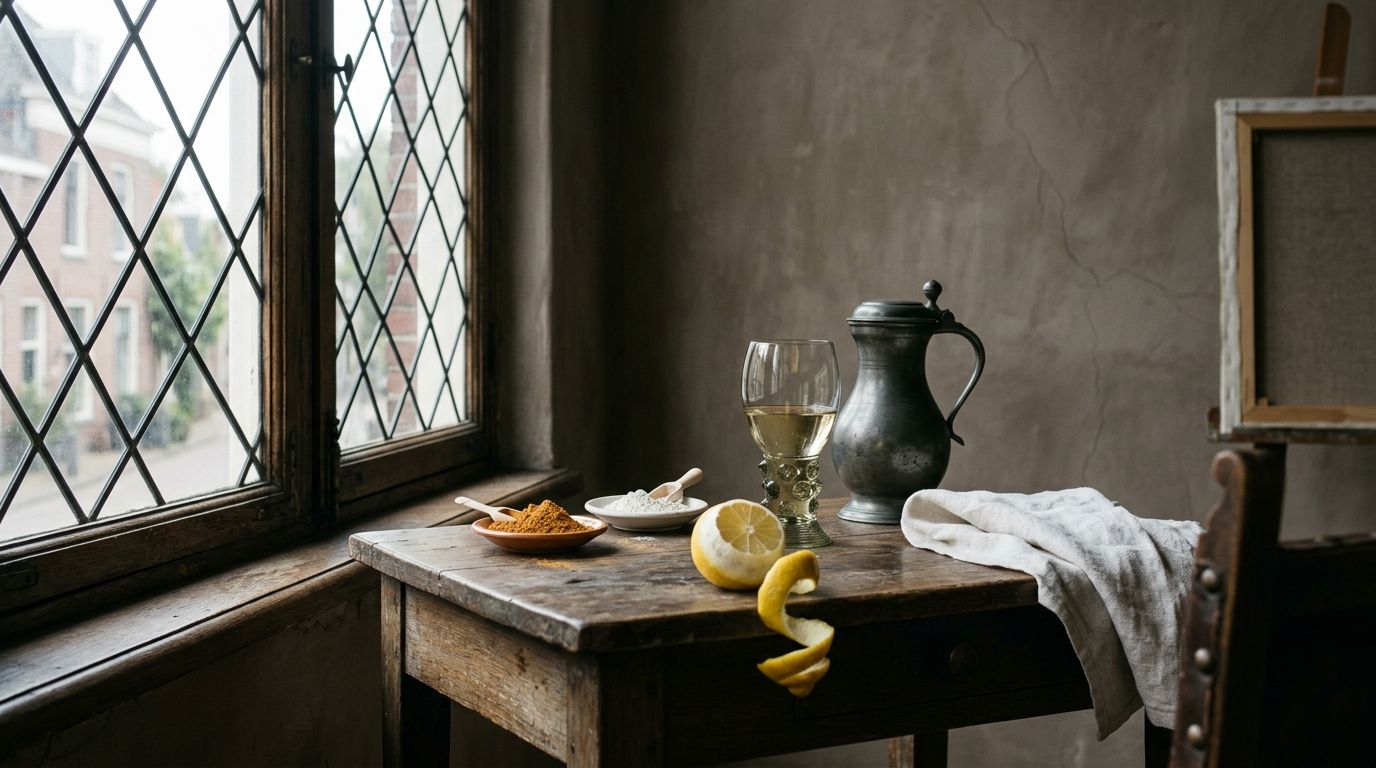
Utrecht painters who returned from Italy kept night scenes and half-length musicians in fashion when Amsterdam pushed daylight realism. Leiden’s Gerrit Dou and Frans van Mieris polished moralising interiors to a glassy finish. Jan Steen mixed comedy and warning in chaotic households. Jacob van Ruisdael (c.1628/29-1682) and Meindert Hobbema built landscape into a major Dutch export, with mills, ruins, and bleaching fields as local heroes. Still-life painters such as Pieter Claesz and Willem Claesz Heda arranged “breakfast” tables where pewter, glass, and lemon peel become tests of skill. When those tables tip into skulls, snuffed candles, and watches, you enter vanitas territory; the motif’s full history sits in Vanitas Painting, Explained (S16-04, planned). Keep the link; do not let skulls hijack this period survey.
Four works worth reading closely
Lists of “famous Dutch paintings” flatten the problem. Close looking at fixed works teaches how patronage, light, and specialisation behave in a room. The four below cover civic action, banquet portraiture, cityscape, and landscape: Rembrandt’s Night Watch (1642), Hals’s Banquet of the Officers of the St George Civic Guard (1616), Vermeer’s View of Delft (c.1660-61), and Ruisdael’s The Windmill at Wijk bij Duurstede (c.1668-70). Together they show Dutch Golden Age painting answering republican briefs rather than Roman chapel ones.
Read them as case studies, not a ranking. Each solves a different problem: how to make a militia look busy; how to stage officers at table without freezing them; how to edit a hometown into calm bands of water, brick, and cloud; how to turn a mill into weather drama. If you can only see one in person this year, choose the Rijksmuseum and Mauritshuis pair. Photographs shrink Rembrandt’s scale and Vermeer’s particulate light into souvenirs.
Rembrandt, The Night Watch (1642)
The Rijksmuseum’s canvas, titled Militia Company of District II under the Command of Captain Frans Banninck Cocq, measures about 379.5 × 453.5 cm and hangs on loan from the City of Amsterdam. Rembrandt painted it for the great hall of the Kloveniersdoelen, headquarters of the arquebusiers’ civic guard. Captain Banninck Cocq, in black with a red sash, gestures to Lieutenant Willem van Ruytenburch in yellow. Guardsmen load weapons, raise the colours, and form up. A girl with a chicken at her belt works as company mascot and emblem play on the clauweniers. Rembrandt signed and dated the work 1642.
The Rijksmuseum wall text states the innovation in direct terms: Rembrandt was the first to paint figures in a Dutch group portrait in the middle of an action. Earlier militia pieces often seated officers in rows or at static banquets. Here light picks the captain’s hand, the lieutenant’s costume, and the girl, while other faces fall into half-shadow. Operation Night Watch research has mapped pigments including lead white, lead-tin yellow, ochres, vermilion, arsenic sulfides, lakes, smalt, and azurite in Van Ruytenburch’s costume, confirming how Rembrandt built warm metallic reflections by a consistent method rather than by accident. The popular title is late and misleading. Darkened varnish once made the scene look nocturnal; the action is daylight drama in a civic key.
Stand in the Night Watch Gallery and the picture behaves like a street you have stepped into. Musket, drum, and dog keep peripheral life alive. Compare it with Roman Baroque martyrdoms and you see shared tools of diagonal motion and selective light used for a merchant city’s self-defence club, not a Counter-Reformation altar. That republican brief is the Dutch difference.
Frans Hals, Banquet of the Officers of the St George Civic Guard (1616)
Hals’s earliest large civic-guard painting hangs in the Frans Hals Museum, Haarlem. Officers celebrate the end of their term at table. Rank orders the room: colonel and captains to the left, lieutenants further right, standard-bearers with flags. Some men look out as if you had just entered. The Frans Hals Museum stresses the movement already present in this first big commission: bodies twist, glances cross, and the banquet feels interrupted rather than posed for eternity.
The picture teaches Haarlem’s social face. These men paid for likeness and for company honour. Orange sashes and flags mark allegiance in a republic still fighting Spain. Hals’s brush turns lace and glass into flickering marks that cohere at distance. Nineteenth-century painters flocked to Haarlem to copy that freedom. Where Rembrandt’s 1642 company surges through a gate, Hals’s 1616 company holds the table and still feels kinetic. Two solutions to the same Dutch problem: how to paint collective identity without a king’s single body at the centre.
Vermeer, View of Delft (c.1660-1661)
The Mauritshuis dates View of Delft to about 1660-61 and measures it at 96.5 × 115.7 cm. Vermeer shows the city from the south across the Kolk harbour. Horizontal bands of water, buildings, and sky organise the calm. Boats sit moored with sails down. Tiny figures talk on the quay. A dark cloud shadows the near shore while sunlight strikes the tower of the Nieuwe Kerk, burial place of William of Orange. The Mauritshuis notes that Vermeer shifted the spire toward centre, straightened the bridge, and tidied a jagged skyline to favour tranquillity over strict survey accuracy.
Empty belfry windows help date the work. The Hemony foundry removed and rehung bells between May 1660 and autumn 1661; Vermeer paints the open tower of that interval. Coarse lead white grains roughen a sunlit roof; lead-tin yellow models the brightest stone; dotted highlights on a boat hull suggest sparkling water. Marcel Proust later called the painting among the most beautiful in the world and wrote a character’s death before it into À la recherche du temps perdu. For Dutch Golden Age painting the canvas shows how a specialist could make topography feel like weather and memory at once, without needing a heroic narrative.
Jacob van Ruisdael, The Windmill at Wijk bij Duurstede (c.1668-1670)
Ruisdael’s oil on canvas (about 83 × 101 cm) is on loan to the Rijksmuseum from the City of Amsterdam (A. van der Hoop Bequest). A mill rises against rain clouds, dwarfing castle and church towers of Wijk bij Duurstede. The River Lek occupies the foreground with a small boat; women walk the bank. The Rijksmuseum describes the design as a convergence of low land, water, and sky on the mill, a catalogue of Dutch motifs pushed into one emblem.
Landscape here carries national weather rather than pastoral escape. Kenneth Clark once called Ruisdael the greatest master of natural vision before Constable; the claim is historiographic praise, yet the looking holds. Clouds do narrative work. The miller on the balcony, if you find him, checks a sky that threatens change. Barbizon painters, Constable, Turner, and later Impressionists studied such constructions. Place this canvas beside Vermeer’s Delft and you see two late-century answers to place: one urban and crystalline, one rural and storm-lit, both selling Dutch ground as worthy of oil.
How Dutch Golden Age painting spread and mutated
Prints moved compositions faster than canvases. Rembrandt’s etchings taught Europe his faces and narratives. Reproductive engravers after Hals, Ruisdael, and still-life specialists stocked albums abroad. Dutch painters themselves travelled: some to England, some to Italy, some into German courts. The idiom mutated wherever patrons asked for Dutch “realism” as a brand: marine painters in London, landscapists who thickened Ruisdael’s drama into Romantic storm, genre painters who softened Steen’s chaos into polite anecdote.
Inside the Republic, mutation followed city and confession. Utrecht’s candlelit half-lengths look closer to international Caravaggism than to Delft’s daylight kitchens. Catholic patrons still ordered history and Marian subjects even as Reformed walls stayed bare. After 1672 the market contracted. Fine painting continued into the eighteenth century in a quieter key. French and English collectors later treated seventeenth-century Dutch cabinets as models of bourgeois taste, stripping them of wartime origin stories.
Colonial circuits carried pictures and pictorial habits overseas. VOC networks moved luxury goods that appear in still lifes; they also moved people whose labour seldom appears as subject. Modern curators now hang Dutch Golden Age painting beside documents of slavery and trade so that the glow of pewter does not erase the supply chain. That is mutation in the museum rather than in the workshop: the same objects, a revised frame.
Comparison with Flanders clarifies the border. Peter Paul Rubens and Anthony van Dyck worked a Catholic, courtly Baroque for Antwerp and Madrid. Dutch painters shared techniques and sometimes training paths, yet their main buyers were regents and merchants in a republic. For the wider European Baroque system of chapel theatre and papal urbanism, stay with the Baroque sibling rather than forcing Amsterdam into Rome’s story.
Critics then and now
Seventeenth-century Dutch writers did not call their century golden. Philips Angel’s Lof der Schilder-konst (Praise of Painting, 1642) defended the dignity of naturalistic painting against charges that only antique history counted. Guild rules and inventories show status contests: history painters claimed prestige; specialists earned livings. Foreign visitors praised Dutch craft and sometimes sniffed at “low” subjects. The value system was already argumentative.
Eighteenth-century classicists often ranked Dutch genre below Italian history painting. Vermeer’s name almost vanished under wrong attributions. The mid-nineteenth century reversed fortunes. French critic Théophile Thoré (Thoré-Bürger) championed Vermeer after seeing View of Delft and related works, helping rebuild the oeuvre. Hals returned as a hero of modern brushwork for Realists and Impressionists. Rembrandt’s reputation never needed the same rescue, though taste swung between early polish and late roughness.
Twentieth- and twenty-first-century scholars tightened attributions, studied workshop practice, and questioned the “Golden Age” label itself. Exhibitions now flag colonial wealth, gender recovery (Leyster above all), and the ecological costs of prosperity. Some Dutch institutions have tested alternative period names to avoid uncritical glow. The paintings remain central to national museums; the metaphor is under review. That double movement (canon secure, adjective contested) defines current criticism.
Afterlife: museums, modernism, and the contested “golden”
Dutch Golden Age painting stocks the identity halls of the Rijksmuseum, Mauritshuis, Frans Hals Museum, and major collections in New York, London, and Paris. The Met’s In Praise of Painting hang used Philips Angel’s 1642 title to reframe its Dutch rooms around religion, consumption, and women’s domestic labour. Operation Night Watch turned conservation into public research theatre. Proust, Tracy Chevalier, and Donna Tartt (The Goldfinch, pivoting on Fabritius) moved specific pictures into literary fame.
Modern painters mined the school for technique and subject. Manet and the Impressionists took Hals’s stroke and Dutch everyday motifs. Abstraction later rejected the whole descriptive project, yet photorealists and contemporary still-life artists still test themselves against Claesz-level surfaces. Camera culture made Vermeer’s optical myths irresistible to speculation about lenses; responsible accounts keep the camera obscura debate open rather than settled.
What the period left is a toolkit: specialised genre as a viable career; group portraiture as civic narrative; landscape weather as national feeling; domestic light as a full subject. It also left a warning label. Call the pictures superb. Call the empire that funded many of them extractive. Dutch Golden Age painting survives best when you hold both sentences at once.
Where Dutch Golden Age painting lives in public collections
Amsterdam remains the densest single stop. The Rijksmuseum’s Gallery of Honour and Night Watch Gallery hold Rembrandt’s militia piece, Ruisdael’s mill, and a deep bench of genre, landscape, and still life. The Amsterdam Museum owns The Night Watch and loans it to the Rijksmuseum; other civic portraits and city history sit nearby. Haarlem’s Frans Hals Museum keeps the St George banquet and the late almshouse regents that nineteenth-century painters travelled to study. The Hague’s Mauritshuis concentrates Vermeer’s View of Delft and Girl with a Pearl Earring, Fabritius’s Goldfinch, and Rembrandt’s Anatomy Lesson of Dr Nicolaes Tulp.
Outside the Netherlands the holdings thin by theme rather than vanish. The National Gallery in London fields Rembrandt portraits and self-portraits that track his career without requiring a separate biographical tour. The Metropolitan Museum of Art’s Dutch rooms, recently reframed through In Praise of Painting, put genre, still life, and women’s domestic labour in argument with history painting. Paris, Berlin, Dresden, and Washington hold further Hals, Ruisdael, and Leiden fine paintings. When you plan a route, treat city clusters as the unit: Amsterdam, Haarlem, and The Hague in two or three days beats a single trophy hunt.
Use wall labels against the genre table above. Ask which market the picture served (militia hall, merchant parlour, church interior). Ask whether the finish sells energy or enamel. Then step to the next room and test the same questions. For collection directories and visiting context beyond this period map, see exhibo.art’s museums listings and the Periods of Art History hub.
FAQ
Searchers asking about Dutch Golden Age painting want a usable definition, a short artist list, and a way to tell the school from Italian or Flemish Baroque. People Also Ask boxes push questions about the “golden” label, Rembrandt’s membership, key characteristics, and which single canvas counts as the most famous. Students often want a checklist of traits; museum visitors want a route through Amsterdam and The Hague.
The answers below follow those patterns. They stay short on purpose. The sections above carry the dates, patrons, and collection pages you can verify against Rijksmuseum, Mauritshuis, and Frans Hals Museum records.
What is Dutch Golden Age painting?
Dutch Golden Age painting refers to pictures made in the northern Netherlands during the seventeenth century, above all from the early 1600s to the crisis year of 1672. Artists specialised in portraits, genre scenes, landscapes, still lifes, marine views, and civic-guard groups for a Protestant, mercantile public. Rembrandt, Hals, Vermeer, and Ruisdael are the names most visitors know; hundreds of specialists filled the market around them.
Why is it called the Dutch Golden Age?
Later historians and collectors used “Golden Age” to praise the Republic’s commercial and cultural peak after independence from Spain. Seventeenth-century painters did not market themselves under that phrase. Modern museums sometimes question the label because it can hide wartime origins and colonial violence behind a shine of prosperity.
Is Rembrandt part of the Dutch Golden Age?
Yes. Rembrandt (1606-1669) is the period’s best-known painter. His Amsterdam portraits, history pictures, prints, and The Night Watch (1642) sit at the centre of Dutch Golden Age painting, even though his biography and late style also pull toward broader European Baroque interests.
What are the key characteristics of Dutch Golden Age painting?
Look for specialised genres sold on an open market; sharp attention to light on ordinary materials; oil techniques tuned for domestic and civic walls; and subjects drawn from contemporary Dutch life as much as from scripture or myth. Finish varies from Hals’s broken stroke to Vermeer’s controlled luminosity. Scale is often intimate, with spectacular exceptions such as militia pieces.
What is the most famous Dutch painting?
No single official answer exists. Rembrandt’s Night Watch is the Rijksmuseum’s signature draw. Vermeer’s Girl with a Pearl Earring and View of Delft dominate Mauritshuis attendance and popular culture. Fame depends on whether you measure by civic scale, tourist recognition, or literary afterlife.
How does Dutch Golden Age painting differ from Baroque art in Rome?
Roman Baroque often serves Catholic chapel and papal urban theatre with diagonal drama and integrated sculpture-architecture ensembles. Dutch Golden Age painting shares some lighting tools yet answers different patrons: merchants, militia companies, and town governments in a Protestant republic. For the Roman and pan-European Baroque system, read the sibling guide on Baroque art.
Where can you see Dutch Golden Age painting today?
Start with the Rijksmuseum and Amsterdam Museum loans in Amsterdam, the Mauritshuis in The Hague, and the Frans Hals Museum in Haarlem. Major holdings also sit in the National Gallery (London), the Metropolitan Museum of Art (New York), and other European and American museums. Use exhibo.art’s museums directory when planning routes around those collections.
Related reading
Van Lévé: Sovereign Caribbean Visions Take Shape at Harvard
A transnational survey charts twenty-five years of Creole and Maroon artistic practice across the French Caribbean and Amazonia.
Harvard's Alain Locke Gallery presents a landmark survey tracing contemporary production from Guadeloupe, Martinique, Guyane, and Haiti since two thousand and one.
Gustave Fayet: Collector—Artist Designer
A comprehensive survey at the Fondation Louis Vuitton reuniting collected masterpieces with the designer's own studio practice.
The Paris institution expands its patronage series with a dual-focused examination of Gustave Fayet, bringing together hundreds of acquired works and restored creations to chart his impact on early modernism.

Mohammad Alfaraj: The Heart Is a Bird's Nest, the Brain Is a Spider Web
First European institutional solo explores cross-species kinship and domestic ecologies
Mohammad Alfaraj's latest showcase at the Delfina Foundation merges multimedia installations with regional folklore to reimagine shared habitats.