
Gwangju · South Korea
The Look is A Li(k)e at the Gwangju Biennale
Interrogating visual culture and national identity at the 16th Gwangju Biennale
The Look is A Li(k)e at the Gwangju Biennale
Running from early September until mid-February next year, Italy's contribution to the sixteenth edition in Gwangju offers a sharp examination of contemporary visual culture. Titled The Look is A Li(k)e and organised by Irene Campolmi, the presentation situates itself within the Donggok Museum while being coordinated through the Italian Cultural Institute in Seoul. Campolmi, who currently directs Art, Technology, and Society programming at Amos Rex, has assembled a roster of five practitioners hailing from Italy and South Korea to interrogate how we construct our visible selves across analogue and virtual realms.
The title operates on a deliberate linguistic pivot, conflating digital validation with social fabrication. Rather than treating appearance as a mere mirror of external reality, the curatorial framework positions it as an active mechanism that dictates recognition, function, and communal belonging. By drawing a structural comparison between Rome and Seoul, the project highlights two distinct cultural ecosystems that have historically leveraged aesthetic refinement and curated reputation to forge modern national identities. This approach deliberately sidesteps conventional diplomatic representation in favour of a more critical dialogue.
Situated alongside Ho Tzu Nyen's overarching biennial mandate, You Must Change Your Life, the pavilion adopts the conceptual architecture of a compact disc. Just as a single optical medium contains disparate musical genres, the spatial arrangement navigates intersecting territories concerning bodily regulation, gendered signalling, algorithmic visibility, and the stripping away of utilitarian purpose.
The sequence commences with SAGG NAPOLI's archival video piece AMEN, originally produced in 2021. Through footage of rigorous archery practice, the work isolates the tension between internal focus and external scrutiny, framing physical stamina as a proxy for ongoing psychological negotiation. Building upon this corporeal investigation, Dew Kim introduces a freshly commissioned sculptural response titled Legion, Nowhere Whole. By presenting fragmented anatomical references, the artist critiques how personal identity becomes flattened into tradable metrics within networked systems, transforming mechanisms of oversight into gestures of autonomous defiance.
Identity fragmentation receives further treatment in Ru Kim's latest installation, Tails of Courage, or the Master's Pirouette. Drawing inspiration from a folktale wherein an owner attempts to reunite with a missing pet by mimicking its behaviour, the piece illustrates how the pursuit of mimicry erodes individual boundaries. Accompanying this is an earlier video work, Courageous, which reinforces the notion that true agency emerges when subjects withdraw from perpetual observation.
Shifting towards interpersonal dynamics, Raffaela Naldi Rossano stages Partenope's Blind Date Room, an immersive environment designed to facilitate unscripted meetings between unfamiliar visitors. Blending architectural cues from Naples and Seoul alongside maritime motifs and romantic ballads, the installation frames attraction as a collaborative storytelling exercise rather than a solitary pursuit.
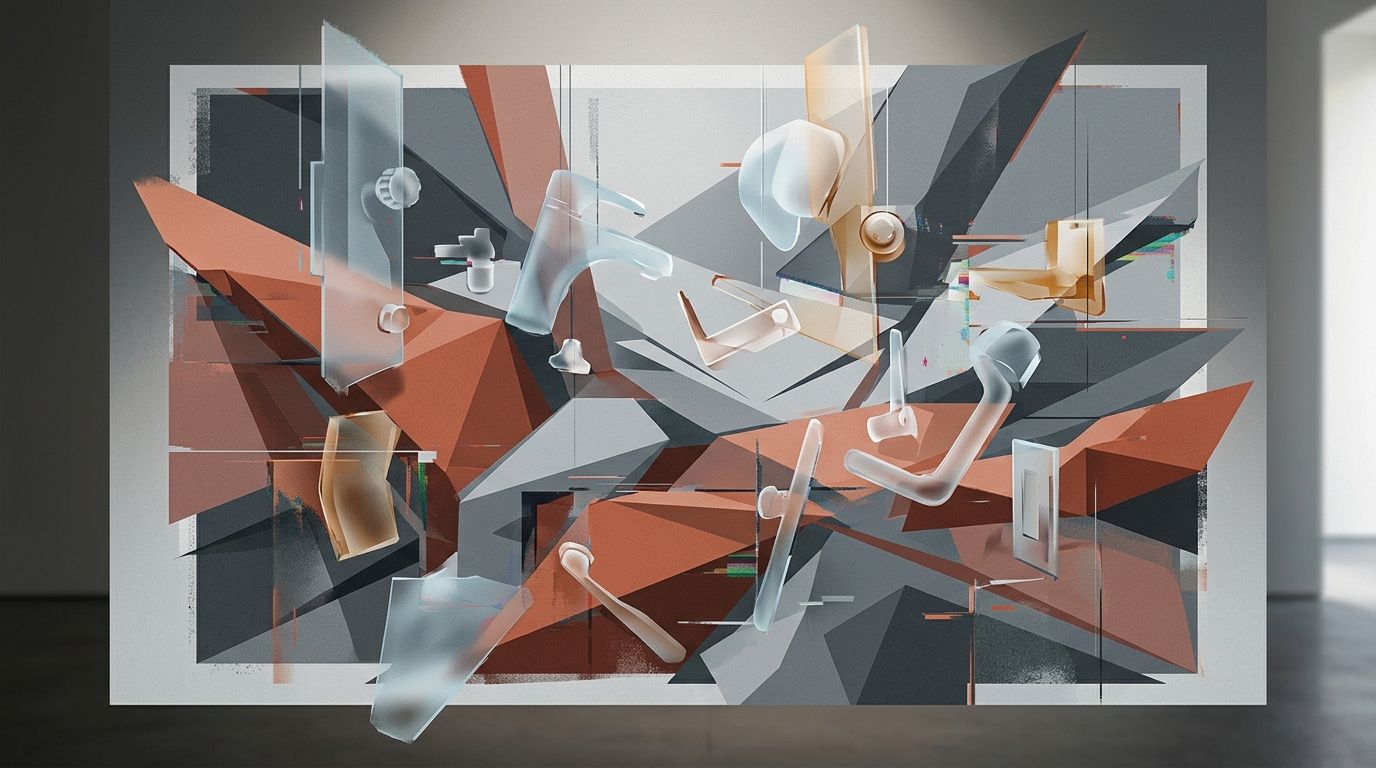
The presentation concludes by extending its critique beyond human subjects. Davide Stucchi contributes Rise & Shine and Light Switch, both dating from 2026. These pieces extract commonplace household apparatuses—mirrors, switches, windows, and step-ladders—from their functional contexts, suspending them in ambiguous configurations. Engaging with minimalist spatial strategies and queer theoretical undercurrents, Stucchi demonstrates how material things can acquire anthropomorphic qualities, while simultaneously suggesting that human beings are frequently reduced to mere commodities.
The exhibition remains open to the public until the middle of February, offering a sustained opportunity to consider how visual conventions continue to shape our daily interactions and institutional frameworks.
Related reading
M+M: The Day of the Mantis at the 16th Gwangju Biennale
Luxembourg Pavilion's immersive insect-centric film trilogy explores ecological anxiety and non-human perspectives
A new cinematic installation by Marc Weis and Martin De Mattia refracts contemporary unease through the eyes of arthropods at South Korea's premier contemporary art festival.
Birke Gorm: the evening and the morning and the night at the Gwangju Biennale
Austria's national pavilion reimagines a museum loft as a living archive of repurposed sculpture and hidden histories.
The Austrian Pavilion transforms an upper-floor gallery into a tactile attic, exploring material memory and marginalised narratives through sculpture and sound.
Vibe Era: Contemporary Abstraction and the Rise of Atmosphere
How four artists reframe non-representational practice through organic process and visual mutation
The Ilmin Museum of Art's latest survey examines how contemporary abstraction navigates the tension between historical legacy and algorithmic generation.