
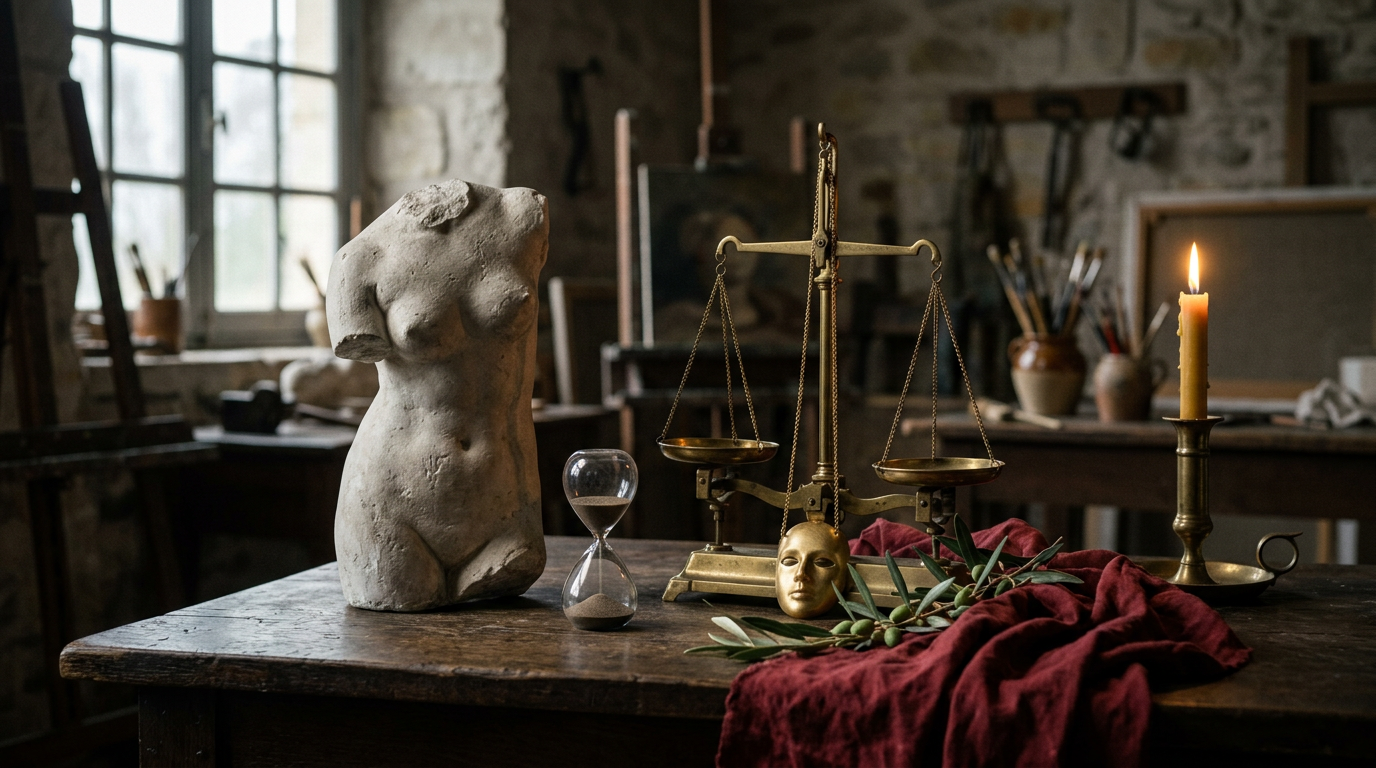
Exhibo Editorial
Allegory in Art, Explained
Personification, Ripa and civic programmes: how Western pictures make Justice and Time visible without a private riddle.
Allegory in art is a mode of representation in which figures, objects and actions stand for ideas a viewer in that time and place could name: Justice, Calumny, Prudence, the Catholic Church, Painting itself. Tate’s glossary puts it as the subject, or the parts of a composition, used to symbolise a deeper moral or spiritual meaning. The Greek root allēgoria is “speaking otherwise.” You see a woman with scales; you are meant to say “Justice,” not “a portrait of the model.” The surface remains a picture of bodies and things. The second register is the claim.
This page stays with that mode in Western painting, fresco and related sculpture. How you identify types belongs to iconography. Narrative pictures of deeds from scripture, myth and civic history belong to history painting. Greek myth as story is mythology in art. Christian cycles sit in Christian iconography. Cesare Ripa’s Iconologia appears here as a workshop tool, not as a dictionary to copy. The cluster lives under Genres & Symbolism in Art. Collections that hold the works below are listed in the museums directory.
What allegory names in pictures
A picture can describe a room. It can recount a deed. It can also stage an idea as if the idea had a body, a costume and a set of props. That third job is allegory. The woman who plants a foot on a globe in Vermeer’s Allegory of the Catholic Faith (The Met, 32.100.18, c. 1670-72) is not a Delft housewife who happened to own a glass sphere. She is the Church, posed for a viewer who already knew the type.
Writers since late antiquity used the same word for a text that means one thing on the page and another in doctrine. Medieval schoolrooms taught four senses of scripture: literal, allegorical, tropological (moral) and anagogical (last things). Search engines still ask for “four types of allegory.” Those four senses are a theological scheme for reading the Bible. They are not four genres of oil painting. Visual allegory in a museum is closer to personification plus a programme: named abstractions, attributes that identify them, and often an inscription or a room that tells you how to read the set.
The mode is older than the Renaissance handbook. Roman coins put virtues in female form. Early Christian sarcophagi mixed biblical narrative with personified ideas. What changes in the fourteenth to eighteenth centuries is density and publicity. City halls, princely gifts and church interiors hired painters to make policy and doctrine visible to people who would never open a treatise. Lorenzetti’s Siena cycle is a civic lecture on three walls. Bronzino’s London panel is a diplomatic puzzle small enough to hang in a cabinet.
Allegory is also a word critics later used against pictures they found over-coded. Eighteenth- and nineteenth-century writers, then modernist ones, treated it as the opposite of “direct” art. Craig Owens, writing in October 12 and 13 in 1980, reversed the insult for a postmodern generation: appropriation, ruin and second-hand images as an “allegorical impulse.” That later debate is useful. It does not rewrite Lorenzetti. Start with the older job: a picture that asks you to name an idea.
How the mode works
A successful allegory does three things at once. It gives you a figure or an object you can see. It attaches that figure to a conventional type. It places the type in a job: a council chamber, a gift to a king, a Catholic room in a Protestant city, a self-portrait that also claims a profession. Fail any of the three and you are left with a pretty woman and a pile of still-life. Succeed, and a magistrate in Siena, a courtier in Paris or a hidden congregation in Delft can read policy without a second book in hand.
The technical kit is small. Personification turns an abstraction into a human body, almost always female in the Latin tradition because iustitia, fides, pictura are grammatically feminine. Attributes are the objects, animals, garments and bodily marks that identify the type: scales, hourglass, mask on a gold chain, crushed serpent. Inscriptions, when present, are not captions for tourists. They are part of the original machine. Programmes bind several types into one argument across a wall, a canvas or a cycle. You do not need Ripa to start. You do need a dated source that could have reached the artist.
Iconography, as method, is how you test the type. Allegory is what the type is doing. A saint with a gridiron is a named holy person in a Christian story. A woman with scales in a town hall is Justice as civic equipment. Mix the two and you write the wrong essay.
Personification and attributes
Personification is the cheapest, clearest device. Give Peace an olive branch and a cushion. Give Time wings and an hourglass. Give Painting dishevelled hair and a mask. The body does the work of a noun. Viewers who share the convention name the noun at speed, even across a nave or a council table.
Attributes prevent the body from collapsing into portraiture. Without the hourglass, Bronzino’s bearded man in the London Allegory (NG651) is an old man. With it, the National Gallery’s wall text calls him Father Time. Without the globe and the crushed snake, Vermeer’s woman is a studio model in a rich dress. With them, the Met’s catalogue names the Church and the serpent of evil. The rule is comparative. One object in isolation is a still-life motif. A cluster that matches a known type is an identification.
Workshops repeated clusters so the type would travel. A later painter who wanted “Painting” could open Ripa, or copy a colleague who already had. That economy is why the same props recur. It is also why you cannot lift an attribute from 1603 and drop it onto a fresco of 1338. Lorenzetti’s Peace reclines with an olive branch decades before Ripa printed. Her type comes from older civic and scholastic lists, and from the inscriptions Lorenzetti’s patrons had written on the walls.
Inscriptions, programmes and the viewer’s job
A single personification can sit in a roundel. A programme occupies a room or a whole composition and asks you to read in order. Lorenzetti’s cycle in the Sala dei Nove, Palazzo Pubblico, Siena, runs from the Allegory of Good Government on the north wall, through the effects on city and country, to Bad Government and its wreckage. Siena’s Museo Civico notes a poetic inscription of 62 verses that works with the images, not as a later label. You start where the verses and the lighting tell you to start.
Botticelli’s Calumny of Apelles (Uffizi, 1890 no. 1496, c. 1495) is a programme on a small panel. The Uffizi tells you to read right to left: king with ass’s ears, Ignorance and Suspicion at his shoulders, Calumny dragging the victim, Fraud and Deceit in her hair, Penitence in black, neglected Truth. The order is the argument. Shuffle the figures and the sentence breaks.
Your job as a viewer is finite. Name the types you can defend. Read any text on the work. Ask what room or gift the set served. Stop before you invent a private novel. Bronzino’s London picture remains debated after a century of articles; the National Gallery says the intended meaning is not certain. That honesty is part of the method. An allegory can be public and still refuse a single slogan.
Handbooks after 1593
Painters needed lists. Antiquity did not supply a body for every virtue a Baroque ceiling required. Cesare Ripa, a Perugian working in Rome, published Iconologia overo Descrittione dell’imagini universali in 1593 as an unillustrated octavo. Hans-Joachim Zimmermann’s survey of the English afterlife stresses the title: descriptions of “universal” images drawn from antiquity and, Ripa admitted, from his own invention when antiquity left a gap. The 1603 Rome quarto added woodcuts (about 151 in that edition; later printings grew). French, Dutch and English adaptations followed. Pierce Tempest’s English version appeared in 1709. You use the edition that could have reached the workshop. A nineteenth-century Ripa does not explain a canvas of 1620.
Ripa is a repertory of personifications, not a theory of pictures and not a method for reading symbols in general. That method is the sibling guide on iconography. Vincenzo Cartari’s Le imagini de i dei (1556) and Pierio Valeriano’s Hieroglyphica (Venice, 1556) fed mythographic and emblematic types. Titian’s London Allegory of Prudence (NG6376) is often linked to Valeriano’s three-headed emblem of Prudence, a serpent with the heads of dog, wolf and lion. The National Gallery notes the match and the problem: Titian’s animals were added late, the execution is uneven, and the picture may still be something else.
Treat the handbooks as period tools. They tell you how a seventeenth-century painter might stage “Painting” or “Faith.” They do not license you to decode every nude as a vice. Ripa invented figures. Later editions altered them. Artemisia Gentileschi used Ripa’s Pittura and dropped the gagged mouth. The omission is the point of her picture. Copying the whole entry would miss it.
Civic walls: Lorenzetti in the room of the Nine
Allegory earns its keep when it has an audience with a job. In Siena that audience was the Nine, the rotating magistrates of the republic, meeting in the Sala dei Nove (also called the Sala della Pace) inside the Palazzo Pubblico. Ambrogio Lorenzetti painted the cycle there. The Museo Civico dates the work to 1338, with payments recorded into 1339. Randolph Starn, reading the same archive in The Art Bulletin, places the commission in 1338-40. Britannica’s caption for the city view uses 1338-40. The disagreement is a year or two, not a century. The frescoes remain in situ, which is rare for a political programme of this scale.
The north wall stages the argument as a court of personifications. Justice holds the scales. Concord joins the cords. A figure of the Common Good, marked as the Commune of Siena, sits among virtues. Peace reclines. The east wall shows what those abstractions buy: a populated city, shops, a school, a countryside with harvest and travel. The west wall, worse preserved and worse lit, gives Tyranny and the vices, with a city under fear. Inscriptions bind the three walls into one poem. Magistrates sat inside the lecture. The window still opens onto the real contado the east wall idealises.
This is allegory as civic equipment, not as a riddle for a private study. You do not need to “decode” Peace. You need to notice that she is asleep with armour at her feet, and that the Nine were meant to keep her that way. Later European town halls copied the habit: virtues in stone and paint around the men who claimed to practise them. Amsterdam’s seventeenth-century Town Hall, with sculpture dependent on Ripa in Artus Quellinus’s programme, is a late, handbook-saturated version of the same public job. Lorenzetti comes first, and without Ripa.
A visitor who treats the east wall as a genre street scene has missed the hinge. The shops and dancers are effects. The cause sits on the throne wall. That hinge, cause pictured as a body, effect pictured as a city, is the civic form of the mode.
Reconstructing a lost picture: Botticelli’s Calumny
Humanist painters also used allegory to recover antiquity. Lucian of Samosata, in the second century AD (the Uffizi English page currently prints “2nd century BC” for Lucian; that is a museum slip: Apelles is fourth century BC, Lucian is second century AD), described a painting by Apelles in which Calumny drags an innocent man before a judge with ass’s ears. The Greek panel was lost. The description circulated in Latin and vernacular. Sandro Botticelli rebuilt the subject in tempera on wood, 62 × 91 cm, now Uffizi inv. 1890 no. 1496. The gallery dates it about 1495, at the end of Laurentian Florence and the rise of the Savonarolan republic, and calls it Botticelli’s last surviving allegorical-mythological work of this kind.
The Uffizi’s order is the sentence. On the right, a king on a throne, donkey-eared like Midas, advised by Ignorance and Suspicion. Calumny, torch in hand, hauls a half-naked man by the hair. Rancour (Livore) in rags attends her. Fraud and Deceit dress her hair. On the left, Penitence in black looks toward nude Truth, whom nobody in the main action regards. The architecture is a learned portico stuffed with reliefs; the gallery notes that their meaning is still disputed and that Bartolomeo di Giovanni may have helped with them. Vasari later saw the panel with Fabio Segni, probably inherited from Antonio Segni.
The picture is an allegory of a speech-act: slander. It is not a myth of a named god’s deed, even though the backdrop quotes antique sculpture. That distinction keeps this page off the mythology guide. Whether Botticelli aimed the charge at a living Florentine, at himself, or at no one in particular remains speculation. The Uffizi records the Lucianic source and the date. It does not certify a personal lawsuit. Read the types. Leave the gossip.
Small scale matters. Lorenzetti occupies a council hall. Botticelli occupies a desk. Both are programmes. One is public law. The other is a humanist reconstruction you hold with the eyes at arm’s length, counting personifications as Lucian listed them.
Court gifts and workshop enigmas
Not every allegory is a public lecture. Some were gifts meant to flatter a learned king. Some may have been cupboard doors. The two National Gallery pictures below show the mode under strain: too many types, or types added late, or a title that scholars still argue. They earn their place because museums still hang them as allegories, and because the arguments are documented, not invented here.
Bronzino’s panel is a diplomatic machine that never quite yields a slogan. Titian’s canvas may be Prudence, a family emblem, a portrait cover, or a studio leftover with animals painted in at the end. Both pictures teach the same caution. If the museum hedges, you hedge.
Bronzino, An Allegory with Venus and Cupid (NG651)
Agnolo Bronzino painted the oil on wood, 146.1 × 116.2 cm, about 1545. The National Gallery bought it in 1860 (Beaucousin collection). Vasari, in the 1568 Life, describes a picture of “singular beauty” sent to King Francis I of France, with nude Venus kissed by Cupid, Pleasure and Play on one side, Fraud, Jealousy and other passions of love on the other. The Gallery treats NG651 as likely that gift from Cosimo I de’ Medici, and notes that no French royal inventory has yet confirmed the stay.
Venus steals an arrow and holds the golden apple of Paris. Cupid returns the kiss and reaches for her crown. Masks lie at their feet. A smiling boy with a bell anklet, Pleasure or Folly, steps on a thorn as he throws roses. A girl offers honeycomb; her body is a hybrid with a sting, Fraud or Deceit, in shot-silk that changes colour. Winged Time, hourglass on his back, pulls or conceals a cloth with a hollow-headed companion often called Oblivion. The howling figure behind Cupid has been named Jealousy, Despair, even syphilis. The Gallery rejects an overt “French disease” reading as a poor gift for a French king.
Michael Levey, Charles Hope, J. F. Conway, Margaret Healy and others have proposed rival programmes. The Gallery’s current public text keeps several in play: Beauty curbing Passion; the pains of unchaste love; even a political hint parallel to Rosso’s Mars and Venus drawing for Francis. Conservation (Plazzotta and Keith, Burlington Magazine, 1999) showed revisions: the hair-tearing figure sat lower; Venus’s arm moved. Speed or indecision sits in the paint. Unravelling was part of the pleasure for a Petrarchan court. You can name Venus, Cupid, Time and the hybrid. You cannot, on present evidence, close the case.
Titian and workshop, An Allegory of Prudence (NG6376)
Three male heads, young, mature and old, sit above a wolf, a lion and a dog. A Latin inscription, split to match the heads, is translated by the Gallery as “Learning from Yesterday, Today acts prudently lest by his action he spoil Tomorrow.” Oil on canvas, 75.5 × 68.4 cm, presented by Betty and David Koetser in 1966. The Gallery’s headline date is about 1550; elsewhere it allows about 1550-65. Nicholas Penny’s 2008 catalogue treats Titian and workshop.
Valeriano’s 1556 Hieroglyphica gave Prudence a three-headed beast. Panofsky read the canvas as that emblem, and as a possible family group: Titian, Orazio, Marco Vecellio. The Gallery records the theory and the mismatch: the heads do not look much like the three men. X-rays show a different figure underneath, seen from the back. The animals arrived late and look summary. Light falls from the right, odd for a right-handed painter, which suggests a specific site: perhaps an attic frieze for Gabriel Vendramin’s camerino, perhaps a portrait cover. The title in the room is a hypothesis that fits the inscription. It is not a contract.
This is allegory as a problem set. The inscription does the naming. The animals try to lock the name to a handbook. The pentimenti refuse to behave. A visitor who walks away saying “Prudence, three ages, wolf-lion-dog” has used the public text. A visitor who adds “Titian’s last will in paint” has outrun the catalogue.
Painting as a woman, Faith as a room
Seventeenth-century painters still used Ripa, but two famous canvases show what a body can do with a handbook entry: wear it as a profession, or stage it as a clandestine rite. Artemisia Gentileschi makes Pittura look like work. Vermeer makes Fides look like a Delft interior with the Mass laid out on a table.
Both pictures are allegories first. The Gentileschi is also a self-portrait, which a male painter could not do with the same body. The Vermeer is also a Catholic statement in a Dutch Republic that forbade public Mass. Neither is a saint’s cycle. Keep the Christian narrative guide for those.
Artemisia Gentileschi, Self-Portrait as the Allegory of Painting (La Pittura), oil on canvas, 98.6 × 75.2 cm, Royal Collection RCIN 405551, about 1638-39. The Royal Collection’s exhibition texts place it in the orbit of Charles I; she may have painted it in Naples, brought it, or made it in London. Charles I’s inventory listed it as an allegory of Painting. Ripa’s Pittura is a beautiful woman with full black hair in disorder, arched brows, a cloth over the mouth, a gold chain with a mask labelled imitation, brush and palette, shot-coloured drapery. Artemisia keeps the hair, the chain, the mask, the tools. She drops the gag. Painting, in her picture, is not mute. The mask still marks imitation. The grinding stone and the dirty hands mark labour. Initials sit below the palette. A male colleague could paint Ripa’s woman. He could not give her his own face.
Johannes Vermeer, Allegory of the Catholic Faith, oil on canvas, 114.3 × 88.9 cm, The Met, 32.100.18, about 1670-72, Friedsam Bequest 1931. The Met’s entry is blunt. Public Mass was forbidden. A woman as the Church sets a foot on a globe. A cornerstone crushes a serpent. An apple of the Fall lies on the floor. A table holds chalice, missal and crucifix. A tapestry is drawn aside, as if on a hidden church in a house. The Crucifixion on the wall copies a Jordaens that Vermeer owned. Curator Adam Eaker, on the museum audio, calls the picture an outlier in the Met’s Vermeer group and notes that visitors often like it least. The distaste is useful. Genre interiors made Vermeer’s name. This canvas uses the same light and the same corner to run a full Ripa-style programme. The globe, snake and apple are not still-life. They are the second register.
How contemporary artists still use the mode
Modernist taste treated allegory as a vice: too many labels, too little “pure” form. The mode did not stop. It changed costume. Craig Owens, in “The Allegorical Impulse: Toward a Theory of Postmodernism” (October 12, spring 1980; part 2 in October 13, summer 1980), argued that appropriation, fragment and the rescue of used images were allegory under another name. He drew on Walter Benjamin’s account of the ruin. The claim is historical, not a licence to call every collage an allegory of Justice.
Tate’s glossary points to Sarah Lucas, Two Fried Eggs and a Kebab (1992): a table, two eggs, a kebab, a photograph, used as a sign for sexual politics. Courtesy the artist and Sadie Coles HQ; it is a Tate example, not a Tate accession in the glossary’s sense. The personification is crude on purpose. Food stands in for a female body. The second register is gender, not a Ripa virtue. Owens’s vocabulary fits better than Cosimo de’ Medici’s.
Kara Walker’s cut-paper silhouettes restage American plantation imagery as a continuous frieze of types: master, enslaved person, child, animal, sexual violence. The figures are not portraits. They are a programme you walk, closer to Lorenzetti’s wall than to a single emblem, and closer to Owens than to Ripa. Tim Rollins and K.O.S., Animal Farm - New World Order (1989-92), sits in Tate’s allegory grouping as a literary allegory made visual, Orwell’s farm as a classroom object. The Contemporary Art Museum St. Louis exhibition Cryptic: The Use of Allegory in Contemporary Art with a Master Class from Goya (2011) treated Goya as a teacher for living artists who wanted meaning “other than the literal.”
If you are looking at a living artist, ask whether the work still asks you to name a type, or whether it only piles symbols. Lucas names a body. Walker names a history as a set of stock figures. A mood board of skulls and clocks is a vanitas habit, covered elsewhere in this series, unless the whole composition argues a second story.
How to identify allegory when you are in the room
Start with the label, then distrust it just enough. Museums title works “Allegory of…” because a catalogue tradition did. Check the date, the inventory number and whether the text hedges. “May be,” “probably sent,” “meaning uncertain” are data.
Then list bodies and props as if you were writing a condition report. Who holds what. Who looks at whom. Where the light comes from. Copy any inscription in full, including abbreviations. Titian’s Prudence picture is unintelligible if you skip the Latin. Lorenzetti’s room is thinner if you skip the verses.
Match the cluster to a type with a dated source. A woman with scales in a town hall after 1300 is likely Justice. A woman with a mask on a gold chain after 1593 may be Painting. A nude with an apple may be Venus, Eve or Discord depending on the rest of the cluster. The sibling method page on iconography is the longer protocol. Here the test is shorter: does the whole set argue an idea, or does it recount a deed? Deeds (Judith and Holofernes, the Crossing of the Red Sea, the death of Germanicus) are history painting or sacred narrative. Ideas (Good Government, Calumny, Faith, Painting) are allegory even when a mythological body is borrowed as a vehicle.
Ask who was meant to stand in front of it. Magistrates. A king. A Catholic household. Charles I’s closet. A postmodern gallery. The audience is part of the technique. A council fresco that “works” for Instagram and fails for the Nine is a photograph of a ruin, not a reading.
Stop when the museum stops. If NG651 still hosts rival articles, your wall-text paragraph should say so. Forced closure is how student essays turn Fraud into a horoscope.
Common confusions and misuses
Metaphor. A metaphor is a local substitution: the state is a ship. An allegory extends the substitution across a composition or a cycle so that several figures keep the second story going. Venus’s apple in Bronzino is an attribute. The whole tangle of Time, Fraud, Pleasure and the kiss is the allegory.
Symbol. A skull can be a memento mori emblem in a still life without the picture becoming an allegory of Death as a person. Vanitas objects have their own page in this series. Allegory needs the second story to govern the design, not a single token.
Iconography. Iconography is the method for identifying types. Allegory is one use of those types. You can iconograph a portrait’s dog without the portrait being an allegory of Fidelity. Link out; do not merge the pages.
History painting. A battle, a coronation or a martyrdom can include a hovering Virtue. The genre is still history painting. Rubens’s Marie de’ Medici cycle in the Louvre is a history of a life told with Olympian extras. This page does not retell it.
Myth. A picture of Apollo flaying Marsyas is a mythological narrative. A picture of Calumny built from Lucian’s description of Apelles is an allegory that uses antique dress. Botticelli’s Primavera is a mythographic puzzle; the Uffizi still calls the full programme a mystery. It is not the clean civic allegory Lorenzetti offers.
The four senses. Literal, allegorical, moral, anagogical: a medieval way to read scripture. Painters did not hang four canvases labelled as such. If an essay asks you for “four types of allegory in art,” give personification, narrative allegory (Calumny), civic programme, and emblem/handbook type, and admit the list is a teaching aid, not a period taxonomy.
Ripa as oracle. Using a 1709 English Ripa on a 1338 fresco is a dating error. Using Ripa to “solve” Bronzino when the Gallery lists six other solutions is overconfidence.
MENA symbol lists. This series does not inventory those. They belong to other editorial streams.
| Work | Artist | Date (museum) | Collection / inv. | Mode | Period source in play |
|---|---|---|---|---|---|
| Allegory of Good and Bad Government (cycle) | Ambrogio Lorenzetti | 1338; payments into 1339 (Museo Civico); 1338-40 (Starn) | Palazzo Pubblico, Siena, Sala dei Nove | Civic programme with personified virtues/vices and effects | Inscriptions on the walls; scholastic and communal virtue lists |
| Calumny of Apelles | Sandro Botticelli | c. 1495 | Uffizi, 1890 no. 1496 | Reconstructed antique allegory; personifications in narrative order | Lucian, On Calumny; Latin/vernacular translations |
| An Allegory with Venus and Cupid | Bronzino | c. 1545 | National Gallery, NG651 | Court gift; erotic personifications; meaning disputed | Vasari 1568; no surviving French royal inventory |
| An Allegory of Prudence | Titian and workshop | c. 1550 (NG); also c. 1550-65 | National Gallery, NG6376 | Inscribed three ages; animals added late | Valeriano, Hieroglyphica (1556); Panofsky’s family reading contested |
| Self-Portrait as the Allegory of Painting | Artemisia Gentileschi | c. 1638-39 | Royal Collection, RCIN 405551 | Personification worn as self-portrait | Ripa, Iconologia, entry for Pittura (gag omitted) |
| Allegory of the Catholic Faith | Johannes Vermeer | c. 1670-72 | The Met, 32.100.18 | Church personified in a domestic “hidden” Mass | Ripa-type Faith; Jordaens Crucifixion in Vermeer’s collection |
| Two Fried Eggs and a Kebab | Sarah Lucas | 1992 | Artist / Sadie Coles HQ (Tate glossary example) | Contemporary personification by substitute objects | Owens’s postmodern allegory, not Ripa |
FAQ
What does allegory mean in art?
It means a picture (or a cycle) whose figures and objects stand for ideas a period viewer could name, so that the composition argues a second story: civic virtue, slander, faith, the art of painting. Tate’s definition stresses moral or spiritual meaning carried by the subject or by the parts of the design. The surface remains visible. The second register is the point of the commission.
How is allegory different from a metaphor or a symbol?
A metaphor is a local stand-in. A symbol can be one object with a conventional charge, a lily or a skull, inside a picture that is otherwise a portrait or a still life. Allegory organises the whole, or a whole wall, so that several personifications or substitutes keep the second story in motion. If you can remove the “symbolic” object and the picture is still the same kind of picture, you probably do not have an allegory.
What are the four types of allegory?
In theology, the four senses of scripture: literal, allegorical, tropological, anagogical. That list does not map onto museum labels. For looking at Western pictures, a more honest teaching split is personification (Justice with scales), narrative allegory (Botticelli’s Calumny), civic or court programme (Lorenzetti, Bronzino’s gift), and handbook emblem (Ripa’s Pittura, Valeriano’s Prudence). Even that split is a modern convenience.
What is a clear example of allegory in painting?
Lorenzetti’s Good and Bad Government in Siena: virtues sit as bodies, then the city and fields show their effects, then tyranny shows the inverse, with verses on the plaster. Vermeer’s Met canvas is a compact later example: Church, globe, crushed serpent, apple, Mass vessels, pulled tapestry. Both ask you to name ideas, not to follow a saint’s biography.
Did painters copy Cesare Ripa line by line?
Some followed an entry closely; Artemisia took Pittura and refused the bound mouth. Vermeer’s Faith picture uses the international language of Catholic personification that Ripa helped standardise. Lorenzetti died in the 1348 plague, two and a half centuries before the 1593 Iconologia. Match the book to the decade.
Why do some allegories feel impossible to finish reading?
Because they were meant to be argued over, or because the documentation is thin. Bronzino’s NG651 has rival identifications for the screaming figure and for Time’s gesture. Titian’s NG6376 changed in the making. The National Gallery publishes those doubts. A finished-sounding blog post that “solves” either picture in one paragraph is selling a closure the object does not give.
Is the Statue of Liberty an allegory?
It is a colossal personification of Liberty, with attributes (tablet, torch, broken shackle in the original scheme). Public sculpture of this kind is the civic mode in metal. It is closer to Lorenzetti’s Peace than to Botticelli’s Lucianic drama. This article stays with pictures you can walk in European and American museums; the statue is the same grammar at another scale.
Further looking
Stand in the Sala dei Nove if you can; photographs flatten the job the Nine had, which was to sit inside the argument. In London, put NG651 and NG6376 on the same afternoon and notice how one allegory is overcrowded and the other is underdetermined. In New York, look at Vermeer’s Faith after a genre interior in the same gallery and watch the props change job. The museums directory is the practical list. The method for checking types is iconography. The genre that swallows allegory as decoration is history painting.
Related reading

Ana Vaz: The Camera is the Body at Mudam Luxembourg
Mudam stages the inaugural major institutional survey of the Brazilian filmmaker's interdisciplinary practice
An immersive exhibition reimagines cinematic perception through embodied filmmaking, ecological inquiry, and postcolonial critique.
Lovis Corinth: Then Came Berlin!
How a mid-life relocation ignited a German modernist revolution
An expansive survey at the Berlinische Galerie traces how Lovis Corinth's 1901 move transformed him into a cornerstone of early twentieth-century avant-garde practice.
Bridging Japanese Craftsmanship and Contemporary Design
How international makers engage with Tokai's industrial heritage at the V&A
An exploration of how global designers collaborate with Japanese artisans to fuse ancestral techniques with modern conceptual frameworks.