
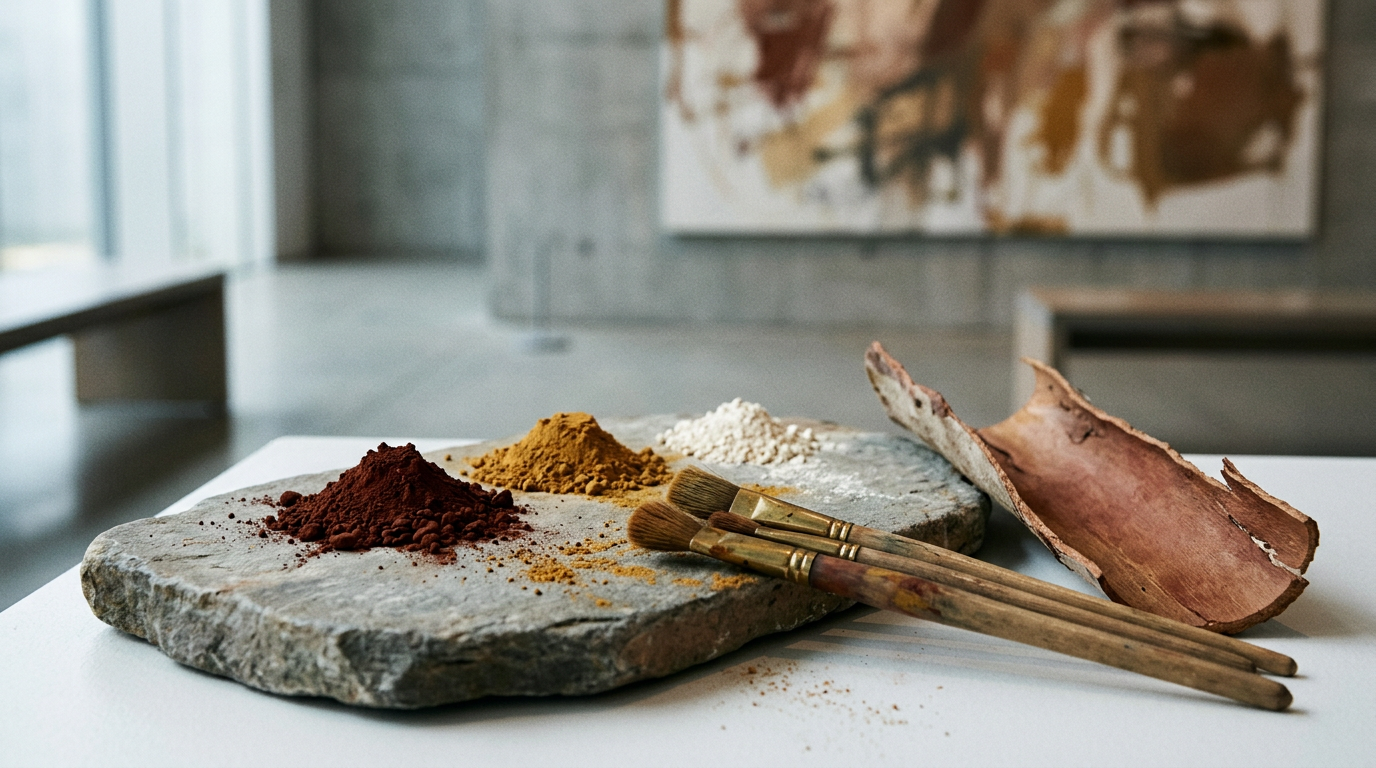
Exhibo Editorial
Aboriginal Australian Art
From Kakadu rock galleries and Arnhem Land bark to Papunya Tula acrylics: a museum-led history with cultural protocols first
Note for Aboriginal and Torres Strait Islander readers: this page names artists who have died and discusses cultural material held in public museums. Families and communities set their own protocols for names, images and ceremony. Institutions revise displays when next of kin ask them to.
Aboriginal Australian art names the visual practices of Aboriginal peoples across the Australian continent and nearby islands: painting on rock, bark, body and ground; carving and fibre work; and, from the late twentieth century, acrylic on board and canvas made for galleries and museums. The phrase is a museum and search label. On the ground you meet language groups, Countries and kinship systems, not one style. Torres Strait Islander art is a related but distinct field; this article stays with Aboriginal traditions while noting where institutions treat both under a First Nations or Indigenous Australian heading.
Search results for “aboriginal art” lean toward commercial galleries, symbol charts and shopping pages. Those pages sell dots and dreamings as a brand. They skip the protocols that govern who may paint what, and they flatten Papunya Tula into a tourist souvenir history. This article follows published institutional accounts: Kakadu Parks Australia on rock art, the National Museum of Australia and Kluge-Ruhe Aboriginal Art Collection on Papunya, the National Gallery of Victoria on Emily Kam Kngwarray, the National Gallery of Australia on The Aboriginal Memorial, and ethics guidance from AIATSIS and Creative Australia (formerly the Australia Council). It belongs to the World Art Traditions series. For another regional survey in the same cluster, see African art, explained. Collection pages for the museums named below sit in the museums directory. This is a history of forms and institutions, not a travel itinerary or a buyer’s guide.
Cultural protocols before any style survey
Writing about Aboriginal art without protocols invites theft of knowledge. Australian institutions and peak bodies publish rules for research, exhibition and publication. You follow those documents rather than inventing meanings for marks you do not hold.
AIATSIS’s Code of Ethics for Aboriginal and Torres Strait Islander Research (2020) sets four principles: Indigenous self-determination, Indigenous leadership, impact and value, and sustainability and accountability. The Code treats research that concerns Aboriginal and Torres Strait Islander peoples as a field that requires engagement, agreement and accountability, not extraction. Art-history writing that paraphrases ceremony, maps restricted sites or invents “symbol dictionaries” sits inside that field even when no fieldwork form is signed.
Creative Australia’s suite of Protocols for using First Nations Cultural and Intellectual Property in the Arts (and the earlier Australia Council visual-arts protocol editions) spell out respect, Indigenous control, consultation and consent, integrity, secrecy, attribution and proper returns. Arts Law and Museums & Galleries of NSW publish parallel guidance for exhibitions that carry Indigenous Cultural and Intellectual Property (ICIP): stories, designs, techniques and knowledge that copyright law alone does not protect. Create NSW’s Aboriginal Arts & Culture Protocols frame self-determination through cultural authority, rights, prior informed consent, integrity of culture, and attribution with benefit-sharing.
Three rules recur across these documents and matter for this page. First, secret and sacred material stays with authorised custodians. Public museum labels give the level of story the artist and community have cleared for outsiders. Second, many communities restrict names, photographs and, at times, display of works after a death; institutions use warnings and consult next of kin. Third, non-Aboriginal makers do not acquire a right to “do Aboriginal art” by copying dots or animal silhouettes. Style appropriation and fake provenance damage living artists and confuse the market; protocol guides treat authenticity and attribution as ethical duties.
Language choice is part of protocol. AIATSIS and many museums prefer specific nation, language or clan names when known (Anmatyerr, Pintupi, Yolngu, Arrernte and so on). “Aboriginal art” remains the search phrase and a broad field label. It should not erase Torres Strait Islander practice or collapse hundreds of Countries into one aesthetic. Gender restrictions on viewing or painting certain subjects appear in Australia Council visual-arts protocol guidance; writers and educators do not override those rules for the sake of a complete diagram.
This article names artists and works only where major museums already publish them with copyright notices, community collaboration notes or clear collection framing. It does not invent sacred imagery, decode restricted designs or supply a tourism map of rock shelters. Kakadu’s Parks Australia pages describe public galleries at Ubirr and Burrungkuy (Nourlangie) as park interpretation under Traditional Owner frameworks; that is institutional text, not a visit brief.
Continuity on rock and Country
Aboriginal painting traditions are continuous over timescales that dwarf European museum chronologies. Parks Australia states that Kakadu holds one of the world’s densest concentrations of rock art (kunbim / gunbim in local languages), with paintings up to about 20,000 years old among the longest pictorial records on Earth. Archaeological work at Madjedbebe rock shelter in Mirarr Country (Kakadu region) has dated occupation layers with ground ochre and related pigment evidence by luminescence methods to around 65,000 years (earlier publications used roughly 50,000–60,000). That shows pigment use in deep time even when a specific rock image cannot be dated to that age. The painting ages come from park interpretation; the deep-time ochre and occupation figures come from peer-reviewed archaeology, not from gallery marketing.
Rock painting is living practice as much as archive. Parks Australia notes that for Bininj/Mungguy the act of painting often matters more than the finished image, so newer layers cover older ones. Some sites remain restricted to people with the right knowledge. Public galleries show animals, x-ray style figures and contact-period scenes that Traditional Owners have opened. Haematite reds survive longest; that is why many older visible images read as red. Brushes of hair, reed, feather and chewed stick, plus blown stencils of hands, belong to published technique descriptions. You treat those pages as park science and cultural interpretation, not as a free licence to photograph every shelter you find.
Rock art sits inside Country: creation ancestors, djang (Dreaming places) and law. Stories arrive in layers. Junior listeners and outsiders receive a public version; deeper levels attach to ceremonial responsibility. Museum wall text that stops at “ancestor story” is doing protocol work, not failing as scholarship. For chronology rather than revelation, stay with dated pigments, style sequences and published site histories.
Arnhem Land rock galleries as public record
Western Arnhem Land’s escarpment country holds thousands of painted shelters. The National Museum of Australia’s Old Masters project links that rock corpus to bark painting styles in the same region: figurative traditions on stone fed figurative traditions on bark. Parks Australia names Ubirr and Burrungkuy (Nourlangie) among Kakadu’s main public rock-art galleries. Contact-period images of ships, rifles and clothed figures sit beside ancestral subjects. Those juxtapositions document encounter without turning the escarpment into a theme park. Conservation remains a joint task for Traditional Owners and park managers: water, insects, plants and human touching destroy pigment.
Ochre, body and ground as earlier supports
Long before acrylic on linen, painters used body paint for ceremony, ground drawings for teaching and sand designs that wind erased. Mission and settlement histories later made portable supports the default for export and sale. The older media did not vanish. Emily Kam Kngwarray’s late canvases, as the NGV records, still carry the logic of women’s arlkeny body markings from awely ceremony. Desert acrylic dots and lines inherit ground and body grammars even when the support is a commercial stretcher. Continuity here means method and law, not a single look repeated for tourists.
Bark painting in Arnhem Land
Bark painting from Arnhem Land is one of the great portable traditions of world art. Artists strip stringybark, flatten and cure it, then paint with ochres bound in orchid juice or similar fixatives. Regional styles differ across western, central and eastern Arnhem Land. The National Museum of Australia holds one of the world’s largest historic bark collections (on the order of two thousand works) and has toured selections as Old Masters: Australia’s Great Bark Artists, naming painters including Yirawala, Narritjin Maymuru, Mawalan Marika and David Malangi. Museums Victoria’s early twentieth-century commissions through Walter Baldwin Spencer and Paddy Cahill at Gunbalanya (Oenpelli) show Gaagadju artists painting animals and spirit beings for anthropological collection between about 1912 and 1922. Those commissions already framed bark as art and as ethnography at once.
Bark painters in the mid-twentieth century pushed for recognition beyond the ethnographic case. Yirawala’s career, as NMA wall essays summarise it, helped shift Australian institutions toward treating bark as fine art. Eastern Arnhem Land clans developed dense cross-hatching (rarrk) systems that encode clan identity. Central and western regions keep strong figurative and x-ray idioms related to rock traditions. Log coffins, sculpture and fibre objects travel with painting in ceremonial and memorial contexts. The 1963 Yirrkala bark petitions, held in national political memory as well as in museum narrative, used bark as a medium of legal and cultural claim.
A bark in a climate-controlled gallery is a fragile organic support. Humidity swings crack paint and warp the sheet. Institutions limit light and handle works with protocol as well as with gloves. Attribution on labels should name the artist, language group and Country where the community has approved that information. Communal designs may sit behind an individual’s hand; ICIP guidance reminds museums that copyright in the object does not exhaust cultural rights in the design.
Collectors, missions and the museum case
Spencer’s role as Protector and museum director mixed fascination with paternalism. Cahill’s commissions at Oenpelli produced some of the earliest dated bark series now in public collections. Later mid-century collectors such as Karel Kupka and Helen Groger-Wurm, whose holdings feed the NMA, gathered barks during a period when anthropologists still debated when “bark painting” began as a portable trade form. Contemporary scholarship stresses Indigenous agency inside those collecting relationships: artists chose subjects, negotiated payment and used commissions to circulate clan knowledge on terms they could control. Reading barks only as salvage ethnography misses that authorship.
From bark to national memorial
In 1987–88, artists from Ramingining in Central Arnhem Land, working with Bandjalung curator Djon Mundine, made The Aboriginal Memorial: two hundred hollow log coffins installed at the National Gallery of Australia. The NGA presents the work as a commemorative forest for Indigenous people who died defending Country since 1788. The path through the poles follows the Glyde River estuary. The Gallery’s 2022 reinstallation, planned with the Ramingining community and Mundine, returned the work toward its intended rectangular plan at the heart of the building. The Memorial shows bark-region sculptural tradition operating at civic scale inside a national museum, with community consultation built into display decisions.
Settlement conditions that produced desert acrylic painting
The Western Desert acrylic movement did not appear from nowhere in a vacuum of “discovery.” Government settlement policy, drought, the cattle industry and assimilation pressure concentrated people from many language groups at Papunya, about 240 km west of Alice Springs. The settlement was built in 1959. By 1971 more than a thousand people lived there in severe poverty and illness. The Kluge-Ruhe Aboriginal Art Collection’s Papunya Tula history records a Pintupi assessment, via anthropologist Fred Myers: people came in hungry and did not know they could not go back. Painting became a way to assert who you were and which Country you came from among strangers forced into one place.
Schoolteacher Geoffrey Bardon arrived in 1971. He encouraged children to draw from their own world, then met senior men who held the designs. Men from several language groups negotiated which aspects of stories could appear in public and which had to stay restricted. That negotiation is the ethical core of early Papunya painting. The Honey Ant mural on the school wall (principal artist Kaapa Tjampitjinpa, with Billy Stockman Tjapaltjarri and Long Jack Phillipus Tjakamarra among collaborators) announced the project; later versions revised symbols after elders judged some forms too revealing. Maintenance staff painted the mural over in 1974. Memory of it survives in photographs and in Bardon’s later books, not as a tourist mural you can still visit.
Artists painted on boards and scavenged supports with acrylics Bardon helped supply. Sales in Alice Springs proved that buyers would pay for Aboriginal designs rather than for Western copies of landscape. The National Museum of Australia’s Defining Moments account records that Bardon’s early Alice Springs sales raised about $1,300 and that more than 600 paintings sold over the next six months. Cash for design controlled by the painters mattered in a settlement built to erase autonomy. White administrators often opposed an Aboriginal-run cooperative because it cut against assimilation policy. The painters kept going.
Acrylic polymer suited desert conditions better than watercolour for hard-edged ceremonial marks and for works that had to travel to town. The medium was new in the settlement even though the designs were old. That mix of industrial paint and ancestral authority is what later critics misread as either “inauthentic craft” or “accidental modernism.” The painters were solving a concrete problem: how to speak Country in a place designed to silence it, on supports a distant buyer could hang.
Papunya Tula and the Western Desert painting movement
In June 1972, at a gathering near Alice Springs, Pintupi man Charlie Tarawa (Tjaruru) named the company Papunya Tula after a hill whose name Bardon recorded as a meeting place for brothers and cousins. Papunya Tula Artists Pty Ltd became Australia’s first Aboriginal-owned art company. The National Museum of Australia treats the cooperative as a defining moment in national cultural history and holds a major collection of 1970s Papunya canvases and related material. Kaapa Tjampitjinpa served as an early chairman and won the 1971 Alice Springs Caltex Art Award, early public recognition for a Papunya painting.
Early boards use dots, circles, tracks and lines that map ancestral itineraries and sites. Dots in this history are not a cute brand. Painters used them, among other strategies, to veil restricted detail so works could circulate beyond initiated viewers. Later desert painting turns that vocabulary toward large, optically intense fields that international critics compared to New York abstraction. The comparison sold tickets. It also risked erasing Tjukurrpa (Dreaming) content that the painters never surrendered. Museum labels that name Country, Dreaming and language group keep the work attached to law.
From boards to monumental canvases
Through the later 1970s, painters scaled up. Clifford Possum Tjapaltjarri’s Warlugulong (1977), synthetic polymer on canvas, about 202 × 337.5 cm, now in the National Gallery of Australia, layers multiple Dreamings associated with places he held knowledge of, including the Lungkata (blue-tongue lizard) narrative. The NGA purchased the work in 2007 for A$2.4 million after it left Commonwealth Bank ownership via auction; Brenda Croft’s acquisition note in Artonview treats it as a national holding. An earlier related Warlugulong (1976) sits in the Art Gallery of New South Wales. These canvases show narrative mapping at architectural scale without becoming tourist posters.
Women painters and the widening desert field
The first Papunya generation was male. From the 1990s, women associated with Papunya Tula and with other desert communities took a leading public role. Utopia, northeast of Alice Springs, produced a parallel explosion when Anmatyerr and Alyawarr women moved from batik (adult education classes from 1977) into acrylic on canvas in the late 1980s. Emily Kam Kngwarray (c.1910–1996), custodian of Alhalkere, painted with a density and scale that national and international museums treat as central to late twentieth-century painting. Community art centres across the desert and Kimberley adapted the Papunya cooperative model: artists retain cultural authority, centres handle materials, provenance and sales. That infrastructure is part of the movement’s form, not a side office.
Artists and museum works to read closely
The works below appear because public museums publish them with copyright, community or commissioning frames. Reproduction and deeper ceremonial reading remain rights held by artists, estates and custodians. Dimensions and credit lines follow the holding museum’s public record at the time of writing; always recheck the live collection page before quotation in print, because loans and orthography of names change.
*Emily Kam Kngwarray, Anwerlarr anganenty (Big yam Dreaming), 1995.* National Gallery of Victoria, Melbourne (1995.709). Synthetic polymer paint on canvas, 291.1 × 801.8 cm. Presented through The Art Foundation of Victoria by Donald and Janet Holt and family; © Emily Kam Kngwarray / Licensed by Copyright Agency, Australia. The NGV states that Kngwarray painted the work over two days at Delmore Downs and that the white network on black figures pencil yam roots, ground cracks at ripening and arlkeny body designs from women’s awely. The museum’s text ties late monochrome drawing back to her batik years. You meet Country as structure, not as a picture postcard. NGA survey materials place her public career after decades of ceremonial work and estimate thousands of works across a short span of painting for exhibition; that volume does not make the pictures casual.
Clifford Possum Tjapaltjarri, Warlugulong, 1977. National Gallery of Australia, Canberra. Acrylic on canvas. Museum acquisition records and Croft’s Artonview note document the purchase and the painting’s status inside Papunya-era monumental narrative. Read it as a map of responsibilities across sites, made for a public that would never hold the full ceremonial load.
Ramingining artists with Djon Mundine, The Aboriginal Memorial, 1987–88. National Gallery of Australia. Two hundred hollow log coffins. Commissioned with Gallery support and installed as a permanent commemorative work; 2022 redisplay followed community consultation. The piece joins Arnhem Land mortuary sculpture to national public space.
Yirawala and peers in the NMA Old Masters corpus. Mid-twentieth-century barks from western, central and eastern Arnhem Land, dated in exhibition materials largely between the late 1940s and mid-1980s. Use the NMA’s artist pages rather than secondary “top ten” lists when you need names and Country affiliations.
Early Papunya boards in the National Museum of Australia. The Museum’s Papunya collection highlight pages describe collaborative painting on boards in the early 1970s, acrylic dots and tracks, and the Aboriginal Arts Board collecting that later fed the national holding. Treat those boards as the laboratory stage before the large canvases.
Avoid treating any single canvas as “the most famous Aboriginal art.” Fame tracks auction headlines and tourism brands. Museum programmes track custodianship, region and history.
How the movement spread and mutated
Papunya Tula’s example travelled. Communities established art centres that localised style: Yuendumu, Balgo, Warmun and many others developed distinct palettes and mark systems while sharing the acrylic-on-canvas economy. Hermannsburg (Ntaria) watercolour landscapes associated with Albert Namatjira and the Arrernte school already showed, decades earlier, that Aboriginal painters could master and redirect introduced media; desert acrylics were a different grammar with different law. Kimberley painters brought Wandjina and other regional subjects into contemporary markets under community rules that restrict who may paint which beings.
Urban and blak artists in cities extended the field with installation, photography, print and political montage. Their work belongs to contemporary Australian art as much as to the desert narrative. This series keeps the historical tradition spine; city scenes and living market tours sit elsewhere in the programme. International exhibitions mattered for reception: Dreamings: The Art of Aboriginal Australia in New York (1988), Papunya artists at São Paulo and Perspecta, Clifford Possum’s London solo, and Michael Jagamara Nelson’s Parliament House mosaic designs in the same year placed desert painting inside state and global spectacle. Kluge-Ruhe’s collecting in the United States built a major university holding that now publishes Papunya histories for students outside Australia.
Critics in the 1980s argued over whether desert acrylics were “authentic” if made with store paint, or “derivative” if they resembled abstract expressionism. Both frames miss the painters’ own terms: Tjukurrpa, Country and company ownership. Some Australian critics welcomed the work into the contemporary canon after Perspecta 1981 and related survey shows; others kept desert painting in a craft or ethnographic corner for years longer. International abstract painters’ fans sometimes claimed kinship that flattered their own taste more than it explained Pintupi or Anmatyerr intention.
Later criticism asks harder questions about dealer ethics, fake art, underpayment and the gap between ICIP rights and Australian copyright. The Myer Report and subsequent Indigenous visual-arts inquiries documented structural failures in the market. Protocol documents from Creative Australia and Arts Law exist because those failures harmed artists and communities. Museum practice shifted in parallel: Indigenous curators, community loans agreements and revised wall texts now sit beside acquisition budgets. You read a 1970s board differently when the label names the cooperative, the language group and the limits of public story.
Hermannsburg watercolours and desert acrylics sometimes share wall space in survey hangs. That juxtaposition teaches media history without ranking one as more “real.” Namatjira’s Arrernte landscapes proved mid-century audiences would buy Aboriginal-authored pictures of Country in a European medium. Papunya painters redirected the lesson toward designs that refuse picturesque distance. Both strands feed the present field. Urban blak practice then adds another pressure: political montage and conceptual work that address the same colonial archive museums once used to classify bark as specimen.
Chronology of forms and institutions
| Period / year | Form or event | Region / site | Institutional anchor |
|---|---|---|---|
| c. 65,000 BP (earlier estimates c. 50–60,000) | Occupation with ground ochre / pigment evidence | Madjedbebe, Kakadu region (Mirarr Country) | Peer-reviewed OSL/TL archaeology |
| Up to c. 20,000 BP and ongoing | Rock painting (kunbim) | Kakadu public galleries (e.g. Ubirr, Burrungkuy) | Parks Australia |
| 1912–22 | Commissioned barks for museum collection | Gunbalanya (Oenpelli) | Museums Victoria (Spencer–Cahill) |
| 1959 | Papunya settlement established | Western Desert, NT | Kluge-Ruhe / NMA histories |
| 1971 | Honey Ant school mural; acrylic boards begin | Papunya | NMA Defining Moments; Kluge-Ruhe |
| 1972 | Papunya Tula Artists Pty Ltd named and founded | Papunya / Alice Springs | NMA; company histories |
| 1977 | Warlugulong (Clifford Possum Tjapaltjarri) | Western Desert | NGA collection |
| 1977–89 | Utopia batik to acrylic transition | Utopia / Alhalkere | NGV; NGA artist profiles |
| 1987–88 | The Aboriginal Memorial | Ramingining artists; NGA Canberra | NGA |
| 1988 | Dreamings exhibition, New York; Parliament House mosaic designs | International / Canberra | Kluge-Ruhe narrative |
| 1995 | Anwerlarr anganenty (Big yam Dreaming) | Delmore Downs / Alhalker | NGV (1995.709) |
| 2007 | NGA acquires Warlugulong (1977) | Canberra | NGA / Artonview |
| 2013– | Old Masters bark exhibitions and tours | NMA collection; international venues | NMA |
| 2020– | AIATSIS Code; refreshed First Nations arts protocols | National | AIATSIS; Creative Australia |
What desert and bark painting left behind
Aboriginal Australian art remade Australia’s idea of its own modernism. National galleries that once filed barks under ethnography now hang Kngwarray beside international contemporaries and give The Aboriginal Memorial central floor space. University collections such as Kluge-Ruhe teach Papunya as a world art movement with primary documents, not as a craft sidebar. Painting as evidence in land claims, noted in Kluge-Ruhe’s public history of the movement, shows how desert canvases operate outside the white cube as well as inside it. Art centres remain the practical legacy: local employment, provenance systems and a channel for young painters to learn from elders on Country.
The unfinished work sits in law and ethics. ICIP still outruns Australian copyright for communal designs. Fake art and unethical dealing persist. Museums revise labels, warnings and loans when communities require it. School worksheets that print unrestricted “symbol keys” for classroom copying repeat the SERP problem at smaller scale. Readers and students can help by preferring museum and art-centre sources over symbol charts, by refusing appropriated “Aboriginal-style” décor, and by treating every public meaning as a cleared surface above deeper knowledge you are not owed.
For comparative reading in this series, the African art survey likewise insists on regional plurality against a single racialised brand. East Asian historical surveys in the same hub, including Chinese art history, use parallel museum-led method without collapsing distinct traditions. Museum routes for NGA, NGV, NMA and international holders of desert and bark works are listed under museums.
FAQ
What defines Aboriginal art?
Aboriginal art is visual practice grounded in Aboriginal peoples’ Countries, kinship and law, across media from rock and bark to acrylic, fibre and new media. Museums use the phrase as a field label covering many languages and regions. A Papunya canvas and an Arnhem Land bark share historical depth and custodial ethics more than they share a single look. Public definitions stop where community clearance stops.
Is it acceptable to say “Aboriginal art”?
In Australian institutional English, “Aboriginal” and “Torres Strait Islander” remain standard when used with precision; many organisations also use “First Nations” or “Indigenous Australian.” Preferences vary by person and community. “Aboriginal art” is a common search and museum phrase for the continental Aboriginal field. Avoid outdated or slur forms. Follow an artist’s or community’s stated demonym or nation name when they give one.
Why do many desert paintings use dots?
Early Papunya painters developed dotted surfaces while negotiating what could be shown to uncleared viewers; dots and related marks could obscure restricted structures while still asserting Country. Later painters extended the vocabulary into large colour fields. Commercial “dot painting” kits for non-Aboriginal hobbyists copy a surface effect without that law. Museums discuss dots as historical technique inside Western Desert painting, not as a free symbol alphabet.
Can non-Aboriginal people make Aboriginal art?
Protocol guides from Creative Australia and related bodies treat Indigenous cultural expression as belonging to Indigenous peoples. Non-Aboriginal artists may collaborate under consent, share credit and respect ICIP, but copying sacred designs or marketing work as Aboriginal is unethical and often fraudulent. Appreciation, citation and support for Aboriginal-owned centres differ from appropriation.
How far back does Aboriginal art go?
Parks Australia cites Kakadu paintings up to about 20,000 years old. Archaeological dating at Madjedbebe in the same region places human occupation with ground ochre around 65,000 years (with earlier published ranges nearer 50,000–60,000). Those are among the longest pictorial and pigment records known. Portable bark and acrylic traditions documented in museums are younger as trade objects, yet they continue older design systems. Exact ages for individual rock images remain hard; agencies and labs publish ranges with method caveats.
What should you know before photographing rock art?
Follow park rules and Traditional Owner guidance. Some sites forbid photography; others allow it for personal use only. Flash, touching and climbing damage pigment. Restricted or sacred images must not be shared. Published park pages are the authority, not social media tips.
Which museum works anchor a first reading?
Start with holdings that publish consent and copyright frames: Kngwarray’s Anwerlarr anganenty at the NGV; Clifford Possum’s Warlugulong (1977) at the NGA; The Aboriginal Memorial at the NGA; and the NMA’s Papunya and Old Masters bark materials. Use each institution’s own object pages for current credit lines.
Does Aboriginal art “go up in value”?
Auction prices fluctuate and sit outside this article’s brief. Ethical collecting runs through Aboriginal-owned art centres and documented provenance, not through price tips. Protocol and authenticity questions come before investment talk.
Related reading
Sharjah Biennial 17 Unveils Curatorial Vision and Opening Schedule
Angela Harutyunyan and Paula Nascimento frame the 2027 edition around archival residue and spatial memory
The seventeenth iteration of the Sharjah Biennial runs from January to June 2027, presenting a dual curatorial methodology that examines historical legacies and infrastructural critique across multiple emirate locations.
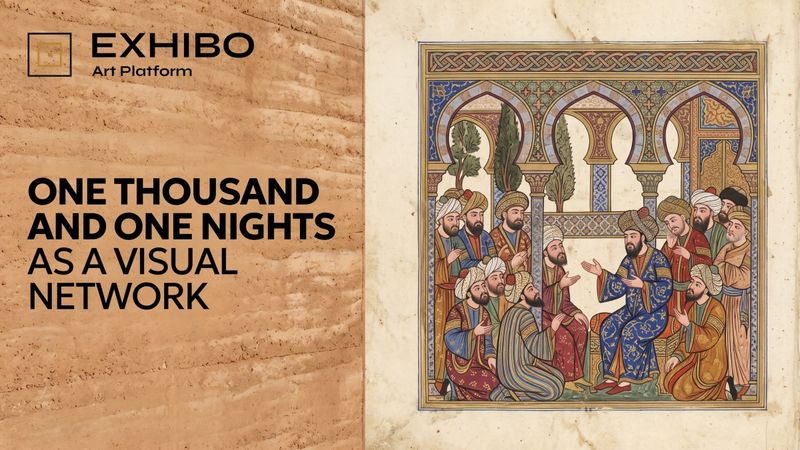
One Thousand and One Nights as a Visual Network
The book that taught Europe to picture the East arrived with no pictures at all. Three centuries of illustrators — Dutch, Egyptian, Persian, French, German, Iraqi — each gave it a face, and every face was a self-portrait.
Open Galland's Thousand and One Nights, the edition that conquered Europe, and there is nothing to look at: no genie, no lamp, not one illustration. The most visually imagined book in the world began blind — and because its text was never fixed either, no picture of it could ever be a copy.
Curating Tomorrow's Archive: Hamburger Kunsthalle Seeks Contemporary Collections Lead
A new permanent appointment will steer the museum's post-1960 holdings across paper, photography, and media formats.
The Hamburger Kunsthalle is inviting applications for a senior curatorial position focused on contemporary acquisitions, exhibition strategy, and digital collection management. Applications close October 2026 for a January 2027 start.