
Curatorial Ethos
A young gallery in La Marsa that reads Tunisian painting through its history, from the orientalists to the École de Tunis to the abstractionists who came after.
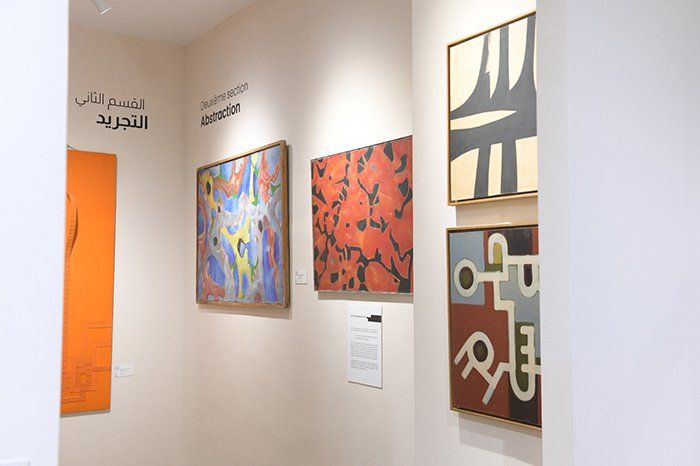
Isharat Gallery opened in spring 2026 in the Tanit Center in La Marsa, close to Phosphore, the new arts quarter. It was founded by Mohamed Ali Habibi, who came to art from finance. He began collecting during years spent visiting French museums, galleries, artists' studios and sale rooms. The director is Majda Smaoui, a painter from a family of artists who previously ran a gallery in Sidi Bou Said. The opening exhibition, «Variations autour de l'abstraction», was curated by the art historian Alia Nakhli, whose thesis on the visual arts in Tunisia from 1881 to 1981 is a standard reference. It traced abstraction in Tunisian painting through artists who never received the recognition they deserved. A solo show of recent work by Ahmed Zelfani followed. In June 2026 the gallery went further back in time: one room held the École de Tunis (Ben Abdallah, Bellagha, Gorgi, Lellouche, Yahia, Dhahak) while the other showed early pioneers and orientalists such as Robert Hue, Armand Vergeaud, Henri Dabadie, along with a panel of small oil sketches by Alexandre Roubtzoff.
Why this gallery matters
Exhibo editorial
Most new galleries open with whatever is selling this season. Isharat opened with a history lesson. Its first show, curated by the academic who wrote the reference work on a century of Tunisian art, put the overlooked abstractionists of the rebel generation back on the wall. Its third went further back, hanging the École de Tunis in one room and the orientalists who painted the country before them in the next. For a visitor it works like a small museum of Tunisian modern painting, except that the works can go home with you.
Visit
Hours, directions, and direct contact. For programme or press enquiries, use the contact form below.
Address
Tanit Center, La Marsa
Opening hours
- Monday
- Closed
- Tuesday
- 11:00 – 19:00
- Wednesday
- 11:00 – 19:00
- Thursday
- 11:00 – 19:00
- Friday
- 11:00 – 19:00
- Saturday
- 11:00 – 19:00
- Sunday
- Closed
Contact
Direct enquiries through Exhibo are available once this profile is verified by the gallery.
Contact unavailable
When the gallery owner verifies this profile on Exhibo, a contact form will appear here so you can reach them directly through our portal — enquiries, press, and partnerships routed to their team.
That has not happened yet, which is why you are seeing this message instead of a form.
Artists & People
Full directory →Artists
Represented and guest artists exhibiting with the gallery.
Jellal Ben Abdallah
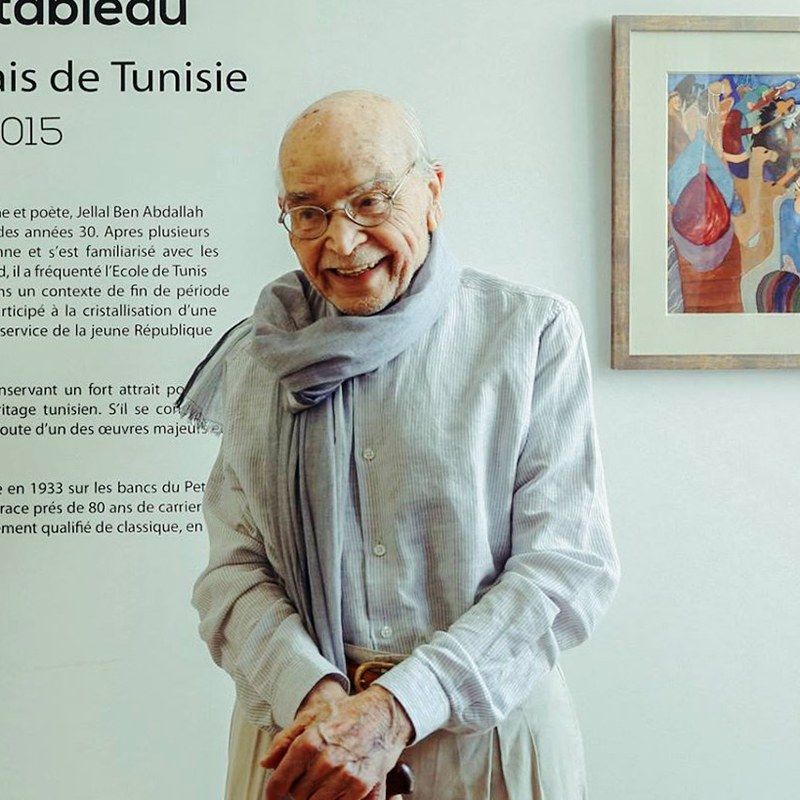
Jellal Ben Abdallah (1921–2017) was a Tunisian painter of the first generation of modern Tunisian artists and a core member of the École de Tunis. Born in Tunis, he lived and worked in Sidi Bou Said, where he died in 2017. He adapted the fine detail of miniature painting to scenes of daily life, still lifes and portraits of women. His first exhibition, with Hatem El Mekki, took place in 1934.
Ali Bellagha
Ali Bellagha (1924–2006) was a Tunisian painter, engraver and designer who brought art and craft together. He came from a family of craftsmen in the medina of Tunis and trained in Tunis and Paris in drawing, engraving, ceramics and decoration. In the 1960s he founded the gallery Les Métiers in Tunis with his wife Jacqueline Guilbert, where antiques, contemporary art and fine craft were shown side by side. He worked in wood, stone, copper, wool, leather and silver as well as paint. He received the Prix national des arts plastiques in 2003.
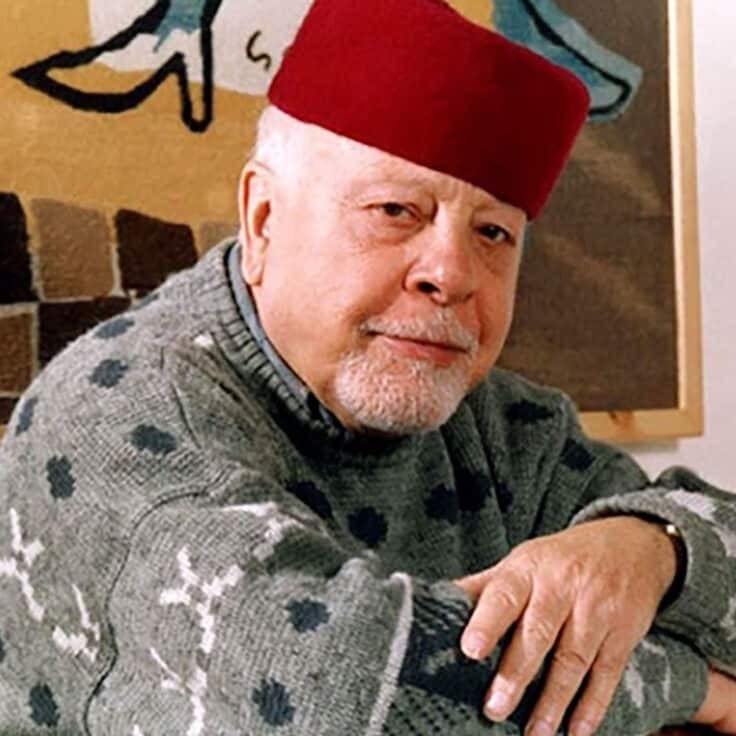
Abdelaziz Gorgi
Abdelaziz Gorgi (1928–2008) was a Tunisian painter and ceramist and one of the founders of the École de Tunis. Born in Tunis, he studied at the École des Beaux-Arts de Tunis from 1944 to 1949 and trained in ceramics studios in Paris. He taught drawing, ceramics and painting at the Tunis school of fine arts from 1959 to 1983. In 1973 he opened Galerie Gorgi in Tunis and in 1988 a second space in Sidi Bou Saïd, today A. Gorgi. His playful, elongated figures drew on the medina and its trades.
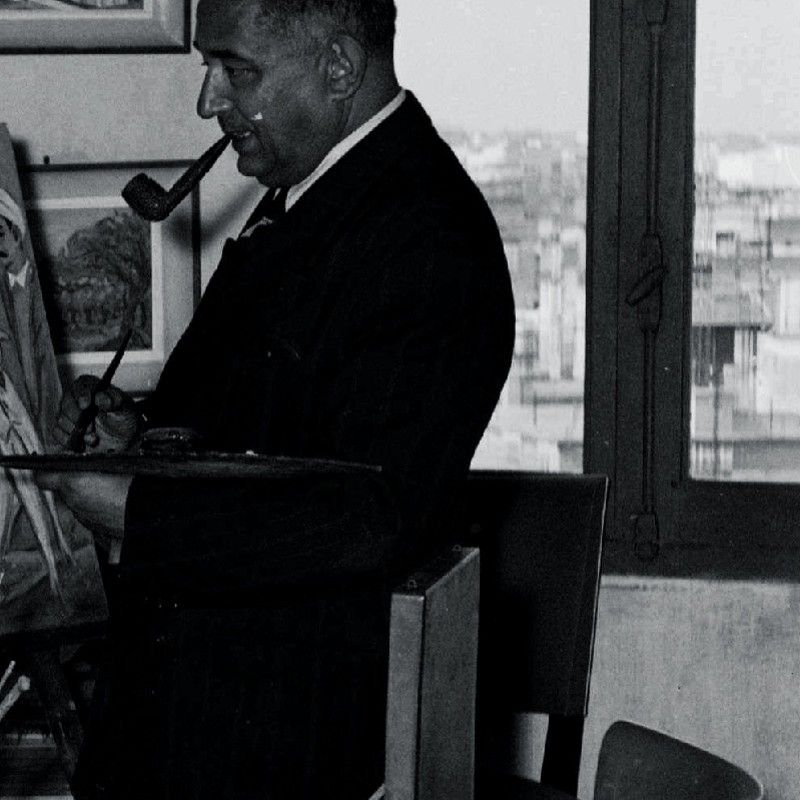
Yahia Turki
Yahia Turki (1903–1969) is often called the father of modern Tunisian painting. Born in Istanbul to a Turkish mother and a Tunisian father from Djerba, he grew up in Tunis and was largely self-taught. He showed at the Salon tunisien from 1923 and spent 1927 and 1928 in Paris. In 1948 he was among the founders of the École de Tunis, which he led until his death. He painted the medina, Sidi Bou Saïd and Djerba, street trades and the daily life of Tunis.
Brahim Dhahak
Brahim Dhahak was a Tunisian painter and engraver associated with the École de Tunis, born in 1931 in El Ksar near Gafsa. He lost his parents young and worked in Tunis cafés before a scholarship took him to the Accademia di Belle Arti in Rome from 1957 to 1961. He later held a residency at the Cité internationale des arts in Paris. He painted village women, landscapes and café scenes. His woodcut series on the Hilalian epic draws on the tradition of popular storytellers. He received the Grand Prix of the City of Tunis in 1991.
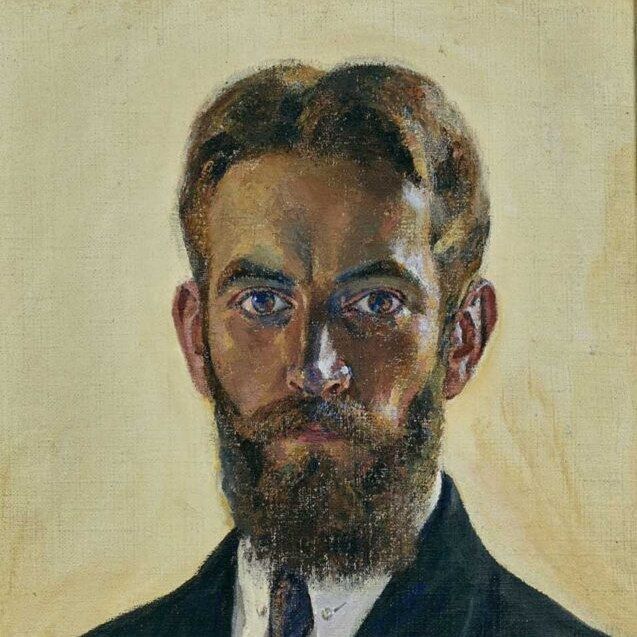
Alexandre Roubtzoff
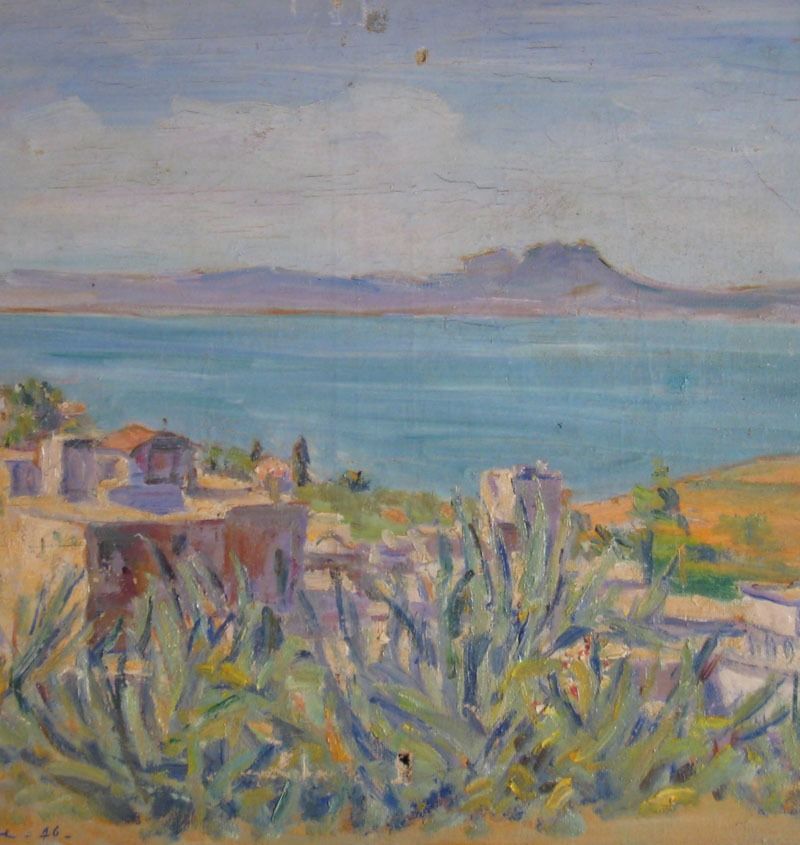
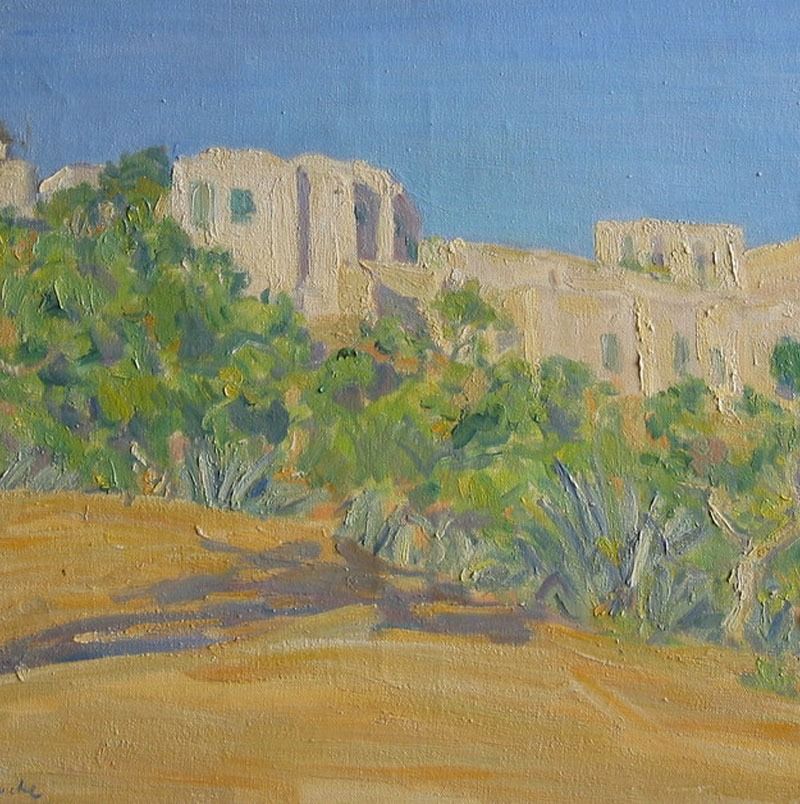
Alexandre Roubtzoff was a Russian painter born in Saint Petersburg in 1884 who died in Tunis in 1949. Trained at the Imperial Academy of Arts, he came to Tunisia in 1914 on a travel grant and stayed for the rest of his life, taking French citizenship in 1924. He painted thousands of landscapes, portraits and scenes of Tunisian life, most of them from life and outdoors.
Ahmed Zelfani
Ahmed Zelfani is a Tunisian artist of many trades: playwright, set designer, lighting designer, photographer and painter. He taught photography at the Institut Maghrébin du Cinéma and has taught at the École des Arts et du Cinéma (EDAC) since 1998. For more than twenty years he has shown his work in Tunisian galleries and abroad, in France, Spain, Vienna, Venice and New York. His paintings often hold slender, anonymous silhouettes drawn in black on white grounds, as in Le Noir est Blanc at Musk and Amber gallery in 2017. TGM Gallery gave him the solo show Multifacette in 2024. In 2026 Isharat Gallery in La Marsa showed a set of his recent works.
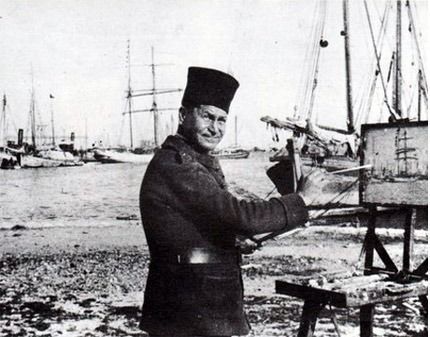
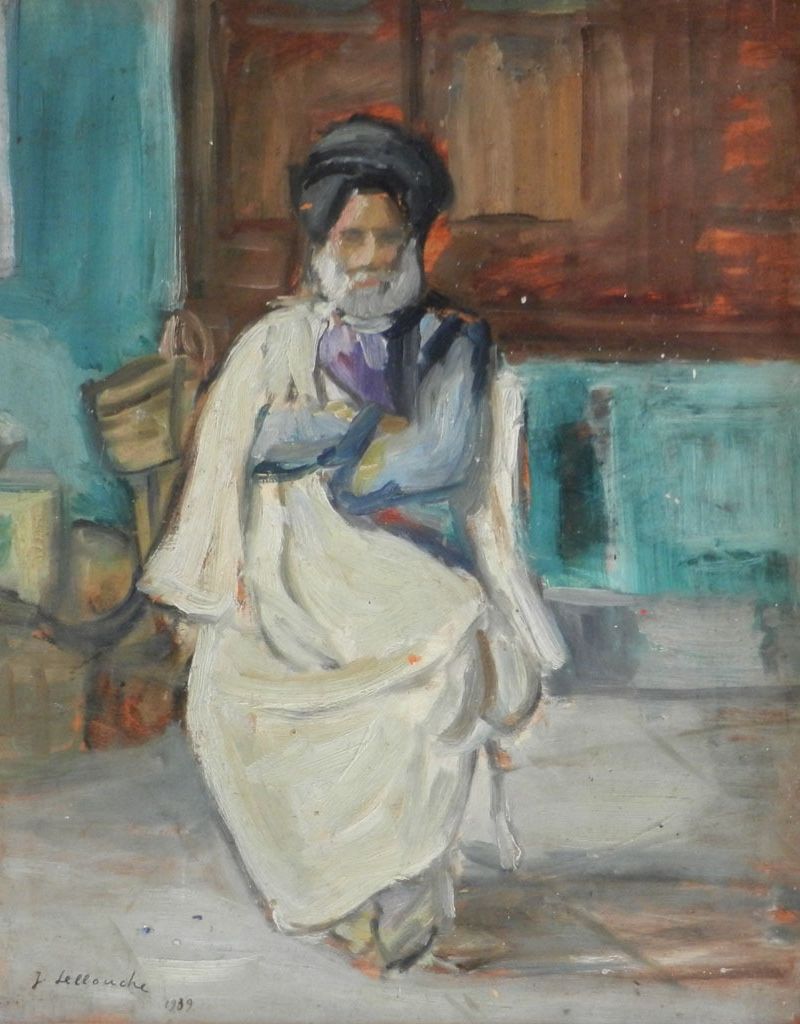
Jules Lellouche
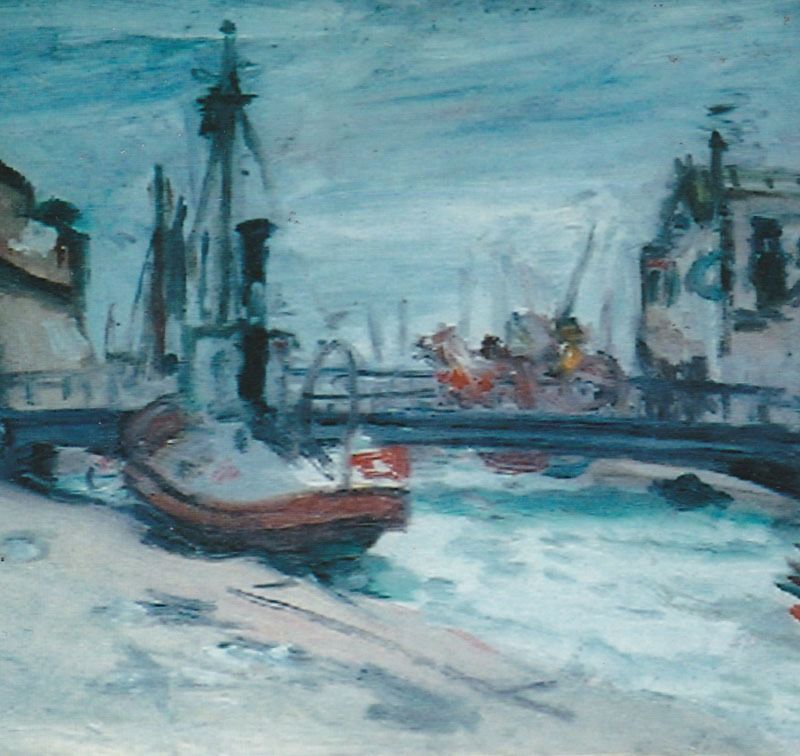
Jules Lellouche (1903–1963) was born in Monastir into a modest Jewish family of the Hara. He grew up far from academic painting and taught himself, apart from a brief late spell at the Beaux-Arts in Tunis. He first showed at the Salon Tunisien in 1921. A state grant took him to Paris in 1926, where impressionist and postimpressionist painting taught him to chase light and clear colour. He travelled to paint in Morocco, southern Algeria and Spain. In 1936 he formed the Groupe des Quatre in Tunis with Pierre Boucherle, Moses Levy and Antonio Corpora. In 1947 he showed with the Groupe des Dix, the circle that became the École de Tunis. After the war years in Sfax and La Goulette he lived in La Marsa until 1954, then settled in Paris in 1955. Critics placed him in the line of Corot and Marquet; his subjects stayed close to home: the canal at La Goulette, the hill of Sidi Bou Saïd, the Mediterranean light.
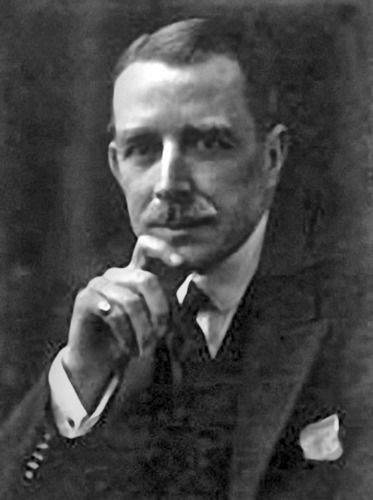
Rodolphe d'Erlanger
Baron Rodolphe d'Erlanger (1872–1932) was a painter and musicologist, the youngest son of the banker Émile d'Erlanger. He trained at the Académie Julian in Paris. His first Orientalist canvases came from journeys to Egypt in 1904 and 1905. Ill health brought him to Tunisia in 1909. He settled in Sidi Bou Saïd, where he built the palace Ennejma Ezzahra between 1912 and 1922 and pushed for the village's blue and white to be protected. Arab music took over the rest of his life: he devoted himself to its learned and popular traditions. Most of the easel paintings now shown at Ennejma Ezzahra, home of the Centre des Musiques Arabes et Méditerranéennes, belong to his Tunisian years.