
Exhibo Editorial
What Makes a Strong Gallery Profile: A Practical Checklist
Most gallery profiles fail in the same few ways. Here is what separates the ones collectors trust from the ones they scroll past — and a checklist to fix yours in an afternoon.
A collector lands on your profile. They have maybe twenty seconds before they decide whether you are a serious gallery worth an inquiry or a half-finished listing to scroll past. Most of that decision is made before they have read a single word properly — it is made on whether the page looks complete, current, and like someone is actually behind it. The frustrating part is how often a strong gallery, with a real programme and genuine artists, loses that twenty seconds to a profile that just looks neglected. None of the fixes are hard. They are mostly about doing the obvious things properly, and not leaving the easy wins on the table. Here is what actually separates a profile that converts from one that doesn't.
Start with the unglamorous truth: completeness wins
The single biggest predictor of whether a profile works is whether it is finished. Not clever, not beautifully written — finished. Every field filled, no blank artist bios, no "exhibition history coming soon", no missing contact route.
This sounds too obvious to mention, except that most profiles fail exactly here. A gap reads as neglect, and neglect reads as "this gallery isn't really paying attention" — which is the last thing you want a collector thinking before they ask about a £40,000 painting. An empty field is not neutral. It actively costs you.
There is a search angle too. Profiles with every section populated give search engines and AI answer engines more to work with, so a complete page is simply more findable than a sparse one. Completeness is the cheapest visibility you will ever buy. It costs an afternoon.
The gallery statement: say what you actually do
Most gallery statements say nothing. They are a paragraph of warm air about "fostering dialogue" and "pushing boundaries" that could belong to any of four hundred galleries. A collector reads it and learns nothing; an AI engine reads it and cannot tell what you focus on.
A good statement answers plain questions. What kind of work do you show — medium, region, generation of artist? What is the thread running through your programme? Why would someone collect from you rather than the gallery next door? You do not need to be poetic. You need to be legible. "We show contemporary work by artists from the Gulf and South Asia, with a focus on photography and works on paper" tells a collector and a machine more than three paragraphs of mission-speak ever will.
One test: if you swapped your gallery's name out of your statement, could a competitor paste it onto theirs unchanged? If yes, it is not a statement. It is filler.
Artist pages: this is where trust is won or lost
Here is a number worth sitting with: roughly 79% of collectors say they want more background on an artist before they will buy. The work is what they fall for, but the artist is what they are buying into — and a thin artist page kills the sale quietly, before any inquiry is ever sent.
So the artist pages are not a formality. They are the heart of the profile. Each represented artist needs a real biography, a clear sense of their practice, exhibition and (where relevant) collection history, and a proper image. "Represented since 2019" and a single thumbnail is not a page; it is a placeholder.
A warning that has teeth in 2026: do not paste the same recycled artist bio that appears on every other gallery and platform listing. Search and AI engines increasingly discount duplicate text — if your artist's bio is word-for-word identical across six sites, none of those pages reads as the authoritative source. Original, specific writing about why the work matters now does double duty: it convinces the collector and it earns the page its own standing in search.
Exhibitions: build an archive, not a calendar
Most galleries treat exhibitions as disposable. The show opens, the page goes up, the show closes, the page comes down. That is throwing away an asset.
A past exhibition page that stays live becomes a permanent, searchable record — it keeps ranking for the artist's name, the show's themes, the works included, long after the doors close. Over a few years, that archive quietly becomes one of the most-visited, best-ranking parts of a gallery's whole presence. Each exhibition page wants the essentials: a real curatorial or press text (not three sentences), the participating artists linked to their own pages, the works shown, installation images, and the dates. Leave them up. They are working for you while you sleep.
Images: the part everyone gets emotionally right and technically wrong
Galleries care enormously about how the work looks, and then undo it with the boring technical details.
High quality, consistent, properly lit. The obvious half, and the half galleries already do well.
Named and described. The half almost everyone skips. An image file called
IMG_2291.jpgwith no caption or alt text is invisible to image search and unreadable to an AI engine. The same file, named for the artist and work and given a plain description, becomes a discovery surface. This is ten minutes of work that most of your competitors will never do.A primary image that holds up small. Your profile's lead image gets shrunk into a thumbnail in directories, search results and shares. Pick one that still reads at that size.
Contact and inquiry: don't make them work for it
A collector ready to ask about a work is the most valuable visitor you will ever have, and galleries lose them at the final step constantly — a contact route buried two clicks deep, an inquiry form that feels like a customs declaration, no obvious way to just ask.
Make the path obvious. One clear, low-friction way to inquire on every artwork and every artist page. Ask for what you need and nothing more. A collector who has to hunt for the "contact" link is a collector you are inviting to leave.
There is a pricing point worth making here too, even though it makes some galleries uncomfortable: a large share of collectors say opaque pricing puts them off entirely. You do not have to publish every price. But a clear "price on request" route, answered quickly, beats a silent wall — the silence reads as either "you can't afford it" or "we can't be bothered", and neither sells a painting.
Keep it current — this is the one that decays
Everything above can be done perfectly and still rot. A profile is not a thing you finish; it is a thing you maintain.
A current show on the page, a recently added work, an artist update — these signal to a collector that there is a living gallery here, and they signal to search and AI engines that the page is worth re-crawling and citing. A profile last touched eighteen months ago tells everyone, human and machine, that nobody is home. Of all the points here, this is the one that quietly undoes the rest if you ignore it.
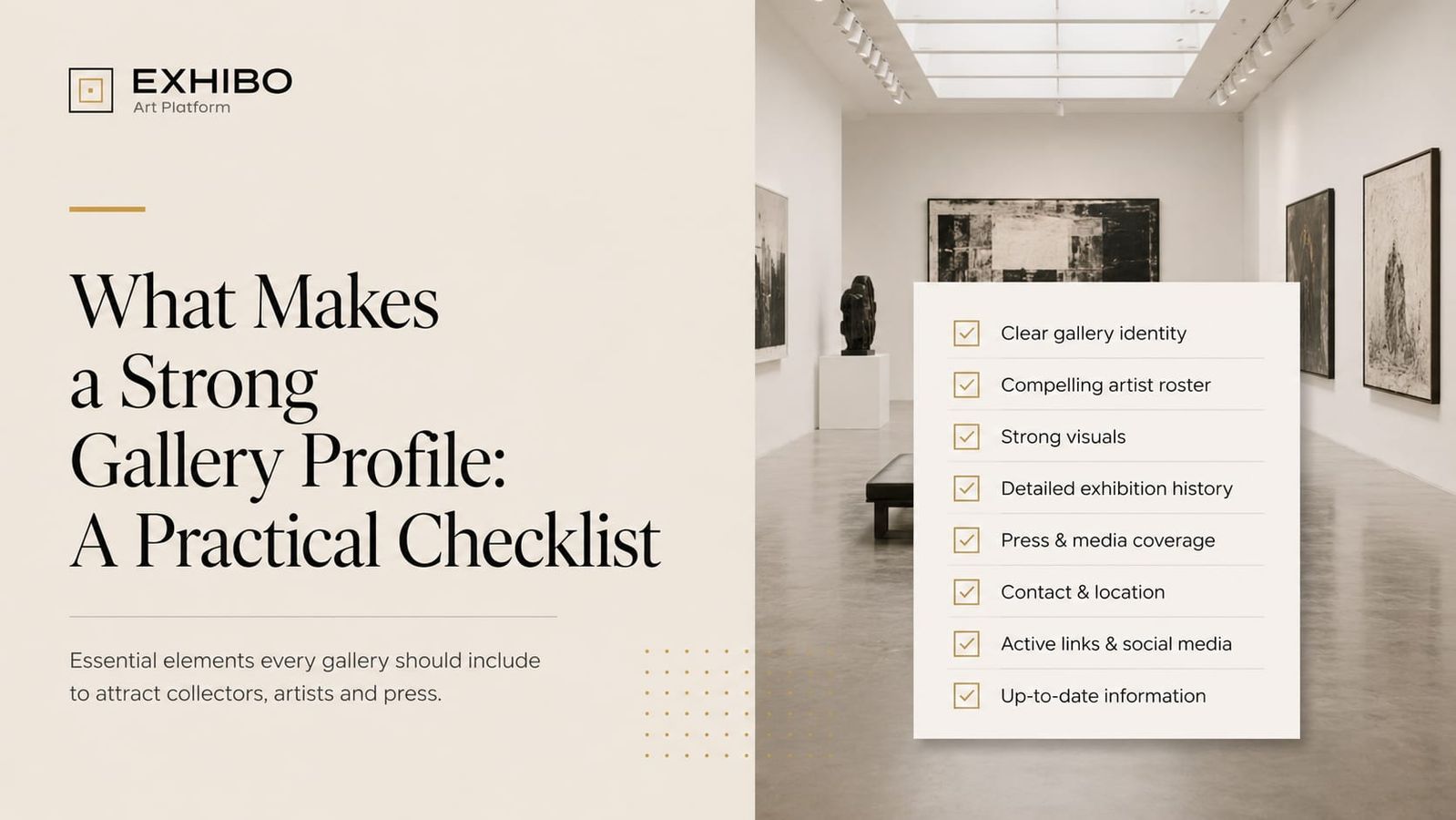
The checklist
Print this. Go through your profile against it once a quarter.
Complete. Every field filled. No blank bios, no "coming soon", no dead ends.
A real statement. Plain language: what you show, who for, why you. Fails the swap test if a rival could reuse it.
Proper artist pages. Original bio, sense of the practice, history, a real image — for every artist. No recycled boilerplate.
A living exhibition archive. Past shows stay up, with real texts, linked artists, works and installation shots.
Images named and described. Descriptive filenames and alt text, not
IMG_2291.jpg. A primary image that survives being shrunk.An obvious way to inquire. Low-friction, on every relevant page. Pricing clear or clearly path-ed.
Current. Touched this quarter. A live show, a new work, something that proves a person is here.
None of this is a budget question. It is an attention question — the same attention a gallery already pours into hanging a show, turned for one afternoon onto the page where most collectors now meet you first.
Galleries mentioned
Exhibitions mentioned
Related reading
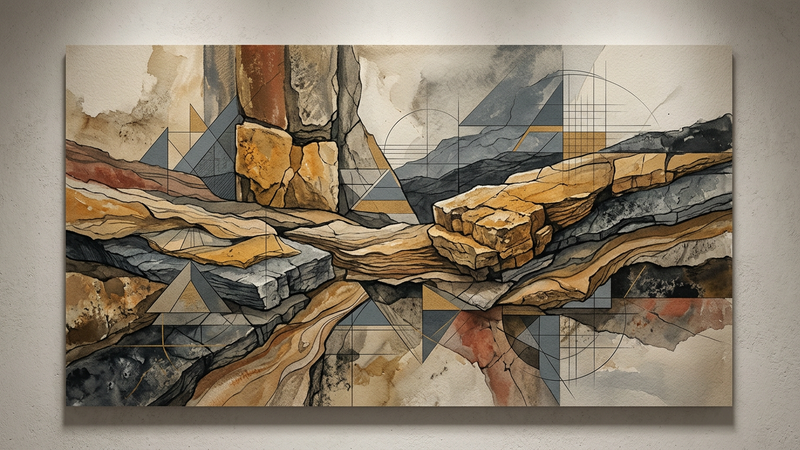
Diego Rivera's Monumental Stadium Relief Set for Conservation in Mexico City
A multi-institutional campaign targets the artist's unfinished stone facade at UNAM alongside works by Siqueiros and O'Gorman
Local conservators will lead a phased preservation effort for Diego Rivera's volcanic stone relief at Mexico City's Olympic stadium, supported by the World Monuments Fund and US diplomatic grants.
Van Lévé: Sovereign Caribbean Visions Take Shape at Harvard
A transnational survey charts twenty-five years of Creole and Maroon artistic practice across the French Caribbean and Amazonia.
Harvard's Alain Locke Gallery presents a landmark survey tracing contemporary production from Guadeloupe, Martinique, Guyane, and Haiti since two thousand and one.
Gustave Fayet: Collector—Artist Designer
A comprehensive survey at the Fondation Louis Vuitton reuniting collected masterpieces with the designer's own studio practice.
The Paris institution expands its patronage series with a dual-focused examination of Gustave Fayet, bringing together hundreds of acquired works and restored creations to chart his impact on early modernism.