
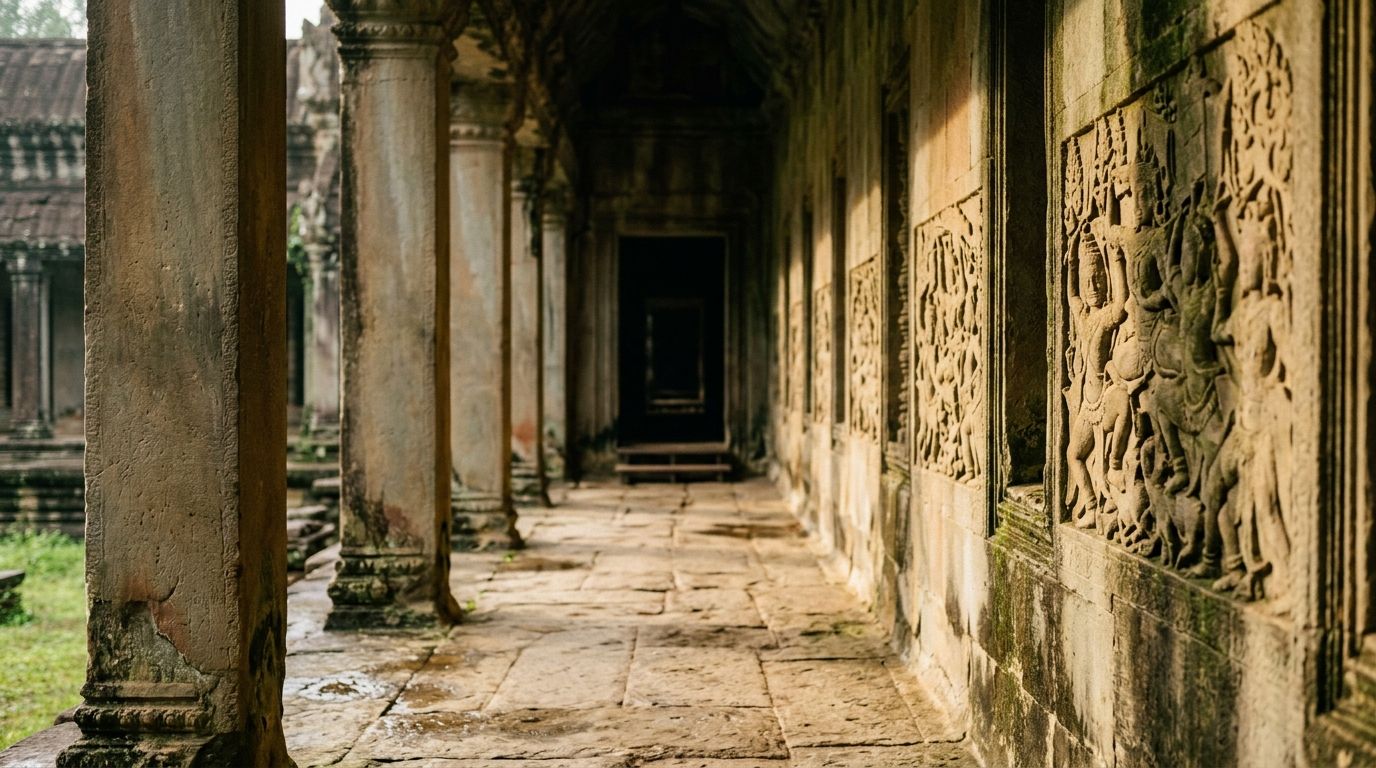
Exhibo Editorial
Southeast Asian Art Traditions
Khmer, Thai, Javanese, Vietnamese and Burmese temple sculpture, court arts and trade routes through named museum works
Southeast Asian art names the historical visual cultures of mainland and island Southeast Asia: Cambodia, Thailand, Laos, Myanmar, Vietnam, Malaysia, Singapore, Indonesia, Brunei, the Philippines and Timor-Leste. Museums use the phrase as a field label. A Khmer sandstone Vishnu, a Sukhothai walking Buddha, a Javanese Borobudur relief, a Dong Son bronze drum and a Burmese Pagan plaque share monsoon trade, Sanskrit and Pali literacy, and temple economies more than they share one look. Hindu and Buddhist stone and bronze dominate the objects Western galleries show. Court textiles, lacquer, ceramics and manuscript illumination fill national museums across the region.
Search results for “southeast asian art” lean toward Wikipedia surveys, Britannica overviews and museum collection landing pages. Those pages name India and China as influences and list media. They seldom keep Khmer, Thai, Javanese, Vietnamese and Burmese programmes distinct for long, and they seldom walk a reader from a named relief to the trade route or court that paid for it. School slide decks flatten the region into “arts and crafts” checklists. Contemporary market sites pull living painters into the same query. This article stays with historical traditions: temple sculpture, court arts and the maritime routes that moved ideas and goods. Contemporary city scenes sit outside the fence. The page belongs to the World Art Traditions series. Parallel Indic court and temple histories appear in the sibling Indian art history. Collection routes for institutions named below sit in the museums directory.
What “Southeast Asian art” names in practice
Curators treat Southeast Asian art as a set of linked but separate maker traditions organised by polity, language group and medium. Mainland programmes (Khmer, Mon, Thai, Burmese, Cham, Vietnamese) and island programmes (Javanese, Balinese, Malay, Philippine) run on related calendars of Hindu-Buddhist temple building, then diverge when Theravada, Mahayana, Islam and local ancestor cults reorganise patronage. Sculpture in stone and bronze supplies the works most often exported to Western museums. Architecture, mural painting, textiles and metalwork carry equal weight on site and in regional collections.
The phrase does not mean one continuous “Southeast Asian style.” Angkorian Khmer sandstone and Central Javanese andesite answer different quarries, different courts and different ritual programmes. Chinese ceramic cargo and Islamic calligraphy arrive on later ships and rewrite island court taste without erasing earlier temple grammar. Keep polity names and medium labels in mind when you read a wall card. A gallery that hangs “Southeast Asia” as a single room still holds several art histories.
Indigenous forms precede the Indianised temple centuries. Dong Son bronze drums from the Red River Delta, Philippine and Indonesian ancestor figures in wood, and highland textile systems all sit inside the field even when museum floor plans push them to side cases. This survey privileges stone and bronze temple arts because those objects dominate encyclopaedia and search results, then returns to court textiles and metalwork so the field does not collapse into Hindu-Buddhist sculpture alone.
Trade routes and religious transmission
From the early centuries CE, merchants and ritual specialists moved along the Bay of Bengal, the Strait of Malacca and the South China Sea. Sanskrit inscriptions, Indic scripts and Hindu-Buddhist iconography appear across the region as local elites adopt and remake them. The Metropolitan Museum of Art’s Heilbrunn chronologies for Southeast Asia (500–1000 and 1000–1400 CE) treat this span as the rise of larger polities: Dvaravati Mon centres on the mainland, pre-Angkorian Khmer sites, the Shailendra and Sanjaya builders of Central Java, and the maritime realm of Srivijaya. Sculpture of Buddhist and Hindu deities becomes the dominant monumental art form in those centuries.
Local workshops did the carving. Indian models arrived as portable images, texts and visiting specialists; Southeast Asian stoneworkers translated them into local body proportions, dress and architectural settings. Chinese ceramics, silk and later blue-and-white porcelain entered elite households through the same ports. By the fifteenth century, Muslim traders had made Islam a dominant force in Sumatra, Java and the Malay Peninsula, shifting court arts toward calligraphy, wood carving and textile display while Hindu-Buddhist programmes continued in Bali and parts of Java’s interior memory.
Indianised courts and Sanskrit inscriptions
“Indianisation” is a historians’ shorthand, not a claim that Southeast Asia copied India wholesale. Rulers took Sanskrit titles, built temples to Shiva, Vishnu or the Buddha, and commissioned inscriptions that record gifts and consecrations. Jayavarman II’s early-ninth-century consecration as devaraja (god-king), dated by the Met chronology to 802 CE, marks the conventional start of the Angkor dynasty. Parallel processes unfold on Java, where Shailendra and Sanjaya courts fund Borobudur and the Prambanan plain temples in the eighth and ninth centuries. The sibling survey of Indian art history covers the source iconographies; here the point is reception. A Khmer Vishnu and a Chola bronze share a deity name and diverge in body, jewellery and architectural frame.
Inscriptions also fix language politics. The earliest dated Khmer-language inscription (K. 557/600, 611 CE) appears at Angkor Borei in the Met’s early chronology. Later Mon legends on Pagan plaques and Old Javanese temple texts show that Sanskrit never stood alone. You read a temple through stone relief and through the script carved beside it.
Maritime networks and Chinese ceramics
Srivijaya’s control of the Strait of Malacca in the eighth and ninth centuries tied Sumatra and the peninsula to Chinese and Indian shipping. Dong Son–type bronze drums travelled south into Indonesia centuries earlier; the Met’s tympanum of a Heger I kettledrum (1995.70, ca. 500 BCE–300 CE) notes that such drums “must have been widely traded in antiquity,” a curatorial phrasing for finds scattered from Vietnam to island sites. Chinese ceramic cargoes fill shipwrecks and court inventories from the Song period onward. Blue-and-white porcelain later enters Southeast Asian elite display as status cargo, then as a local taste to imitate or resist. Island courts absorb Islamic decorative systems without abandoning older shadow-play and textile grammars. Trade multiplies options for patrons who still commission local workshops. A single cosmopolitan style never replaces Khmer sandstone or Javanese andesite.
Khmer temple sculpture from pre-Angkor to Bayon
Khmer art is the densest sculptural tradition Western museums display under the Southeast Asia label. Pre-Angkorian brick and sandstone temples of the seventh and eighth centuries give way to the Angkor period (802–1431 CE), when the capital at Angkor becomes the centre of an empire that at times includes parts of present-day Thailand, Laos, Myanmar and Vietnam. Temple-mountains rise as stepped pyramids with towers, galleries and narrative relief. Freestanding sandstone gods and bronzes fill niches and processional spaces. Styles change with reigns; art historians date sculptures by costume, facial type and architectural context as much as by inscription.
Patronage is royal and religious at once. Kings build temples as meritorious acts and as statements of cosmic kingship. Workshops organise labour at a scale that rivals any contemporary Asian court. Hydraulic engineering around the Angkorian barays and canals funded the surplus that paid for stone. When you stand before a Khmer torso in a museum case, you are looking at a fragment of that architectural programme, often removed from its lintel, pediment or sanctuary decades or centuries ago. Reassembly projects in Cambodian museums now treat findspot and rejoined heads as part of conservation storytelling.
Angkor Wat and the temple-mountain
Suryavarman II builds Angkor Wat in the early twelfth century as a temple-mountain dedicated to Vishnu. The Met’s Heilbrunn entry records a moat about 820 feet wide and a plan measuring about 4,920 feet east–west by 4,260 feet north–south, approached by a long causeway and organised as three terraces and five towers. Relief galleries narrate the Ramayana, the Mahabharata and royal processions. Figures of the Angkor Wat style stand upright and formal, with muscular torsos, ornate belts and jewellery. National Museum of Cambodia galleries in Phnom Penh hold freestanding sculptures that match that formal grammar; the temple itself remains the primary “collection” for relief.
Earlier Angkorian temple-mountains such as Phnom Bakheng (late ninth–early tenth century) and the Baphuon (mid-eleventh century) set the pyramid type that Angkor Wat enlarges. Sculpture chronology for portable works often tracks those building campaigns. Collectors and museums later prized detached heads and torsos; recent provenance research has returned many Khmer pieces from Western collections to Cambodia.
Bayon faces and Jayavarman VII’s Buddhist programme
Jayavarman VII (r. 1181–1218) reasserts Mahayana Buddhism as state cult and builds Angkor Thom with the Bayon at its centre. Towers carry large smiling faces that scholars link to Avalokiteshvara (Lokeshvara) or related Buddhist identities. External galleries show unusual bas-relief of daily life beside mythic combat. Bronze and stone triads of Buddha, Lokeshvara and Prajnaparamita circulate as portable cult images. The National Museum of Cambodia holds a late-twelfth to early-thirteenth-century bronze triad from Prei Monti, Roluos (Ga.2424 / Ga.5470): Buddha sheltered by the naga, four-armed Lokeshvara with rosary, lotus, book and amrita vase, and Prajnaparamita with book and lotus. Bayon-style scarves with rosette decoration and triangular scarf ends fix the date.
Portrait-like images of Jayavarman VII as meditating bodhisattva survive in Cambodian museums; Angkor National Museum documents a Lokeshvara whose head and torso, found at different Angkor sites, were matched by 3D research in 2016 and physically reunited for display in 2024–25. The “smile of Angkor” that tourists name is a Bayon stylistic trait with a specific royal Buddhist programme behind it.
Thai traditions from Dvaravati to Sukhothai
Thai art history in museum labels begins with Dvaravati, the Mon-speaking Buddhist culture of central Thailand (sixth to eleventh centuries). Stone dharmacakra wheels, Buddha images and stucco temple decoration show early Theravada and related Buddhist forms. Khmer political expansion into the Chao Phraya basin brings Angkorian styles into Thai territory; Lopburi and related centres produce sculpture that reads as Khmer and local at once. After Angkor’s power wanes, Thai kingdoms at Sukhothai, Lanna and Ayutthaya build their own Buddhist iconographies. Lanna workshops in the north favour their own Buddha facial types and footprint imagery; they share Theravada devotion with Sukhothai without copying its walking bronze formula.
Sukhothai (thirteenth to fifteenth centuries) is the style Thai museums and textbooks treat as a classical peak. Bronze Buddha images gain flame finials, soft androgynous modelling and a walking posture unique to the Thai repertoire. The walking Buddha (pang lila) shows the Buddha in mid-stride, left hand often in abhaya mudra, right arm hanging in a continuous curve with hip and torso. Thai interpreters link the posture to the Buddha’s descent from Tavatimsa Heaven after preaching to the gods. Bangkok’s National Museum holds major examples in its Sukhothai rooms; loan exhibitions have sent iconic walking Buddhas as far as the National Museum of Korea. The Metropolitan Museum of Art’s bronze Walking Buddha (1984.481, first half of the thirteenth century, Gallery 249) brings a smaller cast into a Western teaching collection. Ayutthaya (fourteenth to eighteenth centuries) later favours more rigid, bejewelled standing and seated Buddhas before Bangkok-period courts continue the lineage.
Thai mural painting, lacquer and manuscript arts run beside bronze. Wat murals narrate the Traiphum cosmology and jataka cycles for monastic audiences. This survey keeps sculpture as the spine because search and museum display still organise Thai historical art around Buddha images. Court textiles and theatre arts (khon masks, shadow figures) belong to the same patronage world; they appear in depth in Thai national museum wings more than in Western “Southeast Asia” rooms.
Javanese temple arts: Borobudur, Prambanan and Majapahit
Central Java in the eighth and ninth centuries produces two of the world’s densest stone narrative programmes. Buddhist Borobudur and the Hindu temples of the Prambanan plain rise in the same landscape under Shailendra and Sanjaya patronage. Volcanic stone, not sandstone, is the medium. Relief cycles teach pilgrims through walking. Freestanding gods fill niches. Later East Javanese Majapahit courts (thirteenth to fifteenth centuries) shift toward brick temple complexes, refined metalwork and court culture that feeds into Balinese Hindu arts after Islam becomes dominant on Java’s coasts. Dutch archaeological service records from the colonial period still underpin findspot data for sculptures now in Amsterdam; those papers are why some Rijksmuseum pieces retain temple attributions that dealer-sourced Khmer works often lack.
Colonial collecting moved Javanese heads and statues to European museums. The British Museum’s volcanic-stone Buddha head from Borobudur (1859,1228.176), collected under Sir Stamford Raffles and dated ninth century, comes from one of the monument’s seated Buddhas. Zwalf’s catalogue note places its globular head and full features in a post-Gupta, eastern Indian orbit already remade as Indonesian. Rijksmuseum holdings of Central Javanese sculpture, acquired through the Dutch East Indies Archaeological Service, form the strongest European group outside Indonesia. Jakarta’s National Museum remains the first address for context.
Borobudur’s stone narrative
Borobudur is a stepped Mahayana Buddhist monument of the late eighth to early ninth century on the Kedu Plain. Galleries carry hundreds of narrative relief panels; upper terraces hold latticed stupas with seated Buddhas. Pilgrims ascend from worldly scenes toward the formless. The relief cycle is the art: processions, jataka tales and doctrinal episodes carved so that walking becomes reading. UNESCO listing and twentieth-century restoration made the site a global monument; earlier, abandonment and volcanic ash buried much of the structure until Raffles’s 1814 rediscovery brought it into colonial scholarly networks.
Detached heads in London, Amsterdam and Paris document both the monument’s sculptural quality and the history of removal. German-funded UNESCO stone-conservation work after the 2010 Merapi ashfall supported on-site Buddha and relief care; that is conservation aid, not repatriation of museum-held heads. When you meet a Borobudur head in a glass case, you meet a fragment of a walking programme designed for a mountain of stone, not for a plinth.
Hindu Prambanan and later courts
Prambanan’s Shiva temple and companion shrines on the plain present Hindu narrative relief and freestanding deities in the same Central Javanese century as Borobudur. The two programmes show concurrent Hindu and Buddhist elite patronage rather than a single state religion. Majapahit later unifies much of island Southeast Asia; its sculptural and metalwork traditions feed East Javanese and Balinese temple arts. After coastal Islamisation, shadow-puppet (wayang) design, batik and court dance absorb older epic narratives into new media. Those later arts are historical court traditions, not contemporary gallery scenes, and they belong in any full account of Javanese visual culture.
Vietnamese strands: Dong Son bronze and Champa stone
Vietnamese historical art refuses a single line. Northern bronze-age Dong Son culture (roughly first millennium BCE into the early centuries CE) casts large Heger Type I drums with solar centres, feathered processions, houses and boats. The Ngọc Lũ drum and related finds in Vietnamese museums are national emblems of early metal skill. The Met’s tympanum fragment (1995.70) stands in for traded drums that reached Indonesia. Lost-wax casting at this scale is already a high-court technology before Indianised temples appear further south.
Champa, an indianised coastal kingdom in central and southern Vietnam (fifth to fifteenth centuries), produces Hindu and Buddhist temple sculpture in sandstone and related stone. Mỹ Sơn and other sites leave brick towers and sculptural programmes; the Museum of Cham Sculpture in Da Nang and the Musée Guimet in Paris hold major collections. Guimet’s 2005–06 exhibition La sculpture du Champa gathered works from Da Nang, Ho Chi Minh City and Guimet itself. Cham faces, dancing apsaras and Shiva images follow Indic iconography with local physiognomy and costume. A Met Head of Shiva (lingakosha) from Champa (late ninth–tenth century, Quang Nam region; 1996.239) is gold and silver repoussé from a linga cover, not sandstone tower sculpture: portable precious-metal cult fittings travel into Western galleries beside the stone heads from Mỹ Sơn. Khmer–Cham wars, including Cham capture of Angkor in the late twelfth century, bind the two sculptural worlds through conflict without merging their styles.
Later Vietnamese dynastic arts (ceramics, lacquer, Confucian temple painting) form another chapter under Chinese cultural pressure and local court taste. Blue-and-white and other high-fired wares from Vietnamese kilns enter regional trade in their own right. This article keeps Dong Son and Champa in view so “Vietnamese art” does not collapse into twentieth-century painting or tourist lacquer alone.
Burmese Pagan and Theravada kingdoms
Bagan (Pagan) on the Irrawaddy plain becomes the great Theravada Buddhist temple city of mainland Southeast Asia between the eleventh and thirteenth centuries. Thousands of brick temples and stupas fill the plain. Glazed terracotta plaques, stone relief and monumental standing Buddhas educate lay visitors in jataka stories and doctrine. King Kyansittha’s Ananda Temple, completed in 1105 CE, is a cruciform brick monument with Mon and Indian architectural fusion, four standing Buddhas facing the cardinal directions, and extensive plaque cycles. Basement plaques carry Mon legends; upper terraces illustrate jatakas in long sequences. Scholars have called the temple a museum of stone narrative in situ. Earthquake damage and later restoration campaigns have altered surfaces, yet the didactic programme of plaques remains the clearest Theravada teaching machine on the plain.
Burmese bronze Buddha images, lacquer manuscript covers and wood carving continue under later Ava, Toungoo and Konbaung courts. Mon and Pyu antecedents precede Pagan’s brick boom; Pyu city cultures leave their own brick stupas and votive materials before Pagan concentrates patronage. Compared with Angkor or Borobudur, fewer freestanding Pagan sculptures travel to Western encyclopaedia pages; the plain itself is the collection. National museums in Yangon and regional site museums hold plaques, Buddhas and architectural elements that fix the Theravada turn on the mainland after Khmer Mahayana experiments at the Bayon.
Court arts beyond the temple: textiles, metalwork, manuscripts
Temple sculpture attracts search traffic and Western gallery space. Court and community arts carry equal historical weight. Indonesian batik and related resist-dye traditions encode status and narrative for ritual and dress. Cambodian and mainland ikat weaving systems move patterns across trade corridors. Thai and Burmese lacquerware coats wood and bamboo with layered resin decoration for court and monastery use. Gold jewellery, ritual vessels and betel sets signal rank in island and mainland courts alike. Illuminated Buddhist manuscripts and folding books (parabaik in Burma, related forms elsewhere) bind text to painting.
These media often survive better in national museums than in the “masterpiece” narrative of detached stone gods. They also record Islamisation and localisation: Arabic calligraphy on Malay court objects, Quranic illumination, and woodcarving for mosques sit beside older Hindu-Buddhist epic imagery in shadow puppets and dance costume. Philippine goldwork and ritual objects from early polities, and highland textile systems across the mainland, further warn against equating the field with Angkor alone. A survey that stopped at Angkor and Borobudur would miss how courts kept commissioning beauty after temple-mountain building slowed.
| Tradition / polity | Approx. dates (CE unless noted) | Principal centres | Dominant media | Named work or site (museum or in situ) |
|---|---|---|---|---|
| Dong Son | ca. 600 BCE–300 CE | Red River Delta, northern Vietnam | Cast bronze drums | Tympanum of Heger I kettledrum, Met 1995.70; Ngọc Lũ drum, Vietnamese museums |
| Dvaravati (Mon) | ca. 6th–11th c. | Central Thailand | Stone Buddha, dharmacakra, stucco | National Museum Bangkok Dvaravati galleries |
| Central Java (Shailendra / Sanjaya) | 8th–9th c. | Kedu Plain, Prambanan | Andesite temple relief and sculpture | Borobudur; Buddha head, British Museum 1859,1228.176; Prambanan Shiva temple |
| Angkorian Khmer | 802–1431 | Angkor, Cambodia | Sandstone temple-mountains, bronze | Angkor Wat; Bayon; Prei Monti Buddhist triad, National Museum of Cambodia Ga.2424 |
| Champa | ca. 5th–15th c. | Central/southern Vietnam (Mỹ Sơn) | Brick towers, sandstone sculpture | Museum of Cham Sculpture, Da Nang; Guimet Cham holdings |
| Pagan (Bagan) | 11th–13th c. | Irrawaddy plain, Myanmar | Brick temples, glazed plaques, stone | Ananda Temple (1105), Bagan |
| Sukhothai | 13th–15th c. | North-central Thailand | Bronze Buddha images | Walking Buddha types, National Museum Bangkok; Met 1984.481 |
| Majapahit / later Java–Bali | 13th–15th c. onward | East Java; Bali after Islamisation | Brick temples, metalwork, textiles, wayang | East Javanese temple sites; batik and shadow-puppet court arts |
Museums, collecting and contested provenance
Western museums built Southeast Asia galleries through colonial officers, dealers and mid-twentieth-century donors. Raffles’s Borobudur heads entered the British Museum in 1859 as evidence, in his own project, that Java matched classical civilisations he knew from Greece and India. French scholarship and collecting shaped Guimet’s Cham and Khmer holdings through Indochina-period networks. American museums expanded Khmer sculpture at speed in the 1970s, often through dealer channels now under investigation. That growth now faces restitution. In December 2023 the Metropolitan Museum of Art announced repatriation of sixteen sculptures linked to dealer Douglas Latchford: fourteen to Cambodia and two to Thailand. Works such as The Bodhisattva Avalokiteshvara Seated in Royal Ease and early Buddha heads, long treated as collection highlights, carry new wall texts about return. Cambodia’s cooperation with US investigators and testimony from former looters rebuilt provenance chains that older acquisition files lacked.
National museums in Phnom Penh, Bangkok, Jakarta, Hanoi, Da Nang and Yangon remain primary for context. Site museums at Angkor, Borobudur and Bagan keep architectural fragments near the monuments that produced them. The Smithsonian’s National Museum of Asian Art and San Francisco’s Asian Art Museum rank high in current search results for “southeast asian art” because they publish collection overviews that match the query. Those pages summarise well. They still flatten plurality unless you leave the landing page for object records. Use the museums directory to find which institutions near you hold Khmer, Thai, Javanese or Cham material, then read labels for findspot and repatriation status as part of the object’s history.
Critics of the field argue along shifting lines. Earlier colonial writing cast Southeast Asia as a derivative of India (“Further India”). Mid-century scholarship swung toward local genius and autonomous invention. Recent work tracks hybridity without erasing either trade or workshop agency. Provenance debate adds another pressure: aesthetic admiration must sit beside legal and ethical history of how a lintel left a temple. Display labels that name Latchford, Raffles or the École française d’Extrême-Orient now teach historiography as well as iconography.
What these traditions leave for viewers today
Southeast Asian historical art leaves methods of looking. Read a temple as an ordered walk: causeway, gallery, sanctuary; or Borobudur’s ascent through relief. Compare a Sukhothai walking Buddha’s continuous bronze contour with a Bayon sandstone smile and a Cham sandstone dance figure. Ask which court paid, which quarry supplied stone, which language appears in the inscription. Keep mainland and island chronologies in parallel rather than forcing one “golden age.”
The field also leaves unfinished business. Looted temple sculpture continues to surface; museums revise labels; national collections reclaim fragments. Textile and manuscript traditions still practised as living crafts sit adjacent to archaeological stone without belonging to contemporary art-market essays. This programme’s World Art Traditions hub places the survey beside India, China, Japan and Africa without ranking civilisations. Start with one named work from the table above. Follow its polity before you reach for the regional label.
FAQ
Search queries mix Southeast Asia with South Asia, ask for characteristics as if one style existed, and hunt for named artists in a workshop culture. School worksheets want bullet lists of “elements and principles.” Travel pages want the most beautiful country. This section answers the historical questions that fit the fence: what the field name covers, how it differs from South Asian art, which works to seek first, why Western galleries favour stone, and where to see material without inventing a single regional genius. The answers stay inside temple sculpture, court arts and trade, and point back to the named works and museums already cited.
What counts as Southeast Asian art?
Museums use the term for historical visual cultures of mainland and island Southeast Asia: temple sculpture, court textiles, ceramics, lacquer, metalwork and related arts from polities such as Angkor, Sukhothai, Central Java, Champa and Pagan. The label is geographic and curatorial. It does not name one style. Contemporary biennial scenes and city gallery guides belong to other articles.
How does Southeast Asian art differ from South Asian art?
South Asia centres on the Indian subcontinent; Southeast Asia covers the lands and islands east of the Bay of Bengal through Indonesia and the Philippines. Indic religions and Sanskrit literacy shape many Southeast Asian temples, which is why search engines mix the two. Iconography travels; workshops, body types, architecture and languages remain local. See Indian art history for the South Asian side of that exchange.
What are typical characteristics of historical Southeast Asian art?
Recurring features include Hindu-Buddhist temple programmes in stone and brick, bronze Buddha and bodhisattva images, narrative relief for pilgrims, court textiles and metalwork, and long engagement with Indian and Chinese trade. Materials follow local ecology: sandstone at Angkor, volcanic stone on Java, bronze lost-wax casting for drums and Buddhas, silk and cotton for resist-dye cloth. Characteristics vary by polity; a checklist that fits Angkor will miss Dong Son drums and Malay Islamic calligraphy.
Which examples should a beginner seek out?
Angkor Wat’s Vishnu temple-mountain and Bayon face-towers; the National Museum of Cambodia’s Bayon-period bronzes; Sukhothai walking Buddhas in Bangkok; Borobudur’s relief galleries and the British Museum Borobudur head; Dong Son drums in Vietnamese museums; Cham sculpture in Da Nang or Guimet; Ananda Temple’s plaque cycles at Bagan. Those seven stops cover mainland and island, Hindu and Buddhist, bronze and stone.
Who are the famous “artists” of historical Southeast Asian art?
Most temple sculpture is workshop-made under royal patronage; named individual artists rarely survive in inscriptions the way literati painters do in East Asia. Fame attaches to rulers and sites: Suryavarman II and Angkor Wat, Jayavarman VII and the Bayon, Kyansittha and Ananda, the Shailendra builders of Borobudur. Living contemporary artists fall outside this historical fence.
Why do museums emphasise Khmer and Javanese stone?
Stone and bronze travel, photograph well and fit Western sculpture galleries. Colonial collecting focused on Hindu-Buddhist monuments that matched European ideas of “civilisation.” Textiles, lacquer and wood survive less often in those same rooms. National museums across the region correct the imbalance if you have time on the ground.
Did Chinese and Islamic art erase earlier traditions?
They added layers. Chinese ceramics and later blue-and-white porcelain entered elite households through maritime trade. Islam reshaped Malay, Sumatran and Javanese court arts from the fifteenth century, privileging calligraphy and new architectural forms. Balinese Hindu temple arts and mainland Theravada Buddha images continued. Overlay is the accurate word; erasure is not.
Where can I see these works without travelling to every site?
Major holdings sit in the National Museum of Cambodia (Phnom Penh), National Museum Bangkok, Museum Nasional Indonesia (Jakarta), Museum of Cham Sculpture (Da Nang), Vietnamese history museums in Hanoi, Musée Guimet (Paris), the British Museum, the Metropolitan Museum of Art, and the Smithsonian National Museum of Asian Art. Check current display and repatriation notes before you go. Exhibo’s museums directory lists institution pages for planning.
Related reading
Sharjah Biennial 17 Unveils Curatorial Vision and Opening Schedule
Angela Harutyunyan and Paula Nascimento frame the 2027 edition around archival residue and spatial memory
The seventeenth iteration of the Sharjah Biennial runs from January to June 2027, presenting a dual curatorial methodology that examines historical legacies and infrastructural critique across multiple emirate locations.
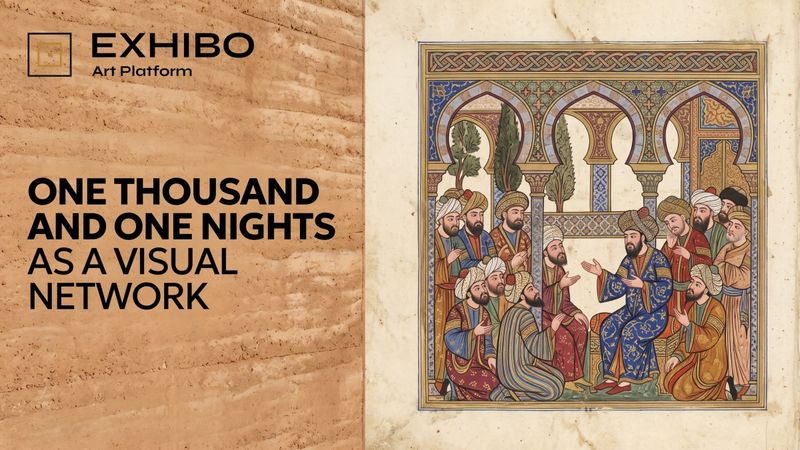
One Thousand and One Nights as a Visual Network
The book that taught Europe to picture the East arrived with no pictures at all. Three centuries of illustrators — Dutch, Egyptian, Persian, French, German, Iraqi — each gave it a face, and every face was a self-portrait.
Open Galland's Thousand and One Nights, the edition that conquered Europe, and there is nothing to look at: no genie, no lamp, not one illustration. The most visually imagined book in the world began blind — and because its text was never fixed either, no picture of it could ever be a copy.
Curating Tomorrow's Archive: Hamburger Kunsthalle Seeks Contemporary Collections Lead
A new permanent appointment will steer the museum's post-1960 holdings across paper, photography, and media formats.
The Hamburger Kunsthalle is inviting applications for a senior curatorial position focused on contemporary acquisitions, exhibition strategy, and digital collection management. Applications close October 2026 for a January 2027 start.