
Exhibo Editorial
Pentimenti: The Paintings Underneath
A change of mind in paint: how pentimenti form, why oil films reveal them, and how to tell an artist's revision from later overpaint
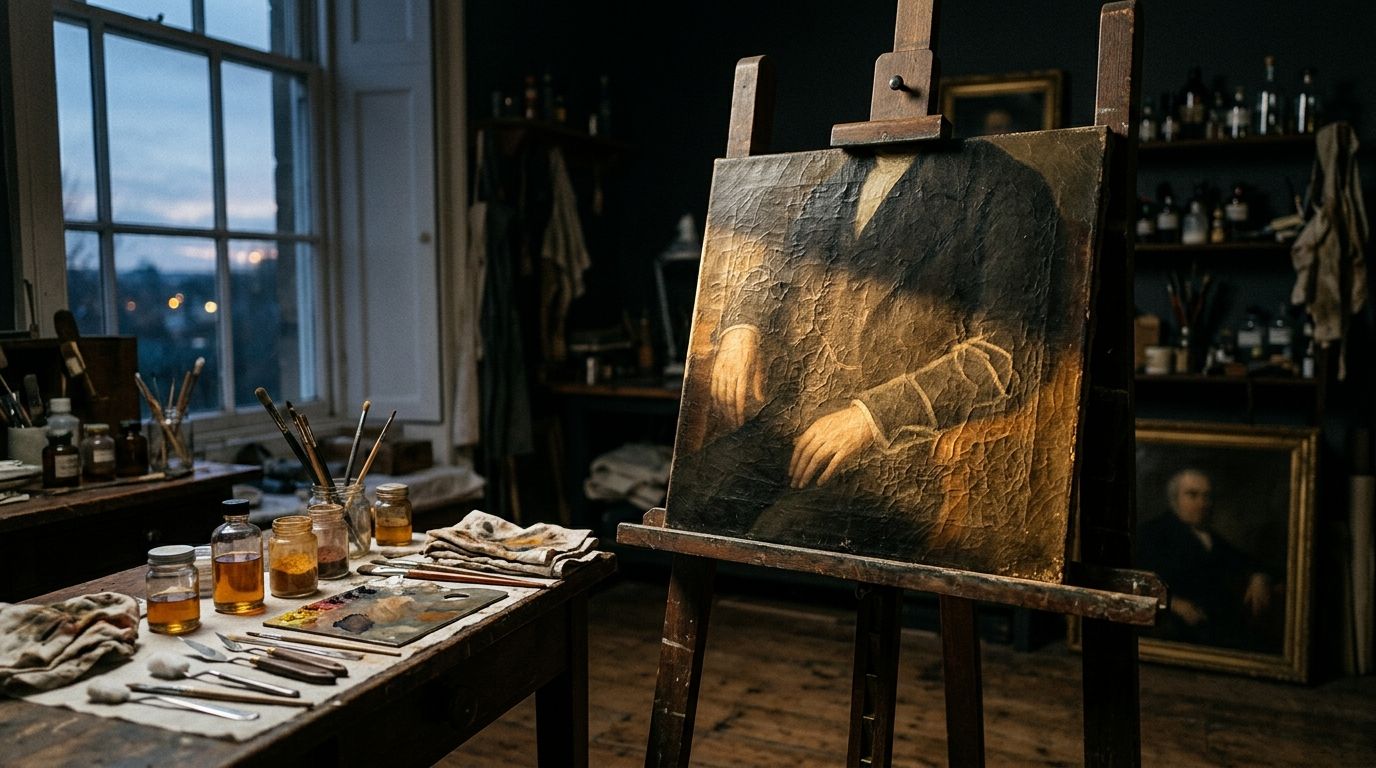
A pentimento is a change the painter made while the picture was still in progress, then covered with later paint. The Italian verb pentirsi means to repent or to change one's mind. Conservators and catalogue writers use the singular pentimento and the plural pentimenti for those revisions: a hand shifted, a hat reduced, a spear painted out. The National Gallery, London, defines the term as a change made by the artist during the process of painting, hidden under a subsequent layer unless time or imaging brings it back.
You meet the word in wall labels and technical bulletins more than in studio slang. This article stays with that art-historical sense. The physics of infrared cameras belongs with infrared reflectography (pending) in this series. A second, abandoned picture on a reused canvas is a different object. The parent map is Art Conservation & Science.
The word and what it names
English borrowed pentimento from Italian art writing. Pentirsi is the verb; pentimento is the noun for the act of changing one's mind. In painting the object of that change is a form the artist had already drawn or painted. The earlier form remains in the physical structure of the picture, even when the surface no longer shows it. The National Gallery glossary is the institutional definition: a change made by the artist during the process of painting, as a rule hidden beneath a later paint layer, and of interest because it records the development of the design and can, in some cases, help attribution.
Britannica's encyclopaedia entry stresses a narrower optical event: the reappearance, in an oil painting, of drawing or paint the artist had covered. That reappearance is one way a pentimento becomes public. A pentimento exists as soon as the artist covers an earlier decision. Ageing, abrasion or a laboratory image may be the first time anyone else sees it. The thing and the sighting of the thing are distinct.
The term is reserved for the maker's own campaign. A restorer who, in 1890, paints a new sky over a damaged one has produced overpaint. A later owner who has a nude clothed has produced censorship. Those sit in a different part of the object's history. The National Gallery's wording ("made by the artist during the process of painting") is the fence.
Underdrawing is a neighbour, not a synonym. Many fifteenth-century Netherlandish painters laid a carbon drawing on a white ground before colour. Infrared imaging can read that drawing. If the drawing and the painted forms agree, you have a preparatory design, not a pentimento. If the painter then moves a foot, shortens a robe or adds a dog that the drawing never contained, the mismatch is the pentimento. Jan van Eyck's Arnolfini Portrait (1434; National Gallery, NG186) is the textbook case of both: a staged underdrawing, then a list of painted additions and corrections.
Copies complicate the folklore. A common claim says that pentimenti prove an autograph original because a copyist would not invent new poses. The National Gallery is more cautious: pentimenti are "sometimes" helpful in attributing paintings. Workshop replicas can include adjustments. A skilled copyist can follow a model and still shift a contour. Treat the traces as evidence of a working process, then weigh them with documents, materials and style.
How a pentimento forms in the studio
Painters revise because the picture in front of them disagrees with the picture in the head, or with the patron's last instruction, or with the pose a model can hold. The revision can happen in the drawing, in the first colour lay-in, or after a passage has already dried. Each stage leaves a different physical record. The studio problem is the same: an earlier form has to be suppressed without scraping the support back to bare ground.
Oil painting on panel or canvas makes suppression incomplete. Lead white, the workhorse opaque, still lets X-rays read the first placement of a limb. Carbon drawing still absorbs infrared. Thin upper layers, or layers that will grow more translucent as the oil ages, will not hide a dark underform forever. The published literature, and the museum cases below, concentrate on oil because that is where the English word earned its life.
Two habits produce most of the pentimenti in the technical literature. Some painters compose on the support, with live models and a spare underdrawing, and correct as they go. Caravaggio's Taking of Christ (1602; National Gallery of Ireland, L.14702) is the museum's example of that habit: numerous pentimenti, now visible as the paint has aged, from posing models in a tableau and altering details in paint. Other painters transfer a squared drawing and still keep revising. Jacques-Louis David's Death of Socrates (1787; The Met, 31.45) was squared from figure studies, then adjusted through the full painting campaign, as Charlotte Hale and Silvia A. Centeno showed in The Met's 2022 technical study.
Revisions in the underdrawing
The first design on the ground is the cheapest place to change one's mind. Chalk, charcoal or a liquid carbon ink can be dusted off, redrawn or ignored once colour starts. Infrared reflectography is the tool that recovers those carbon lines; the method itself is the subject of the pending infrared reflectography article. For vocabulary, the point is this: a pentimento at this stage is a disagreement between the drawn design and the painted design, or between two campaigns of drawing.
Van Eyck's Arnolfini Portrait shows the sequence on the National Gallery's own page. Infrared reflectography shows the underdrawing done in stages. In the first campaign van Eyck sketched the figures, the main furniture and the architecture of the room, and left out objects the painting is now famous for: the terrier, the chandelier, the chair, the beads on the wall, the discarded shoes. Those were painted in late. He also altered both faces and both bodies. Rachel Billinge and Lorne Campbell published the reflectogram composite in the National Gallery Technical Bulletin 16 (1995). The room, the couple and the scale stay the same. The painter edits likeness, costume and props. Late-added objects (the dog, the chandelier) are compositional afterthoughts, and catalogues still file them with the pentimenti because they post-date the first drawn scheme.
David, four centuries later, used a different drawing culture to the same end. The Met's infrared images of The Death of Socrates show fine black painted contours transferred by squaring from the paper studies. The underdrawing already follows those studies. The pentimenti come after, in paint: a chain reduced, a forearm pulled back from the cup, fingers of the drinking hand relaxed. The drawing was a plan. The paint was still a place to think.
Revisions in the paint
Once colour is down, a change costs more. The painter may scrape, may paint an opaque local cover, or may glaze over a form and hope the cover holds. Lead-white passages show both the old and the new placement on an X-radiograph, as a double image. Darker, more translucent paints may vanish from the X-ray and survive in infrared or in elemental maps. Macro X-ray fluorescence (MA-XRF) has added a third class of evidence: pigment-specific maps that show, for example, a vermilion hairband David painted and then suppressed.
Rembrandt's Night Watch (1642; Rijksmuseum) is the large-scale version of paint-stage revision. Operation Night Watch stated in December 2021 that earlier studies had already found dozens of pentimenti, and that new imaging added more: helmet feathers covered, a militiaman's leg moved, an extra sword and extra spears suppressed. The same campaign found a beige, chalk-rich sketch on the brown quartz ground: a compositional search on the canvas rather than a traced cartoon.
Manet's A Bar at the Folies-Bergère (1882; The Courtauld, P.1934.SC.234) shows the same class of decision in a Paris interior. X-radiographs discussed in The Courtauld's technical commentary record the barmaid, Suzon, with arms crossed at the waist in an earlier campaign. In the finished picture her hands rest on the marble. A woman with opera glasses in the reflected crowd is a late addition. The pentimento is a social adjustment as much as a spatial one.
How pentimenti become visible
A pentimento can remain a laboratory fact for centuries. It can also walk into the gallery as a ghost contour, a second hat brim, a four-legged dancer. Three physical routes bring the earlier form to the eye: the oil film grows more translucent; the upper paint is worn or thinned; imaging reads through layers the eye cannot. The first two are the picture ageing or being handled. The third is a conservator's tool, named here without rehearsing detector physics.
Gerard de Lairesse already described increased transparency of oil paint in Groot Schilderboek (1707). Nineteenth-century handbooks repeated the warning that oil darkens and that dark grounds "devour" the colours. As drying oil polymerises, its refractive index rises. Fresh linseed oil sits near 1.48; aged films have been measured above 1.52 and, in old paintings, towards 1.58. Pigment particles scatter light when their refractive index differs from the medium. As the gap closes, less light scatters, more light passes, and you see deeper into the stratigraphy. Lead-white films can also form metal soaps that alter scattering and create local translucency. Petria Noble and colleagues, writing from Rijksmuseum and University of Amsterdam research, treat increased transparency as a combined optical and chemical problem. For the visitor, the result is the same class of ghost: an earlier leg, column or hat that the painter had covered.
Ageing oil films
The classic visible pentimento is a double contour in an old oil picture. The first form was painted with a pigment load that still reads through a thinned or clarified upper layer. Earths, lakes and some lead-white mixtures are the usual culprits. Rubens's modello The Miracles of Saint Francis of Paola is a published teaching example of an archway returning through later columns as the cover lost hiding power. Antoine Watteau's Fêtes Vénitiennes (c.1717; National Galleries of Scotland) is the gallery version you can still walk up to: the male dancer's first leg positions have become visible enough to give him a four-legged stance, and the partner's first hat tilt and hemline have returned. John Leighton, writing on colour, taste and conservation, used those two Watteau pictures in the National Galleries of Scotland as demonstrations of the rising refractive index of oil.
Visibility is uneven across a single canvas. Thick impasto and high-index pigments (lead white at full strength, vermilion, dense blacks) keep covering. Thin skies, shadowed flesh and passages of lake over a dark underlayer do not. A pentimento that "appears" in 2020 may have been inching into view for a century. Lighting in the gallery changes what you notice. Raking light raises ridges where the first form still has body. Transmitted light, used in a studio, can silhouette a dark under-shape.
Conservators record those ghosts as part of the object's condition. Suppressing a pentimento would be a new intervention on an artist's own history.
Wear, cleaning and technical images
Abrasion is the unkind route. If a restorer in the past scrubbed varnish with a solvent that also bit into original paint, the upper layer thins and the underform prints through. Operation Night Watch found this on Rembrandt's dog: the light-coloured sketch now sits nearer the surface than Rembrandt intended, so the animal reads paler. That is wear exposing an underlayer, adjacent to pentimento but not identical with a change of mind.
Cleaning can reveal pentimenti the varnish had masked, or it can create the false impression of a new discovery by removing yellowed resin that had unified the surface. Distinguishing those outcomes is a conservator's job, documented in treatment reports. The visitor sees a clearer ghost after a clean and should not assume the painter wanted it seen.
Technical images recover pentimenti that the surface still hides. X-radiography reads dense pigments, above all lead white, and shows double placements of hands, architecture and costume. Infrared reflectography reads carbon underdrawing and some dark paints. MA-XRF maps elements and can show a vermilion detail painted out, as in David's disciple hairband, or an iron-rich window David blocked in and then abandoned. The National Gallery glossary lists infrared reflectograms and X-rays as the detection methods. Camera settings, misses and mosaic assembly belong in the sibling imaging article. A pentimento can be known from a radiograph decades before anyone sees it on the wall.
Six paintings, six changes of mind
The cases below are chosen for published technical study, named collections, and spread across periods. Each is a pentimento in the National Gallery's sense: the same artist, the same campaign, a design revised in drawing or paint. They are a working set you can check against museum pages and technical bulletins. Collection pages and museums directories will tell you whether the picture is on view before you travel.
The table is a map. Dates follow the holding institution. "Naked-eye" means a visitor with patience and decent light can see at least one ghost without a radiograph. Several of the most important changes remain laboratory facts.
| Work | Artist and date | Collection | What changed | How it is known | Naked-eye? |
|---|---|---|---|---|---|
| The Arnolfini Portrait | Jan van Eyck, 1434 | National Gallery, London (NG186) | Faces, bodies, feet, hat and robe; dog, chandelier, shoes and beads added late | Infrared reflectography; Billinge and Campbell, NGTB 16 (1995); NG collection text | In part (late props are the finished surface; facial revisions are imaging) |
| Bacchus and Ariadne | Titian, 1520–23 | National Gallery, London (NG35) | Among other revisions, the boy-satyr's wreath: anemones covered with jasmine | Surface pentimenti; NG Technical Bulletin 2 (1978) imaging; later published readings of the wreath | Yes, in the wreath and related surface pentimenti |
| The Taking of Christ | Caravaggio, 1602 | National Gallery of Ireland (L.14702) | Numerous adjustments from live posing | Ageing paint; NGI collection text | Yes, in several contours |
| Las Meninas | Diego Velázquez, 1656 | Museo del Prado | Pertusato's leg; a different figure beneath the painter's self-portrait; other shifts in the group | Prado X-radiography (1984 campaign; 2018 re-imaging); Garrido, Velázquez: Técnica y evolución (1992) | Yes, in the dwarf's leg; the figure under the self-portrait is radiographic |
| The Night Watch | Rembrandt, 1642 | Rijksmuseum | Helmet feathers painted out; Kemp's leg moved; extra sword and extra spears suppressed | Operation Night Watch (from 2019); Rijksmuseum, 8 Dec 2021 | Some surface wear; most compositional pentimenti are imaging |
| The Death of Socrates | Jacques-Louis David, 1787 | The Met (31.45) | Chain, goblet hand, oculus window, extra figures on the stairs, right tacking margin opened | IRR, X-radiography, MA-XRF; Hale and Centeno, 2022 | No: Hale and Centeno call the changes imperceptible from the surface |
| A Bar at the Folies-Bergère | Édouard Manet, 1882 | The Courtauld | Barmaid's arms uncrossed; opera-glass figure added | X-radiograph; Courtauld technical commentary | No |
Fifteenth and sixteenth centuries
Van Eyck's oak panel (82.2 × 60 cm) is the Early Netherlandish demonstration that a "photographic" interior was built. The National Gallery's public technical note is blunt: the chandelier cannot fit the space it seems to occupy; there is no fireplace; the bed is too short; the convex mirror is too large. The pentimenti sit inside that constructed room. Arnolfini's face was edited towards a more regular likeness. The wife's gaze and forehead were adjusted. Props that now carry the iconographic load (dog, chandelier, prayer beads, discarded pattens) were absent from the first drawing. Some of those objects arrived late, without underdrawing, as Billinge and Campbell noted for architectural details long treated as central symbols.
Titian's Bacchus and Ariadne (oil on canvas, about two metres across; begun in Venice in 1520 or 1522, finished at Ferrara in 1523) was a substitute for a Raphael the Duke of Ferrara never received. Arthur Lucas and Joyce Plesters published the 1967–69 cleaning and the X-ray and infrared mosaics in National Gallery Technical Bulletin 2 (1978). A still-visible pentimento on the child-satyr (identified in published iconographic work as Ampelos) shows a wreath of anemones covered with jasmine. The first plant would have labelled the boy through a specific myth; the second plant sits in the finished colour chord. You can look for that wreath on the wall. You should not invent Titian revisions the 1978 bulletin does not support.
Caravaggio, between those two poles, offers a control. The National Gallery's Supper at Emmaus (1601; NG172) has, in Larry Keith's technical account, few pentimenti: the one major change is the right-hand apostle's left knee, moved behind the carpet rather than in front of it, to strengthen the thrust of the arm and the fruit basket. The Taking of Christ, painted the next year for the same patron, Ciriaco Mattei, is the opposite: the Dublin canvas carries numerous pentimenti now visible as the paint has aged. Same painter, same years, different degree of on-canvas search.
Seventeenth century
Velázquez's Las Meninas (1656) is the Prado's most examined picture. The museum's 2018 statement, issued after a night campaign of pigment analysis, radiography and infrared reflectography, repeated a finding from 1984: the picture is a complex, meditated construction. Carmen Garrido's 1992 monograph, based on the 1980s Prado technical campaign, remains the printed baseline. A pentimento visitors still hunt for is the leg of Nicolasito Pertusato, the court dwarf at lower right: a parallel shadow records a first placement, then a shift. More contested is the radiographic figure beneath Velázquez's self-portrait. Garrido described a younger person in different dress and a different pose. Later writers have read that form as female, even as Queen Mariana moved into the mirror. The Prado has not, in its public 2018 notes, issued a new named identification. Report the X-ray fact. Leave the romance.
Rembrandt's civic militia piece is the other seventeenth-century laboratory. Operation Night Watch, begun in 2019 in a glass chamber in the Gallery of Honour, mapped the 379.5 × 453.5 cm canvas with macro-XRF, reflectance imaging spectroscopy and related methods. Taco Dibbits called the recovered sketch the genesis of the picture. Petria Noble stressed the beige, chalk-rich paint of that sketch as, at the time of the announcement, unmatched in other Rembrandts. The pentimenti (feathers, spears, sword, Kemp's leg) are edits on top of that search. A separate fact, easy to confuse with pentimento, is the 1715 cutting of the canvas when the picture moved to Amsterdam's Town Hall: strips were lost from the edges. That is later damage to the support.
Vermeer's Girl with a Pearl Earring (c.1665; Mauritshuis) belongs in the same century as a small, precise counterpart. The 2018 Girl in the Spotlight project, published in Heritage Science in 2019–20, named pentimenti that include shifting the ear upward, adjusting the line between cheek and headscarf, and softening the contour at the back of the neck. The changes are millimetres of contour. They still count.
Eighteenth and nineteenth centuries
David's Death of Socrates (oil on canvas, 129.5 × 196.2 cm) is The Met's demonstration that Neoclassical "finish" can hide a restless campaign. Hale and Centeno, working ahead of Jacques Louis David: Radical Draftsman (2022), combined infrared, X-radiography and MA-XRF. The mercury map showed vermilion in a hairband on a dark-haired disciple, then painted out as a distraction. The iron map showed an oculus window blocked in behind Socrates, then replaced with a severe wall and a small ring-and-hook. On the stairs, in the group long read as the departing family, MA-XRF revealed further figures: a cloaked woman carrying a child who holds her neck and reaches back. Hale and Centeno suggest, with due caution, Xanthippe and the youngest son from Plato's Phaedo. David painted them out. He also opened the right tacking margin so the far disciple's arm could close the edge.
Manet's barmaid is the last of the six core cases, and the one whose X-ray has entered undergraduate slide lists. The Courtauld's collection text still leads with the spatial puzzle of the mirror. The technical record adds a puzzle of pose. Suzon first guarded her waist with crossed arms. Manet then opened the pose onto the counter. The opera-glass woman in the crowd arrived late. The pentimenti leave the reflection unsolved. They show that the social geometry of the picture was still being decided in paint, in the studio, with a hired barmaid, after the on-site sketches.
How living painters use the idea
Twentieth- and twenty-first-century painters inherited the word and, in some studios, kept the habit as a visible ethic. The historical pentimento was a cover that failed with age. Some living painters refuse to complete the cover. Charcoal lines of rejected poses stay on the sheet. Oil scrapes leave a ridge of an earlier shoulder. The viewer is meant to see the search.
Jenny Saville has titled drawing series Pentimenti and has said she wants "simultaneous realities" in one image: retained contours that record a body in more than one position. Lucian Freud sanded and restated flesh until the final crust hid most of the trial; Nicholas Penny, reviewing him, still found underdrawing and revised cheek contours visible in the etched Head of Francis Bacon. Frank Auerbach and Leon Kossoff built pictures by scraping back and leaving the archaeology in the paint.
Picasso is the trap in this chapter. He reused supports, painted new subjects over abandoned ones, and let underforms ghost through thin Blue Period layers. The Art Institute of Chicago's Old Guitarist (late 1903–early 1904; oil on panel) is the famous case: infrared and X-ray campaigns found a woman and, in further work, a mother-and-child composition Picasso had described in a letter to Max Jacob. Conservators at the Art Institute have been plain that Picasso skipped an intermediate ground on many supports and even harvested a contour or a shadow from the picture underneath. That is reuse of a support, sometimes with deliberate show-through. A pentimento revises this picture. A reused canvas buries another picture. Popular writing collapses the two because both produce ghosts.
Conceptual uses of the word (Lillian Hellman's 1973 memoir Pentimento, the video game Pentiment, a Philadelphia gallery named Pentimenti) are metaphors. They borrow the Italian and leave the studio. They do not change how a conservator uses the term on a condition report.
How to look for pentimenti in a gallery
Stand at a normal viewing distance first, then step in to the limit the ropes allow. You are hunting for a double: a second brim around a hat, a dark oval inside a calf, a spear-point that belongs to no spear on the surface, a hand that seems to have too many fingers until you realise one set is a ghost. Watteau's dancer in Edinburgh is the courtesy example: once you have seen the extra legs, you cannot unsee them. Velázquez's Pertusato, if the room is quiet and the light is kind, offers a fainter version of the same lesson.
Raking light, if the hang gives you any, is your friend. A pentimento with body (a scraped ridge, a first lead-white sleeve) casts a small relief shadow. Specular light on varnish can hide the same ridge. Move your head. Museum lighting is designed for the finished image, so some ghosts appear in published radiographs alone. David's Socrates will not yield its stair figures to your unaided eye. Hale and Centeno said as much.
Read the label and the online technical note before you invent a narrative. National Gallery collection pages for van Eyck and Caravaggio already tell you what the imaging showed. The Rijksmuseum published the Night Watch pentimenti in a press release you can still retrieve. The Met published the Socrates campaign in a 2022 Perspectives essay. If the institution has not claimed a pentimento, do not announce one from a patch of abraded sky.
Visible without a laboratory
Surface pentimenti share a family look. The ghost is in register with the picture's space: a first version of a form that is still in the composition, or a form the painter suppressed. The paint of the ghost is the same campaign: craquelure running through both layers, the same yellowing, the same wear. The colour of the ghost is a cooler or dirtier version of a neighbouring passage, because you are seeing an underlayer through a translucent cover.
Touch is forbidden, so use your eyes on edges. A contour that thickens, splits or carries a dark halo is a candidate. Flesh next to a costume change is a candidate: painters move arms more than they move architecture. Look at hands, hats, swords, animal legs and the junctions where a figure meets a table. Those are the studio's revision sites.
Compare, if the museum allows, the picture with a documented copy. Gerrit Lundens's copy of The Night Watch still shows a musket-smoke plume that abrasion has almost removed from Rembrandt's canvas. That is condition, not pentimento. A copy that lacks a ghost you can see on the original may tell you the ghost appeared after the copy was made, as the oil grew translucent. De Lairesse's 1707 remark is the period witness that painters already knew this would happen.
Limits of looking from the rope
Authorship, date of the change, and the difference between the artist's cover and a restorer's cover are laboratory and documentary questions. Ultraviolet fluorescence can show later retouching as dark patches. A cross-section, taken from a loss or an edge, can show whether the covering paint sits above an aged, dirtied, or varnished surface (later) or within a continuous, unvarnished build-up (studio). Pigments invented after the painter's death (zinc white in quantity, titanium white, Prussian blue in a fifteenth-century panel) date a layer. None of that is available from the visitor's position.
Do not use a phone torch against the varnish. You will annoy the room and you will not get an infrared reflectogram. If the museum has a technical display (the Rijksmuseum has made a public virtue of Night Watch imaging), use that. If it has not, trust the published study over your hunch.
A silent label is normal. Many pentimenti are known from radiographs the museum has not printed beside the picture.
Pentimento versus later overpaint
Overpaint is paint applied after the work left the artist's working process: a restorer filling losses, a dealer hiding damage, an owner clothing a nude, a later hand "improving" a sky. It can sit on top of original varnish. It can use pigments the first painter did not have. It can ignore the original craquelure and sit as a skin that ages on a different clock. Conservators remove overpaint when it is disfiguring and when the original can take the treatment. They do not remove pentimenti. The pentimento is original.
The practical test in a studio is stratigraphy plus materials. A pentimento's covering layer is the artist's own paint, bound in the same oil, continuous with adjacent original passages, without an intervening varnish or dirt line. Later overpaint has a fluorescence under ultraviolet distinct from the original, a different medium (natural resin mixed in, or a modern synthetic), and a crack pattern that does not match. Cross-sections make the sandwich visible: ground, underdrawing, first paint, second paint of the same campaign, then, much later, varnish, then overpaint.
Moral language is a nuisance here. A pentimento is a decision, not a "mistake" the painter failed to hide. Later overpaint can be a rescue (a lost passage reconstructed from a copy) or a falsification (a signature added, a saint added to please a new market). The ethics live in the later intervention. The Prado's Velázquez campaign since 1982, summarised in Studies in Conservation 37 (1992), treated compositional change as part of technique and evolution, then cleaned and inpainted losses. The pentimenti stayed.
Censorship overpaint is the public cousin. Draperies added to nudes, fig leaves, smoked-out political emblems: these are historical facts about later viewers. They are later campaigns. If a conservator removes them, the museum is reversing that campaign. The vocabulary stays tight: that work is not "restoring a pentimento."
Common confusions and misuses
The highest-volume Google query is the bare word pentimento (about 2,900 searches a month in the United States). That query is a language pile-up: the art term, Hellman's memoir, a pop-punk band, a Dead by Daylight perk, a shop, a wine, a photographer's project. This article's keyword, pentimento art, is the disambiguation.
Reused canvas is the main studio confusion. Picasso's Old Guitarist hides other compositions, as the Art Institute of Chicago's conservation talks have shown. Poverty, speed and appetite all explain reuse. The ghost is real. The term, if you follow the National Gallery, is wrong. Say "abandoned composition" or "reused support."
Underdrawing show-through is the second confusion. A carbon line that was always meant to guide the brush, and that now prints through thin paint, is not a change of mind. It is a drawing doing its job too well after the cover thinned. Infrared will show a complete, coherent design that the paint follows. A pentimento is the place the paint refuses the drawing, or the place a second drawing corrects the first.
Condition phenomena steal the word in casual talk. Abraded dogs, blanched varnish, lead-soap specks, craquelure that lets a dark ground wink through: all can look like "another picture underneath." Craquelure has its own guide in this series. Lead soaps on The Night Watch are a documented ageing product, thousands of white specks, some fallen out. They are not Rembrandt's first idea returning.
Attribution folklore is the third misuse. Auction copy and television scripts treat pentimenti as a lie-detector test. The National Gallery's "sometimes helpful" is the adult version. A change of mind is evidence that someone was thinking on that support. It does not name the thinker. Materials, provenance and comparative technique still have to do that work. Forgery detection as a method sits in a sibling article.
Metaphor is allowed in criticism and memoir. On a condition report, pentimento means the painter changed this picture while making it.
FAQ
What does pentimento mean in art?
A pentimento is a revision the artist made during the making of the work and then covered with later paint or drawing. The Italian source is pentirsi, to repent or to change one's mind. The National Gallery, London, uses that definition in its glossary and notes that the change is as a rule hidden unless the upper paint has grown transparent or unless infrared and X-ray images recover it.
What is the difference between pentimento and pentimenti?
Pentimento is singular; pentimenti is the Italian plural, used in English catalogues. One shifted hand is a pentimento. The set of shifts in The Night Watch are pentimenti. English "pentimentos" appears in some dictionaries and is unnecessary in museum prose.
Which famous paintings have pentimenti?
Documented cases include van Eyck's Arnolfini Portrait (National Gallery, London), Titian's Bacchus and Ariadne (same collection), Caravaggio's Taking of Christ (National Gallery of Ireland), Velázquez's Las Meninas (Prado), Rembrandt's Night Watch (Rijksmuseum), Vermeer's Girl with a Pearl Earring (Mauritshuis), David's Death of Socrates (The Met) and Manet's A Bar at the Folies-Bergère (The Courtauld). Each has a published technical study or an institutional collection text that names the changes.
How can pentimenti be detected?
Some become visible as oil paint grows more translucent with age, or as upper layers wear. Others remain hidden until X-radiography, infrared reflectography or elemental mapping (MA-XRF) records them. The National Gallery glossary names infrared reflectograms and X-rays. The cameras and their limits are covered in the pending infrared reflectography article.
Does a pentimento prove a painting is an original?
No. Pentimenti record a working process on that support. They can support an attribution when they match a painter's known habits, as the National Gallery notes. Copies, workshop variants and later forgeries can all include adjustments. Absence of pentimenti does not prove a copy.
Is Picasso's Old Guitarist a pentimento?
The Art Institute of Chicago's imaging found earlier figures under the 1903–04 panel, including a woman and a mother-and-child group. That is a reused support with abandoned compositions, a habit Picasso repeated. A pentimento, in the glossary sense used throughout this article, is a revision of the same picture, not a different picture buried for economy or experiment.
Related reading
Diego Rivera's Monumental Stadium Relief Set for Conservation in Mexico City
A multi-institutional campaign targets the artist's unfinished stone facade at UNAM alongside works by Siqueiros and O'Gorman
Local conservators will lead a phased preservation effort for Diego Rivera's volcanic stone relief at Mexico City's Olympic stadium, supported by the World Monuments Fund and US diplomatic grants.
Van Lévé: Sovereign Caribbean Visions Take Shape at Harvard
A transnational survey charts twenty-five years of Creole and Maroon artistic practice across the French Caribbean and Amazonia.
Harvard's Alain Locke Gallery presents a landmark survey tracing contemporary production from Guadeloupe, Martinique, Guyane, and Haiti since two thousand and one.
Gustave Fayet: Collector—Artist Designer
A comprehensive survey at the Fondation Louis Vuitton reuniting collected masterpieces with the designer's own studio practice.
The Paris institution expands its patronage series with a dual-focused examination of Gustave Fayet, bringing together hundreds of acquired works and restored creations to chart his impact on early modernism.