
Riyadh · Saudi Arabia
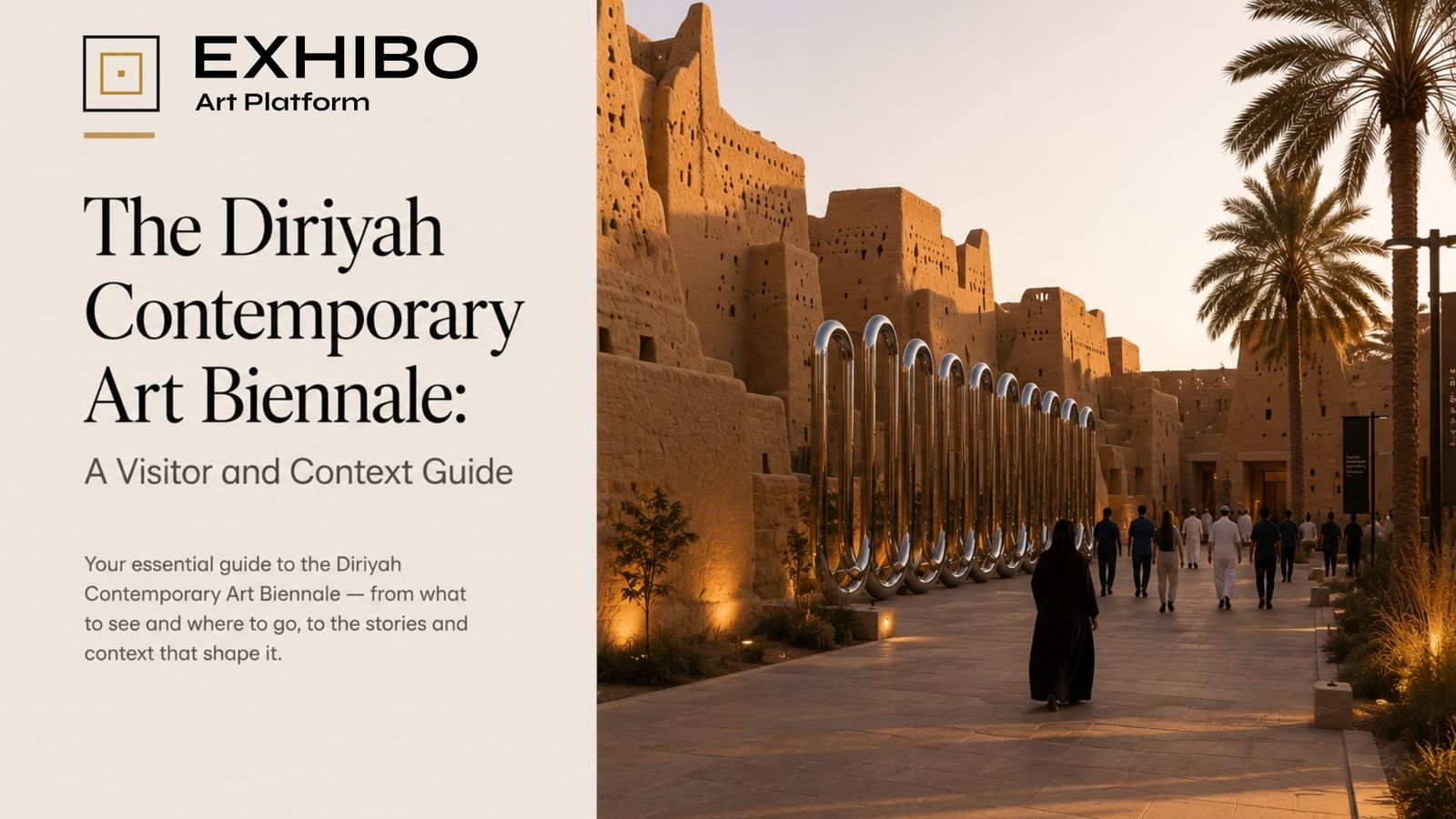
The Diriyah Contemporary Art Biennale: A Visitor and Context Guide
An in-depth look at the curators, scenography, and regional commissions shaping Saudi Arabia’s premier international contemporary art platform.
The Diriyah Contemporary Art Biennale represents a major development in the global cultural calendar, transforming the historic town of Diriyah on the outskirts of Riyadh into a central meeting point for international artists, curators, and collectors. Established in 2020 by the Ministry of Culture under the Diriyah Biennale Foundation, this recurring exhibition is designed to place regional creative practices in direct conversation with global movements. Rather than relying on traditional, sterile museum formats, the biennial utilizes the vast, raw spaces of the JAX District, a former industrial warehouse park, to display site-specific installations, soundscapes, performances, and digital works.
For anyone traveling to the Kingdom to experience this event, the sheer scale of the exhibitions and the rapid growth of the local creative scene can feel overwhelming. This guide offers an in-depth exploration of the biennial's curatorial history, highlighting key commissions from the recently concluded third edition, "In Interludes and Transitions," while providing practical advice for navigating the site. Navigating this fast-moving cultural terrain is made much easier with contemporary discovery tools like Exhibo, which maps out active exhibitions and independent galleries across the wider Riyadh art scene.
The origins of the Diriyah Biennale Foundation
The Diriyah Biennale Foundation was established during a major period of social and economic reform in Saudi Arabia, serving as a primary cultural output of the Vision 2030 programme. The foundation was tasked with producing two distinct, alternating biennials: the Contemporary Art Biennale in Riyadh and the Islamic Arts Biennale in Jeddah. By separating these two initiatives, the foundation created two clear platforms—one dedicated to current, multi-disciplinary global art practices, and the other focused on the historical and contemporary artistic traditions of Islamic civilisation.
This structural separation has allowed the Contemporary Art Biennale to experiment with highly modern, sometimes controversial themes that address global concerns like urbanisation, ecology, migration, and digital identity. The choice of Diriyah as the permanent host city is highly symbolic. As the ancestral home of the House of Saud and a major historic oasis along ancient trade and pilgrimage routes, Diriyah represents the foundation of the country's heritage. Placing cutting-edge contemporary art within this historic context creates a productive friction between the weight of history and the fluidity of modern life.
Rather than importing pre-packaged international exhibitions, the foundation has prioritised commissioning new, site-specific works that respond directly to the local environment, climate, and architecture. This commitment to production has turned the biennial into an important incubator for regional talent, giving emerging Saudi artists the financial support and space to realize complex, large-scale projects. By presenting these new commissions alongside works by established international figures, the foundation has successfully positioned Riyadh as a serious producer of contemporary culture, rather than just a consumer of global art trends.
Curatorial framework of "In Interludes and Transitions"
The third edition of the Diriyah Contemporary Art Biennale, which ran from 30 January to 2 May 2026, marked a significant departure from the curatorial structures of previous years. Titled "In Interludes and Transitions" (في الحِلّ والترحال), the exhibition focused on the physical and cultural movements that shape our world. Rather than presenting static, decorative objects, the curators assembled a series of temporal experiences that examined migration, memory, and the constant movement of peoples across regional borders.
The curatorial vision of Nora Razian and Sabih Ahmed
Co-artistic directors Nora Razian and Sabih Ahmed structured the 2026 edition around the idea of the world in intense motion. Razian, who previously directed exhibitions at Art Jameel in Dubai and Jeddah, joined forces with cultural theorist Sabih Ahmed to think about how global developments look when viewed from the Gulf. They resisted the traditional Western practice of categorising art by national boundaries, choosing instead to map how ideas, stories, and materials travel across oceans and desert routes.
The title "In Interludes and Transitions" borrows from a colloquial Arabic phrase that refers to the cycles of encampment and departure common to nomadic communities in the Arabian Peninsula. This linguistic starting point allowed the curators to examine ideas of home and displacement in a highly nuanced way. It suggested that continuity and identity are not found in staying in one place, but rather in the shared traditions, songs, and languages that survive repeated migrations.
This conceptual framework was particularly fitting for the historic town of Diriyah itself. Once a major oasis and trade crossroads along ancient pilgrimage routes, the district is now being actively rebuilt as a contemporary cultural hub. By connecting regional history with modern international movements, the curators demonstrated how temporary states of transition can produce lasting cultural alliances.
Scenography by Formafantasma
The spatial experience of the exhibition was designed by the acclaimed Italian research and design studio Formafantasma. Spanning roughly 12,900 square metres of renovated industrial warehouses, the scenography rejected the sterile, white-walled aesthetics common to international art fairs. The designers worked to preserve the historic, industrial character of the JAX District, allowing the raw concrete floors and exposed steel rafters to participate in the exhibition.
Formafantasma used sustainable, locally sourced materials to partition the cavernous warehouse interiors into smaller, intimate viewing areas. By choosing non-intrusive structures, they ensured that visitors remained aware of the larger warehouse environment and the outdoor paths connecting the different pavilions. This design approach encouraged a slow, thoughtful exploration of the works, mimicking the slow journeys of migration that defined the curatorial theme.
The spatial layout divided the massive exhibition space into five distinct choreographic movements: "A Procession," "Disjointed Choreographies," "A Hall of Chants," "A Collective Observation," and "A Forest of Echoes." Each movement guided visitors through different sensory experiences, transitioning from loud, performative installations to quiet, conceptual rooms. The resulting layout felt like a physical score, encouraging people to move in rhythmic patterns through the art.
Connecting global geographies
The 2026 Biennale gathered over 65 artists from 37 different countries, creating a truly global dialogue in the middle of Riyadh. The selection of artists represented a deliberate effort to look beyond the dominant galleries of Western Europe and North America. Instead, the exhibition highlighted strong connections between West Asia, South Asia, Africa, and East Asia, reflecting on shared histories of trade, colonial division, and migration.
By displaying works by veteran international artists alongside newly commissioned projects by emerging Saudi creators, the exhibition provided a rare space for generational exchange. Visitors could see how older, established practices from the Global South intersected with the immediate, urgent concerns of younger regional artists. This approach moved the discussion away from simple representation, focusing instead on deep, shared histories.
For those attempting to trace these global networks, keeping track of how different international artists integrate into Riyadh's art scene can be a challenge. Online directories like Exhibo offer a comprehensive resource, allowing users to trace exhibition histories and discover how global biennials influence local gallery spaces. By mapping these complex interactions, Exhibo helps visitors explore the broader context of the Riyadh art scene.
Notable commissions and artistic highlights
With over 20 new commissions created specifically for the 2026 edition, the Biennale functioned as an important incubator for new artistic production. These works spanned visual art, sound installations, performance pieces, film, and architectural research, responding directly to the industrial architecture of JAX and the wider history of the Arabian Peninsula. The resulting displays offered a highly tactile, physical engagement with the themes of movement and transition.
Mohammed Alhamdan's opening procession "Folding the Tents"
One of the most talked-about events of the Biennale’s opening night was a major public performance titled "Folding the Tents," conceived by multidisciplinary Saudi creative Mohammed Alhamdan (known locally as 7amdan). The performance began on the desert highway leading to the JAX District, where a procession of Toyota LC79 pickup trucks (popularly known as "shass" vehicles in the region) slowly crawled towards the exhibition site. These vehicles are deeply rooted in Saudi rural and desert culture, representing a rugged, practical resilience.
As the trucks reached the venue, they were joined by traditional camels and a large procession of young men beating drums and singing. The performance quickly transformed into a lively celebration, drawing the massive, diverse opening night crowd into a collective dance. The energy was further elevated when Palestinian rapper Shabjdeed took the microphone, leading the audience in a high-energy performance that echoed through the surrounding wadi.
By bringing these everyday symbols of desert work and contemporary youth culture into the formal boundaries of an international art biennale, Alhamdan challenged the stiff, elite atmosphere that often dominates such events. The performance served as a physical demonstration of the biennale’s core theme, showing how traditional nomadic ideas of movement can be translated into modern, urban celebrations. It was an opening that felt genuinely authentic to the local community.
Petrit Halilaj's "Very volcanic over this green feather"
Located in one of the central warehouse spaces, Petrit Halilaj's immersive, large-scale installation, "Very volcanic over this green feather," offered a powerful look at the personal trauma of conflict and displacement. The artist suspended dozens of large felt panels from the high rafters of the warehouse, creating a theatrical, walk-through forest of imagery. On one side, the panels displayed colourful, innocent drawings of birds, plants, and domestic scenes, which Halilaj created when he was a thirteen-year-old living in a refugee camp during the Kosovo war.
However, as visitors walked through the installation, the reverse side of the felt panels revealed dark, violent scenes of soldiers, burning houses, and the physical destruction of war. This contrast between private, childhood imagination and the brutal realities of geopolitical conflict created a heavy, quiet atmosphere within the cavernous industrial space. The installation forced viewers to confront the psychological transitions that happen when a person is suddenly forced to flee their home.
In the context of early 2026, with the wider region experiencing ongoing conflicts and displacement, Halilaj’s work took on a particularly sharp, immediate relevance. It prompted deep conversations among visitors about what happens to individual memories when physical homes are destroyed. The piece demonstrated how contemporary art can bypass simple politics to address the shared human experience of survival and resilience.
Afra Al Dhaheri's "Dining East or West?"
Emirati artist Afra Al Dhaheri presented an installation, "Dining East or West?", which used heavy industrial materials to examine domestic spaces and shifting cultural boundaries. The piece was constructed using glass, ceramic, cement, and concrete cinderblocks, arranged in a way that mimicked both traditional domestic dining layouts and rapid urban construction sites. By using these everyday building materials, Al Dhaheri created a physical tension between the intimacy of the home and the coldness of city planning.
The choice of concrete cinderblocks was a deliberate nod to the rapid, concrete-driven urbanisation of the Gulf over the last fifty years. These blocks are the literal foundations of the region’s modern expansion, yet they also represent a loss of traditional clay and stone building techniques. Al Dhaheri’s work suggests that our domestic spaces are constantly in a state of transition, caught between traditional heritage and the rapid demands of modern development.
The heavy, blocky structure of the installation contrasted beautifully with the delicate ceramic and glass elements placed on top, representing the fragile nature of personal relationships within rapidly changing societies. Visitors spent long periods examining the textures of the concrete and the smooth glass, reflecting on their own experiences of domestic life in the Gulf's expanding cities. It was a subtle, highly material contribution to the biennale's overall narrative of transition.
The physical venue: JAX District as a cultural stage
The choice of the JAX District as the permanent home of the Contemporary Art Biennale is central to the event's identity and success. By situating a major international exhibition within a formerly active industrial zone, the Diriyah Biennale Foundation has bypassed the traditional museum formats of Western capitals. This industrial setting changes how art is viewed, forcing a direct engagement with physical scale, material history, and urban transformation.
Industrial conversion and spatial layout
The JAX District consists of massive, corrugated iron and concrete warehouses that once stored materials for Riyadh’s early expansion. The conversion of these spaces into exhibition galleries was carried out with a light touch, keeping the raw industrial spirit of the district intact. Rather than hiding the buildings' histories, the galleries embrace their irregular plans, high ceilings, and exposed utility pipes, creating a unique backdrop for large-scale contemporary works.
Unlike traditional museums, which keep visitors enclosed in a single, climate-controlled building, the Biennale is spread across multiple separate warehouses. Visitors must walk outside through the dusty lanes of JAX to travel from one pavilion to the next, exposing them to the sights, sounds, and heat of the local environment. This outdoor movement keeps the audience connected to the reality of Riyadh's climate, making the visit feel like a physical journey rather than a sterile academic exercise.
The surrounding lanes of the district are also home to independent cafes, design firms, and creative agencies, which remain active long after the biennial doors close. This means that visiting the exhibition is not an isolated cultural event, but rather an entry into a living, working creative neighbourhood. The industrial layout encourages casual interactions between international curators, local artists, and everyday visitors, creating an open, community-driven atmosphere.
The role of the Saudi Museum of Contemporary Art at JAX
The JAX District also houses the Saudi Museum of Contemporary Art (SAMoCA), a permanent institution that works in close coordination with the Biennale Foundation. While the Biennale is a temporary, rotating event, SAMoCA provides a lasting public repository for contemporary works, ensuring that the critical discussions started during the biennial are preserved. The museum's presence in JAX establishes a permanent anchor for the district's creative community, offering year-round exhibition programming.
The physical proximity of the museum to the biennial warehouses allows visitors to easily experience both temporary international surveys and permanent, state-curated collections in a single afternoon. This setup helps visitors understand how the temporary, experimental ideas of the biennial feed into the permanent collection of the country's national museums. It shows a clear, organised progression from temporary artistic experiment to lasting cultural heritage.
SAMoCA also provides essential infrastructure for the district, including high-quality research libraries, conservation labs, and archival spaces. This institutional backbone is necessary for supporting the local creative community and training a new generation of Saudi museum professionals. By linking the global perspective of the biennial with the local preservation efforts of the museum, the JAX District functions as a complete, self-sustaining cultural ecosystem.
A platform for regional education and dialogue
Education was central to the design of the 2026 Biennale, with the foundation organising an extensive public programme that ran alongside the main exhibition. This programme included panel discussions, curator-led gallery walks, and practical workshops designed for local students, artists, and families. These educational efforts aimed to demystify contemporary art, making its conceptual ideas accessible to an audience that is still relatively new to the biennial format.
The foundation also produced a comprehensive, bilingual guidebook and a series of research-based publications to document "In Interludes and Transitions." These catalogues do not simply list the artworks; they include scholarly essays, artist interviews, and historical research that analyse the exhibition's themes from a Middle Eastern perspective. This focus on publishing is an important step towards building a regional body of art criticism, ensuring that the ideas generated during the biennial are recorded for future study.
By offering these educational resources, the Biennale helps train a new generation of local curators, art historians, and cultural writers. The workshops provide hands-on experience in exhibition design, installation management, and public programming, building the local expertise needed to support the country's rapidly growing cultural sector. It is these educational initiatives that will have the most lasting impact on Riyadh's creative scene, far surviving the temporary displays of the exhibition.
Historical context: Comparing previous editions of the Biennale
To fully appreciate how the Diriyah Contemporary Art Biennale has matured, it is helpful to look back at the curatorial paths of its previous editions. Each iteration has marked a different stage in Saudi Arabia's cultural opening, moving from an initial introduction of international practices to a highly self-reflective, regionally grounded dialogue.
The inaugural edition in 2021, titled "Crossing the River by Feeling the Stones" and curated by Philip Tinari, was designed as a broad introduction to global contemporary art. It focused heavily on themes of rapid social transformation and modern history, drawing parallels between the economic developments of China in the late twentieth century and the current reforms in Saudi Arabia. The exhibition was highly structured, presenting a clean, international style that established the raw warehouses of JAX as a viable, professional art destination.
In contrast, the second edition in 2024, titled "After Rain" and led by artistic director Ute Meta Bauer, shifted the focus towards ecology, environmental change, and local climate realities. Bauer structured the exhibition as a slow, organic process, using natural light and presenting works that engaged directly with soil, water scarcity, and agricultural history. This edition felt much more contemplative, encouraging visitors to slow down and consider how regional traditions of land management could offer solutions to modern ecological crises.
By the time the third edition, "In Interludes and Transitions," opened in early 2026, the biennial had successfully moved away from simply displaying imported art. The curators Nora Razian and Sabih Ahmed were able to build on the lessons of the previous two editions, presenting a highly complex, postwestern narrative that felt deeply rooted in the actual experiences of the local population. This progression demonstrates that the biennial is not a static corporate event, but a living, evolving institution that responds to the changing critical needs of the region.
The Biennale's place in Riyadh's cultural geography
The Contemporary Art Biennale does not exist in a vacuum; it is the flagship event of a much larger, highly active city-wide creative ecosystem. For visitors traveling to Riyadh, experiencing the monumental scale of the JAX District is just the first step in understanding the local art scene. To get a complete picture, one must explore how these temporary biennial experiments connect with the permanent commercial and historical institutions of the capital.
After viewing the large-scale installations in Diriyah, visitors can head to the Al Olaya district in central Riyadh to see how regional artists transition to smaller, highly collectible formats. The commercial galleries in Riyadh, particularly the unique vertical cluster of spaces located within the vintage Al Mousa Centre on Olaya Street, offer an intimate look at the local art market. Here, spaces like Errm Gallery and Tajreed Gallery exhibit contemporary paintings, sculptures, and calligraphy that are actively sought after by regional collectors.
At the same time, the historical context that informs many of the biennial’s themes can be explored in the city’s major public institutions. The National Museum of Saudi Arabia in Al Murabba houses extensive archaeological and cultural collections that trace the visual heritage of the Arabian Peninsula over thousands of years. By consulting directories of museums in Riyadh, visitors can coordinate their biennial trips with historical tours, creating a complete cultural itinerary that bridges the ancient past with the contemporary present.
Practical guide for visitors planning a Biennale trip
Visiting the Diriyah Contemporary Art Biennale requires some advance planning due to the sprawling nature of Riyadh's urban layout and the seasonal differences in temperature. The exhibition pavilions are spread across several converted warehouses in the JAX District, meaning that you will spend a significant amount of time walking outdoors between different indoor galleries.
To ensure a comfortable and productive visit, keep the following practical tips in mind:
Ticket Registration: Admission to all exhibition pavilions and public programmes is completely free of charge, but visitors must register for a specific entry slot online in advance via the official Diriyah Biennale Foundation website or mobile app.
Transportation: The JAX District is located on the western outskirts of the city, approximately a 30-minute drive from central Riyadh. Hiring a car or using ride-hailing services like Uber or Careem is the most practical way to reach the venue, as public transport options to this specific area are limited.
Timing Your Visit: Plan your arrival for late afternoon, around 4:30 PM, to avoid the high midday heat. This timing allows you to walk the outdoor paths comfortably, catch the sunset over the surrounding Wadi Hanifah, and experience the district as it comes alive with local visitors in the evening.
Recommended Duration: Allow at least three to four hours to fully explore the multiple exhibition warehouses, outdoor installations, and to enjoy a break at one of the independent cafes or bookshops operating within the JAX District.
By taking these steps, you can avoid the worst of the city's traffic and heat, leaving you free to focus entirely on the complex contemporary works on display.
Analytical breakdown of the Biennale's structural impact
The table below outlines the core differences in scale, leadership, and conceptual focus across the three editions of the Diriyah Contemporary Art Biennale, illustrating how the event has matured into a highly reflective, international institution.
Edition | Dates | Key Curators | Central Themes | Scenography Style |
1st Edition: "Crossing the River by Feeling the Stones" | Dec 2021 – Mar 2022 | Philip Tinari, Luan Shixuan, Neil Zhang | Social transformation, regional modernism, and international cultural exchange | Highly structured, clean white-cube pavilions constructed inside raw warehouses |
2nd Edition: "After Rain" | Feb 2024 – May 2024 | Ute Meta Bauer, Rose Lejeune, Anca Rujoiu | Ecology, soil, water scarcity, organic processes, and environmental resilience | Open, breathing layouts with natural light and spaces dedicated to research and poetry |
3rd Edition: "In Interludes and Transitions" | Jan 2026 – May 2026 | Nora Razian, Sabih Ahmed | Migration, nomadic cycles, planetary movement, and postwestern alliances | Choral and rhythmic paths designed by Formafantasma, utilising sustainable materials |
Frequently asked questions
What is the difference between the Contemporary Art Biennale and the Islamic Arts Biennale?
The Diriyah Biennale Foundation organises both events on an alternating, biennial schedule. The Contemporary Art Biennale is held in the JAX District of Diriyah (Riyadh) and focuses on multi-disciplinary, modern global art practices. The Islamic Arts Biennale is held at the Western Hajj Terminal in Jeddah, focusing specifically on the historical and contemporary visual arts, calligraphy, and material heritage of Islamic civilisation.
How often is the Diriyah Contemporary Art Biennale held?
The Contemporary Art Biennale is a recurring event held once every two years, usually running for several months in the winter and spring. Because the foundation alternates this event with the Islamic Arts Biennale, Riyadh hosts the contemporary edition in even-numbered years (such as 2024 and 2026), while Jeddah hosts the Islamic arts edition in odd-numbered years.
Can I visit the JAX District when the Biennale is not running?
Yes, the JAX District remains open as a year-round creative quarter even when the main biennial is not active. The district houses the Saudi Museum of Contemporary Art (SAMoCA), multiple private artist studios, design offices, and independent cafes that operate on regular weekly schedules. It is always worth visiting to experience the local creative community.
How does Exhibo help visitors plan their trip to the Diriyah Biennale?
Exhibo functions as a dedicated digital discovery directory and map for contemporary art lovers. Because the art scene in Riyadh is changing rapidly, Exhibo keeps collectors and visitors updated on active exhibitions, exact gallery locations, opening hours, and curator details. By using Exhibo, you can easily plan your visit to JAX alongside commercial gallery tours in central Riyadh.
Galleries mentioned

Museums mentioned


Related reading
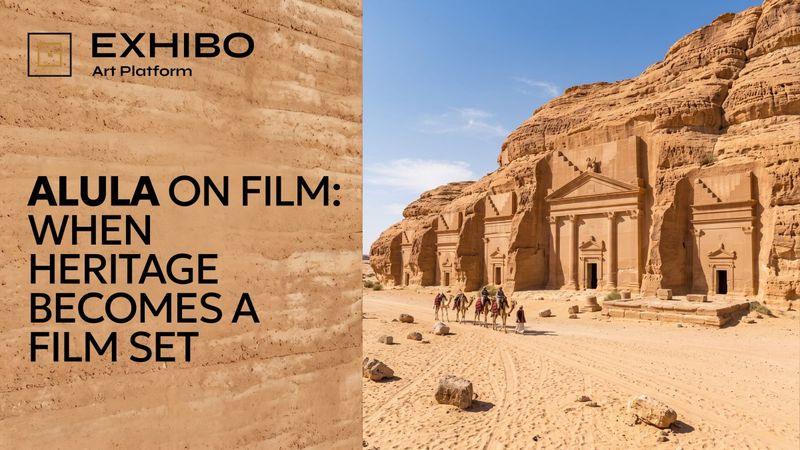
AlUla on Film: When Heritage Becomes a Film Set
Hollywood came to AlUla to build Iraq and Afghanistan. Saudi Arabia is using the same landscape to build AlUla itself — destination, museum, cultural stage — and the old stone is being asked to say something new.
Hollywood built Iraq and Afghanistan in AlUla; Saudi Arabia is building AlUla into itself. On carved kings, a warning old as scripture, a mirror the size of a building, and who gets to author a place.
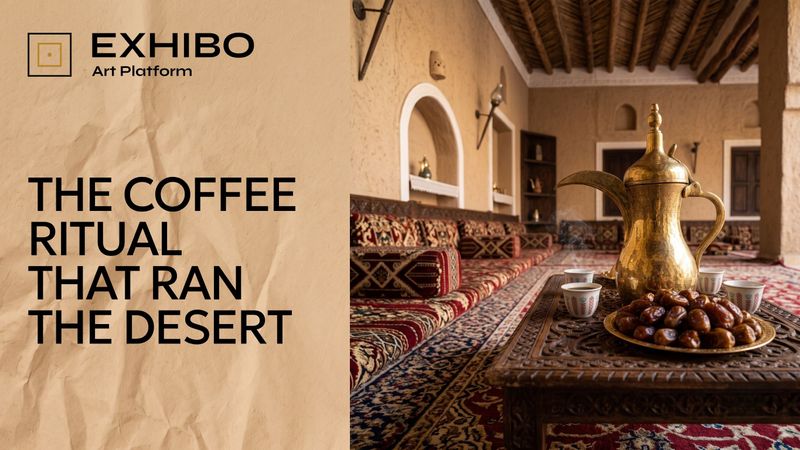
The Coffee Ritual That Ran the Desert
A cup of coffee in the desert was a contract, a test, a truce, and a promise of protection — a whole social order in the tilt of a small white cup.
Among the Bedouin of Arabia, serving coffee was never just hospitality — it was a code. The order of the cups, the amount poured, the shake of the wrist that says enough: a whole unwritten language for turning a dangerous stranger into a guest, and sometimes an ally. The story of Arabic coffee as the social law of the desert — and how it lives on in the region's museums and art.
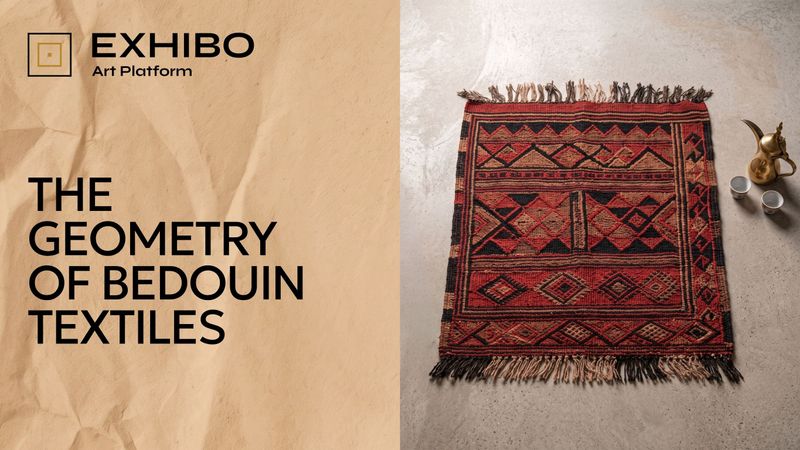
Sadu Weaving: The Geometry of Bedouin Textiles
The geometry the Bedouin wove, and the women who carried it in memory because nothing was written down.
On a loom you stake into the sand, Bedouin women wove the interior world of the Gulf — tents, dividers, camel trappings — and threaded through the wool a geometry that carried tribe, family and meaning. A story of Sadu: the patterns and their names, the women who transmitted them without a single written word, and the quiet work of keeping the craft alive.