
Exhibo Editorial
The High Renaissance
Rome and Florence at the peak: Leonardo, Michelangelo, Raphael and Bramante, c.1490–1530, between Early Renaissance and Mannerism
The High Renaissance is the short peak of Italian Renaissance art when Leonardo da Vinci, Michelangelo Buonarroti, Raphael and the architect Donato Bramante concentrated classical proportion, anatomical conviction and large-scale papal patronage into a run of works that later academies treated as the standard. Most surveys place the centre between about 1490 and 1527 (Britannica) or about 1500–1530 (Tate), with Rome under Julius II and Leo X as the main stage and Florence and Milan as earlier laboratories. The look is measured space, weight-bearing bodies, clear narrative groups and architecture that quotes antiquity without collapsing into pastiche.
This article stays inside that peak. For the wider fifteenth-century story, Florence’s early workshops and the Northern parallel, start with Renaissance Art, Explained. Technique essays on sfumato (pending) and perspective (pending) cover method elsewhere. What follows maps the conditions that funded the moment, how scholars define it, who made it, four works worth standing under, how the style spread and mutated, how critics invented the label, and what museums and academies kept. The parent map sits in the Periods of Art History series.
What produced the High Renaissance
Papal ambition and competitive city-states paid for the High Renaissance. After decades of Florentine experiment, Rome under Julius II (r. 1503–1513) and Leo X (r. 1513–1521) treated the Vatican and the city’s pilgrimage routes as a single building site. Julius hired Bramante to begin rebuilding St Peter’s (foundation stone 1506), summoned Michelangelo to the Sistine Chapel ceiling (contract 8 May 1508; Mass celebrated 1 November 1512 after completion by 31 October), and brought Raphael to the papal apartments from 1508. Those commissions stacked painting, sculpture and architecture in one patronage system. Artists who had trained in Florence or Milan found budgets and visibility that a single republican hall could not match.
Florence still mattered as a proving ground. The republic’s Opera del Duomo awarded Michelangelo the marble David in 1501; the statue went up outside the Palazzo Vecchio in September 1504 as a civic emblem after a committee that included Leonardo and Botticelli chose the site. Leonardo returned from Milan after the fall of Ludovico Sforza and competed with Michelangelo for frescoes of battle scenes in the Palazzo Vecchio’s Great Council Hall. Both cartoons drew crowds; neither mural survives. That rivalry trained eyes on monumental narrative before both men answered Rome’s call. Earlier Medici and guild patronage had built the skill base; High Renaissance Florence converted that skill into republic and, later, restored Medici display.
Milan under Ludovico Sforza had already given Leonardo the refectory wall at Santa Maria delle Grazie for The Last Supper (c.1495–1498). French invasion and Sforza exile scattered that court, but the mural’s design travelled through copies and descriptions. Courts in Urbino, Mantua and Ferrara kept hiring. Prints and drawings moved poses across the Alps faster than fresco crews. Humanist advisers supplied programmes that mixed theology with classical learning: Raphael’s Stanza della Segnatura staged philosophy, theology, poetry and law as a working library for a pope. Access to antique sculpture in Roman collections, from the Apollo Belvedere to the newly unearthed Laocoön (found 1506), gave living models of torsional anatomy. None of this erased sacred demand. Altars, tombs and chapel walls still absorbed most of the money. What changed was scale, classical density and the expectation that sacred stories would persuade as if bodies shared your air.
War and politics set hard edges. Charles VIII’s French invasion of 1494 opened decades of foreign armies on Italian soil. Florence’s Savonarolan years (1494–1498) interrupted Medici culture before the republic’s short revival. The restored Medici returned with a different court taste; by the 1530s Florence was sliding toward a duchy. In Rome, Leo X, a Medici pope, continued heavy spending on Raphael’s shop, tapestry designs and festival culture even as European politics darkened. Printing houses multiplied engraved copies of Roman and Florentine inventions, so a German or Netherlandish workshop could study a pose without crossing the Alps. Antique finds kept arriving: the Laocoön’s excavation in 1506 gave sculptors a writhing group to measure against living models and against Michelangelo’s own torsions.
The Sack of Rome by mutinous troops of Charles V in May 1527 killed and dispersed artists, emptied papal coffers and gave later historians a convenient end date. Style did not flip overnight. Mannerist experiments were already underway in Florence and Rome in the 1520s. The sack accelerated the scatter of talent and made the confident centre feel, to many contemporaries, broken. Survivors carried Roman habits to Genoa, Fontainebleau and other courts, where High Renaissance clarity met local stone and local politics.
What the High Renaissance means
“High Renaissance” is a later label, not a workshop password. Art historian Jill Burke has traced the German Hochrenaissance to Jacob Burckhardt in 1855, with roots in Johann Joachim Winckelmann’s eighteenth-century idea of a “High Style” around the early sixteenth century. English and other European surveys adopted the phrase for the brief Italian peak that Vasari had already ranked as perfection. Modern scholars argue over borders: some stop at Raphael’s death in 1520, others at about 1525, 1527 or 1530. Tate’s 1500–1530 window and Britannica’s early 1490s–1527 window both work as teaching centres. Treat them as useful brackets, not cliffs.
What the label names is a cluster of habits perfected in a few cities by a few shops under intense patronage. Early Renaissance painters and sculptors had already rebuilt weight, gesture and optical recession; High Renaissance artists pressed those tools toward large, lucid ensembles and idealised bodies that still read as flesh. Harmony, clarity and classical citation became the public face. Soft tonal transitions, monumental nudes and painted architecture that continues real rooms appear again and again. Venice ran a related but distinct oil-rich colour culture through Giorgione and Titian in the same decades; textbooks that ignore Venice flatten the map. The High Renaissance of school quizzes remains the Leonardo–Michelangelo–Raphael shortlist centred on Rome and Florence.
You recognise the period less by a single invention than by how parts lock together. A chapel ceiling, a civic marble and a papal fresco can share the same ambition: make the human figure carry meaning at architectural scale, and make antiquity feel useful rather than merely cited. Early Renaissance painters had already broken gold-ground habits and planted feet on measured floors; High Renaissance artists raised the stakes until a vault or a piazza could hold an entire argument about God, the republic or classical wisdom. That is why later academies treated the moment as a peak, and why Mannerist painters soon found the balance worth breaking.
Bodies, balance and narrative control
High Renaissance figures stand or turn with weight you can feel in your own knees. Michelangelo’s marble and fresco nudes treat muscle as structure; Leonardo’s heads and hands register thought through soft transitions of tone; Raphael groups apostles, philosophers and Madonnas so that gesture and interval do the explaining. Pyramid and circular compositions steady crowded scenes. Emotion runs through hands and glances rather than through chaotic scatter. Sacred subjects keep their theology, yet faces and drapery behave as if gravity and bone agree.
Anatomy study underwrote that conviction. Dissection, life drawing and study after antique statues fed the same shops. Ideal proportion mattered, but so did expressive bending of rules when Michelangelo needed force. The nude returned as moral, civic and mythological speech, not only as antique quotation. Drapery falls as if a body underneath pushes it. For visitors, the test is simple: does the figure occupy space the way a person does, and does the group tell you who acts first?
Painted and built architecture
Linear perspective and classical orders were already workshop tools. High Renaissance artists used them to stage rooms that feel continuous with yours. Raphael’s School of Athens (1509–11, Vatican Museums) sets philosophers under a coffered vault that borrows Bramante’s architectural language. Leonardo’s Last Supper aligns painted space with the Dominican refectory in Milan. Ceiling programmes and wall frescoes treat architecture as actor, not backdrop. The how-to of vanishing points belongs in a separate perspective essay (pending); here the point is function. Measured space persuades you that dogma, philosophy or civic virtue occupies the same air you breathe.
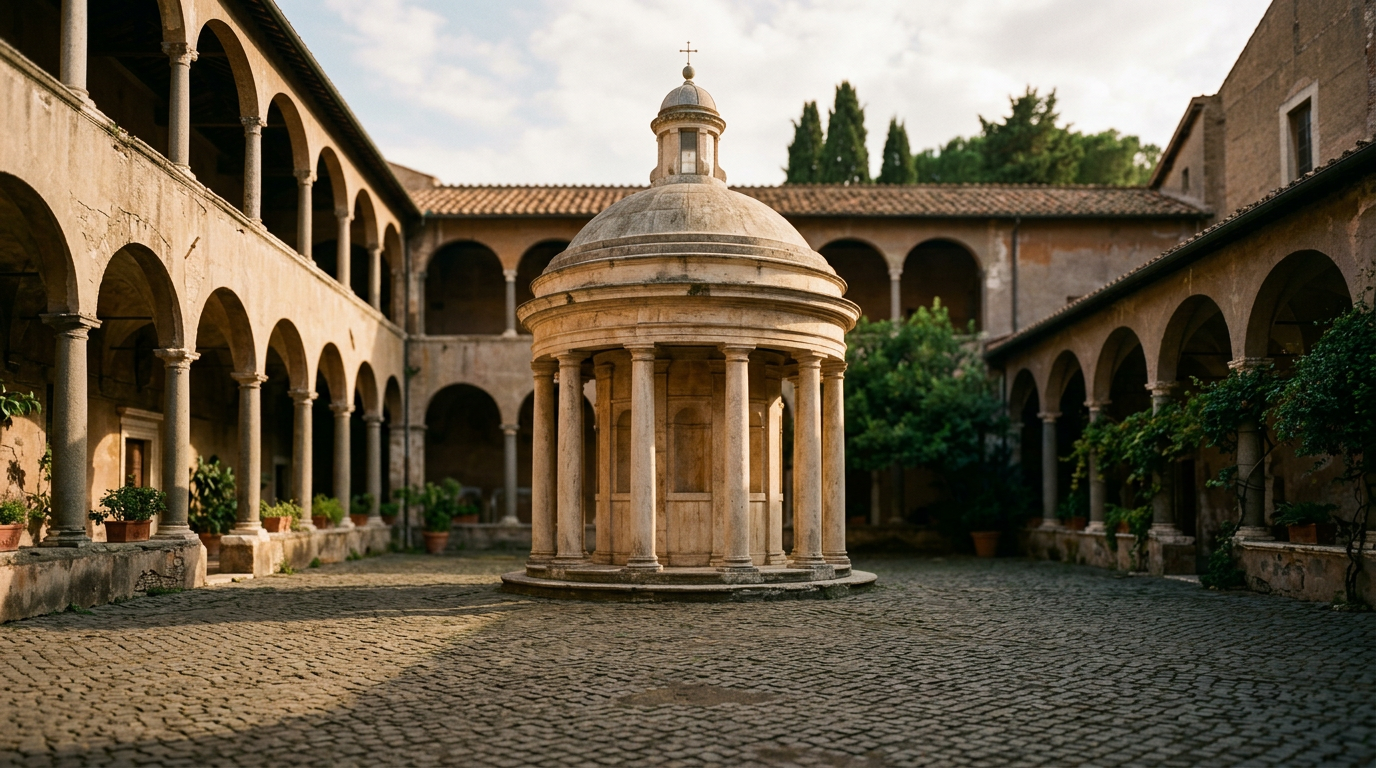
Built fabric followed the same classical grammar. Bramante’s Tempietto at San Pietro in Montorio (c.1502) condensed a circular martyrium into a miniature antique temple. His plans for new St Peter’s aimed at a centralised, monumental church on the scale of imperial memory. Michelangelo later altered that project, but the High Renaissance appetite for clear orders, proportion and antique typology was already set. Sculpture and architecture met in tombs, niches and chapel ensembles where marble bodies and stone frames share one programme.
Artists and patrons who set the pace
Three painters and one architect still organise most introductions, and for once the shorthand matches the archive of major commissions. Around them stood Venetian colourists, Florentine rivals, papal theologians who wrote programmes, and Spanish and French patrons who funded Roman shrines. Women patrons and convent communities commissioned altarpieces that Vasari’s male biography machine often skimmed. The market was a competition among courts and orders, not a ladder climbed by solitary genius alone. If you only remember names, remember also who paid: Julius II and Leo X in Rome, the Florentine Opera and Signoria, Ludovico Sforza earlier in Milan, and the Spanish monarchs at San Pietro in Montorio. Those budgets decided which walls and blocks received the decade’s best hands.
Leonardo, Michelangelo and Raphael
Leonardo da Vinci (1452–1519) brought Milanese and Florentine research into court painting: observation of water, rock, flesh and flight; unfinished panels that still organise museum crowds; and the damaged refectory mural that teaches narrative grouping even as paint fails. Soft blending of edges, later labelled sfumato, is a signature effect; the process steps belong elsewhere. Michelangelo Buonarroti (1475–1564) treated the body as architecture in marble and on vaults. The David, the Vatican Pietà (1498–99, St Peter’s Basilica) and the Sistine ceiling made the male nude a vehicle for force and theology at once. Raphael (1483–1520), called to Rome in 1508, organised classical learning into lucid fresco cycles and ran a large shop that exported his manner across Italy. Tate still notes that academies held Raphael as the prime model until mid-nineteenth-century revolt.
Their careers overlapped tightly. Leonardo’s Florence years around 1500–1506, Michelangelo’s David and early Roman sculpture, Raphael’s Umbrian training under Perugino and his Florentine study of Leonardo and Michelangelo, then the simultaneous Vatican projects of 1508–1512: that cluster is the textbook “peak.” Deaths of Leonardo (1519) and Raphael (1520) thinned the centre before the Sack finished the scatter.
Bramante, Julius II and the Roman stage
Donato Bramante (1444–1514) translated High Renaissance ideals into stone. After Milanese work, he designed the Tempietto for Ferdinand of Aragon and Isabella of Castile at San Pietro in Montorio, then served Julius II as planner for St Peter’s and Vatican courts. Papal patronage under Julius and Leo X concentrated talent: Michelangelo on the vault, Raphael in the Stanze and later on tapestries for the Sistine walls, Bramante and successors on the basilica. Cardinals and religious orders filled secondary chapels. The programme logic was political as well as pious. Rome had to look like the capital of a recovering Christendom after decades of French and Spanish pressure on the peninsula.
Florentine and Milanese experience fed that Roman concentration. Without earlier workshops, Julius would have had no Michelangelo or Leonardo to summon. Without Rome’s budgets, those skills might have stayed civic and court-scale. The High Renaissance is the meeting of both.
Patron contracts and shop labour sit under the myth of solitary genius. Assistants ground pigments, transferred cartoons and painted secondary figures; Raphael’s Roman enterprise was a firm as much as a signature. Contracts specified ultramarine, gold and deadlines. Theologians supplied Latin programmes that painters translated into gesture. When you read a clean textbook biography, remember the unpaid names in the shop books.
Four works worth standing in front of
Close looking beats another list of masterpieces. The four works below sit in marble, oil, fresco and stone across Florence, Paris and Rome. Each compresses a problem the period cared about: civic body as republic emblem; portrait as living presence; vault as Genesis theatre; architecture as antique martyrium rebuilt at chapel scale. Dates and locations follow museum and institutional records. You could swap in Raphael’s Stanze, Leonardo’s Virgin of the Rocks or Michelangelo’s Vatican Pietà and learn related lessons. These four keep sculpture, painting and architecture in one conversation and stay visit-able.
Photographs flatten height and surface. Crowd noise, timed tickets and the angle of a vault belong to the meaning. Where travel is impossible, collection pages from the Galleria dell’Accademia, the Louvre and the Vatican Museums remain the next best evidence.
Michelangelo, David, Galleria dell’Accademia, Florence
Commissioned by the Opera of Florence Cathedral on 16 August 1501 for 400 ducats, Michelangelo carved the David from a damaged block of Carrara marble left by earlier sculptors. A committee including Leonardo and Botticelli decided in January 1504 to place the finished statue at the entrance of the Palazzo Vecchio rather than on the cathedral. Unveiled on 8 September 1504, it stood outdoors as a symbol of Florentine strength until weather and politics moved it indoors; the Accademia now houses the original (Inv. Scult. n. 1076; height with base 517 cm). Gilding once marked the head garland, the tree stump and the sling.
Stand at the designed viewing angles and the contrapposto locks: weight on one leg, sling over the shoulder, head turned toward a threat you cannot see. Michelangelo shows the moment before the stone flies, not the aftermath with Goliath’s head. Hands and head run slightly large for a high outdoor viewpoint. The nude revives antique heroic scale for a Christian republic’s doorway. Later casts and the outdoor replica in the Piazza della Signoria prove how completely the type colonised civic memory. High Renaissance sculpture here means a single body carrying a city’s argument.
Leonardo, Mona Lisa, Musée du Louvre, Paris
Leonardo began the portrait of Lisa Gherardini, wife of the Florentine silk merchant Francesco del Giocondo, by October 1503, as a marginal note by Agostino Vespucci records. He kept the poplar panel with him for years, working into the 1510s; the Louvre’s collections entry and standard surveys date the painting c.1503–1519. Francis I acquired it for the French royal collection; it hangs today in the Salle des États. Soft transitions of tone model the face and hands against a distant, invented landscape. The sitter turns toward you in three-quarter view, hands folded, without the hard contour of earlier profile portraits.
Fame and glass now fight the painting. Still, the design explains why portraiture became a High Renaissance laboratory: presence without heraldic props, landscape as psychological weather, flesh that seems to breathe because edges dissolve. Technique essays will walk you through glaze and sfumato; in the room, watch how little local colour the face needs to feel alive. Copies by followers and Raphael’s related portrait experiments show how quickly the type spread. For British and French visitors, this panel is often the first High Renaissance object met in person, long before a Vatican ticket.
Michelangelo, Sistine Chapel ceiling, Vatican Museums
After a crack damaged the old ceiling decoration, Julius II contracted Michelangelo on 8 May 1508. The first brief called for apostles in the pendentives; Michelangelo renegotiated a fuller Genesis programme. Nine central scenes run from Creation to Noah, flanked by ignudi, prophets, sibyls, ancestors and corner narratives of Israel’s salvation. The Vatican Museums record completion of the first half by August 1510 and the whole by 31 October 1512, with papal Mass on 1 November. Painted architecture frames the histories so that bodies seem to sit and turn on a second structure above the chapel.
Crowd flow pushes you toward the Creation of Adam, where God’s outstretched finger nearly meets Adam’s. Step back and read the vault as a single machine: chronology, typology and athletic nudes woven through one painted order. Michelangelo’s later Last Judgment on the altar wall (1536–41) belongs to a darker post-sack climate; the ceiling still speaks the High Renaissance appetite for heroic anatomy in sacred service. Timed entry and neck strain are part of the encounter. Give the prophets and sibyls equal time. They hold the vault’s weight as much as the famous fingertip.
Bramante, Tempietto, San Pietro in Montorio, Rome
Commissioned by Ferdinand II of Aragon and Isabella I of Castile to mark the traditional site of Saint Peter’s crucifixion, Bramante’s Tempietto was founded in 1502 in the cloister of San Pietro in Montorio. A circular cella, Doric (Tuscan) colonnade, entablature and dome compress antique temple language into a martyrium you can walk around in minutes. Scholars read precedents in Roman round temples and early Christian memorial buildings. The tiny scale is the point: classical grammar perfected as a jewel, not diluted across a city block.
Stand in the cloister and the Tempietto teaches High Renaissance architecture without a lecture. Proportion, order and commemorative clarity replace Gothic vertical drama. Bramante’s larger St Peter’s project aimed at the same classical ambition on imperial scale; later architects revised his plan, yet the Tempietto remains the cleanest built manifesto of the moment. Spanish royal patronage on a Roman hillside also reminds you that the “Italian” peak ran on international money and pilgrimage politics.
How the High Renaissance spread and mutated
Ideas moved with people and paper. Artists travelled for commissions; engravers copied cartoons; courtiers imported foreigners. Rome’s papal projects set the prestige centre, but Venice developed oil-rich colour and poetic landscape through Giorgione and Titian in parallel years. Florence continued to train and to hire. Courts in Mantua, Ferrara and Urbino commissioned works that mixed local taste with Roman lessons. French kings later drew Leonardo across the Alps; Spanish monarchs had already funded the Tempietto. A survey that treats the Uffizi and the Vatican as the whole map misreads the decade’s traffic.
Mutation arrived from inside and outside. Younger painters in Florence and Rome elongated proportions, sharpened artifice and unsettled balance even before 1527. Pontormo, Rosso Fiorentino and Parmigianino pushed elegance toward strain: unexpected colour, crowded foregrounds, bodies that refuse stable standing. Historians gather those experiments under Mannerism; the sibling essay Mannerism, Explained (pending) takes that turn in full. Raphael’s own late shop, and his unfinished Transfiguration, already show denser emotion and more complex staging than the clear Stanze. After 1527, assistants and rivals carried fragments of the Roman manner into Genoese palaces, French court decoration at Fontainebleau and Spanish royal projects.
North of the Alps, Dürer and others absorbed Italian theory through travel and prints while keeping Northern precision; the Northern Renaissance (pending) holds that parallel. Reformation iconoclasm smashed or whitewashed images in parts of Northern Europe even as Catholic courts doubled down on persuasive sacred art. Venice kept exporting oil paintings as portable luxury goods, a different economy from papal fresco cycles. The High Renaissance did not end on a single morning. It frayed into regional styles, confessional politics and a darker emotional register visible in Michelangelo’s later work.
Critics then and now
Giorgio Vasari’s Lives (1550; enlarged 1568) organised Italian art as a climb from Giotto’s “infancy” through fifteenth-century vigour to the perfection of Leonardo, Raphael and Michelangelo. Dedicated to Cosimo I de’ Medici, the book mixed workshop gossip, technical notes and Florence-first bias. Venetian painting gained space in 1568 after Vasari’s travel, yet the tilt remained. Modern scholars treat the Lives as a primary source that needs documentary checks, and as the template that made “Renaissance progress” feel natural. When you read that the High Renaissance is a peak, you are still hearing Vasari’s plot, translated.
Nineteenth-century cultural history widened the frame. Burckhardt’s Civilization of the Renaissance in Italy (1860) and his earlier use of Hochrenaissance helped fix the period label. Twentieth- and twenty-first-century art history then fractured the story: archival patronage studies, technical imaging, feminist and social histories of workshops, and critiques of centre-versus-periphery models. Some scholars now call “High Renaissance” an over-simplification that flattens Venetian colour, ignores lesser-known shops and smuggles a perfection myth. Others keep the term as a practical classroom bracket for the Julius–Leo years. Both positions can be true at once. The confident textbook timeline is itself an artefact: Vasari’s ranking, German periodisation, museum tourism and school curricula reinforcing one another.
Debates continue over end dates, over how much classical “rebirth” obscures medieval continuity, and over how Grand Tour collecting shaped which objects you meet in London or Paris. Napoleonic seizures and later museum nationalism moved panels and marbles into public galleries where “High Renaissance” became a room label as much as a scholarly term. Conservation science now argues with connoisseurship on equal footing: infrared reflectograms and X-radiographs rewrite workshop stories for panels once treated as solitary miracles. Attribution fights still flare around Leonardesque and Raphaelesque shops, where assistants finished surfaces the master designed. The label survives because visitors still need a name for the room where Leonardo, Michelangelo and Raphael seem to share a decade, and because search engines reward that name with steady informational traffic.
What the High Renaissance left behind
European academies taught Raphael’s clarity and classical contour as standards for centuries. Students drew after antique casts and after High Renaissance prints. That pedagogy shaped art schools into the nineteenth century. The Pre-Raphaelites founded their Brotherhood in 1848 in explicit revolt against Raphael’s academic authority, which tells you how complete the victory had been. Neoclassical artists returned to Rome with different politics; Romantic painters stole Renaissance drama while discarding its balance. Modernism broke the perspectival window, yet museums still hang these decades as the hinge where “art history” feels most like a pilgrimage.
Tourism and national identity wrapped themselves around the same objects. Florence markets Michelangelo’s David; the Vatican queues for the Sistine ceiling; the Louvre’s Mona Lisa concentrates crowd attention that Leonardo’s Milan mural cannot absorb. Conservation ethics, climate control and timed tickets are now part of how the works mean. Reproduction rights, cinema quotation and classroom posters keep the images circulating far from their walls. School curricula in many countries still treat these decades as the hinge between “medieval” and “modern,” which keeps search demand high even when scholarly fashion prefers workshops, gender or global exchange. Architecture students still measure Bramante’s Tempietto; life-drawing classes still chase contrapposto under fluorescent light.
For a practical next step, browse public collections through Exhibo’s museums directory and plan around the rooms that still hold the period’s arguments in marble, oil and plaster. Pair a Vatican morning with a quiet hour at San Pietro in Montorio if your legs allow; the Tempietto rewards the walk after the chapel crush.
The deeper inheritance is methodological. Stage emotion at architectural scale. Argue with antiquity in public. Bind sacred and civic claims to optical persuasion. Later artists could refuse those demands. Few could pretend the demands had never been made.
High Renaissance at a glance: chronology and locations
| Year (approx.) | Work or event | Artist / agent | Place (then → now if moved) | Medium / note |
|---|---|---|---|---|
| c.1495–1498 | The Last Supper | Leonardo da Vinci | Santa Maria delle Grazie, Milan | Tempera/oil on dry wall; early design landmark |
| 1498–1499 | Vatican Pietà | Michelangelo | St Peter’s Basilica, Vatican | Marble; signed on the sash |
| 1501–1504 | David | Michelangelo | Palazzo Vecchio → Accademia, Florence | Marble; unveiled 8 Sep 1504 |
| 1502 | Tempietto | Donato Bramante | San Pietro in Montorio, Rome | Circular martyrium; Spanish royal commission |
| c.1503–1519 | Mona Lisa | Leonardo da Vinci | Florence workshop → Louvre, Paris | Oil on poplar; begun by Oct 1503 |
| 1506 | New St Peter’s begun; Laocoön unearthed | Bramante / ancient find | Vatican / Rome | Papal rebuilding; antique anatomy model |
| 1508–1512 | Sistine Chapel ceiling | Michelangelo | Vatican Museums | Fresco; Mass 1 Nov 1512 |
| 1509–1511 | School of Athens (Stanza della Segnatura) | Raphael | Vatican Museums | Fresco; philosophy wall of papal library |
| 1519 / 1520 | Deaths of Leonardo / Raphael | (biographical) | Amboise / Rome | Centre of the “peak” thins |
| 1527 | Sack of Rome | Troops of Charles V | Rome | Common textbook end date; artists dispersed |
FAQ
These questions track common search and classroom confusions: definition, the “big three,” period borders, characteristics and where to look in person. Answers stay short and point outward where a sibling article owns the wider ground.
What is meant by the High Renaissance?
It names the brief peak of Italian Renaissance art, centred on Rome and Florence, when Leonardo, Michelangelo, Raphael and Bramante produced works of classical balance, anatomical force and large-scale patronage. The phrase is nineteenth-century in origin; Vasari had already ranked those artists as the summit. Use it as a practical bracket for roughly 1490–1530, not as a membership card with fixed borders.
Who are the three famous artists of the High Renaissance?
Classroom lists name Leonardo da Vinci, Michelangelo Buonarroti and Raphael. Bramante belongs beside them for architecture. Venetian painters such as Giorgione and Titian worked in the same decades with a different colour culture. “Three” is a teaching shorthand, not a census.
What is the difference between the Renaissance and the High Renaissance?
The Renaissance is the broader European revival of classical models across the fifteenth and sixteenth centuries. The High Renaissance is a short Italian peak inside that longer story, when earlier tools of perspective, anatomy and antique citation reached concentrated monumental form under papal and civic patronage. For the full arc, including early Florence and the North, read Renaissance Art, Explained.
What are the dates of the High Renaissance?
Institutions disagree at the edges. Britannica gives early 1490s to 1527; Tate gives about 1500–1530; some historians stop at Raphael’s death in 1520. Start dates often track Leonardo’s Milanese maturity and the turn of the century; end dates track Raphael’s death, the Sack of Rome or about 1530. Style on the ground changed city by city.
What ended the High Renaissance?
No single switch. Raphael’s death in 1520 and Leonardo’s in 1519 removed central figures. The Sack of Rome in 1527 dispersed workshops and wrecked papal finances. Younger artists were already twisting balance into Mannerist artifice. Treat “end” as a fray into regional and confessional styles, not a calendar cliff.
What are the main characteristics of High Renaissance art?
Expect weight-bearing, idealised bodies; clear narrative groups; measured, often classical painted architecture; harmonious intervals; and sacred or civic subjects persuaded through optical presence. Sculpture and building share the same appetite for antique order. Soft tonal blending and linear recession appear often; method essays cover those tools separately.
Is Venetian painting part of the High Renaissance?
Many surveys fold early sixteenth-century Venice into the wider Renaissance while keeping the “High” label for the Roman–Florentine shortlist. Giorgione and Titian belong in any honest map of the decades around 1500–1530. They pursue oil, colour and poetic landscape on terms that do not copy Raphael’s Stanze.
Where should you see High Renaissance art in person?
Florence for Michelangelo’s David (Accademia) and related holdings; the Vatican Museums for the Sistine ceiling and Raphael’s Stanze; Milan for Leonardo’s Last Supper (timed entry); Paris for the Mona Lisa at the Louvre; Rome’s Janiculum for Bramante’s Tempietto. National Gallery, London, holds major Raphael Madonnas and related panels for British viewers. Use the museums directory to plan rooms around opening hours and tickets.
Related reading
Van Lévé: Sovereign Caribbean Visions Take Shape at Harvard
A transnational survey charts twenty-five years of Creole and Maroon artistic practice across the French Caribbean and Amazonia.
Harvard's Alain Locke Gallery presents a landmark survey tracing contemporary production from Guadeloupe, Martinique, Guyane, and Haiti since two thousand and one.
Gustave Fayet: Collector—Artist Designer
A comprehensive survey at the Fondation Louis Vuitton reuniting collected masterpieces with the designer's own studio practice.
The Paris institution expands its patronage series with a dual-focused examination of Gustave Fayet, bringing together hundreds of acquired works and restored creations to chart his impact on early modernism.

Mohammad Alfaraj: The Heart Is a Bird's Nest, the Brain Is a Spider Web
First European institutional solo explores cross-species kinship and domestic ecologies
Mohammad Alfaraj's latest showcase at the Delfina Foundation merges multimedia installations with regional folklore to reimagine shared habitats.