
Turin · Italy
Celebrating Marisa Merz: A Triptych Exhibition Honours Arte Povera's Sole Female Pioneer
A landmark centenary survey unfolds across three Turin institutions, re-examining domestic craft, fragile materials, and quiet innovation.
A Centenary Triptych for Arte Povera's Lone Woman
Turin is preparing to host an unprecedented institutional convergence dedicated to Marisa Merz. Marking one hundred years since the birth of the sole female figure associated with the Arte Povera movement, a sprawling retrospective titled The Dance of the Hours will unfold simultaneously across three distinct venues this week. The Castello di Rivoli Museo d'Arte Contemporanea, the Fondazione Merz, and the Galleria Civica d'Arte Moderna e Contemporanea di Torino have pooled their resources for what organisers describe as a once-in-a-generation undertaking.
Curatorial Voices and Institutional Memory
This collaborative model echoes a previous joint effort mounted in 2005 to commemorate Mario Merz, her late husband and frequent collaborator. For the current project, co-curator Francesco Manacorda and Marianna Vecellio aim to dismantle the singular biographical narrative often attached to the artist. Working directly with the estate, which controls the bulk of her output, the team has crafted three separate interpretive lenses. Manacorda notes that this structural division reflects Merz's own tendency to cultivate enigma, allowing visitors to encounter a polyphonic version of her practice rather than a monolithic biography.
The Domestic as Methodology
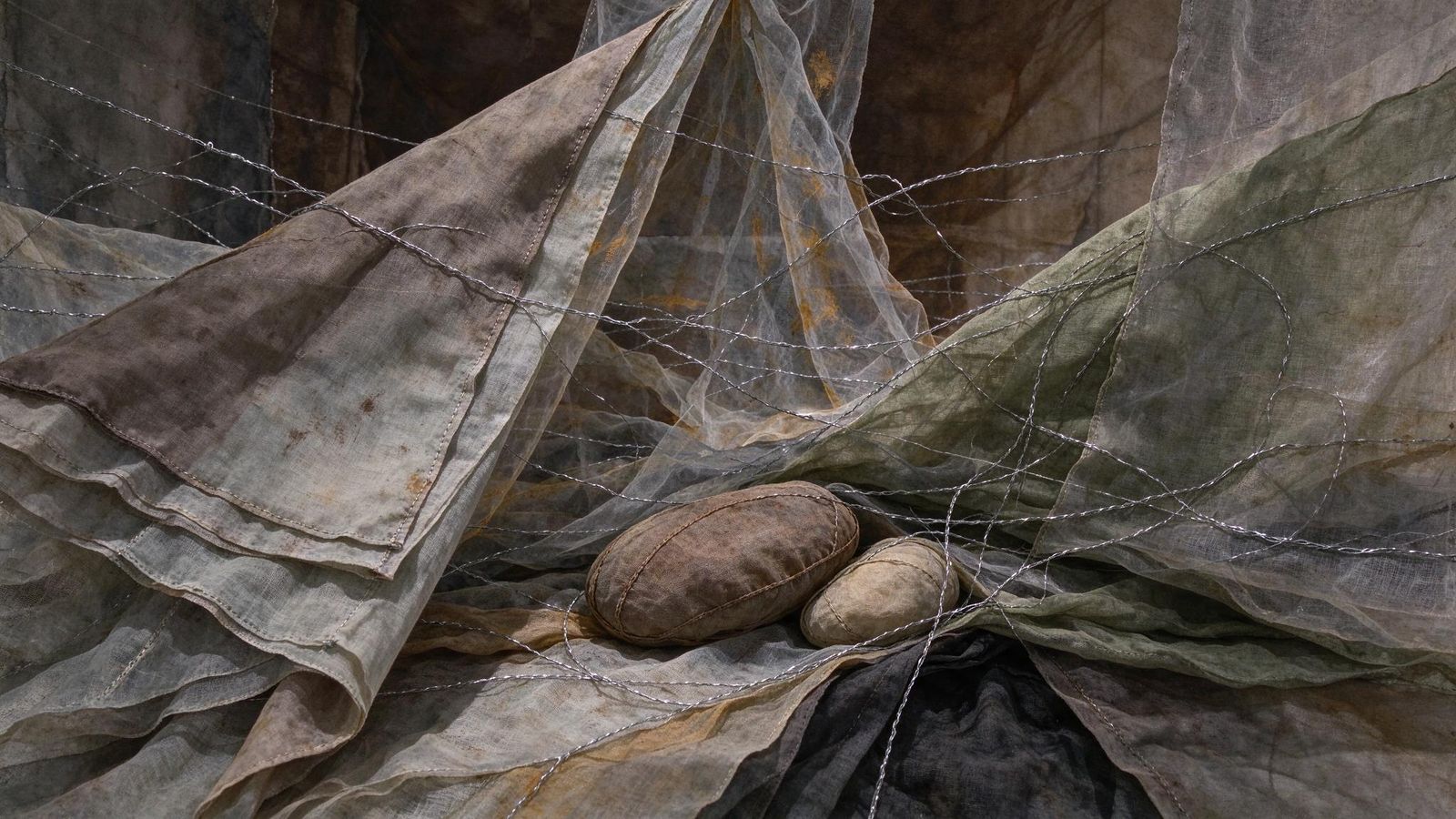
While her male counterparts frequently utilised industrial refuse or raw geological elements, Merz anchored her creative output within the private sphere. Her residence functioned as both sanctuary and workshop, yielding works constructed from knitting wool, kitchen foil, sewing thread, and even dried legumes. Beatrice Merz, who now leads the family foundation, emphasises that this spatial arrangement was never merely convenient; it constituted a deliberate artistic strategy. The domestic environment provided the very conditions necessary for her experimental processes.
One of her earliest masterpieces, Living Sculpture from 1966, exemplifies this approach. Composed of stapled aluminium tubing, the sprawling assembly originally occupied her living quarters, spilling across furniture and challenging traditional notions of household order. Created while she cared for her young daughter, the piece transforms invisible maternal duties into something tangible and slightly unsettling. Its visual impact proved so potent that it later inspired sequences in an avant-garde horror production during the following year.
Recovering Fragile Histories
Much of Merz's oeuvre resists permanent preservation due to its inherently transient nature. Conservation teams must navigate complex ethical decisions regarding materials designed to age, degrade, or shift over time. Several installations vanished after initial presentations, requiring painstaking archival research to reconstruct. At Castello di Rivoli, curators are piecing together a multi-component work drawn from a Giacomo Leopardi verse. By cross-referencing historical photographs with physical remnants discovered within the preserved family flat, the team has restored the installation's original configuration, acknowledging that any recreation inevitably diverges from the artist's potential future iterations.
Contemporary Dialogues
To extend the conversation beyond historical documentation, ten modern practitioners have been invited to engage with Merz's legacy at the Castello di Rivoli venue. Contributions span sculpture, photography, and moving image, including a cinematic response from Tacita Dean alongside interventions by Lara Favaretto, Thea Djordjadze, and Leonor Antunes. These commissioned pieces operate as critical commentaries, bridging mid-century experimentation with present-day artistic concerns.
The comprehensive programme runs from late October through early April next year. By distributing the survey across multiple locations, Turin offers a nuanced examination of an artist who consistently evaded easy categorisation, leaving behind a residue of quiet innovation that continues to reshape our understanding of twentieth-century Italian avant-garde practices.
Related reading

Toledo Museum of Art Launches Africa Art Library Initiative
A transcontinental book donation programme reshaping scholarly access and institutional ethics
Edible Structures and Post-Occupation Cycles: Hartwig's 2026 Gingerbread Competition
Interrogating structural lifecycles through edible media
Fermata: Hong Kong in Venice
Exploring urban rhythms and forgotten details at the 61st Venice Biennale