
Exhibo Editorial
What Actually Fades: UV and Artwork
Lux budgets, UV limits, window films and conservation glazing for home display, drawn from CCI, Smithsonian and Getty practice
Yes: sunlight damages paintings. Direct sun can deliver tens of thousands of lux plus a high ultraviolet (UV) load; that combination fades pigments, chalks paint films, yellows and embrittles binders and varnish, and heats the surface until paint softens or blisters. Visible light alone fades fugitive colours even after you filter every UV photon. Damage scales with dose: illuminance in lux multiplied by hours of exposure. Move works off sunny walls, cut daylight with blinds and UV film, glaze frames with conservation glass or acrylic, and keep display lighting near museum bands of about 50 lux for sensitive media and about 150 lux for many oil and acrylic paintings, with UV as close to zero as you can manage and never above 75 microwatts per lumen (µW/lm).
This page sits in the Caring for Art series. It covers light and UV on display: why fading happens, how to measure it, how to cut intensity and time, window films and frame glazing, lux and UV targets by medium, edge cases, what museums do, costs, and when a conservator should examine the work. Humidity and temperature belong with ideal humidity for artwork (S7-09, pending). Long-term racks and wraps live in how to store paintings. Agents of deterioration as a system sit in preventive conservation. Wall hanging hardware and display systems are a separate display topic (S6, pending). For museum collections that publish lighting practice, use the museums directory.
Why sunlight damages paintings
Light gives paint the energy for photochemical change. The Canadian Conservation Institute (CCI) treats light, ultraviolet and infrared as a single agent of deterioration: visible wavelengths fade colourants; UV drives chalking of some paints and yellowing, embrittlement and cracking of binders and varnishes; infrared and other heat sources warm the surface. Sunlight through a window packs all three. NEDCC quotes direct sunlight around 30,000 lux. CCAHA’s teaching example puts outdoor sun near 100,000 lux. Either figure dwarfs a living room in evening light at about 50 lux or a typical office at about 400 lux.
Fading is the damage owners notice first. CCI Notes 10/4 state that highly sensitive lake pigments and aniline dyes begin to fade in a noticeable way within about 1.5 to 20 years even at a prescribed low level of 50 lux, while medium-sensitivity colours start within about two decades. Push the same materials into office light at 500 lux and high-sensitivity paint can fade in months to two years; medium-sensitivity paint begins around two years. At average daylight of about 30,000 lux, high-sensitivity paint can show change in a day to two weeks, and medium-sensitivity paint between two weeks and a year. UV through unfiltered windows can chalk medium-sensitivity paints and crack varnish within about three years; highly sensitive paints can show UV damage within several months.
The reciprocity rule governs planning. CCI Notes 10/4 put it in arithmetic: 200 lux for 200 hours equals 100 lux for 400 hours or 50 lux for 800 hours. Halve the lux and you halve the damage over the same calendar period, provided the spectrum stays similar. CCAHA restates the same product as lux hours. One hour at 100,000 lux equals 2,000 hours at 50 lux if you only count dose. Museums use that arithmetic to trade brighter short shows against dimmer long ones. Private owners use it to decide whether a bright south wall is tolerable for a weekend or catastrophic for a decade.
UV is not the whole story. CCI’s agent-of-deterioration essay on light notes a common error among donors and framers: the belief that a good UV filter stops fading. For many of the most light-sensitive colourants, UV contributes less than half of the fading and often only about a tenth; reducing total light exposure is the only reliable path. UV control still earns its keep. For paintings with permanent pigments, and for monochrome prints and drawings, UV-driven yellowing and disintegration of media and support can be the dominant damage under uncontrolled museum or domestic lighting. Filter UV, then still cut lux and hours.
Heat rides with sun and with lamps placed too close. CCI Notes 10/4 warn that high temperature over about 30°C with high humidity softens paint and varnish so dirt sticks; direct sun or high-intensity lamps near the surface can desiccate size, ground and canvas or blister paint and varnish. Picture lamps clipped to frames rarely give even light and often overheat the top of the painting. Track spots aimed from a distance with dimmers beat frame-mounted bars for both spectrum control and thermal risk.
Measure light and UV before you move anything
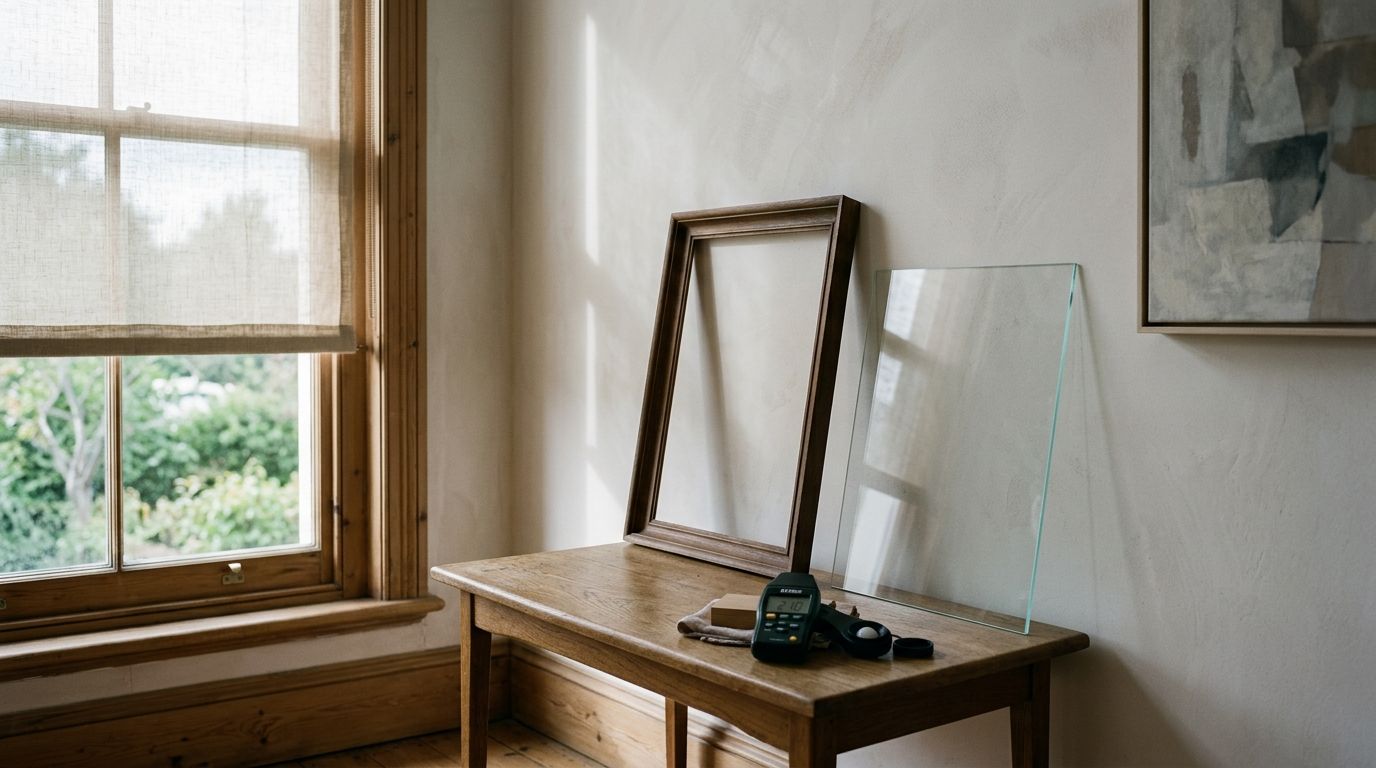
You cannot manage what you guess. Buy or borrow a lux meter and, if you can, a UV meter that reports microwatts per lumen. CCI’s light essay treats museum-grade meters that combine lux and UV as normal kit. CCAHA accepts handheld meters or dataloggers and notes that smartphone apps are less accurate. Place the sensor where the painting face sits, not on a nearby table in shadow. Read at the brightest hour of the day for window walls, then again after blinds close and after you change lamps.
Convert old foot-candle meters by multiplying by about 10 (precisely 10.76). One foot-candle is about 11 lux in CCAHA’s shorthand. UV as µW/lm is a ratio of UV to visible light, so the absolute UV dose rises when you raise lux even if the ratio stays fixed. That is why a “low UV” reading under dim light can still become a high absolute UV load if you flood the wall with daylight that has the same UV fraction.
Log readings with dates, weather notes and whether blinds were open. Blue Wool cards can sit beside a hanging as a crude fade monitor, but CCAHA warns that the most sensitive Blue Wool swatch is more lightfast than many artists’ colourants, so the card alone understates risk. For a valued work you already suspect is fading, a paintings conservator can arrange microfade testing or spectrophotometer checks; Getty Conservation Institute work on museum lighting and microfadeometry sits behind much of that institutional practice.
Map the house by risk, not by décor. South- and west-facing glass in the northern hemisphere deliver the harshest day doses. East walls catch morning spikes. North walls and interior partitions receive softer, more stable light. Skylights behave like solar furnaces. Measure before you decide a “nice bright room” is safe. A wall that hits 5,000 lux at noon for four hours a day already delivers 20,000 lux hours in a single afternoon; at museum 50 lux that dose would take 400 hours of gallery time.
Cut intensity, time and heat
Once you have numbers, change the room before you change the painting. CCI Notes 10/4 list the levers: lower wattage or dimmers, longer throw from lamp to painting, shallower angle so beam intensity falls, tinted window films that cut visible light, drapes or blinds, and lights that stay off when nobody looks. Safe retrieval in stores can use 300–500 lux office light if timers keep it dark most of the time. The same logic applies at home: bright task light for hanging and inspection, then off. Reciprocity means you can trade a slightly brighter evening hanging for closed blinds all afternoon, provided the annual lux-hour total still fits the medium. Heat control travels with the same decisions: pull lamps back, kill frame-mounted bars that cook the top rail, and treat sun patches as thermal events as well as optical ones.
Position and daylight control
Move sensitive works off the brightest walls. Leave oils with robust, lightfast pigments on moderate walls if you must, and keep watercolours, pastels, dyes, photographs and textiles in the darkest display rooms you have. Cover windows with blinds or curtains you can close during peak sun and when the room is empty. Neutral-density or tinted films cut total daylight; clear UV-absorbing films cut UV while leaving more visible light. Use both strategies when a room must stay bright for living: film for UV and heat gain, blinds for hours of high lux.
NEDCC’s preservation leaflet on light damage adds practical detail: keep collections off top shelves under skylights, close shades in the brightest part of the day, and never leave light-sensitive material in permanent sun. CCAHA notes that UV-filtering window films last about ten years in their guidance and need re-testing; NEDCC puts high-quality film life nearer 15–20 years depending on climate. Either way, film is a replaceable filter, not a permanent cure. Verify performance with a UV meter after installation and on a schedule, not by trusting the original brochure.
Lamps, LEDs and picture lights
Choose electric light for colour rendering and low damage, then dim it. CCI Notes 10/4 keep two conservation rules: keep exposure as low as you can while colours remain legible, and keep the colour rendering index (CRI) as high as you can so colours read true. Traditional tungsten had negligible UV and CRI 100 but ran hot and inefficient. Quartz halogen replaced much of that market and still needs high-temperature UV filters for long permanent displays. Fluorescent tubes often sit in the 75–150 µW/lm UV band and need sleeves or filtered fixtures. White LEDs now dominate museum and domestic upgrades: UV output is typically very low (CCI cites about 0–75 µW/lm), heat at the beam is modest, and energy use is low.
Getty Conservation Institute museum lighting research (2002–2015) tested solid-state lighting against older sources, including a Department of Energy GATEWAY demonstration of LED retrofit lamps on nineteenth-century photographs at the J. Paul Getty Museum. Conservators ran the show at about 25–50 lux for 26 weeks and monitored colour; changes stayed within what filtered halogen would have produced. CCI Technical Bulletin 36 on LED lighting in museums concludes that good-quality LEDs (CRI over 90) do not cause more fading than UV-filtered halogen of similar colour temperature, and blue-pump LEDs can cause less discolouration of some fugitive colours because they lack some violet light. Poor early LEDs with high colour temperature and weak CRI could fade some dyes faster; those lamps belong in bins, not on art walls.
Skip frame-mounted picture lights unless a lighting designer or conservator has signed off. CCI Notes 10/4 call them rarely successful: uneven light and local heat. Prefer ceiling track or wall washers with dimmers, aimed so the beam does not graze varnish into glare hotspots. Fibre-optic LED systems keep the lamp away from the object; they suit cases more than ordinary hanging paintings but illustrate the principle of cool light at the surface.
Block UV with film and conservation glazing
UV control is a stack: filter daylight at the window, choose low-UV lamps, then add UV-screening glazing in the frame when the work warrants it. CCI Notes 10/4 want paintings exposed to no UV from daylight or unfiltered fluorescent lamps if possible. If you cannot reach zero, stay at or below 75 µW/lm. CCAHA and many museum loan sheets use the same 75 µW/lm ceiling and treat 0–10 µW/lm as the modern achievable target. Smithsonian National Museum of Asian Art light-duration guidelines require galleries to block UV or keep it at or below 75 mW/L (the same microwatts-per-lumen limit in different notation).
Window films and secondary glazing
Clear UV-absorbing films on window panes cut UV damage without solving visible-light fading; CCI states that limit plainly. NPS Conserve O Gram 3/10 on choosing UV-filtering window films notes that older Thomson-era targets near 50–75 µW/lm reflected what tungsten lamps emitted, while current films and lamps can push readings toward 5–10 µW/lm. Ask installers for products specified for museums or conservation, demand a post-install UV meter reading at the wall where art will hang, and re-check when the film ages. Secondary acrylic panels hung inside the window can filter UV if they cover the full opening so no unfiltered strip remains; CCI’s light essay lists that option among filter possibilities.
Film that also rejects heat reduces infrared load and summer temperature spikes on the wall. That helps paint films and RH stability, but deep climate control still belongs in the humidity sibling (S7-09, pending). Do not treat a cool, UV-filmed room as a licence for permanent high lux on watercolours.
Frame glazing: glass and acrylic
CCI Notes 10/4 recommend glazing artworks, including works on paper, canvas and rigid supports, with UV-screening glass or acrylic in the frame. Glazing also buffers short-term RH swings when paired with a sealed backing board, blocks dirt and reduces mechanical damage. CCI Note 10/8 covers framing method; the preventive science article on this site carries the wider framing logic. Leave a small air gap so glazing never touches paint or soft varnish. Unvarnished contemporary paint, high impasto and pastel need a conservator or experienced framer to set spacers correctly.
Conservation-grade products advertise high UV cut. Tru Vue and similar manufacturers treat about 97% UV blocking (300–380 nm) as the Professional Picture Framers Association threshold for calling a product UV-protective, and market museum glass and Optium Museum Acrylic at up to 99% UV block with anti-reflective coatings. Acrylic is lighter and shatter-resistant for large or travelled works; glass may suit smaller traditional frames when weight is fine. Ordinary float glass and cheap “non-glare” frosted glass do not deliver conservation UV performance; frosted anti-glare that must sit against the image is wrong for paintings. Tate’s review of glazing for works on paper stresses manufacturer transmission curves: choose products that cut radiation below 400 nm while keeping high visible transmission, and re-test UV performance every five to ten years because filters age.
Glazing does not replace lux control. A watercolour behind 99% UV acrylic in a 2,000 lux sun patch still accumulates a destructive visible-light dose. Use glazing as one layer in a stack that already moved the work and cut daylight hours.
Lux and UV limits by medium
Guidelines disagree in detail because collections and risk appetites differ, but the bands cluster. Sensitive organic colourants and paper supports sit near 50 lux. Many oil and acrylic paintings sit near 150–200 lux in older teaching charts, with some Smithsonian oil categories allowing higher continuous levels when pigments are stable. Least sensitive inorganic objects can sit near 300 lux. UV targets converge on “as near zero as practical,” with 75 µW/lm as the long-standing maximum and 0–10 µW/lm as the preferred modern band.
CCI’s light essay starts visibility planning at a 50 lux benchmark for a young viewer and allows upward factors for dark surfaces, low contrast, fine detail and older viewers. For paintings, CCI Notes 10/4 note that most people see colour reasonably well at 50 lux, while darker passages may need about 150 lux, and any painting with a suspected high-sensitivity colour should drop lux even if dark areas suffer. Smithsonian National Museum of Asian Art categories put watercolours, organic pigments, pastels and textiles at 50 lux with short display windows over five years; oil paintings in category E may run to 300 lux with unlimited duration in that institutional scheme. CCAHA’s conservative chart uses 50 lux for paper, photographs and textiles (often three months display per five years), 150 lux for oil paintings, wood and leather (often three months per two years), and 300 lux for metal, ceramic, stone and glass. The AIC Conservation Wiki summary places most susceptible materials at 50 lux, a middle band near 100 lux, moderately susceptible oils and tempera near 200 lux, and least susceptible inorganics higher as the exhibition allows.
Use the table below as a working home-display digest. Treat the strictest applicable row when a work mixes media. Annual lux-hour budgets matter as much as the instantaneous reading: NEDCC cites about 50,000 lux hours per year as an ideal ceiling for light-sensitive materials (for example 50 lux × 1,000 hours, or 100 lux × 500 hours).
| Medium / category | Typical visible light target | UV target | Display-time notes (institutional practice) | Main failure modes in sun |
|---|---|---|---|---|
| Watercolour, gouache, pastel, organic dyes on paper | ≤50 lux (CCI / CCAHA / Smithsonian A–B) | Prefer 0–10 µW/lm; max 75 µW/lm | Often months on view then years in dark storage (e.g. 3–6 months / 5 years at Freer/Sackler for high categories) | Rapid pigment fade; paper yellowing and weakening |
| Photographs (esp. colour, albumen, dyed) | ≤50 lux; Getty demo used 25–50 lux for sensitive prints | Same | Short exhibitions; rotate; monitor | Dye fade; binder and paper change |
| Textiles, dyed leather, feathers | ≤50 lux | Same | Strict rotation; darkness in store | Dye fade; fibre weakening |
| Tempera; ink drawings; light-stable pigments on paper | 50–100 lux (Smithsonian C band) | Same | Longer than watercolour, still limited | Selective fade of vulnerable passages |
| Oil and acrylic paintings (general) | Often 150 lux teaching max (CCAHA); CCI visibility 50–150; some guides to ~200 lux | Same | Continuous display common if pigments are lightfast; still cut sun | Lake and glaze fade; varnish yellow/crack; chalking under UV |
| Oil paintings with known lightfast inorganic palette | Up to ~300 lux in some SI category E schemes | Same | Continuous display possible; avoid direct sun | Binder and varnish ageing; heat softening |
| Wood, undyed leather, ivory/bone (not primary painting topic) | 50–150 lux bands in SI / CCAHA charts | Same | Moderate limits | Surface colour change; drying |
| Metal, stone, ceramic, glass (no organic colour) | ~300 lux typical; higher sometimes acceptable | Still filter UV near organics in same room | Continuous display | Less colour fade; heat and pollution still matter |
Oil paint is not a free pass. CCI Notes 10/4 flag thin red lake glazes in nineteenth- and twentieth-century flesh tones as highly sensitive even inside oil films. Many portraits have already lost those pinks; remaining ones need the watercolour mindset for lux, not the “oils can take light” slogan. Acrylic faces the same visible-light chemistry for fugitive pigments, plus cold brittleness and soft dirt pickup treated in storage guidance.
Edge cases that break the average rule
Mixed-media works inherit the weakest component. A collage with kraft paper, dye and newsprint follows the paper row even if oil paint sits beside it. Smithsonian Asian Art guidelines assign category by the most sensitive material present. Check verso labels, artist notes and old condition reports for lake pigments, fluorescent paints, felt-tip, ballpoint, coloured pencil and early plastics. A single fluorescent highlight or dye wash can force the whole hanging onto a 50 lux budget even when the surrounding oil looks robust. Owners often discover that fact after one summer on a bright wall. Treat unknown contemporary materials as high sensitivity until a conservator or the artist’s technical notes say otherwise, and photograph colour references before you commit to a permanent site.
Unvarnished modern paint and high impasto
Matte acrylic and unvarnished oil pick up dirt and show abrasion under glazing if the glazing touches peaks of paint. Spacers and deeper frames solve contact; they do not solve sun. Soft acrylic also takes impressions from packing; keep wraps off the face when you rotate works into dark storage (how to store paintings).
Works already faded or previously restored
Proofed fluctuation thinking from climate science has a light analogue: further damage still accumulates, but the remaining colourants may be the more lightfast fraction. That is not permission to sun-bleach a ruined watercolour “the rest of the way.” Document current colour with dated photographs in consistent light, then tighten exposure so the surviving passages last. Conservators may use digital surrogates or facsimiles for bright rooms while originals rest in the dark; CCAHA lists facsimiles among exhibition strategies.
Outdoor sculpture, murals and architectural paint
This article’s lux table addresses indoor easel paintings and works on paper. Exterior polychromy and murals face weather, pollution and uncontrolled sun; treat them as building conservation problems with a wall-paintings or sculpture conservator. Do not apply indoor 50 lux rules to a fresco on a sunlit facade and call the job done.
What museums and lighting professionals do
Museum lighting is risk management with paperwork. Registrars and conservators assign sensitivity categories, log lux hours per exhibition, and force rest periods in dark storage. Smithsonian National Museum of Asian Art guidelines keep exposure records in the collections database and extend dark rest if display overruns the budget. Motion sensors, timed galleries and blackout outside opening hours cut dose without changing the design lux. Loan contracts often write UV maxima and lux caps into facility reports before a painting ships.
Lighting designers who work with collections specify spectrum, CRI, beam angle and dimming curves alongside lux. Getty’s solid-state guidelines for museums compare LED efficacy, lumen maintenance, colour rendering, cost and payback so institutions can replace halogen without raising fading risk. Conservators add microfade testing when a colourant’s behaviour is unknown, then set a custom lux and duration pair. Blue Wool and spectrophotometer campaigns verify that the gallery matches the plan.
Private owners can copy the method at smaller scale. Categorise each work as high, medium or low sensitivity. Give high-sensitivity works the darkest walls and the shortest annual hours. Put a cheap datalogger or periodic lux readings on the worst wall for a season. Glaze and back the frames. Replace fluorescent kitchen spill-light that washes a dining-room painting. Hire a residential lighting designer who has museum or conservation references if the collection is large enough to justify a track redesign.
Collection managers in historic houses face a harder compromise: daylight architecture versus fugitive furnishings. Many close shutters on a rota, use UV film on every pane, and rotate textiles and watercolours off display. That rota is the domestic version of Freer/Sackler duration limits.
Costs of meters, films and conservation glazing
Spend first on measurement and daylight control; they protect every object in the room. A basic lux meter often costs from tens to low hundreds of pounds or dollars. Combined lux/UV meters and loggers used in museums (Elsec-class handhelds appear in CCAHA monitoring notes) climb into the mid hundreds and beyond. Smartphone apps are free and rough; use them only for triage.
Window film pricing varies by product and access. US commercial install guides for 2026 often quote about $6–18 per square foot installed for common solar and ceramic films, with specialty work higher; UK quotes usually arrive per square metre for the specified film. Clear conservation UV film sits in the premium clear or spectrally selective band. NPS still describes UV film as relatively inexpensive beside HVAC, with an effective life often cited around 8–15 years in Conserve O Gram discussion. Budget for re-testing and eventual replacement.
Conservation glazing is a per-frame cost. Retail cut sheets of museum acrylic for small sizes can sit around several tens of dollars for an 8×10 in. panel in consumer listings; custom Optium Museum Acrylic for larger works is quoted by the square foot with up-charges when offcuts waste sheet area. Framers add labour, spacers, sealed backs and sometimes new mouldings. Expect the glazing upgrade on a medium easel painting to land from low hundreds upward once labour enters, and far higher for oversized museum acrylic.
Professional advice has its own line items. An examination visit from a paintings conservator may be chargeable even when no treatment follows. Lighting redesign for a whole flat is a design fee plus fixtures. Compare that total with the insurance and market value of the works on the sunny wall.
When to call a conservator
Call a paintings or paper conservator when you see new fading on one side of a work, blanched or chalking paint, cracked or sticky varnish after sun exposure, cupped paint after heat, or a watercolour that has lost washes you remember. Call before you hang a high-value or undocumented work permanently opposite unprotected glass. Call if microfade testing or a formal light budget matters for insurance, loan or estate paperwork.
Call a framing conservator or an experienced conservation framer when you need UV glazing, sealed packages or spacers for vulnerable surfaces. Call a lighting professional when track layout, dimming and daylight sensors exceed DIY. Icon’s Conservation Register in the UK and AIC Find a Conservator in the US list accredited practitioners; museum conservation departments listed via the museums directory sometimes advise on general care even when they cannot treat private works.
Stop DIY chemical “revivers,” bleach, and sun-fading of stains. Light damage is cumulative and irreversible in the original colourant. A conservator can document loss, stabilise flaking, and advise display limits. They cannot put vanished lakes back into the paint film. Prevention is the cheap half of the job; treatment is the expensive half that still leaves a changed object.
For adjacent care decisions, return to the caring for art hub, keep climate questions for the humidity sibling, and keep racks and darkness-as-storage in how to store paintings. System-level agents of deterioration remain in preventive conservation.
FAQ
Does sunlight damage paintings even through glass?
Yes. Window glass blocks some UV-B but still passes large amounts of UV-A and almost all visible light. CCI treats unfiltered daylight through windows as a UV and fading source strong enough to chalk paint and crack varnish within years. Add conservation film or secondary glazing, then still manage lux and hours.
Is UV the main reason paintings fade?
For many highly light-sensitive colourants, visible light does most of the fading; CCI estimates UV’s share at less than half and often about a tenth. UV remains a primary driver of yellowing and structural breakdown in binders, varnish and supports. Filter UV and reduce visible light together.
How many lux should I use for an oil painting at home?
Start near 50–150 lux at the paint surface, following CCI visibility notes and CCAHA’s 150 lux teaching maximum for oils. Drop toward 50 lux if the painting uses thin lake glazes or unknown modern pigments. Keep UV at or below 75 µW/lm, preferably near zero with LEDs and UV glazing. Never leave oils in direct sun because of heat as well as light.
Do LED lights fade art less than halogen?
Good museum-grade LEDs with high CRI cause similar or lower fading than UV-filtered halogen at the same lux and colour temperature, per Getty demonstration work and CCI Technical Bulletin 36. LEDs emit little or no UV and less beam heat. Poor high-CCT LEDs with weak colour rendering can be worse; choose quality lamps and still control lux.
Will UV museum glass stop all fading?
No. Conservation glass or acrylic that blocks about 97–99% of UV (300–380 nm) removes most ultraviolet risk and helps varnish and support longevity. Fugitive pigments still fade under visible light. Combine glazing with lower lux, shorter hours and better wall choice.
How long does UV window film last?
Guidance clusters around a decade or more. CCAHA cites about ten years; NEDCC cites about 15–20 for high-quality film depending on location; NPS discusses roughly 8–15 years as a planning band. Re-measure UV transmission periodically and replace film that no longer meets your µW/lm target.
Can I hang a watercolour in a bright room if it is framed?
Only with strict limits. Keep surface lux near 50, block UV, use conservation glazing, and limit annual hours (institutional practice often uses a few months on view then years in the dark). A bright untreated window wall remains a poor site even with good glass.
When is direct sun ever acceptable?
Short, controlled inspection or photography may be tolerable for robust objects after a risk check; continuous display in sun is not. CCAHA’s dose arithmetic shows one hour of extreme sun can equal many hours of museum light. For valued paintings, treat direct sun as an emergency to correct, not a display style.
Galleries mentioned
Related reading
Olga de Amaral: Weaving the Infinite
A transatlantic survey tracing six decades of textile innovation across architecture and craft.
A Rare Market Appearance: Hilma af Klint's Geometric Masterwork Heads to Stockholm
A tightly guarded abstract canvas enters the secondary market, challenging established price benchmarks and highlighting sustained institutional momentum.
A Marketing Mismatch Over Impressionist Iconography
Why a Eurostar campaign overlooks a major London loan