
Exhibo Editorial
What Is a Condition Report?
A dated record of an artwork’s physical state for loans, sales, claims and intake, with the fields examiners actually fill
An art condition report is a dated written record, often backed by photographs, that describes the physical state of an artwork and its frame or housing at a specific moment. The Canadian Conservation Institute (CCI) defines it as a record based on close examination of the painting and frame that, kept as a series over years, documents change over time. Museums, galleries, registrars, conservators, shippers and insurers use the same basic idea: fix what you saw, where you saw it, and under what light, so a later reader can tell new damage from old. A report is evidence of state, not a valuation of market worth and not a full treatment proposal, though those documents often sit beside it in a file.
Owners meet condition reports at loans, sales, insurance claims, acquisitions and studio intake. Institutional practice follows Spectrum’s “condition checking and technical assessment” procedure in the UK, AIC documentation guidance in North America, and travelling “nail-to-nail” check sequences that lenders and borrowers update at each venue. Private clients commission shorter or fuller versions from Icon Accredited Conservator-Restorers or AIC Professional Members when a work changes hands, travels or suffers an incident. This guide stays on what a report is, when you need one, which fields it holds, who writes it, and what it tends to cost. Insurance policy language belongs with art insurance. The day-to-day conservator role belongs with art conservation. Broader home care sits in the caring for art series. Browse museums when you want the public collections that run loan paperwork at scale.
Why a Dated Physical Record Matters
A painting that looks “fine” in a living-room photograph can hide a slack canvas, a cracked corner of a stretcher, foxing under a mount, or a prior tear repair that only shows under ultraviolet light. Memory fails. Staff change. Couriers hand crates to other couriers. Without a baseline, every later scratch becomes an argument about when it appeared. Te Papa’s museum guidance puts the point in operational terms: when a loan object leaves, you examine and document condition in clear language; when it arrives at a borrower with a travelling report already in the crate, you note change only rather than rewrite a full new narrative from scratch.
Responsibility tracks the paperwork. ARTE Generali’s fine-art claims training describes the condition report as a document updated at four stages of a loan journey: before departure from the lender, on arrival at the temporary venue, before repacking at the end of the show, and on return. Signing at each stage helps fix when damage occurred and which party held custody. That sequence matches museum loan practice: the lender supplies the initial report; borrowers add incoming and outgoing notes; the lender compares the returned object to the outgoing baseline before the work goes back into store or display. Spectrum’s loans-out procedure for accredited UK museums requires a condition check with images before objects leave and again on return.
The same logic protects private sales and claims. A buyer who receives only a glossy gallery image cannot prove a corner abrasion pre-dated purchase. An insurer who receives only post-loss phone photographs cannot separate pre-existing craquelure from impact damage. CCI Notes 10/6 list insurance settlement and, in some cases, forensic investigation among the uses of maintained documentation. The report does not decide liability by itself. It gives adjusters, solicitors and conservators a shared factual floor.
Condition records also feed collection care. A survey that flags active flaking, mould or insect activity lets managers prioritise treatment and storage upgrades. Exhibit planners use the same data to decide which works are display-ready and which need stabilisation first. Preparators use notes on glazing, hanging hardware and fragility to design crates. Over years, the file becomes an audit trail of material change, which is why Spectrum treats condition checking as a standing procedure rather than a one-off form.
Private owners gain a quieter version of the same benefit. A report filed when you buy a work becomes the reference when a framer later opens the reverse, when a shipper collects for a fair, or when an heir asks what that white haze on the varnish already was. Without it, every later conversation starts from guesswork and phone photos taken after the fact.
When You Need an Art Condition Report
You commission or update a report whenever the work’s custody, location or risk profile changes in a way that would make later disputes expensive. CCI lists the usual institutional triggers: acquisition, storage monitoring, display decisions, periodic checks while on view, travel and loan (before, during and after), immediate post-incident recording, and examination before conservation treatment. Private owners hit a shorter list more often: purchase or consignment intake, outbound shipping, fair or exhibition loans, insurance schedule updates after reframing or restoration, and any claim after water, impact, theft recovery or transit mishandling.
The depth of the document should match the use. A five-minute checklist at a gallery desk may suffice for a low-value print moving across town under your own care. A travelling oil painting under nail-to-nail cover needs annotated photographs, controlled vocabulary, examiner names and dates at every handoff. Tell the writer who will read the report: a registrar, a loss adjuster, a buyer’s solicitor, or a conservator planning treatment. Icon notes that report type and audience change the level of detail; a loan form without treatment recommendations is a different product from a studio examination that ends in a treatment proposal.
Loans, exhibitions and nail-to-nail handoffs
Museum loans treat the condition report as part of the loan agreement, not as optional courtesy. The Horniman Museum’s published loans-out procedure, for example, requires Collections Conservation and Care to create a full illustrated report, agreed and signed at the start of the loan, with further checks at unpacking by both institutions. Borrowers must report change at once. Long loans may include annual visits. The UK Registrars Group facilities report and Spectrum loans-out workflow sit around that document: facilities and security first, then condition, then transit.
Private loans to museums, fairs or temporary displays follow the same spine even when the paperwork is lighter. Ask for outgoing photographs before the crate closes, incoming notes at the venue, and a return check against the same image set. If a courier opens a crate without you present, the person who signs the travelling report becomes your witness. Keep a copy of the lender’s original report at home for the whole loan period; Te Papa stresses that borrowers should annotate the travelling form rather than substitute a rival template that loses the baseline.
Sales, gallery intake and acquisition files
Acquisition is the moment a collection’s baseline should begin. CCI frames the first examination as the chance to judge overall condition, ongoing problems and hazards such as fungal or insect infestation before you accept care duties. Auction houses and dealers often attach short condition notes to lots; those notes are sales documents with their own disclaimers. A buyer who wants an independent record commissions a conservator’s examination after purchase, or as a condition of sale for a high-value work. Gallery intake for consignments likewise needs a dated state of play so the consignor and the gallery share one description of scratches, losses and prior restoration.
The report at intake should match inventory fields line for line: artist, title, medium, dimensions with and without frame, inventory number, current location. Mismatched titles and dimensions create later claim friction. Photograph labels and inscriptions on the reverse; they are part of the object’s identification and often carry exhibition or framer history that explains older repairs.
Insurance claims and post-incident files
After damage, write down what you see before you clean, move or “improve” the scene. Note time, place, suspected cause and who was present. Pair that incident note with any pre-loss report and photographs already on file. Fine-art claim handbooks treat pre-loss condition records as the difference between a grounded discussion and a reconstruction from memory. The policy wording, agreed values and exclusions live in art insurance; the condition report’s job is to show the physical before and after.
Insurers and brokers may also ask for condition documentation when you add a work to a schedule, move it into storage, or send it on loan under a certificate. A fresh report will not invent cover you lack, but an absent report weakens your position when the adjuster asks what was already cracked. Update photographs after major conservation or reframing so the schedule matches the object you now own.
How Examiners Build a Reliable Report
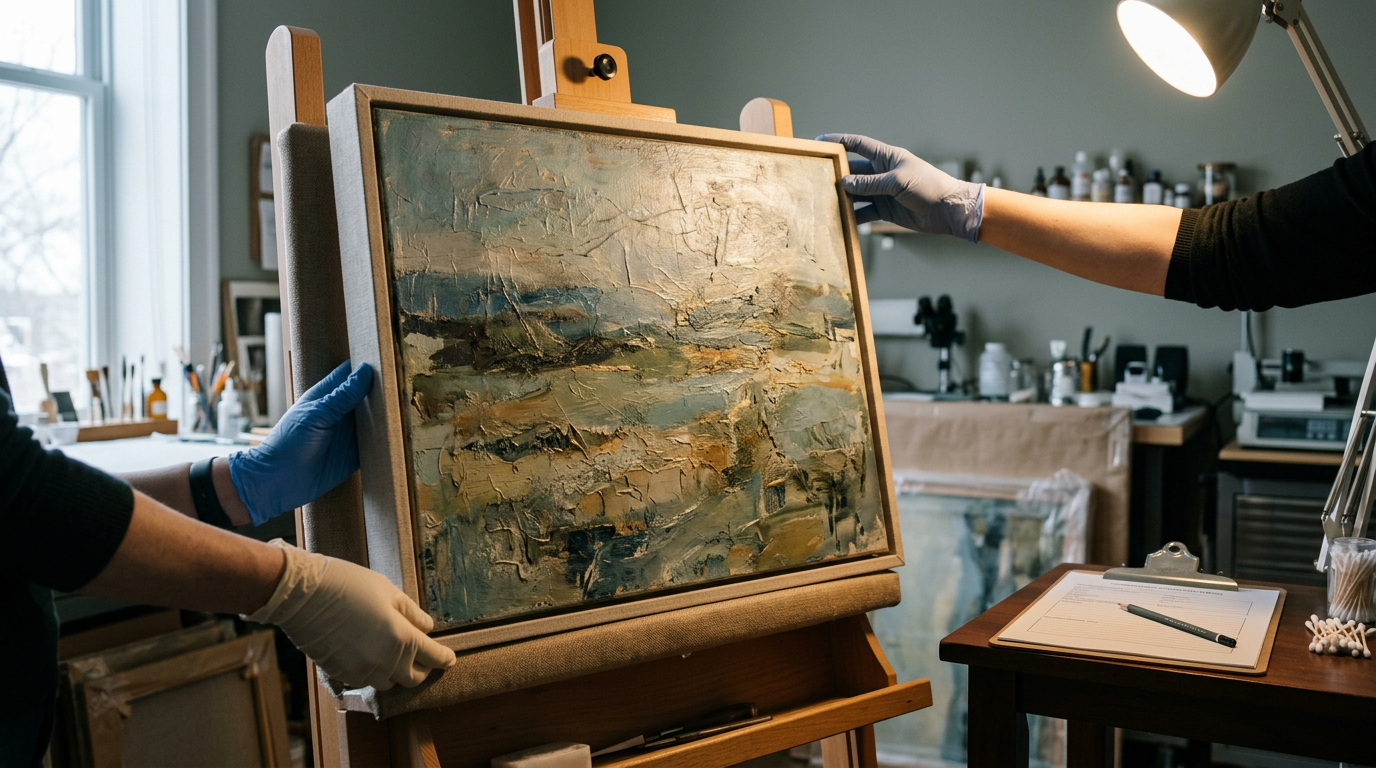
Good reporting is methodical rather than theatrical. The examiner works in controlled light, handles the object with clean hands or gloves suited to the material, and records one structural layer at a time. CCI’s painting notes advise concentrating on paint layers, ground, surface coating, primary support, auxiliary support and frame as separate blocks so a complex object does not blur into a single vague “fair” label. Spectrum’s suggested procedure expects institutions to decide who may carry out which level of check: any trained staff for routine intake notes; conservation-skilled staff or a professional conservator for loan-out reports; a full conservator examination before major treatment.
Start with identification that matches the catalogue or invoice. Measure height, width and depth, noting whether figures include the frame. Record medium as observed, not as marketing copy. Note glazing, backing boards, hanging hardware and any travel frame. Then move to overall rating using a glossary your organisation has defined: excellent, good, fair, poor, and sometimes very poor, or a numeric scale tied to written definitions. SHARE Museums East’s condition-reporting crib sheet warns that word or letter ratings only work when a pre-set glossary sits where every examiner can read it.
Surface examination needs precise nouns. Note crack patterns (age network, drying cracks, impact cracks), flaking or loss, abrasion, scratches, accretions, bloom on varnish, foxing on paper, staining, discoloration and visible inpainting. Structural notes cover canvas tension and tears, panel warp or split, paper cockling and tears, sculpture joins and corrosion. Frame notes cover gilding losses, loose joints and whether the frame appears original. Previous restoration belongs in its own section: linings, replaced stretchers, fills, varnish campaigns. Ultraviolet examination often reveals retouching invisible in normal light; if you use UV, say so and attach those images.
Photography is not optional for any report that might face a claim or loan dispute. Capture overall front and reverse under even light; raking-light views for texture and deformation; detail shots of damage with a scale; labels and inscriptions. Annotated diagrams or marked printouts speed complex surfaces: circle the loss, number it, and use the same number in the prose. Institutional practice still often starts with pencil notes on paper in the gallery (ink pens risk transfer) and then expands into a searchable digital record the same day. Digital files should keep originals in a lossless or high-quality format for the master archive, with working JPEGs for email if needed. Annotate prints or screen images so arrows and circles point to the same losses named in the text.
Checklist, narrative and hybrid formats
AIC’s Book and Paper Group documentation chapter distinguishes checklist-style and narrative reports and notes that intended use, audience and resources should drive the format. Checklists speed routine loans and force consistent fields. Narratives handle unusual damage and complex object histories. Hybrid forms dominate serious painting baselines: tick-boxes for common conditions plus free text where the glossary runs out. SHARE Museums East likewise pushes controlled vocabulary for searchable records and free text for exceptions.
Choose the shallowest format that still answers the reader’s question. A cursory inspection after a weekly gallery walk needs date, examiner, location and “no change” or a short new-damage note. A purpose-based loan-out report needs enough detail that a stranger at the next venue can spot a new scratch. A baseline acquisition report should be rich enough that, five years later, a different conservator can compare like with like.
Light, access and working conditions
Examination quality collapses in bad light or rushed unpacking. Raking light needs space and a movable lamp. Reverse examination needs the work off the wall or out of the crate with enough hands to support the object. Sculpture and large canvases may need a studio visit rather than a corridor glance. If the only access is a fair booth under mixed spotlights, say so in the report; limited visibility is itself a finding. Never force a full baseline in conditions that hide the surface. Schedule a proper check when light and handling allow, and use a provisional note for the interim handoff if the loan clock cannot wait.
Sample Fields Every Useful Report Should Hold
The table below consolidates fields that recur across CCI baseline forms, AASLH-style loan checklists, AIC examination headings and common private-studio templates. Adapt labels to your collection-management system, but keep the information units intact so a registrar, conservator and insurer can read the same file.
| Field group | What to record | Why it matters | Typical failure if omitted |
|---|---|---|---|
| Identification | Artist/attribution, title, date, medium, inventory/accession no., owner, current location | Ties the report to the correct object and schedule | Claim or loan file attached to the wrong work |
| Dimensions | H × W × D, with and without frame; units stated | Separates object from frame; supports crate design | Shipper builds for the wrong footprint |
| Overall rating | Excellent / good / fair / poor (or defined numeric scale) plus glossary reference | Gives a searchable summary for surveys and loans | Readers invent their own meaning for “fair” |
| Surface condition | Cracks, flaking, loss, abrasion, stains, foxing, bloom, dirt, visible retouch | Locates existing surface damage before travel or sale | New scratch cannot be distinguished from old |
| Structure / support | Canvas tension, tears; panel warp/split; paper tears/cockling; joins; insect evidence | Flags travel risk and active failure | Unstable work approved for loan |
| Coatings & prior treatment | Varnish condition; lining; fills; replaced stretcher; UV notes | Explains non-original material and earlier campaigns | Buyer or insurer treats restoration as fresh damage |
| Frame / housing | Gilding, joints, glazing, backing, hardware, originality note | Frames carry value and cause abrasion if loose | Frame loss blamed on borrower without baseline |
| Environment / use notes | Display light advice, RH sensitivity, handling limits, crate needs | Turns observation into care instructions | Work hung in unsafe light after “good” rating |
| Photodocumentation | Overall front/back, raking, details with scale, UV if used; file names and date | Makes the written claims checkable | Text-only dispute with no shared image |
| Examination meta | Examiner name/role, date, place, light conditions, report type | Creates accountability and comparison points | Unsigned form rejected by lender or insurer |
| Change log (travelling) | Incoming/outgoing notes per venue with signatures | Pins damage to a custody stage | Entire loan chain shares blame |
Use the rating column only with a written key stored with the form. A “3” or “B” without definitions is decoration. For travelling reports, keep the change log on the same document the lender started; parallel rival forms break the chain of comparison Te Papa and ARTE Generali both describe as essential.
Report Types You Will Meet in Practice
CCI organises painting documentation into four interlocking types: baseline, cursory inspection, purpose-based and cumulative. Knowing which one you hold stops you from overwriting a rich baseline with a thin checklist, or from expecting a fair-booth scrawl to do the work of a loan-out file.
A baseline report is the full first examination at acquisition or during a collection survey. It records materials, construction, condition, labels, frame and care recommendations, with photographs. Later documents should measure change against it rather than reinvent description. A cursory inspection is short: new damage, date, circumstances, action taken. CCI suggests frequent checks for works on display and for fragile storage items, with lower frequency for stable stored works. A purpose-based report is the loan-out examination completed just before departure; it is leaner than a baseline but must name every feature that differs from an undamaged state so borrowers can spot change. A cumulative or travelling report is the purpose-based form plus incoming and outgoing annotations at each venue, returned to the lender for final comparison.
Spectrum levels and museum staffing
UK museums working to Spectrum 5.1 treat condition checking as a standing collections-care procedure (not one of the nine Accreditation primary procedures) that feeds loans, acquisition, conservation and use. Collections Trust’s suggested procedure describes three practical levels: a condition check by trained staff or volunteers at enquiry, loan-in or potential acquisition; a condition report by conservation-skilled staff or a professional conservator for outbound loans and before chemical or tool-based treatment; and a full conservator report before major treatment of complex objects. Policy should name who is authorised for each level. That ladder keeps routine intake moving without pretending every volunteer note equals a paintings conservator’s loan file.
Private-studio report products
Private conservators sell related products under different names. Icon guidance distinguishes preliminary, interim, final and standalone condition reports, and separates them from treatment proposals and treatment reports. A standalone condition report for a sale or insurer may omit treatment recommendations on purpose. A preliminary studio assessment may be brief and image-led; a full examination before a major clean will be longer and may include testing notes. Ask which product you are buying. Paying for a treatment proposal when you only need a claim baseline wastes money; buying a one-page checklist when a lender demands a full illustrated loan report wastes everyone’s time at the loading bay.
Edge Cases That Break Naive Templates
Contemporary and time-based works stretch checklist language designed for easel paintings. An installation may depend on playback equipment, spare bulbs or software that age faster than the sculptural shell. Condition assessment then includes function: does the piece run as the artist requires? Museum time-based media labs often stage the work with alternative equipment before exhibition; that rehearsal is part of the condition record. Owners of such works should involve the artist, studio or estate when substitution rules are unclear.
Sacred, ceremonial and culture-restricted objects may limit photography, sampling or even who may view the reverse. A report that ignores those protocols is unethical even if every surface has a photograph. Ethnographic and community consultation practice belongs inside the examination brief, not as an afterthought.
Previous restoration confuses graders. Overpaint, wax linings and amateur fills can look like damage or can hide it. UV and magnification help, but examiners should state uncertainty rather than invent a clean story. Multi-venue tours create another trap: each borrower must annotate the travelling form. Substituting a house template mid-tour resets the baseline and muddies liability. Sculpture with detachable parts needs a parts list; missing elements are condition facts. Works under glass hide surface issues; note whether glazing was removed for examination.
Disaster response prioritises triage notes over perfect prose. Flood, fire and mould events need rapid recording of wetness, soot, active mould and unstable media, then professional advice. Do not bleach, heat-dry or iron objects to “improve” them before the examiner arrives; those interventions become new damage in the file.
Who Writes the Report
Authorship follows competence and purpose. Registrars and collection managers often own loan paperwork and travelling forms in museums. Conservators write baselines before treatment, detailed loan-out reports for fragile works, and post-treatment records. Preparators and art handlers may add packing and crate observations. Couriers and venue technicians sign handoff checks against the lender’s form. Private owners can take useful photographs and write plain-language notes for their own files; for sales, claims and institutional loans, a named professional examiner carries more weight.
In the UK, Icon’s Find a Conservator directory lists Accredited Conservator-Restorers by specialism and location. In North America, AIC’s Find a Professional tool lists Professional Members who opt in. Match the specialism to the object: paintings, paper, objects, textiles, frames. A paintings ACR who declines a waterlogged archaeological textile is doing the job as ethics require. For the wider role of examination, ethics and treatment, read art conservation; this page stays on the document those professionals produce.
Dealers and auction specialists produce condition notes as commercial descriptions. Read their terms: many exclude liability for unmentioned defects and invite private inspection. An independent conservator’s report after purchase still has value even when the sale note was competent, because the audiences differ. Shippers’ delivery tickets that say “OK” without photographs are custody receipts, not substitutes for a condition report.
What Professional Reports Cost
Fees follow time, complexity, photography and whether the visit is in-studio or on site. They do not follow the auction estimate of the object. Published UK studio pages from 2024 to 2026 give useful order-of-magnitude bands, not a national tariff. Examples: full condition reports advertised from about £100 and rising with size and urgency; formal paper-conservation condition reports around £140 beside treatment charged near £70 per hour; other studios billing assessment and documentation at about £90 per hour plus VAT, with headed PDF reports on request; some paintings practices quoting £40 to £60 per hour or day rates near £400 plus VAT after a free initial consult. Off-site rates run higher than studio rates when travel and setup enter the clock.
North American private practice often pairs a flat examination-report fee with treatment billed by the hour, and may offer free in-studio verbal consults before a paid written report. Collection surveys and multi-object inventories bill by day or by object batch. Insurance and legal audiences may require more photography and firmer language, which increases hours. Ask whether the fee includes: examination time, image processing, a travelling-form template, VAT, and a follow-up visit after treatment. Some studios roll a short report into treatment if you proceed; others always invoice documentation on its own line.
Compare quotes on scope. A cheaper page that skips reverse photography, UV notes or a defined rating glossary can fail at the first loan venue. A dearer report that your registrar, broker and borrower can all use without rewriting saves money across the object’s life. For policy-side costs of appraisals and schedules, see art insurance; keep valuation invoices separate from condition invoices in your records.
When to Commission One (and When a Photo Set Suffices)
Commission a professional condition report when the work will leave your control under a loan or consignment agreement; when you buy or sell above a value where a dispute would hurt; when you file or prepare for an insurance claim; when a museum, fair or shipper demands one; and before major conservation so treatment has a clear baseline. Commission one after treatment to reset the baseline for the next decade of loans and schedules. High-value or fragile works in otherwise stable homes still benefit from periodic professional checks on a multi-year cycle; many collection managers treat three to five years as a reasonable full-review rhythm for stable holdings, with shorter intervals for sensitive materials or frequent travellers.
A careful owner photo set can bridge low-risk moves: same-day transport in your car, a local framer you trust, or a domestic rearrange. Shoot front, reverse, details of existing marks, and the packed state. Date the files. That set is better than nothing for a minor household claim, but it is thin evidence for a multi-venue loan or a six-figure schedule. Upgrade to a named examiner when the other party is an institution, an insurer or a buyer with counsel.
Refuse to pad the file with conflicting templates. One travelling form, updated at each stage, beats three incompatible PDFs. Store reports with invoices, loan agreements and treatment files, and pass the folder to the next owner. Museums listed in the museums directory publish conservation and loans contacts when you need institutional norms to compare against private practice. For ongoing preventive care at home, return to the caring for art hub rather than treating the condition report as a substitute for climate, handling and storage discipline.
FAQ
Owners, lenders and adjusters ask the same cluster of questions once a report enters a deal or a claim. Confusion clusters around three boundaries: money versus materials, who is allowed to sign at a handoff, and how much an owner can do with a phone camera before the file needs a named professional. The answers below stay inside the fence of this guide. They define what the document is and is not, who signs travelling forms, how baselines differ from cumulative loan paperwork, and when a private photo set is enough versus when you should commission an accredited examination. Read them as operational clarifications, not as legal advice for a live dispute.
Is a condition report the same as an appraisal?
No. A condition report describes physical state at a date. An appraisal or valuation estimates monetary worth for insurance, tax or sale. Insurers often want both in a claim file, but different professionals produce them. Conservators and registrars write condition documents; valuers and appraisers write value opinions. Icon tells clients not to treat conservators as valuers. Full appraisal method sits outside this guide’s fence.
Who should sign a loan condition report?
The lender’s examiner signs the outgoing baseline. At each venue, a named representative of the borrower (and often a lender courier) signs incoming and outgoing notes on the travelling form. On return, the lender signs the final comparison. Unsigned stages weaken the custody chain ARTE Generali and museum loan procedures rely on.
Can I write my own report for insurance?
You can and should keep dated photographs and plain notes. For scheduled fine-art policies and serious claims, carriers and adjusters give more weight to a report from an accredited conservator or an experienced registrar-style examiner, especially when pre-existing restoration or structural issues are in play. Ask your broker what their claims team expects before a loss happens.
How is a travelling report different from a baseline?
A baseline is the rich first record of materials and condition. A travelling or cumulative report starts from a purpose-based loan examination and then accumulates short change notes at each handoff. Borrowers should not replace the lender’s form with a new full narrative that erases the comparison points.
Do frames need their own section?
Yes. Frames abrade paint, hide labels, and often hold separate historic or market value. CCI’s painting notes treat painting and frame as linked subjects of examination. Note glazing, backing, hardware and whether the frame appears original.
What vocabulary should I use for damage?
Prefer controlled terms your glossary defines: abrasion, loss, flaking, cleavage, craquelure, foxing, cockling, bloom, dent, tear. Avoid vague praise or blame (“beautiful patina”, “ruined”) without physical description. SHARE Museums East and CCI both stress agreed definitions so searchable records mean the same thing to every staff member.
How soon after an incident should I document?
As soon as it is safe to approach the object. Record time, place, cause if known, and visible change before remedial cleaning. Then call a conservator or your insurer’s claims line according to the policy. Delay invites further handling damage and weakens the chronology adjusters reconstruct.
Does Spectrum apply to private collectors?
Spectrum is the UK museum collections-management standard. Private owners are not accredited against it, but its condition-checking logic (authorised examiners, linked procedures, image-backed records, change over time) is the same practice dealers, shippers and conservators already expect. Using Spectrum-like discipline makes your file readable to institutional partners when you lend.
Galleries mentioned
Museums mentioned
Exhibitions mentioned
Artworks mentioned
Related reading
Olga de Amaral: Weaving the Infinite
A transatlantic survey tracing six decades of textile innovation across architecture and craft.

A Rare Market Appearance: Hilma af Klint's Geometric Masterwork Heads to Stockholm
A tightly guarded abstract canvas enters the secondary market, challenging established price benchmarks and highlighting sustained institutional momentum.

A Marketing Mismatch Over Impressionist Iconography
Why a Eurostar campaign overlooks a major London loan