
Exhibo Editorial
Academic Art and the Academies
How European art academies set training ladders, genre ranks and the polished Salon style that dominated the nineteenth century.
Academic art is painting and sculpture made under the doctrines of Europe’s official art academies: staged training, a ranked ladder of subjects, and a finished surface that hides the labour of the brush. From the seventeenth century through the late nineteenth, academies in Paris, London, Rome and other capitals told students what to copy, which genres carried prestige, and how a picture should look when it reached the public exhibition hall. The National Gallery’s glossary puts the point cleanly: academic work followed the doctrines of those academies and held up ancient art, Raphael and Poussin as models.
You meet the style as porcelain flesh, clear contour and myth or history on a large canvas, yet the deeper subject is institutional power. Teachers, juries and scholarships shaped careers as much as any single manner of painting. This article tracks the conditions that produced the academies, what the doctrine required, who carried it, which museum works repay close looking, how the model travelled and mutated, how critics attacked and later revised it, and what it left for ateliers and museums today. For the Neoclassical period that fed French teaching, see Neoclassicism, Explained. The wider period map sits in Periods of Art History.
From guilds to state schools
European artists once trained inside craft guilds that controlled apprenticeships and market rights. By the later Renaissance, Italian cities began to separate “fine” design from trade regulation. Florence’s Accademia del Disegno (founded 1563 under Cosimo I de’ Medici, with Vasari among its organisers) and Rome’s Accademia di San Luca gave drawing (disegno) an institutional home. Those Italian schools supplied a template: life study, antique models, lectures, and a claim that painting and sculpture belonged with the liberal arts rather than with the mechanical trades.
France built the most consequential machine. In 1648 the Académie royale de peinture et de sculpture opened in Paris, with royal backing that grew under Louis XIV and Jean-Baptiste Colbert. Charles Le Brun helped turn the academy into a school of doctrine as well as a club of members. From 1663 the Prix de Rome offered a state-funded stay at the French Academy in Rome (founded 1666), so a winning student could live among antiques at public expense. André Félibien, as academy secretary, set out the hierarchy of genres in 1669, ranking history painting above portraiture, genre scenes, landscape and still life. That ranking governed prizes, wall space and professional honour for generations.
Britain followed later. The Royal Academy of Arts, founded in London in 1768 with Joshua Reynolds as first president, combined a school, an annual exhibition and a public rhetoric of the “Grand Manner.” Reynolds’s Discourses told students to study the old masters and elevate portrait and history above mere likeness. Elsewhere, academies multiplied: Copenhagen, Madrid, St Petersburg, Vienna, Munich and many German and Italian centres ran parallel schools. In the United States, the Pennsylvania Academy of the Fine Arts (1805) and the National Academy of Design (1825) imported European curricula. By the mid-nineteenth century, as Jason Rosenfeld notes in the Metropolitan Museum’s Heilbrunn essay on the Salon and the Royal Academy, the French and English academies still held near-monopoly power over public taste and official patronage, even as challengers gathered at the edges.
The academy was never only a style club. It awarded medals, controlled access to Rome, advised the state on commissions, and (in France) fed the Salon’s jury culture. When writers later used “academic” as an insult, they named that whole apparatus: pedagogy, hierarchy and polished finish bound together.
| Year | Institution or milestone | Place | What it did |
|---|---|---|---|
| 1563 | Accademia del Disegno | Florence | Early state-backed academy elevating disegno above guild craft |
| 1593 (refounded) | Accademia di San Luca | Rome | Roman teaching hub for drawing, antique study and later Prix circuits |
| 1648 | Académie royale de peinture et de sculpture | Paris | French royal academy; model for European art schools |
| 1663 / 1666 | Prix de Rome; French Academy in Rome | Paris / Rome | Scholarship and residency that capped the French training ladder |
| 1669 | Félibien’s hierarchy of genres | Paris | Official ranking of history painting over lower genres |
| 1768 | Royal Academy of Arts | London | British school, annual exhibition and Grand Manner doctrine |
| 1793–95 | Revolutionary closure and École des Beaux-Arts reorganisation | Paris | Royal academy dissolved; teaching rebuilt under new state forms |
| 1803 | Institut de France / Académie des Beaux-Arts consolidation | Paris | Fine-arts membership inside the Institut; Beaux-Arts teaching continues |
| 1863 | Cabanel’s Birth of Venus bought from the Salon | Paris | Peak Second Empire academic prestige (canvas now Musée d’Orsay) |
| 1874 | First Impressionist group exhibition | Paris | Independent show that undercut Salon monopoly without ending academic production |
| 1968 | Prix de Rome abolished (André Malraux) | France | State ends the classic Rome prize after cultural upheaval |
What academic art means on the wall
Stand in front of a mid-century Salon favourite and the checklist is practical. Contour stays firm. Flesh is idealised rather than weather-beaten. Brushmarks disappear into a continuous skin of paint. Colour supports modelling instead of announcing itself as broken strokes. Subjects lean toward mythology, scripture, antique history or allegory when the painter aims at the top of the hierarchy. The National Gallery stresses that training began with drawing after prints, then sculptures, then the live model, before composition and history painting. That sequence produced artists who could invent multi-figure dramas and still make every limb read as studied anatomy.
Academic art overlaps Neoclassicism without collapsing into it. David’s generation used academy tools for civic severity; mid-nineteenth-century academicians often mixed classical clarity with Romantic sentiment, Orientalist costume or soft erotic myth. Google Arts & Culture’s entity note captures a common scholarly shorthand: art shaped by the French Académie des Beaux-Arts across Neoclassical and Romantic generations, then by later painters who tried to synthesise both. Treat “academic” as institutional allegiance and finish more than as a single decade’s fashion. For the archaeological and civic programme of the earlier period style, keep the Neoclassicism piece open beside this one rather than forcing both surveys into a single page.
The word also names a finish that dealers and jurors could recognise at speed. A “licked” surface (the French sneer léché) meant the painter had sanded away evidence of struggle. Modernists later mocked that polish; for academicians it signalled mastery and respect for the exhibition wall, where pictures hung frame to frame under harsh light and needed to carry from a distance. Once you can spot that continuous skin, you can also spot the exceptions: a Couture that keeps more open handling inside history painting, or a Bastien-Lepage that admits outdoor light while still chasing Salon scale.
The training ladder and the hierarchy of genres
Academic power rested on a curriculum you could diagram. Students did not begin with personal expression. They climbed a graded path that treated drawing as the foundation of invention. The same institutions then ranked finished pictures by subject, so a still life of oranges could never outrank a canvas of Roman virtue no matter how deft the handling. Understanding academic art means watching those two systems work together: how a hand was trained, and how a subject was valued.
Teachers defended the ladder as moral and intellectual, not only technical. History painting, they argued, required knowledge of literature, anatomy and ideal form; lower genres copied what the eye already saw. That claim justified scholarships, wall height at exhibitions and state purchases. It also created career traps. A gifted landscapist might sell well yet remain a second-class citizen inside the academy’s honour code. Nineteenth-century markets slowly loosened that grip, but the ideology outlived its usefulness and became a target for Realists and Impressionists who wanted the street, the café and the open air admitted as serious art.
From print copy to the live model
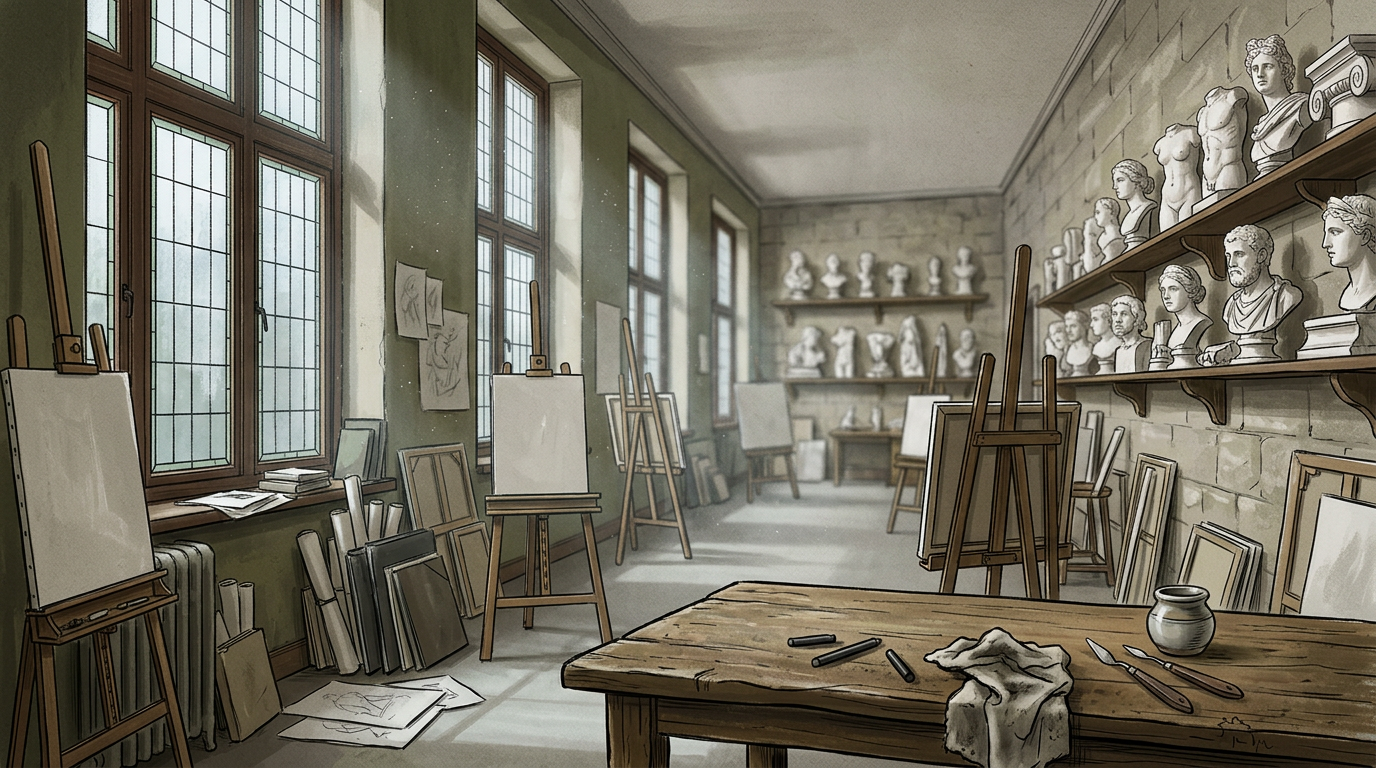
The National Gallery’s account of academic training matches studio memoirs across Europe. Beginners copied prints to learn contour and proportion. They moved to plaster casts of antique sculpture, drawing under controlled light until the eye could turn marble into tone. Only then did they draw the nude model, often in timed poses supervised by a professor. Composition studies and painted sketches followed. The ultimate test, in the French system, was history painting ambitious enough for the Prix de Rome contest, where candidates worked in isolation on an assigned theme.
That sequence produced shared visual habits. Cast drawing taught students to prefer the generalised antique body over the quirks of a particular sitter. Life study added volume and gesture, yet teachers still corrected toward ideal proportions. Colour arrived late, after line had locked the design. Debates between poussinistes (line, structure) and rubénistes (colour, painterly warmth) never fully vanished, but nineteenth-century French academic orthodoxy still treated drawing as the skeleton of the picture. When you see a Salon nude whose anatomy looks “correct” to the point of anonymity, you are seeing that ladder’s success.
Private ateliers orbiting the École des Beaux-Arts complicated the story. Students often paid a master such as François-Édouard Picot, Thomas Couture or, later, Jean-Léon Gérôme for studio instruction while also competing inside the state school. Cabanel and Bouguereau both passed through Picot’s orbit and the Beaux-Arts, then won the Prix de Rome (1845 and 1850). The academy was a network of rooms, not a single classroom.
History painting at the summit
Félibien’s hierarchy put history painting first because it demanded invention: myth, scripture, allegory or exemplary history staged with multiple figures. Portraiture came next, then scenes of everyday life, then landscape, then still life. Animal painting sometimes sat near the bottom of related schemes. Prizes and Rome scholarships favoured the top rung. A painter of genre scenes could grow rich and still hear that the work lacked seriousness.
By the Second Empire the hierarchy had softened in practice. Mythological nudes sold as “history” while functioning as erotic display. Peasant piety and Breton costume, as in William-Adolphe Bouguereau’s Breton Brother and Sister (1871; Metropolitan Museum of Art), borrowed the finish of high art for popular subjects. Orientalist studios used archaeological props to dress invention as research. The official ladder remained the language of juries even when the market rewarded polished fantasy over Plutarch.
Painters and teachers who carried the doctrine
Charles Le Brun (1619–1690) set an early French pattern: court painter, academy organiser, theorist of expression. Joshua Reynolds (1723–1792) did comparable work for Britain, preaching eclectic study of the masters while running the Royal Academy’s public face. Jacques-Louis David belongs to the Neoclassical story told elsewhere in this series; his studio nevertheless became a pipeline for academic draughtsmanship that nineteenth-century teachers still cited. Names matter here because academic art travels through studios and membership lists as much as through manifesto pages.
Jean-Auguste-Dominique Ingres (1780–1867), briefly David’s pupil, became the nineteenth century’s high priest of line. His portraits and history subjects taught academies that contour could stay severe while flesh turned sensual. Students copied his drawings; rivals mocked his elongations; institutions claimed his authority. He bridges Neoclassical discipline and later Salon taste without exhausting either label. When later painters wanted to prove loyalty to “correct” drawing, they pointed at Ingres even if their colour warmed toward Romantic taste.
Alexandre Cabanel (1823–1889) and William-Adolphe Bouguereau (1825–1905) embody mid-century French success. Both studied under Picot, won the Prix de Rome, and built careers on myth, religion and ideal bodies. Orsay’s artist files record Cabanel’s 1845 Rome prize and his 1863 election to the Institut; Bouguereau’s Rome prize fell in 1850, with Italian years until 1854. Cabanel taught at the École des Beaux-Arts and sat on Salon machinery; Bouguereau’s porcelain surfaces became a byword for academic finish, admired by collectors and derided by modernists who coined verbs from his name. Together they show how Rome prizes, teaching chairs and state purchases stacked into a career architecture younger artists could read as a map.
Jean-Léon Gérôme (1824–1904) pushed academic craft toward archaeological spectacle and Orientalist staging. He taught a generation of students, including many Americans, and treated the studio as a research theatre of costumes and props. Print dealers such as Goupil spread his compositions through reproductive engraving, so academic images reached parlours that never saw a Salon hanging. In Britain, Frederic Leighton and the later Victorian classicists kept a related polish: Rosenfeld notes Leighton’s continental training and the smooth Salon-like surface of works such as Lachrymae (1894–95; Metropolitan Museum of Art), shown at Burlington House. Thomas Couture (1815–1879) mattered as teacher and as painter of Romans of the Decadence (1847; Musée d’Orsay), a moralising history machine that critics read as a mirror of July Monarchy France. Manet studied briefly with Couture; the pupil’s later refusals of academic finish make that apprenticeship part of the style’s aftershock.
Women entered these systems under tighter limits. Academies restricted life-class access for female students for decades; career routes often ran through private instruction, portrait markets and selective exhibition. Rosa Bonheur’s animal painting success, noted in the Met’s nineteenth-century academy essay, shows how a painter could win Salon medals while still sitting outside the highest history-painting honour code. Any honest account of academic power has to register who the schools admitted to the nude model and who they kept at the door.
Four works that repay close looking
Survey traits stay abstract until you test them against canvases in public collections. The four pictures below sit in the Musée d’Orsay or the Metropolitan Museum of Art. Each solves a different academic problem: moralised antiquity on a vast scale, myth as licensed nude for an emperor’s collection, a second Venus for the state museums, and Ovid restaged as a sculptor’s fantasy. Read them in sequence and you watch the doctrine move from public sermon to private erotic licence to late-century studio allegory, without abandoning the same tools of contour, ideal flesh and invisible brushwork.
Dimensions, frames and wall labels change with loans and rehangs. Confirm display before you travel; collection pages and directories such as exhibo.art/museums help you map where related academic canvases hang across cities. The close readings that follow stay with what the paint and the institutional record still support.
Thomas Couture, Romans of the Decadence (1847)
Couture spent three years on this enormous oil, now in the Musée d’Orsay. Orsay’s catalogue note records a state commission of 1846 and exhibition at the Salon of 1847. The canvas fills a ruined classical hall with revelers among statues; upright Romans of an earlier age seem to watch the debauch. Couture printed lines from Juvenal in the Salon livret: vice, crueller than war, falling upon Rome. Critics then read the orgy as a jab at contemporary French elites under the July Monarchy. The picture is history painting doing double duty as coded politics.
Formally, you see the academy’s ambition at full stretch. Architecture sets a deep stage. Bodies knot into groups a student could dissect for gesture studies. Antique sculpture inside the painting supplies a moral chorus. Couture wanted, Orsay notes, a synthesis of Greek, Renaissance and Flemish lessons to revive French painting. Whether you find the sermon heavy or lucid, the craft is the point of this article: multi-figure invention, readable allegory, and a finish built for the Salon’s crowds.
Alexandre Cabanel, The Birth of Venus (1863)
Shown at the Salon of 1863 and bought at once by Napoleon III for his private collection, Cabanel’s Naissance de Vénus is now in the Musée d’Orsay. A smaller 1875 version belongs to the Metropolitan Museum of Art. Venus reclines on a crest of foam while putti hover above; the body is continuous, pearly, almost without pore or bruise. Orsay’s commentary calls the myth a pretext for an idealised nude that still reads as lascivious, and quotes Émile Zola’s jab that the goddess looks like pink-and-white marzipan rather than flesh.
Hang this canvas beside the memory of Manet’s Olympia (also 1863 territory in the public fight over the nude) and the academic contract becomes visible. Cabanel offers mythological cover, soft edges of respectability, and a surface that flatters gaslight. Manet’s stare and flatness refuse that cover. Cabanel’s triumph that year (Institut membership, teaching power, imperial purchase) shows how academic art could still command the summit of official taste while a rival modern language gathered force. The Salon politics of acceptance and refusal belong to a sibling essay; here the lesson is pictorial: ideal contour as institutional speech.
William-Adolphe Bouguereau, The Birth of Venus (1879)
Bouguereau’s own Naissance de Vénus (Musée d’Orsay), shown at the Salon of 1879 and bought by the state for the Musée du Luxembourg, restages the goddess upright in a shell, ringed by nymphs, tritons and putti. The canvas is about three metres high. Every wet body shines with the same enamel continuity. Salon records list Bouguereau as hors concours and a member of the Institut: an artist past the need for ordinary medals.
Compare the two Venuses and you see academic flexibility inside a shared grammar. Cabanel’s figure reclines in languor; Bouguereau’s stands in a choreographed oval of attendants. Both hide the brush. Both treat classical subject matter as a passport for the nude. Both pleased an official public that still equated finish with virtue. Modernist critics later used Bouguereau as shorthand for empty perfection; looking at the Orsay canvas, you can see why the insult stuck and why collectors ignored it. The painting performs competence at a level few rivals could match.
Jean-Léon Gérôme, Pygmalion and Galatea (c. 1890)
At the Metropolitan Museum of Art, Gérôme’s oil shows the sculptor kissing his statue at the instant she warms to life, a subject from Ovid. Galatea’s lower body still reads as marble; her upper body flushes. Cupid aims an arrow. The studio props (masks, studies, tools) advertise the painter’s own world of making. Gérôme painted several angles of the theme and related sculptural versions; the Met’s picture is the best-known painted variant.
This is academic art as meta-craft: a polished narrative about sculpture’s power, executed by a painter who taught accuracy as a creed. Where Couture moralises a crowd, Gérôme isolates a miracle of technique. The picture arrived late, after Impressionist exhibitions had already split Paris’s public. That timing matters. Academic production did not stop when critical fashion moved; it continued to invent subjects that justified ideal bodies and invisible brushwork for buyers who still wanted them.
How the model travelled and mutated
French doctrine exported well because other capitals wanted state-facing art schools. Students from the Americas, Eastern Europe and the Middle East enrolled in Paris ateliers, then carried cast culture home. World’s fairs from the 1850s, as Rosenfeld notes, gave academic painting a global stage beside industrial display. Local academies adapted the hierarchy to national histories: British painters folded Shakespeare and medieval legend into Grand Manner rhetoric; German academies mixed Nazarene linear piety with later history spectacle; Russian and Scandinavian schools used the Paris ladder to build local subject matter.
Mutation came from inside as much as from rebels outside. Orientalist compositions used ethnographic costume to refresh history painting. Naturalist painters such as Jules Bastien-Lepage kept Salon scale while admitting broken outdoor light, as in Joan of Arc (1879; Metropolitan Museum of Art), shown at the Salon of 1880. Aesthetic movement artists in London could show at the Royal Academy and at alternative galleries such as the Grosvenor without abandoning skilled finish. Academic art, in practice, was a family of compromises around a training core.
The Salon and the Royal Academy exhibitions remained the public face of that family. Full narratives of jury battles, the Salon des Refusés and independent group shows belong with the dedicated Salon essay in this series (planned as The Salon and the Salon des Refusés, pending). For this article the point is narrower: academies needed a shop window, and those exhibitions were it. When artists founded rival venues, they attacked the shop window while often still using academic drawing skills learned in the same schools.
Critics then and revisionists now
Enlightenment and Revolutionary writers had already questioned courtly softness; nineteenth-century Realists and Naturalists went further. Gustave Courbet treated stone breakers and funerals as subjects equal to Rome. Édouard Manet flattened the nude’s alibi. Impressionist painters took the optical present tense outdoors and, from 1874, showed outside the Salon’s rules. Zola’s attack on Cabanel’s Venus as confectionery is a period sample of the charge sheet: academic flesh looked cooked for the market, not observed from life. Dealers and juries still bought the polish; the critical press began to treat that purchase as evidence of bad faith.
Modernist histories of the early twentieth century hardened the verdict. “Academic” came to mean derivative, official and empty. School curricula skipped Bouguereau; museums stored Salon giants in the basement. Survey narratives of modern art needed a foil, and academy painting supplied one: finish without risk, myth without present tense. That story contained truth about institutional gatekeeping and about the limits of ideal form in an industrial century. It also erased the academies’ role as the only advanced training many artists could get, including women and foreigners who later joined avant-garde circles after learning to draw under the same casts.
Late twentieth-century revision shifted again. Exhibitions and dealers rediscovered academic painting’s technical intelligence. Conservators and atelier teachers studied nineteenth-century methods (ébauche, scraping, glaze sequences) as recoverable craft. Art historians mapped patronage, gender barriers and colonial looking in Orientalist academism without pretending the canvases never existed. You can now walk Orsay’s academic rooms and read wall texts that admit both the polish and the politics. The slur and the revival sit in the same gallery, which is the honest place for a style that once ran the public conversation about what counted as art.
What academic art left behind
Walk a plaster-cast corridor in an old art school and you are inside the afterlife. Many European and American academies still drill contour from casts before life drawing, even when the rest of the curriculum is contemporary. Private ateliers in Paris, New York, Florence and elsewhere market “classical realism” as a deliberate recovery of Beaux-Arts sequence. Their students may never paint Venus for a Salon jury, yet they inherit the ladder: print, cast, model, composition.
Museums hold the public half of that inheritance. Orsay’s Couture, Cabanel and Bouguereau canvases let you test Zola’s insults against the paint. The Met’s Gérôme, Cabanel replica, Bouguereau peasants and Leighton classicisms show how academic finish travelled into American collections. Civic buildings and mural cycles from the later nineteenth century still speak the same language of allegory and ideal anatomy on ceilings and stair halls. Academic art shaped what “serious painting” looked like for audiences long after critics changed camps.
The deeper residue is bureaucratic. Scholarships, life classes, ranked exhibitions and teaching hierarchies remain familiar even where the doctrine of history painting has gone. Whenever a school argues about whether drawing still matters, it restages an academic quarrel. Whenever a public complains that contemporary art abandoned skill, it quotes, without always knowing the source, the old academy’s claim that craft and moral subject should bind together. Academic art is finished as a monopoly. As a set of habits and arguments, it still occupies the room.
FAQ
These questions track what search results and classrooms keep asking once the definition is on the table: how academic art differs from neighbouring period labels, which names and canvases to remember, when the monopoly cracked, and whether the training still matters. Several prompts echo People Also Ask phrasing; the replies match those intents without turning the section into a keyword dump. Answers stay short enough to use and long enough to avoid the one-line trap. If you came for a definition, start with the first two questions; if you came to plan looking, jump to the museum list near the end.
What is academic art in simple terms?
Academic art is work made to the standards of official art academies: staged drawing training, preference for elevated subjects (especially history and myth), and a smooth, continuous finish. The National Gallery defines it as art created according to the doctrines of those academies from the seventeenth to the nineteenth centuries. In everyday looking, it means idealised bodies, clear contours and polish that hides brushstrokes.
Is academic art the same as Neoclassicism?
No. Neoclassicism is a period style, strongest from the later eighteenth century into the early nineteenth, that revived Greek and Roman form and civic subject matter. Academic art is the longer institutional system that taught and rewarded such classicism, then also absorbed Romantic, Orientalist and sentimental variants. David is central to Neoclassicism; Cabanel and Bouguereau are academic without being Neoclassical in the strict period sense. Use the Neoclassicism guide for the period survey.
What was the hierarchy of genres?
André Félibien’s 1669 ranking for the French Academy placed history painting highest, then portraiture, genre (everyday life), landscape and still life. The scheme treated moral and intellectual invention as superior to copying ordinary appearances. It guided prizes such as the Prix de Rome and shaped how exhibitions hung pictures. Markets and modern movements later weakened the ranking, yet it still explains why a mythological nude could outrank a brilliant still life inside official culture.
Who are the best-known academic artists?
In France, core names include Ingres (as lineal authority), Thomas Couture, Alexandre Cabanel, William-Adolphe Bouguereau and Jean-Léon Gérôme. In Britain, Joshua Reynolds founded the rhetorical tradition; later Victorian classicists such as Frederic Leighton kept related finish on Royal Academy walls. Many other national schools produced academic painters; French and British institutions simply set the loudest international standard in the nineteenth century.
When did academic art lose its dominance?
There is no single end date. Mid-century Realism and the 1860s scandals around Manet damaged prestige; the Impressionist exhibitions from 1874 offered a durable alternative public. Academic painters still won state purchases and teaching posts into the 1880s and 1890s. Early twentieth-century modernist taste then pushed Salon painting out of progressive narratives. Production continued; critical dominance did not.
Why did modern artists attack academic art?
They attacked gatekeeping (juries, patronage, Rome prizes), the hierarchy that demoted modern life, and a finish they read as false smoothness. For painters chasing contemporary subjects and visible brushwork, academy polish looked like obedience. The attack was also career politics: independent exhibitions needed a foil, and the academy was the established foil.
Where can I see major academic paintings today?
Paris’s Musée d’Orsay holds Couture’s Romans of the Decadence, Cabanel’s and Bouguereau’s Birth of Venus canvases and related Salon painting. The Metropolitan Museum of Art holds Gérôme’s Pygmalion and Galatea, a Cabanel Birth of Venus version of 1875, Bouguereau genre works and Victorian classicist pictures. London’s National Gallery and Tate holdings, plus the Royal Academy’s own collections and loan shows, cover the British strand. Check current displays before visiting.
Does “academic” still matter for artists in training?
Yes, as method more than as monopoly. Cast drawing, sight-size measurement and staged life classes descend from academy pedagogy. Some contemporary ateliers teach that sequence as classical realism. Art schools that reject the old hierarchy still argue with its ghost whenever they debate skill, life drawing and what counts as finished work.
Related reading

Van Lévé: Sovereign Caribbean Visions Take Shape at Harvard
A transnational survey charts twenty-five years of Creole and Maroon artistic practice across the French Caribbean and Amazonia.
Harvard's Alain Locke Gallery presents a landmark survey tracing contemporary production from Guadeloupe, Martinique, Guyane, and Haiti since two thousand and one.

Gustave Fayet: Collector—Artist Designer
A comprehensive survey at the Fondation Louis Vuitton reuniting collected masterpieces with the designer's own studio practice.
The Paris institution expands its patronage series with a dual-focused examination of Gustave Fayet, bringing together hundreds of acquired works and restored creations to chart his impact on early modernism.

Mohammad Alfaraj: The Heart Is a Bird's Nest, the Brain Is a Spider Web
First European institutional solo explores cross-species kinship and domestic ecologies
Mohammad Alfaraj's latest showcase at the Delfina Foundation merges multimedia installations with regional folklore to reimagine shared habitats.