Qubbet el-Hawa (Tombs of the Nobles, Aswan)
Rock tombs of the governors of Elephantine high on the west bank — and the best view over Aswan and the cataract.
The governors' hill
Qubbet el-Hawa — "the dome of the wind", named after the small domed shrine of a local holy man on its summit — is a hill on the west bank of the Nile at Aswan, facing the city and Elephantine Island. Its slopes are cut with rock tombs of the governors and high officials of Elephantine from the Old and Middle Kingdoms, between about 2300 and 1700 BC: men who led trading and military expeditions into Nubia and Africa on behalf of the pharaohs.
Expeditions recorded
The most famous tomb belongs to Harkhuf, a governor of the Sixth Dynasty, whose façade carries an autobiography describing his expeditions to the southern land of Yam, from which he brought back incense, ebony, leopard skins and ivory. It also reproduces a letter from the boy-king Pepi II, eager to see a dancing pygmy that Harkhuf was bringing back, urging him to take every care of him on the journey. Other tombs include the joint tomb of Mekhu and his son Sabni, who recovered his father's body from Nubia, and those of Sarenput I and Sarenput II of the Middle Kingdom, the latter with a pillared hall and finely painted niche showing the owner with his family.
Excavation and view
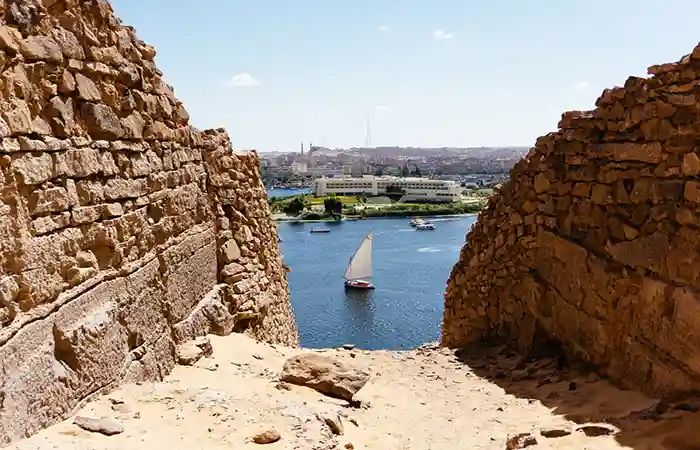
The site has been excavated in recent years by a Spanish mission from the University of Jaén, which has made important discoveries, including intact burials. From the top of the hill, the view takes in the whole of Aswan: the city and its corniche, Elephantine and Kitchener's Island, the granite boulders of the cataract, the desert and the Aga Khan Mausoleum to the south.
Exhibo editorial
Climb the stairs from the river landing — they are steep, so take your time — and the tombs open off the hillside like doorways in a cliff. Read Harkhuf's façade with its royal letter: a child pharaoh, four thousand years ago, begging his governor to bring the dancing pygmy home safely. It is one of the most human documents of the ancient world.
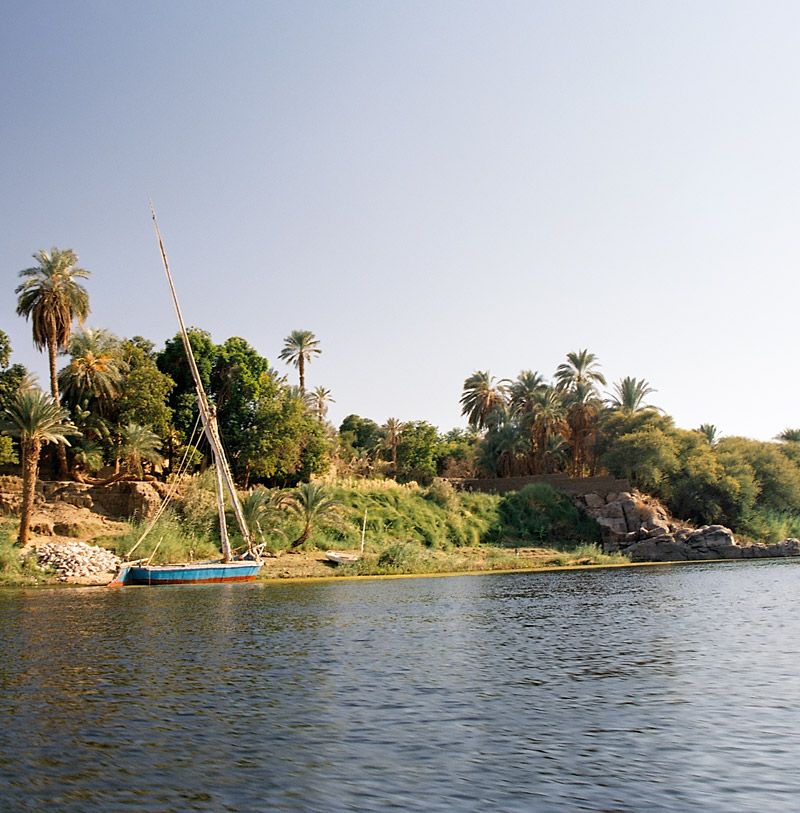
Then keep climbing to the domed shrine at the top for the view: the Nile sliding between granite islands, feluccas with white sails, the city on the far bank. Come in the late afternoon, when the light turns gold and the wind lives up to the hill's name.
How to find it
Take the public ferry from the northern Corniche to the west bank landing below the hill, or hire a felucca or motorboat. Buy tickets at the foot of the hill and climb the stairway to the terrace of tombs; Harkhuf's tomb and Sarenput II's are signposted. A path continues to the domed shrine on the summit for the panoramic view.