
Al Bateen & Al KhalidiyaAbu Dhabi
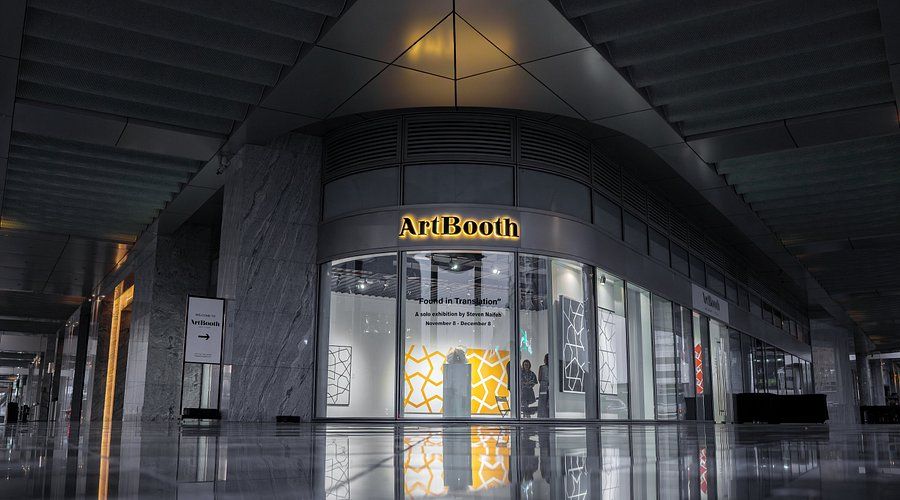
Artbooth Gallery
Artists, curatorial team, advisors, and partners connected to Artbooth Gallery.
Artists
Represented and guest artists exhibiting with the gallery.
Dina Matar
Fatima Abu Rumi
Marwa Alnajjar
Lana Khayat
Afra Al-Suwaidi
Gilbert Halaby
Gilbert Halaby Gilbert HalabyGilbert Halaby was born in 1979 and raised among the olive groves and pine-covered hills of Mount Lebanon. From early childhood, the landscape shaped his imagination. He would spend long hours drawing in the shade of trees, where wind and light wove patterns across the ground. The beauty of nature whispered to him quietly, and those whispers became the language of his art. His academic path led him to study archaeology at the Lebanese University in Beirut, driven by a desire to understand the hidden layers of the past. But it was Rome that called him forward. When he first arrived in the Eternal City, the encounter felt like destiny. In 2003, he settled there and opened a boutique near the Pantheon, where he began crafting jewelry and leather handbags with an artist’s eye for harmony and detail. In time, the boutique blossomed into a full expression of his vision. By 2010, his first women’s collection was released, and in 2016, his atelier on Via di Monserrato opened its doors. This space was more than a boutique. It became a haven for conversation, reflection, and creative exchange. Shelves lined with books, walls adorned with watercolors and oils, and the quiet hum of ideas filled the air. Visitors not only admired the elegance of his designs but also found themselves drawn to the paintings. One by one, the canvases were taken home by collectors, marking the beginning of a new chapter in his artistic journey. Entirely self-taught as a painter, Halaby committed himself to the discipline with deep sincerity. His studio, just steps from the boutique, became a sanctuary of solitude and creation. Over the past six years, he has painted daily, developing a voice rooted in memory, intuition, and light. In 2023, he presented his first solo exhibition, Domus Berytus, in Beirut. This was followed by A Roman Comedy in his adoptive city of Rome. In early 2024, Will You Wait for Me Under That Pine Tree opened in Abu Dhabi, followed by Apogee of Light in Palm Beach, and later, The First Harvest on the island of Hydra in Greece. Halaby’s work carries the quiet strength of reflection. His brush does not rush. It listens. It remembers. Through delicate gestures and carefully chosen tones, he opens a door into a space where silence has a voice and memory becomes matter. There is no need for spectacle, for within the stillness of his compositions lies a deep emotional resonance, one that does not declare itself loudly but lingers gently, like a soft echo within the soul. His paintings unfold like whispered confessions, of longing, of place, of time suspended. They offer no answers, only the grace of presence and the honesty of feeling. In Halaby’s universe, beauty is not a performance but a meditation, and art is not a product but a passage. It is an intimate journey between the visible and the unseen, between what is lost and what is quietly held. His work is represented in important private collections and is part of the permanent collections of the Malvina Menegaz Foundation in Castelbasso, Italy, the Kinda Foundation in Riyadh, Saudi Arabia, and the Lebanese Presidential Contemporary Collection.
Soraya Abu Naba
Soraya Abu Naba Soraya Abu Naba'ASoraya Abu Naba’a was born in 1985 in Melbourne, Florida, at the meeting point of diverse cultural currents that would go on to shape her life and her art. Her father was Palestinian and her mother Lebanese, though born in the Dominican Republic, a lineage as layered and complex as the works she would later create. Though American by birth, it was in the lush, tropical streets of Santo Domingo that Soraya spent her formative years, absorbing the colors, rhythms, and contrasts of the Caribbean landscape. It is perhaps from this early exposure to cultural multiplicity that she draws her gift for weaving the inner and outer worlds into a single, fluid reality. At the age of eighteen, Soraya left for Paris, a city that would deepen her connection to both tradition and transformation. She studied French language and civilization at the Sorbonne before enrolling at the Paris American University, where she earned a Bachelor of Fine Arts degree in 2007. Her academic path was enriched by hands-on experience through internships at the Enrico Navarro Gallery in Paris and the Gary Nader Art Gallery in Miami. These early encounters with curatorial and gallery practices offered her not only professional insight but also a wider artistic vocabulary. Her journey continued through a sculpture course at the Accademia di Arti in Florence, followed by an intensive painting program at Columbia University in New York, and ultimately culminated in a Master’s degree in Painting from the Royal College of Arts in London in 2016. Soraya’s art evokes an interior cosmos in constant bloom. In her floral series, meticulously rendered dreamscapes unfold with astonishing detail, florid visions that verge on the surreal yet remain rooted in the sensual and organic. Her works are less representations than revelations, each canvas a stage where imagination, discipline, and emotion converge. She refers to her creative process as an outburst, a term that captures both the spontaneity and the introspective depth of her practice. For Soraya, the boundaries between nature and self, between universe and gesture, dissolve into a multidimensional expression that is at once personal and profoundly universal. Her career has been marked by both prolific output and critical acclaim. She has participated in over forty group exhibitions, four biennials, and twenty solo shows in renowned galleries across the globe, including Gary Nader Art Centre in Miami, La Galleria in London, and the Royal Houses Museum in the Dominican Republic. Her work, collected privately in cities as diverse as Miami, New York, Santo Domingo, Istanbul, Amman, Geneva, and Toronto, resonates across continents and cultures. Each exhibition seems to affirm her capacity to speak to a shared human impulse, the search for beauty, for meaning, and for transformation through art. Since 2009, Soraya has lived and worked between Santo Domingo and Miami, continuing to build bridges between her cultural heritage and her contemporary vision. In her world, the garden is not merely a motif but a metaphor for inner growth, for layered identity, for the ever-blooming possibilities of creation. Her practice reminds us that in the interplay of roots and reinvention lies the essence of art itself, a space where memory flowers into form and where imagination becomes the truest home.
Jamal Bassiouni
Jamal Bassiouni Jamal BassiouniJamal Bassiouni was born in 1993 in Alexandria, the storied city where the desert meets the sea and ancient myths still whisper through the streets. His journey as an artist began in this luminous city, where sky and stone seem to speak in color. A graduate of the Faculty of Fine Arts in Alexandria with the highest honors, Bassiouni’s early work already revealed an acute sensitivity to chromatic harmony. His graduation project, devoted to the complex relationships between colors and their role in shaping modern art, marked the beginning of a lifelong dialogue between form, emotion, and history. With a Master of Fine Arts in Oil Painting and Drawing, obtained in 2019, Bassiouni turned his gaze deeper into the past, grounding his thesis in the visual beliefs of Ancient Egypt. For him, painting is not merely the act of applying pigment to surface, but an act of remembrance, a resurrection of symbols that still breathe beneath the surface of modern consciousness. His brush becomes a conduit between worlds, reviving gestures long buried beneath the sands of time and offering them to the present with reverence and wonder. Jamal’s presence on the contemporary art scene emerged early, nurtured through his participation in Egypt’s Youth Salons and General Salons under the auspices of the Ministry of Culture. These spaces allowed his work to unfold in public view, where its poetic rigor and layered symbolism began to resonate with a broader audience. In 2014, he crossed the Mediterranean to join a videography workshop at the École Supérieure d’Art in Aix-en-Provence, expanding his practice into moving image. A year later, he represented Egypt at the Biennale des Jeunes Créateurs de l’Europe et de la Méditerranée, adding his voice to a generation of artists weaving threads across continents and histories. Now based once more in Alexandria, Jamal Bassiouni continues to cultivate his art close to the source of his inspiration. At the Bibliotheca Alexandrina, he leads workshops and training programs for the next wave of young artists, passing on not only technique but a sense of devotion to the unseen forces that shape artistic vision. His studio, much like his painting, is a threshold between myth and memory, between craft and contemplation. Jamal paints as others might pray or dream, his canvases filled with the echo of ancient walls and the breath of new mornings. In each work, there is a delicate balance between silence and intensity, a stillness that vibrates with meaning. His art reminds us that time is not a straight line but a spiral, that in looking back we often see more clearly where we are going.
Karine Hochar
Karine Hochar Karine HocharKarine Hochar is a self-taught sculptor whose artistic soul finds its truest expression through bronze. Born in Beirut in 1970, she carries the rich tapestry of Mexican and Lebanese heritage, a fusion that colors her work with unique sensibility and depth. Her twelve years in Paris, a refuge from Lebanon’s civil war, became a crucible where her artistic voice was forged anew, imbuing her creations with a layered dialogue between memory and displacement, belonging and longing. The experience of uprooting and renewal quietly breathes beneath the surface of her sculptures, inviting us into a world shaped by both absence and resilience. In 2008, Karine unveiled her first collection of bronze sculptures, marking a pivotal chapter in her journey. Nestled in the serene Cedar mountains, her workshop overlooks the sacred valley of Qadisha, where nature’s grandeur meets the spiritual echoes of Gibran Khalil Gibran. Amidst ancient trees and whispering winds, Karine’s hands coax from clay and metal forms that speak of place and spirit, grounding her art in deep cultural memory and reverence for the land. Her creative process begins with clay, shaping generous volumes and sweeping curves, roughening surfaces to capture a raw, tactile vitality. Her sculptures often evoke serene joy, quietly celebrating life’s rhythms. Yet beneath this calm pulses Lebanon’s political turmoil, a tension she does not shy away from. Her work stands as a poignant witness to conflict and endurance, embodying the fragile strength of the human spirit amid chaos. Karine crafts a dialogue between past and present, beauty and struggle, peace and turmoil. Her bronzes are tactile poems, delicate yet powerful, speaking of identity, memory, and resilience. Each curve and texture whispers stories that transcend cultural boundaries, transforming space into a realm of empathy and shared humanity. Her sculptures hold a silent yet compelling presence, asking viewers to witness both suffering and hope, the unyielding pulse of life beyond hardship. Her work embodies transformation itself. The alchemy of clay and metal becomes a vessel for emotion and meaning, where history and hope intertwine and silence carries weight. Her creations resonate with the spirit of a land beloved and battered, alive with memory and possibility. They beckon the viewer to look beyond surface appearances, to sense the unseen currents beneath bronze’s cold exterior, and to hear the whispered stories within form and texture. Karine’s art has carved a revered place in the contemporary scene, bridging the ancient and the modern, the intimate and universal. Her work has been showcased worldwide—in Beirut, New York, Florence, London, Cairo, Dubai, and Abu Dhabi—and exhibited at both the historic Salon d'Automne and the prestigious Grand Palais in Paris. She received the "Special Commendation From the President" medal at the XIVth Florence Biennale. Through her evolving practice, she weaves her personal narrative into the fabric of collective memory, crafting timeless pieces that celebrate resilience, beauty, and the enduring pulse of homeland and heart. Within her sculptures lies more than artistry; there is a meditation on existence, a tender, unyielding affirmation of life amidst upheaval, and a poetic invocation of peace. Her works invite us to pause, to feel deeply, and to connect with the enduring rhythm of humanity flowing through every curve and contour, leaving a lasting echo long after we have turned away.
Sarah Alagroobi
Sarah Alagroobi Sarah AlagroobiSarah Alagroobi is a multidisciplinary artist, researcher, and educator whose work traverses the shifting terrains of culture, identity, and memory. Holding a Master’s degree in Painting from the Royal College of Art in London, she operates at the intersection of the Arab world and the West, drawing from post-colonial theory to question fixed narratives and inherited truths. Her art does not seek to answer but to unearth, revealing layers of personal and collective experience with a clarity that feels both intuitive and deliberate. Whether confronting borders, places, or the quiet tension of belonging, Sarah creates with a graceful urgency that is as cerebral as it is visceral. Her practice reflects a deep engagement with the complexities of heritage and hybridity. Through paintings, installations, text, and spatial interventions, Sarah crafts visual language out of contradiction. She moves with ease between disciplines, but always returns to the fundamental question of how identity is shaped, fragmented, and reframed through time and space. There is a meditative minimalism in her approach, a distilled precision that allows emotion to emerge not through spectacle but through nuance. Her work invites viewers into a dialogue that is at once deeply personal and broadly resonant. Sarah’s art has received international attention and recognition, capturing the interest of influential design and culture publications such as ESTRO, ID, and Close-Up. Her pieces have been exhibited across prominent regional and global platforms, including Somerset House in London, Salone del Mobile in Milan, Versus Art Project in Istanbul, the Venice Biennale, Dutch Design Week, and ME Collectors Room in Berlin. Within the region, her work has appeared in key cultural spaces such as Warehouse421, Art Jameel, Art Dubai, Abu Dhabi Art, and Alserkal Avenue, affirming her place as a vital voice in contemporary Arab art. As both an artist and an educator, Sarah occupies a space of reflection and provocation. She does not merely illustrate identity, she dissects it, showing how displacement, diaspora, and duality form the architecture of belonging. Her research complements her artistic practice, grounding it in theory while allowing it to breathe through material exploration. She cultivates an art that questions the architecture of language and power, of home and homeland, of history and inheritance. Sarah Alagroobi’s work is not a fixed point but a constellation of evolving inquiries. It moves like memory, folding back on itself to reveal new dimensions of what it means to be between worlds. Her art lingers, not in the grand gesture, but in the quiet echo it leaves behind, prompting us to reconsider not only where we come from but how we come to know who we are.
Asaad Arabi
Asaad Arabi Asaad Arabi(1941 - 2025)Asaad Arabi, born in Damascus in 1941, has spent a lifetime navigating the boundaries between image and emotion, theory and expression, East and West. A painter, theorist, and critic, he has developed a body of work as complex and multifaceted as the cities and figures that inhabit his canvases. Deeply shaped by his memories of Syria, Arabi has continually reinvented his visual language to capture what he calls the rhythms and sensuality of urban life and the human form. His paintings oscillate between abstraction and figuration, often merging the two into a single, fluid vision where color, line, and form become a kind of visual melody. Since relocating to Paris in 1975, where he completed advanced studies in painting at the Higher Institute of Fine Arts and earned a PhD in Aesthetics from the Sorbonne, Arabi has continued to build a career rooted in both intellectual rigor and emotional resonance. Across his many series, he achieves a subtle balance between structure and spontaneity, deploying color with great sensitivity to reveal emerging bodies, architectural echoes, and layered textures. Whether working in abstract or figurative modes, he composes each piece like a musical score, where visual motifs repeat, evolve, and harmonize. Music is more than metaphor in Arabi’s work; it is a driving force. He often speaks of sensing form in sound, of hearing the city before painting it. This synesthetic approach imbues his canvases with a lyrical energy that makes them feel both immediate and meditative, personal yet universal. Over the decades, his work has found its way into prestigious public and private collections around the world, including the Institut du Monde Arabe in Paris, the Barcelona Contemporary Museum of Art, the National Museum in New Delhi, the National Museum of Korea in Seoul, the Los Angeles County Museum of Art, and the Barjeel Art Foundation in Sharjah. Through every brushstroke, Arabi continues to seek the invisible threads that bind sound to sight, memory to place, and sensation to form. Today, Asaad Arabi’s work continues to resonate across generations, not only for its technical mastery but for its emotional depth and cultural complexity. As both an artist and a thinker, he occupies a singular position in the contemporary art world, bridging traditions while constantly renewing his vision. His canvases invite viewers to pause, to listen with their eyes, and to enter spaces where architecture dissolves into atmosphere, and bodies become echoes of memory. With each composition, Arabi reminds us that painting is not merely a visual act, but a deeply lived experience, where intellect and intuition meet in vibrant harmony.
Oussama Diab
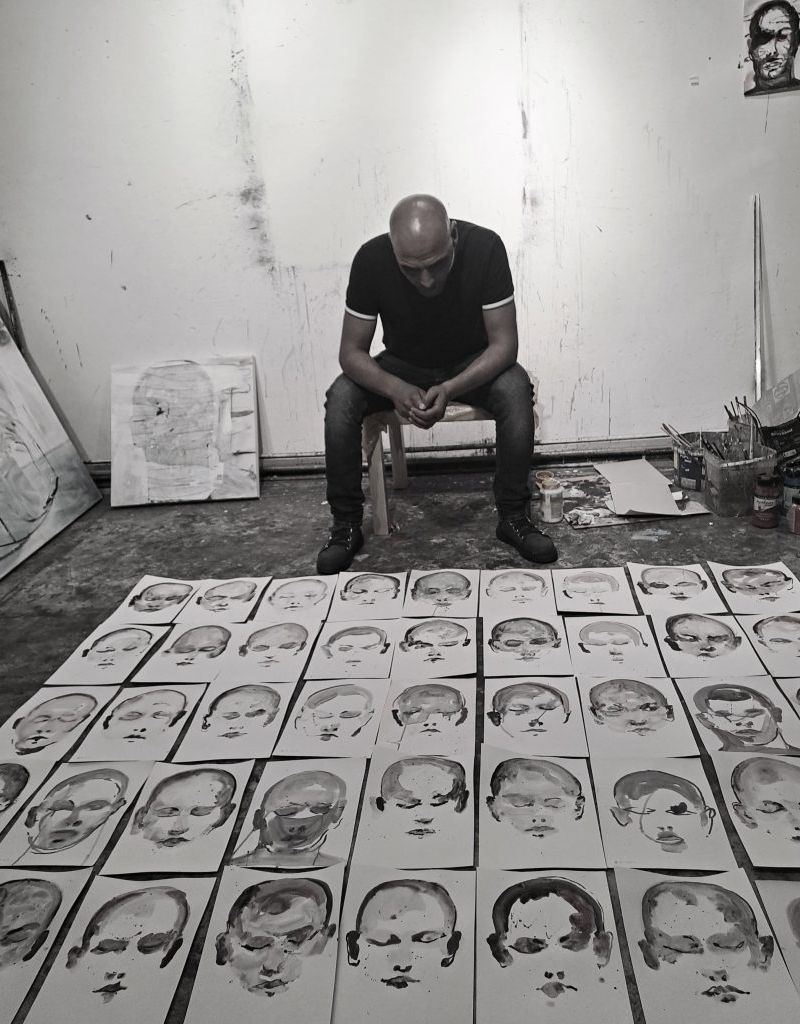
Oussama Diab is a Palestinian - Syrian contemporary artist whose work drifts between memory and myth, figuration and abstraction, capturing the deep tremors of exile, identity, and transformation. Born in Damascus in 1977, Diab came of age in a region marked by rupture, carrying within him the layered history of displacement. He now lives and works in the Netherlands, a land far from his roots but woven into his evolving artistic vocabulary. A graduate of the Faculty of Fine Arts in Damascus in 2002, Diab has since cultivated a language of images that resists fixity, choosing instead to shift with each new series like a tide returning to unfamiliar shores. In his paintings, the personal meets the political in intricate, poetic choreography. Symbols float across his canvases like fragments of forgotten dreams or long-lost songs. Traces of war, echoes of migration, and the residue of revolutions are gently folded into scenes that evoke both tenderness and unrest. His figures stand against ornate, almost infinite backdrops, bathed in patterns that dissolve the boundaries of space and time. There is no clear beginning, no defined end, only a persistent unfolding, a visual murmuring that invites reflection more than resolution. Diab describes his work as autobiographical, yet it reaches far beyond the self. His characters, often suspended in gestures of longing or stillness, embody the quiet ache of those caught between worlds. Their grace does not deny their sorrow; it heightens it, allowing melancholy to settle like dust on velvet. Amid icons of pop culture, historical motifs, and whimsical symbolism, the viewer encounters a dialogue between playfulness and gravity, between ornament and loss. His paintings become places of passage, where memory does not settle but continues to move. Over the years, Diab has taken part in numerous group exhibitions across the Middle East and Europe. He is the recipient of several honors, including recognition from the Shabab Young Artists exhibition in Syria. His solo exhibitions with Ayyam Gallery in Damascus, Dubai, and Beirut between 2009 and 2012 marked important milestones in his journey. Each show revealed a new gesture, a new rhythm in his evolving dance with image and meaning. Through all of this, Oussama Diab remains an artist of movement, not only across borders, but across styles, symbols, and states of being. His canvases are not declarations but invitations, quiet calls to wander through the layered terrains of memory, exile, and imagination. With every brushstroke, he gives form to what resists containment. His art reminds us that beauty can coexist with sorrow, and that even in displacement, there is a rhythm that continues, steady and profound, like a heartbeat beneath the surface of the world.
Najib Kasir
Najib Kasir NAJIB KASIR (B.1977) David Najib-Kasir is a contemporary oil-painting artist. His work consists of personal narrative and cultural histories or events. Kasir recognizes much of his work as an act of coming to terms with the challenges of family, life, love, and loss. In particular, recent work portrays his parents’ migration to the U.S. from Syria and Iraq (respectively). Kasir employs his paint and designs to inform viewers on recent wars in the Middle East and North African regions. By using beautiful traditional Arab designs, called Zellige, to dress the figures in his work, Kasir shows the beauty of a culture and the tragedy as families try to hold on to it and hold on to each other as everything around them falls apart. Kasir has a BFA in painting from Milwaukee Institute of Art & Design from 2001.For WaterMarks, David painted a mural on the north-facing wall of the Beerline Connector building along the Beerline Trail at Keefe and Richards.
Wadeei Khaled
Wadeei Khaled wadeei KhaledWadeei Khaled, Palestinian artist based in Ramallah, was born in Al-Aroub camp in January 1986. His pursuit of artistic expression led him to earn a bachelor's degree in fine arts from Al-Quds University. Khaled's oeuvre unfolds through oil and watercolor paintings of varying sizes, each marked by meticulous attention to detail and a vibrant, expressive palette. In his work, he captures with rare sensitivity the essence of his cultural heritage, inviting viewers into a dialogue with the beauty and complexity of his identity. At the heart of Khaled's artistic discourse lie the themes of homeland and identity, which return again and again like the refrain of a long, unending song. He draws inspiration from a profound connection to the land, to the stories of his heritage, and to his own lived experiences, particularly the formative years spent in a refugee camp. From these roots, he weaves intricate narratives of belonging and resilience. His art transcends the limits of the personal, reaching into wider political and cultural landscapes, offering meditations on the act of remembering and the quiet strength of endurance. His paintings breathe nostalgia, carrying the scent of olive groves, the warmth of late afternoon sun, and the silent horizon of distant hills. Through landscapes rich with symbolism and nature rendered in tender detail, Khaled summons the sensory fabric of his childhood. Each brushstroke becomes a testament to an unbroken bond with the homeland, a connection that resists the erosion of time and the distance of place. Khaled’s creative process is a dialogue between memory and material, an act of both excavation and construction. He approaches the canvas as if it were a threshold, a place where absence and presence can meet and converse. Layer upon layer of color builds a surface that feels alive, as if the pigments themselves remember the landscapes they depict. This layering is deliberate, a slow and meditative act that mirrors the way memories evolve over time, shifting in hue and clarity, yet never losing their essence. Sometimes he leaves traces of earlier brushstrokes visible beneath the surface, like whispers of untold stories that still breathe beneath the present image. In this way, each work becomes not just a painting, but a palimpsest of moments, a living document of what remains and what has been transformed. Beyond personal expression, Khaled views his art as a form of cultural preservation. In a world where displacement can threaten the threads of tradition, his work becomes a living archive. Every olive branch, every stretch of land, every shadow of a village is a piece of a collective memory, safeguarded in color and form. His paintings speak to those who share his story, and to those who seek to understand it. His contributions have found recognition both locally and internationally. He has participated in numerous collective exhibitions, and his works have been acquired by esteemed art collectors and institutions. Yet Khaled remains deeply rooted in the soil of his inspiration, committed to exploring the ever-evolving relationship between identity and place. In the quiet light of his Ramallah studio, surrounded by unfinished canvases and the scent of drying oils, his art continues to grow. Each piece is a seed sown into the vast field of cultural memory, where, one day, it will bloom again for those who remember and for those who are yet to know.
Elias Naman
Elias Naman Elias NamanElias Naman is an Italian-Syrian sculptor whose art breathes life into marble through the ancient and instinctive technique of direct carving. Eschewing preparatory sketches and mechanized tools, he lets the stone guide his hand, engaging in a silent yet profound conversation where form emerges organically. This intuitive process reveals the marble’s hidden spirit, allowing its natural veins and textures to dictate the flow and contour of each piece. Naman’s sculptures become more than mere objects; they are vessels of identity, spirituality, and the fragile human condition, capturing transient emotions and eternalizing them in stone. Naman’s journey began at the University of Fine Arts in Damascus, where he laid the foundation of his artistic language. He then honed his mastery at the renowned Academy of Fine Arts in Carrara, Italy, a place steeped in centuries of sculptural tradition. There, he specialized in Sacred Art and Marble Sculpture, immersing himself in the rich heritage of his medium. This dual heritage, Syrian roots and Italian craftsmanship, imbues his work with a layered complexity, where East meets West, history meets the present, and the sacred meets the personal. His sculptures have traveled far beyond their birthplace, exhibited in prestigious venues across Italy, France, Switzerland, Lebanon, Norway, and the Vatican. They inhabit both public spaces and private collections, touching souls from the hallowed halls of the Syriac Catholic Church in Rome to the academic corridors of the Pontifical Lateran University. Each installation is a testament to his ability to transform cold stone into warm, evocative forms that speak quietly yet powerfully of the human experience. The latest chapter in Naman’s oeuvre is the series Fragments of Humanity, a meditation on the soul’s subtle yet indelible mark upon marble. Using rare and esteemed materials such as Black Portoro, Calacatta, and Statuario from Carrara, he carves with reverence and precision, unveiling shards of existence frozen in time. These sculptures invite contemplation, urging viewers to reflect on the fractured yet interconnected facets of identity, memory, and resilience. Elias Naman’s work embodies a timeless dialogue between artist and material, where the stone’s voice is both heard and amplified through delicate craftsmanship. His sculptures stand as silent witnesses to the enduring search for meaning, beauty, and transcendence, reminding us that beneath the surface of every block lies a story waiting to be revealed.
Chaouki Chamoun
Chaouki Chamoun chaouki chamoun Chaouki Chamoun, a towering figure in Lebanese art, was born in 1942, in an era when his homeland was already undergoing profound transformations. Graduating with honors from the Lebanese University in 1972, he set out for the United States to refine his craft and open new horizons for his artistic sensibility. In 1975, he earned a Master of Fine Arts from Syracuse University, then continued his studies and experiments at the prestigious New York University until 1979. Immersed in the cultural effervescence of New York, he forged an artistic identity deeply rooted in a dialogue between Mediterranean heritage and Western modernity. From 1975 onwards, Chamoun began exhibiting across the globe, seizing every opportunity to share his vision. More than forty solo exhibitions and over sixty group shows trace a creative path marked by insatiable curiosity and a constant desire to explore new forms of expression. Each of his exhibitions becomes a meeting ground for cultures, a space where painting engages with history, memory, and emotion. Alongside his work as an artist, Chamoun devoted himself passionately to teaching, passing on to his students not only technique but also a vision that sees art as a bridge between people and across eras. His influence also reached into interior architecture, a field in which, from 1989 onwards, he left his mark on major New York projects. His creations, at once functional and aesthetically refined, bear the signature of a mind capable of weaving together space and light in a subtle, harmonious balance. International recognition was quick to follow. In 2007, he set a record sale for a living Lebanese artist at a prestigious Christie’s auction. This achievement confirmed his singular place on the global art scene, not only as a creator, but as an ambassador of a culture engaged in an ongoing dialogue with the world. Ranked by Art Price among the fifty most influential newly auctioned artists worldwide, Chamoun established himself as an essential voice in contemporary art. In 2011, Arabian Business magazine named him among the 500 most influential Arab personalities, a recognition that acknowledged not only his talent but also his commitment to projects extending far beyond the artistic sphere. Since 2008, he has offered his work in charity auctions supporting educational and social institutions, channeling his art toward causes that foster knowledge and solidarity. These acts of generosity reveal an artist deeply aware of his role in the world around him. Today, Chaouki Chamoun embodies a rare union of technical mastery, poetic sensibility, and human engagement. His canvases, imbued with flashes of light and color, are fragments of both a personal and collective narrative. They invite us to journey beyond visible borders, into inner landscapes where memory, hope, and beauty converge. In each of them resounds the conviction that art, beyond aesthetics, is a universal language capable of uniting souls.
Caleen Ladki
Caleen Ladki Caleen LadkiCaleen Ladki’s art reflects life’s transformative currents, often born from the quiet depths of uncertainty and shaped by the courage to transcend fear. Raised in the sweeping landscapes of Riyadh and later honing her craft in London, she embodies the meeting of cultures and sensibilities, infusing her work with both introspection and audacious exploration. Her artistic journey took a decisive turn in 2014, when she moved to Beirut. This city, vibrant yet fragile, became a canvas itself, offering both challenge and inspiration. Within its bustling streets and storied corners, she found the freedom to experiment, to engage deeply with her surroundings, and to weave her experiences into her art. Each painting became an invitation, a space where viewers could confront uncertainty and discover beauty in its unfolding. Her works are conversations between serenity and turbulence, freedom and tradition, where colors and patterns pulse with life. Central to her vision is the ability to transform fleeting emotions into lasting impressions, allowing viewers to move beyond the immediate and engage with the deeper resonance of each piece. Her bold, expansive canvases, alive with rhythm and symmetry, offer layers of meaning—each brushstroke revealing moments of stillness, bursts of joy, and whispers of reflection. During her time at Central Saint Martins, Caleen reached the semi-finals in a design competition for the Evoke Radio by Pure, a testament to her inventive and perceptive eye. Her work has since traveled across continents, exhibited at the Marie Jose Gallery in London, Walls House of Art in Abidjan, and within prestigious collections such as the Oakridge Hotel in Lebanon. Participation in group shows and Artbooth UAE at Beirut’s ABC Mall further cemented her reputation as a contemporary voice capable of bridging cultural and emotional landscapes. Beyond exhibitions, Caleen’s practice is a continuous dialogue with the world around her. Her art absorbs the fleeting moments, landscapes, and stories that spark her imagination, translating them into vivid visual experiences. Each painting carries the quiet resilience of the human spirit, inviting viewers not merely to observe, but to feel, reflect, and immerse themselves in the delicate interplay between perception and emotion. Ultimately, Caleen Ladki’s work is a testament to the alchemy of uncertainty transformed into beauty. Her canvases resonate as living narratives, guiding audiences through introspection, discovery, and the boundless possibilities that emerge when one embraces the unknown. Through her art, she captures the ephemeral yet eternal, the intimate yet universal, leaving a lasting impression on all who encounter her vision.
Abdessalem Elfalah
Abdessalem Elfalah Abdessalem ElfalahAbdessalem Elfalah, born in 1984 in the quiet town of Mezzouna in Sidi Bouzid, Tunisia, has followed a path where tradition merges with innovation, and reflection intertwines with creation. Now based in Abu Dhabi, United Arab Emirates, his life and work are imbued with a continuous dialogue between the tangible and the intangible, translating lived experience into a visual language that resonates far beyond borders. In 2010, Elfalah was awarded a professorship in the plastic arts at the Higher Institute of Fine Arts in Nabeul, Tunisia, marking the beginning of a journey devoted to nurturing both art and thought. Four years later, he earned a master’s degree in Science and Technology, and today he is pursuing his doctoral thesis in art theory at the Higher Institute of Fine Arts of Tunis. Each step of his academic path informs his practice, embedding intellectual rigor within the emotional and material textures of his work. Elfalah’s art has been exhibited widely across Tunisia, France, and the United Arab Emirates, transforming gallery spaces into realms of reflection and dialogue. His work has been presented at the Gallery of the National Library in Tunisia (2017 and 2018), Kan Art Space in Sousa (2017), the Cultural Complex Neapolis (2018 and 2019), Neapolis Cultural Foundation (2018 and 2019), Yosr Ben Ammar Gallery (2019), and Galerie Patrick Bartoli in Marseille, France (2019). Each exhibition becomes a moment of engagement with light, form, and atmosphere, inviting viewers to dwell in the delicate tension between abstraction and traces of lived reality. After relocating to the United Arab Emirates, Elfalah continued exploring the interplay between environment and emotion, particularly through his participation in the “COVID Conversation” exhibition at Tashkeel, Dubai, in 2020. These works respond to unprecedented global circumstances while meditating on resilience, connection, and the capacity of art to illuminate shared human experience. In 2021, Elfalah was awarded the Cultural Foundation Art Residency in Abu Dhabi, a recognition of his unique artistic voice and his dedication to expanding the boundaries of contemporary art. His paintings and installations resonate as visual essays, where every brushstroke, texture, and composition invites contemplation. They weave together memory, identity, and place, embodying a poetic engagement with the intimate and the universal. Through his art, Elfalah creates spaces where the viewer lingers, feeling the quiet intensity of a life devoted to observation, understanding, and creation.
Noor Bahjat
Noor Bahjat Noor BahjatIn 2016, a pivotal visit to the Philippines transformed Bahjat’s approach to color and composition. The heavy shadows and restrained palette that had previously dominated her work gave way to luminous backgrounds alive with light. Nature, water, and organic elements began to flow into her portraits, becoming both narrative and symbolic, reflecting renewal, serenity, and the simplicity of existence. By surrendering to her subconscious impulses, Bahjat creates richly detailed compositions where still-life elements and figurative motifs interact, producing a sense of quiet poetry and contemplative space. Born in Damascus, Syria, in 1991, Bahjat now lives and works in the United Arab Emirates. She graduated with honors from the Faculty of Fine Arts at the University of Damascus, where she confronted a lifelong challenge with perspective. Rather than allowing it to constrain her, she transformed this challenge into a defining feature of her artistic language. The resulting style blends painterly expressionism with a still-life sensibility, producing dreamlike spaces where forms gently blur and figures seem to dissolve into their surroundings, creating a delicate tension between subject and environment. The female figure that threads through her work embodies both vulnerability and quiet strength, acting as a guide through the emotional terrain of each painting. Through subtle textures, layered colors, and careful interplay of light and shadow, Bahjat invites viewers to move beyond the surface and engage with the psychological and poetic dimensions of her compositions. Her work reveals the intricate rhythms of memory, identity, and introspection, offering a meditative space where imagination and reality coexist. Bahjat’s paintings have reached audiences far beyond her studio, finding homes in both private and public collections across the Middle East, Asia, and Europe. They resonate across cultures, linking diverse histories and personal memories through a shared language of feeling and imagination. Each work becomes a quiet conversation, a bridge connecting viewers to the universal currents of human experience, where identity, memory, and dream converge. In the stillness of her studio, surrounded by pigments and brushes, Noor Bahjat continues to explore the delicate balance between presence and absence, the visible and the unseen. Her artistic journey remains an evolving meditation on life, memory, and longing, where every image is both a personal revelation and an invitation to see the hidden layers of the human soul.
Azza Al Qubaisi
Azza Al Qubaisi Azza Al QubaisiAzza Al Qubaisi is an artist whose creative spirit thrives in the interplay between metal and nature. As a jewelry artist, sculptor, and product designer, she holds the distinguished place of being often celebrated as the UAE’s first Emirati jewelry designer. Her works embody a prolific creativity, where precious metals like gold and silver meet humble materials such as wood, rubber tires, palm branches, and the fragrant Oudh incense. Each piece tells a story, blending the tactile with the symbolic to evoke both history and modernity. Azza’s artistic vision is deeply rooted in a commitment to sustainability and cultural preservation. She draws from the essential materials that once formed the backbone of Emirati family life before the discovery of oil. Palm branches and the traditional weaved Sadu fabric become her chosen mediums, reimagined through methods she has developed over the past decade. These materials, steeped in history, find new life in her work, where the desert’s shapes, patterns, and textures intertwine with revived ancient techniques, creating a harmonious dialogue between past and present. Reflecting on her practice, Azza shares, “The works reflect my journey as an artist to understand who I am as an Emirati. They highlight all the materials I have used throughout my artistic journey and revolve around the fabric of life that existed in the past.” This intimate connection between identity and materiality infuses her creations with a profound sense of place and memory, inviting viewers to experience the quiet strength of tradition renewed through innovation. Holding a Master’s degree in Cultural and Creative Industries alongside a Bachelor of Arts in Jewelry Design, Silversmithing, and Allied Crafts, Azza brings both scholarly insight and hands-on expertise to her practice. Her career is marked by international recognition, her work traveling across the globe and resonating with diverse audiences. Notable exhibitions include 'Three Generations' at Sotheby’s London in 2013, the UAE National Day exhibition at Expo 2015 Milan, and ‘Portrait of Nation’ in Berlin in 2017, each showcasing her ability to weave narratives that transcend borders while rooted firmly in Emirati heritage. Azza’s influence extends beyond the gallery walls; her work has been documented in respected publications such as ‘500 Earrings: New Directions in Contemporary Jewellery’ by Lark Crafts in 2007. Through these pages, her artistry reaches new generations of creators and appreciators, securing her place within the evolving story of contemporary design and cultural identity. Her work, at once delicate and bold, carries the whispers of the desert winds and the heartbeat of a nation embracing its past and future. In the journey of Azza Al Qubaisi, we find a harmonious fusion of craft and concept, tradition and innovation. Her creations are not merely objects but vessels of memory and meaning, embodying a timeless dialogue between the earth’s raw materials and human creativity. Through her hands, the ancient and the modern converse in silent eloquence, inviting us to contemplate the enduring power of cultural roots and the endless possibilities that arise when we honor and transform them.
David Daoud
David Daoud David DaoudDavid Daoud, a Franco-Lebanese painter and draughtsman, was born in Lebanon in 1970. In 1978, he left Beirut as a child, carrying with him not only the memory of a country torn by conflict, but also the quiet beginnings of an artistic voice shaped by distance. Though decades have passed, exile continues to ripple through his work like a half-remembered melody. His canvases speak not only of departure, but of presence found in absence, of stories scattered and yet softly stitched together. Each painting becomes a mirror in which anyone might catch a glimpse of their own wandering. Upon settling in France, Daoud pursued formal training in the arts. He studied at the National School of Fine Arts in Paris and later at the National School of Decorative Arts, where he trained under the sculptor Charles Auffret, who had once learned from the disciples of Auguste Rodin. Daoud began with sculpture, drawn to its gravity and weight, its way of anchoring emotion in form. Yet it was a course at the Beaux-Arts that nudged him toward the fluid and luminous world of oil painting. There, he discovered a different kind of truth. Through brush and pigment, he could give a soul to objects, allowing images to emerge not fully formed, but as if remembered. His paintings often explore the themes of migration, nostalgia, and the silence left by absence. Yet these are not works of torment. Instead, they evoke a gentle lyricism, like dreamscapes suspended in time. Forms dissolve at the edges, outlines blur, and colours fade into one another, leaving the viewer with only traces the ghost of a figure, the echo of a place. His compositions do not shout; they whisper. They leave space for the viewer to listen, to wonder, to complete what is left unsaid. Daoud’s works have been exhibited in galleries, museums, and cultural venues across France and Lebanon. In 2018, one of his paintings was chosen by the musician Ibrahim Maalouf to grace the cover of the album "Levantine Symphony" a quiet dialogue between image and sound. In 2020, Daoud was awarded the Hermitage Foundation Prize, a recognition of both his skill and his singular vision. That same year, the Arab World Institute in Paris acquired several of his works, securing their place in a broader cultural narrative that crosses geography and memory alike. Now living and working between Paris, Liège, and Beirut, David Daoud continues to move between worlds, both real and imagined. In each of these places, he gathers fragments of light and silence, stitching them into a language that needs no translation. His studio is not just a space for painting, but a threshold a place where borders vanish and the invisible becomes visible. And so he paints, not to capture life as it is, but as it feels, as it lingers, and as it slips quietly into the timeless. Like the last line of a book that does not quite end, his work leaves us with the gentle sense that something more is still unfolding.
Kim Ja Hae
KIM JA HAE KIM JA HAEKim Jahae, born in 1985, is a South Korean artist whose work interrogates the nature of the reality we inhabit. Her pieces have been recognized in both institutional and market contexts, and in 2021 her painting “Between the Curtains” achieved 4,923 USD at Korea Premier Auction. Beyond auction results, her practice is rooted in a sustained inquiry into the ever-changing nature of the world and how it can be perceived when every instant transforms it into something new. Kim begins with the premise that we never truly remember the world as it is, because the world never appears the same from one moment to the next. Her work responds to this instability by juxtaposing elements that seem fixed with elements in constant flux. Buildings, machines, and industrial objects, which suggest permanence, are set against wood, water, and clouds, whose forms are continuously transformed. This contrast becomes the foundation of her practice, allowing the enduring and the ephemeral to coexist and inform one another. Her paintings are constructed in layers, with each layer recording a specific moment while simultaneously opening a spatial field. These works do not function as mere surfaces but as thresholds, where time is experienced as a tangible presence. By multiplying perspectives and reflecting subtle temporal shifts, Kim creates compositions that destabilize perception and extend the sense of duration. In her hands, painting is both structure and experience, preserving fragments of reality while allowing them to unfold anew. Through this layering process, familiar spaces are rendered unfamiliar, and conventional reality is questioned. Recognizable forms are transformed into territories of uncertainty, encouraging the viewer to engage with the present with renewed attention. Her works reveal the surrounding world as more complex, more mysterious, and more compelling than it initially appears. Boundaries between images suggest the provisional nature of perceived reality and highlight the impermanence of what is often taken for absolute. Kim asserts that the world is not static but organic, constantly evolving. Understanding it requires flexibility and openness, a willingness to dismantle the artificial boundaries imposed by habit and convention. Her paintings function as thresholds, offering access to alternative perceptions of reality. They do not depict another world but invite the viewer to recognize the shifting, dynamic nature of the one we inhabit. In this way, Kim Jahae’s work aligns with a broader exploration of perception and experience, where art does not merely represent reality but reframes it. By transforming time into spatial experience and turning the familiar into the unfamiliar, she creates environments that demand active engagement. Her paintings are not only visual compositions but immersive experiences, spaces in which the ever-changing nature of the world is revealed with clarity and intensity.
Bahram Hajou
Bahram Hajou BAHRAM HAJOU (B.1952) Bahram Hajou (born 1952 in Amuda, Syria) is a Syrian–Kurdish painter internationally recognized for his powerful figurative works exploring themes of identity, displacement, solitude, and human connection. Educated in Germany, where he graduated from the Kunstakademie Münster as a master student of Norbert Tadeusz, Hajou developed a distinctive visual language influenced by German Expressionism, characterized by layered surfaces, expressive lines, and psychologically charged compositions. His works are held in prominent museum and public collections, including the Mathaf: Arab Museum of Modern Art in Doha, the ArtHall Oldenburg in Germany, the corporate collection of Deutsche Bank, and the collection of Rashed Al Khalifa in Bahrain, among others. Through decades of exhibitions across Europe, the Middle East, and the United States, Hajou has established an international presence, continuing to live and work between Münster and New York while producing art that bridges cultures and reflects the emotional complexity of contemporary human experience.
Hanibal Srouji
Hanibal Srouji HANIBAL SROUJI Contemporary Lebanese artist Hanibal Srouji was born in Beirut in 1957. He residedin Saïda, Southern Lebanon, before immigrating with his family to Canada in 1976.Before plunging into the multidisciplinary realm of art, Srouji completed a degree inSocial Sciences at Vanier College in 1978, where he explored interests inmathematics and chemistry. He obtained a B.F.A. in Fine Arts in 1982 and an M.F.A.in 1987 from Concordia University in Montréal. Towards the end of his education atConcordia, Srouji accomplished his thesis study at the Ecole des Beaux-arts inNîmes, where he received a Diplôme National Supérieur d'ExpressionPlastique (D.N.S.E.P.) in 1987. He taught at different universities in the UnitedStates, Canada, and Paris, and in 2010 joined the faculty of the Lebanese AmericanUniversity in Beirut, where he holds today the position of Associate Professor. He has participated in numerous personal and collective exhibitions in Abu Dhabi,Basel, Belfast, California, Dubai, Geneva, London, Paris, Montreal, Morocco, NewYork, Singapore, Strasbourg and Tokyo. His work has been auctioned at Christie’sans Sotheby’s and is part of famous public and private collections.
Jung Jinshu
Jung Jinshu CHO HEEJUNGHeejung Cho lives and works in New York, where she pursues an artistic practice deeply rooted in the resonances of memory. Trained first at Seoul National University, where she earned a bachelor’s degree in sculpture, she later moved to the United States to expand her academic and creative path. She holds a Master of Fine Arts from the Mason Gross School of the Arts, a decisive stage that broadened her relationship to materials and form. Her relocation to New York also led her to an artist residency at the Elizabeth Foundation for the Arts, a fertile ground for her first experiments in the metropolis. It was within this context that she presented a major work at the Museum of Arts and Design (MAD) in New York. Two monumental sculptural panels reimagined the perspectives of Columbus Circle, Broadway, and 8th Avenue, as if memory itself had reconstructed them from fragments. Visitors were invited to step inside the installation, to feel the vertigo of its shifting lines and depths, with a spectral view of Central Park and Broadway unfolding through its windows. The experience was at once a traversal of the city and an immersion into a personal memory, shared, distorted, and reconfigured. Cho’s practice centers on the fragile mechanics of memory, on the subtle shifts that, over time, erase the clarity of familiar places and dissolve them into architectural abstractions. Her works emerge from this oscillation, from the moment when an image no longer remains precise but becomes raw material for imagination. Facades and landmarks decompose into planes, volumes, and fragments. Memory does not faithfully return what it has stored, it reconstructs, alters, and reinvents. Through concrete, wood, cardboard, and plaster, she transforms raw matter into sensitive archives. Each fragment of wood or piece of construction debris, found in her wanderings, bears a singular story, a faint trace of a past use. In her collages and sculptures, these elements are not mere scraps; they become metaphors for scattered identities, recomposed into interior landscapes. By assembling them with meticulous care, Cho maps a deeply personal cartography of memory. The artist herself describes her process as one of reconstructing spaces and figures from memory and imagination. Boundaries between representation and abstraction blur, much like the workings of memory itself, which never preserves things intact. The dialogue between figure and space becomes a shifting dynamic of line, texture, and color, a pursuit of the invisible energy that circulates between people and their surroundings. The fragments of wood she gathers, each carrying its own hue, grain, and history, embody this diversity. Brought together within a single work, they replay the encounter of multiple individualities, forming perspectival landscapes infused with reimagined memory. In this reassembly, Cho conjures a renewed sense of belonging, granting meaning to materials once abandoned. Through woodblock printmaking and casting in resin or plaster, she further extends the life of these fragments, fixing their presence into permanence. Materials once destined for disappearance are transformed into enduring vessels of memory. Her practice thus resides in a space between reconstruction and preservation, between recollection and invention. Heejung Cho’s work unfolds as a poetry of reconstituted space, not nostalgia frozen in time but an invitation to see memory itself as a living construction site, endlessly open, endlessly becoming.
Cho Heejung
Cho Heejung JUNG JINSUH Jung Jinsuh, born in 1979, lives and works in South Korea, where his artistic path is defined by a sustained exploration of the emotional core of human experience. A graduate of Seoul National University’s College of Fine Arts and its Graduate School of Sculpture, he first devoted himself to three-dimensional work before discovering wax painting, a medium that would profoundly shape his practice. His works have reached international audiences, including the auction market, where in 2023 his piece “Fountain_18” achieved a record price at Korea Premier Auction. Yet beyond market recognition, the true measure of his work lies in the intimate and unmediated encounter it establishes with the viewer. Jung conceives of the inner world as a complex constellation of emotions accumulated through the layering of experience. He maintains that a human being reduced to rational expression alone, stripped of emotional depth, becomes little more than a machine masked in human form. For him, true emotion is not a violent outburst that appears and vanishes like a geyser, but a continuous, inexhaustible spring that rises quietly and naturally from within. His work seeks to capture this subtle flow, avoiding forced unease and instead evoking a form of strangeness that refreshes rather than unsettles. This notion of “comfortable unfamiliarity” serves as a foundation for his reflections. Where unfamiliarity is often linked with anxiety, Jung regards it as a condition of renewal. Gentle strangeness allows the viewer to rediscover a sense of immediacy and newness in what might otherwise appear familiar. For him, this encounter is not about knowledge, which is temporary and constructed, but about truth, which endures. Essence is truth, truth is soul, and soul is life. His aim is therefore not to produce images but to create works that exist as living presences, speaking directly to the viewer without annotation or interpretation. The choice of beeswax is central to this pursuit. Produced within the body of bees and refined in the hive, beeswax carries with it the imprint of life itself. Its purity, both fragile and enduring, drew Jung to the medium, which he enriches with rosin and pigment. His process involves carefully layering this mixture onto canvas, then scraping and removing parts of it. Each gesture becomes an act of inscription and erasure, balancing presence and absence. In this slow, deliberate practice, time and material are shaped together, creating works that are at once surface and depth. His transition from sculpture to painting was not merely a shift in form but a return to origins. Wax painting, or encaustic, emerged in fourth-century BCE Greece, spread through Egypt and Rome, and then fell into decline before being revived in modern Western art. By re-engaging with this ancient technique, Jung situates himself in a lineage that connects past and present, renewing it through a contemporary vocabulary. His beeswax paintings, with their translucent layers and subdued luminosity, stand as meditations on permanence, fragility, and transformation. Through these works, Jung Jinsuh affirms his conviction that art must reveal essence rather than produce image. His paintings invite the viewer to remain before them, to enter the silence of the wax and perceive within it a condensed form of life. They are not static objects but living surfaces that communicate directly, allowing the truth of the artist’s vision to meet the inner truth of those who engage with them.
Richard Hearns
Richard Hearns richard hearns (B.1970) Richard Hearns was born in Beirut in the late 1970s in the midst of fierce fighting in the Lebanese capital. Since then, Hearns has become one of Ireland's finest contemporary painters, working and living in the surrounds of the heart of the Burren, a beautiful national park in the southwest of the country. His work is rooted in the landscape of Ireland while reflecting his dual heritage and global perspective. Hearns paints from his studio at the edge of The Burren National Park in County Clare. Surrounded by the rugged beauty of earth, sea, and sky, he creates dynamic and expressive paintings that explore memory, identity, and the universal human experience. Hearns’ practice is characterized by gestural abstraction, where each canvas becomes an extension of the body and a meditation on belonging, culture, and the natural world. His paintings invite viewers into a space of contemplation, resonance, and connection. He has held several notable exhibitions at institutions and galleries including Cadogan Gallery (London), The Sheen Center for Thought and Culture (New York), and Sotheby’s (London). His works are also represented in prominent international collections such as Dublin City University, the Irish State Collection, Galgorm Group (Northern Ireland), St. Patrick’s Cathedral (New York City), Naomi House Children’s Hospice (UK), Aston Wealth Management (Ireland), ITC Company (Ireland), and SEPIL (Ireland). Through his art, Richard Hearns continues to build a visual language that bridges cultures, histories, and geographies, affirming the timeless role of painting as a medium of exploration and connection.
Hussein Baalbaki
Hussein Baalbaki Hussein Baalbaki Born in 1974 amidst the echoing streets of Beirut, Hussein Baalbaki emerged as a contemporary voice in abstract expressionism. His art speaks not with shouts but with the whisper of dense textures and the gentle murmur of soft colors. His canvases seem carved rather than painted, thick layers of medium rising like memory itself, sedimented over time. A graduate of the Lebanese University’s Institute of Fine Arts in 2002, Baalbaki stepped into the international art world with early conviction, participating in the Tehran Biennials of 2003 and 2005, where his vision was honored with a special prize, an early recognition of a language that would continue to deepen in resonance. His solo journey began in 2008 with the exhibition Accumulation of Time at Agial Art Gallery in Beirut, a suite of works that traversed scale yet remained unified in emotional depth. His brush did not simply lay paint; it summoned presence. The titles of his exhibitions are themselves quiet poems in motion: Four Season’s Songs in 2012, followed by Garden of the Soul in 2013 at Dar Al Funoon Gallery in Kuwait. Each one opened a window into his inner weather, a world where sensation took shape in gentle abstraction. Since 1999, his work has woven into the fabric of many collective exhibitions, each appearance a new layer in an ever-growing conversation. His participation is less an act of display than an invitation to contemplation, a subtle reminder that art is not always meant to resolve but to reflect. With each show, his artistic language gained gravity, echoing a quiet evolution. The rhythm of his exhibitions traces a steady unfolding, a life observed through the shifting lens of color and form. Beyond galleries, Baalbaki’s work has resonated in the curated silence of auctions, with Hidden Inside finding a home through Christie’s in 2011, and The Red Orchard following in 2012. Each piece is a testament to the enduring pull of his vision, rooted more in the inner landscape than in the outer world. In his own words, Baalbaki describes his technique as a kind of isolation within composition, a space carved out to reveal the work’s essence, drawn from the soul’s cavernous interior, much like the markings on ancient cave walls. These surfaces pulse with quiet life, their texture challenging the softness of their palette, a deliberate contradiction that evokes depth beyond what is seen. His forms hold an elemental silence, a silence that does not retreat from presence but instead fills it completely. One does not simply look at his work; one enters it slowly, like stepping into an ancient room lit by breath and memory. The viewer is no longer a spectator but a participant, gently navigating the thresholds between presence and absence. What emerges from his work is more than form; it is experience. The manipulation of color is not merely aesthetic, but philosophical, suggesting movement and transformation, hinting at light as a symbol of time, as a gesture toward the infinite. The canvas becomes a field where time thickens and thins, where space breathes and bends. He does not depict time, he distills it, pressing its essence into pigment and gesture. The result is not only visual but deeply spatial, a kind of echo unfolding across the eye and inward into thought. His paintings invite stillness, not as stagnation, but as quiet unfolding. In their silence, they speak of that which escapes language, the invisible thread that binds memory, material, and meaning. Hussein Baalbaki does not ask to be understood at once. His work invites us instead to pause, to dwell within subtlety, to listen to silence, and to rediscover the gentle vastness within ourselves. In each brushstroke there is an offering; in each surface, a threshold. His journey through abstraction is not a retreat from meaning, but a return to it, to the kind that lives without noise and lingers like the memory of light across a stone wall at dusk.
Soraya Abu Naba’a
Hanny Al Khoury
Park SungNam
Park SungNam Korean Artist in Abu Dhabi PARK SUNGNAM An artist’s unique mode of expression constitutes the language of art, and the grammar of expression he develops forms the very identity of his work.Artist Park SungNam employs the distinctive material of urethane foam to impart a profound sense of texture to the canvas, upon which he portrays figures from everyday life. The figures in his works exist, yet they emerge faintly through the material’s physical qualities, symbolically conveying theordinary lives of people and the truths embedded within their daily experiences. At first, Park SungNam’s works may not leave a striking impression, but over time they resonate quietly, leaving behind subtle emotional echoes. This effect arises from the essence of painting—its form and authenticity. Through the concealed themes in the background and the sincerity within his humble gaze, the artist offers a renewed perspective on the aesthetics of contemporary painting.
Louma Rabah
Babak Rashvand
Nour El Saleh
Ihab Ahmad
Muatasim AlKubaisy
Shadi Abousada
Omar Zeidan
Mohannad Orabi
Mostafa Rabie
Aula Al Ayoubi
Ahmed Farid
Omran Younes
Habuba Farah
Habuba Farah HABUBA FARAH (1931 - 2025) Born in 1931 to a family of Lebanese immigrants who had settled in Brazil, Habuba Farah grew up straddling two cultural worlds, Arab and Brazilian, and from this intersection emerged a distinct artistic vision. In the vibrant São Paulo of the 1950s, she immersed herself in a blossoming avant-garde scene. It was there that she encountered the studio of Samson Flexor, a key figure in geometric abstraction. His influence shaped her early trajectory, but Farah’s path quickly evolved beyond imitation. She began crafting a unique language rooted in radiant color, architectural form, and an ever-present sense of motion. Her canvases became spaces where geometry was not a constraint but a kind of breath, where lines moved like phrases in a musical composition. Her career, remarkable in its longevity and unwavering in its integrity, carried her to exhibitions across Brazil, Europe, North America, and Asia. In each context, Farah reinterpreted the core elements of her practice, form, rhythm, balance, without ever losing sight of the intuitive, poetic force at its heart. In 2019, her lithographs were featured in Enquanto Estou Viva, a book of poetry by Miriam Portela, merging text and image in a dialogue that deepened both. In 2021, her work was included in Acervo em Transformação: Doações Recentes at the Museu de Arte de São Paulo (MASP), and her pieces were acquired by major institutions including the Guggenheim Abu Dhabi, affirming her stature on the international stage. The year 2023 marked a symbolic turning point in Farah’s recognition within the Arab art world. In London, Kawkaba: Highlights from the Barjeel Art Foundation, an exhibition at Christie’s, presented her work for the first time in a specifically Arab context, an overdue yet poignant acknowledgment of her cultural lineage. That same year, she returned to the spotlight with her first solo exhibition in over three decades, hosted by Gomide&Co, and the launch of her first monograph, published in partnership with Galeria MaPa. Even in her nineties, Farah’s work continued to pulse with life, synthesizing light and line, form and breath, geometry and reverie. Her art continues to live and evolve beyond her passing. Today, her pieces remain on view at Artbooth Gallery in Abu Dhabi, where visitors can experience the singular world she created. In these works, one senses her lifelong dialogue between cultures, her seamless weaving of silence and structure, intuition and precision. The enduring presence of her work in such spaces is testament not only to its beauty, but to its relevance, its quiet defiance of time. Farah passed away in 2025 at the age of 94. A towering figure of modern art and a pioneer of lyrical geometric abstraction, she leaves behind an artistic legacy that is both singular and luminous. Her work, infused with light, rhythm, and a quiet yet resonant poetry, spans more than seven decades and has left a lasting imprint on the history of contemporary art. Though her voice is now silent, her art continues to speak, resonating across galleries, collections, and generations to come.
Walid El Masri
Walid El Masri Walid El Masri Of Lebanese origin and born in Syria in 1979, Walid El Masri began his artistic journey in the ancient craft of mosaic making. This early immersion shaped his sensitivity to texture and detail before he entered the Damascus Faculty of Fine Arts, graduating in 2005. His studies deepened under the artist Marwan at the Darat Al Funun Summer Academy in Jordan, a period that expanded his expressive language. A well-known painter based in Damascus for many years, Walid exhibited widely across Syria, London, Paris, Lebanon, Egypt, and the Gulf States. His move to France in 2011 marked a new chapter, where he continued painting and drawing, weaving his past into new visual explorations. Beyond his solo practice, Walid also took part in group exhibitions at the Busan Museum of Art in South Korea (2014); the Institut du monde arabe in Paris (2014 and 2018); the MUCEM in Marseille (2014); and the Institut des Cultures d’Islam in Paris (2020). His early series Chairs, created between 2004 and 2011, revealed a vigorous, raw hand marked by bold gestural strokes. These empty seats whisper of absence and solitude, inviting contemplation of unseen presences and forgotten stories. The paintings become silent rooms where memory and loss linger, a poetic meditation on human isolation and the spaces we leave behind. The series Cocoons, painted from 2014 to 2017 after Walid’s exile, offers a quiet, haunting response to Syria’s upheaval and personal displacement. White, oblong forms hang suspended from a lone tree, poised between earth and sky, caught in a fragile dance of transformation. These cocoons, both cradle and shroud, embody the tension between death and rebirth. The artist’s reflection on the cocoon’s dual nature, life and death intertwined, evokes a delicate hope amid despair, a metaphor for resilience and surrender alike. In 2015, Walid turned to the Children series, portraying naked infants with swollen faces drifting across vast canvases. Their dark, vacant eyes speak of innocence interrupted, of a childhood stolen by tragedy. These spectral figures float between oblivion and memory, embodying the fragile humanity caught in the crossfire of conflict. Yet amid this sorrow, the paintings strive to restore a glimmer of lost innocence, a silent plea for healing. The haunting presence of these children lingers, evoking empathy and a powerful reminder of the cost of war on the most vulnerable. Their presence in the vast, empty spaces speaks not only to loss but also to the enduring spirit of those who survive against all odds. Their fragile forms, suspended in silence, become both witness and testament to lives disrupted yet persistently hopeful. The Peacocks, begun in 2018, place a majestic bird at the heart of Walid’s vision. The peacock’s shimmering feathers and mournful call resonate like a solitary lament echoing through ancestral tales. This sacred creature, a symbol of beauty and vulnerability, embodies the artist’s reverence for life’s fragile splendor. Through it, myth and memory entwine, creating a poetic testament to endurance and grace. Walid El Masri’s work unfolds as a profound visual narrative where exile, memory, and beauty intertwine. His canvases become sacred spaces where silence speaks, absence sings, and the unseen finds form. Through his evocative brushwork and haunting imagery, he offers a meditation on loss and transformation, reminding us that even in darkness, art can kindle hope and reveal the fragile light of resilience.
Bruno Sfeir
Bruno Sfeir Bruno SfeirBruno Sfeir’s artistic path unfolds like a quiet incantation, stretching across continents and the shifting landscapes of the inner self. Born in Montevideo, Uruguay, he first trained at the Escuela Nacional de Bellas Artes, where the seeds of his creative instinct began to take root. His formation deepened under the guidance of disciples of Joaquín Torres García and at the Montevideo Engraving Club, immersing himself in the disciplined geometry of constructivism. Yet even in those early years, his work was already leaning toward a more dreamlike current, a language closer to surrealism, where the boundaries between waking life and reverie dissolve. For Sfeir, creation has never been a proclamation, but a meditation: an inward gaze that resists confinement and invites the viewer into a contemplative hush. For him, intuition is not a mere tool but a compass, guiding his hand through the unmapped terrain of sensation and symbol. His canvases emerge not from meticulous design but from fragments of the unseen, whispers from the subconscious that weave into an evolving iconography, mysterious and open-ended. These works do not seek to explain; they linger instead, like the shadow of a half-remembered dream or the faint trace of a poem that hovers between memory and forgetting. In 2000, Sfeir traveled for the first time to Lebanon, the land of his paternal grandfather. The encounter awakened in him a deep yearning for the ancient traditions of teaching and spirituality, a call to the hidden wisdom of the past. Two years later, he chose to settle there. Lebanon’s charged energy, layered history, and potent symbolism became a wellspring for his art, a powerful catalyst for a new visual language. His journey soon widened to Kuwait, Egypt, and Morocco, each landscape leaving an indelible mark, not only on his palette but on his inner life. These travels were not simply geographical; they were pilgrimages that ignited his creative flame and deepened the sacred pulse of his work. Since then, Sfeir’s paintings have spoken in a voice at once intimate and universal, weaving symbolism and mystery into a distinctive, poetic universe. His art has graced an impressive array of venues: the Museum of the Gaucho in Montevideo, the Renato Russo Institute in Brasília, the Borges Cultural Center in Buenos Aires, the Cervantes Institute in Beirut, and UNESCO in Paris. Each exhibition becomes an extension of his journey, a meeting point between the visible and the invisible. His paintings, now part of both private and public collections across continents, carry with them that “something more” he constantly seeks, the alchemical transformation of lived experience into an inner world that can be shared. Today, Sfeir lives and works in Spain, his studio a sanctuary where canvas and silence engage in quiet dialogue. He paints with the patience of a calligrapher and the devotion of a seeker, each brushstroke a vessel for memory, each image a shard of dreamscape or the echo of a distant horizon. His work bears the dust of forgotten temples, the shimmer of desert mirage, the poetry of exile and return.To stand before one of Bruno Sfeir’s paintings is to cross into a realm where time folds softly upon itself and mystery breathes freely. His art offers a space where symbols drift untethered, where the viewer becomes both witness and traveler. And it is in this timeless threshold, between the known and the ineffable, that Bruno Sfeir’s vision continues, not as a fixed statement, but as a living conversation between the artist and the soul.
Yervant Hawarian
Yervant Hawarian YERVANT HAWARIAN Born in Qamishli, Syria, in 1949, Yervant Hawarian is a Lebanese-Syrian painter of Armenian descent, and one of the most prolific image-makers of Lebanon’s contemporary visual culture. Based in Beirut since the early 1960s, his career began at the age of fifteen as a cinema- affiche painter, producing monumental film posters for major theatres across Lebanon. By the early 1970s,he was operating multiple cinemas, including Cinema Royal, where his studio was located, merging the site of production with the site of display. During this time, he had employed a full studio of assistants, working to meet the demand for his commissioned work across Lebanon’s urban film circuit. Alongside his cinematic works, Hawarian became the unofficial portraitist for Lebanese presidents, receiving commissions from five consecutive heads of state between the 1970s and 1990s, as well as other prominent political figures.His practice extended to large-scale public murals, ecclesiastical commissions,and portraits of major Arab cultural figures. He also produced banners and posters dispersed through the streets of Lebanon, serving a promotional function. Since the early 2000s, Hawarian has transitioned into a self-reflective fine-art practice, reinterpreting the golden era of Arab cinema through large-format acrylic canvases and sculptural box works that revisit iconic titles, such as Casablanca and Gone with the Wind, during the Hope in an Age of Dystopia exhibition (2024) at the Ramzi and Saeda Dalloul Art Foundation. His work was also featured in For the Children of Gaza (2024) at Msheireb Museums, Doha,and Divas: From Oum Koulthoum to Dalida (2025) at Sursock Museum, Beirut.Between 2005 and 2011, Hawarian was also commissioned to paint religious iconographic depictions for six churches across Lebanon. His work is held at the Ramzi and Saeda Dalloul Art Foundation, Beirut, and has been featured in exhibitions addressing the visual history of Lebanon and popular Arab imagery. Widely regarded as a foundational figure in the history of hand-painted cinema posters in the Middle East, his six-decade career boasts an estimated twenty thousand works, situated in the intersection of cinema,politicians’ and artists’ portraits, religious iconography, and vernacular graphic culture.
Rania Amoudi
Rania Amoudi RANIA AMOUDIRania Amodi, born in 1978 in Saudi Arabia and currently based in Ramallah,is a Palestinian artist whose work illuminates the lives and experiences of Palestinian women. She earned her bachelor’s degree in fine arts from Najah University in 2002 and has since become deeply involved in the cultural and educational life of Palestine, serving as director of the Arts Department in the Education Directory. Over the years, she has held numerous solo exhibitions and participated in various national and international exhibitions and residencies,establishing herself as a prominent voice in contemporary Palestinian art. Her artistic practice focuses on creating vivid and detail-oriented oil paintings that explore both personal and collective narratives of Palestinian women.Through her work, she presents authentic experiences, highlighting there silience, individuality, and femininity of women in moments of solitude as well as within their communities. Her aim is to create a space for empathy and dialogue, allowing viewers to witness and understand the multifaceted lives of Palestinian women. Her personal lineage also informs her artistic vision. She recalls her grandmother stitching tatreez while recounting stories of her uprooted village, and her mother managing household and teaching responsibilities while the world often overlooked them. These intimate memories are embedded in her paintings,bridging private experience and collective memory. As Rania notes, “Every painting I create is rooted in the strength of Palestinian women—the ones who raised me, stood before tanks, survived prison, and dared to hope.” Through her paintings, Rania Amoudi invites audiences to witness the resilience of women who have shaped and continue to shape Palestinian society. Her art embodies memory, defiance, and hope, creating spaces for reflection, empathy,and dialogue. Committed to supporting the communities she portrays, she often channels part of her work’s proceeds to organizations such as the Women’s Affairs Center in Gaza, emphasizing that resistance and resilience are collective endeavors, and that women have always been at the forefront.
Lee Young A
Lee Young A LEE YOUNG A (B.1967)Born in Seoul in 1967, Lee Young-A is a Korean abstract painter who has long built her practice around the accumulation of memory, emotion, and traces of time on abstract surfaces. Her work goes beyond a simple combination of color and form. Within repeatedly layered textures and restrained compositions, one finds the subtle imprint of passing time,the warmth of human relationships, and the lingering emotional resonance of life. Lee earned her BFA in Fine Arts, Master of Design, and PhD in Design from Konkuk University. For many years, she balanced research, teaching, and artistic creation while serving as a professor at the university. She currently serves as President of the Human Image Design Association and continues her artistic practice actively as an Invited Artist of the Korean Fine Arts Association. One of Lee’s representative series, Beautiful Times, symbolically encapsulates her artistic world. The small repeated units accumulated across the canvas are not merely formal devices, but metaphors for memories of time past and traces of emotion. Her refined colors and delicate rhythmic surfaces reveal how fleeting moments gather to form a life, and how emotional textures remain even as time disappears. This body of work received official recognition in 2022 when it won the Grand Prize in the Non-Representational Painting Division at the 41st Korea National Art Exhibition. Another major body of work, the Seonyeon series, expresses the sense of relationship and connection through a more condensed visual language. Repetitive textures, the tension and balance of color fields, and rhythms inscribed onto the surface evoke invisible ties between people, memories, and time. For the artist, the canvas is not a space for representation, but afield in which accumulated emotions and memories breathe again. This series further established her distinctive abstract language, culminating in the Grand Prize at the 26th Unification Culture Festival Art Exhibition in 2022. Lee Young-A has held invited solo exhibitions at venues such as Banyan Tree Hotel, Hyundai Department Store Gallery H, and the World Art Expo, and has received major awards including the Grand Prize and the Critics’ Award at the Korea National Art Exhibition. Through a language of restraint and accumulation rather than dramatic gesture,her work demonstrates how abstraction can hold memory, relationships, and the depth of human existence.
David Najib Kasir
Soraya Abu Naba'a
Soraya Abu Nabaa
Steven Naifeh
Steven Naifeh STEVEN NAIFEHBorn in Iran in 1952 to American diplomats, Steven Naifeh is an artist whose works are included in numerous museum and public collections and have been exhibited extensively throughout the Middle East, the United States, Africa, and Asia. After studying art history at Princeton University, Naifeh received degrees from both the Harvard Law School and the graduate program at the Fogg Art Museum of Harvard University, where he collaborated with Glenn Lowry, now Director of the Museum of Modern Art, on a study of the influence of traditional Islamic architecture on the wave of new construction that swept across the region between Morocco and northern India in the 1970s and 1980s. That project took the artist to Abu Dhabi, Dubai, Sharjah, Kuwait, Riyadh, Jeddah, Cairo, Damascus, Amman, Tunis, Algiers, Fez, New Delhi, and Agra. Naifeh is also an accomplished writer whose most recent book is Van Gogh and the Artists He Loved. Together with co-author Gregory White Smith, Naifeh has written five New York Times bestsellers, including Van Gogh: The Life, which Michiko Kakutani of the New York Times called “majestic”. Their biography Jackson Pollock: An American Saga won the Pulitzer Prize and inspired the Academy Award–winning film Pollock as well as John Updike’s novel Seek My Face. Naifeh has been profiled in many publications, including The New Yorker, The New York Times, USA Today, and People, and has appeared twice on CBS’s 60 Minutes.
Sabry Mansour
Sabry Mansour SABRY MANSOUR (B.1943) Sabry Mansour completed his BA at the Faculty of Fine Arts, Helwan University in 1964. He also served as a professor of drawing at the Faculty of Fine Arts in San Fernando, Madrid in 1978. From 1983 to 1987, he was a member of the board for Egypt's Syndicate of Fine Artists, and went on to pursue a teaching career as head of painting department and dean at the Faculty of Fine Arts Helwan. Inspired by ancient Egypt, Coptic culture, and the organic figures and architectural patterns of Islamic design, Mansour's artistic vision weaves together elements from Egyptian mythology and rural landscapes within an imaginary nocturnal environment. His distinctive near-monotone palette predominantly consists of consistent tones of blues.He has held various solo and group exhibitions since the 1970s, beginning in Alexandria and later expanding to Cairo including participating in the Cairo Salon and the Annual Exhibition of Fine Arts in Egypt from 1969 to 1988. Throughout his career, Mansour has received numerous accolades for his contributions to the art world. He won the first prize at the Kuwait Biennale in 1985. Additionally, he has received domestic recognition, including the painting award at the 1982 edition of the Annual Exhibition of Fine Arts. His works feature in private and public collections worldwide, including esteemed institutions such as the Museum of Fine Arts, Qatar, Museum of Modern Egyptian Art, The Opera House Museum, Egypt.
Karina El Azem
Karina El Azem KARINA EL AZEM Born in Buenos Aires in 1970, Karina El Azem is an Argentine contemporary artist of Syrian descent. Her artistic practice explores perception, representation, ornament, nature, culture, and the systems through which meaning and beauty are constructed. Working across photography, installation, sculpture, painting, assemblage and digital processes, El Azem transforms familiar visual languages and everyday materials into works that invite viewers to reconsider what they see and how they interpret it. El Azem graduated from the Escuela Nacional de Bellas Artes Prilidiano Pueyrredón, now part of the National University of the Arts (UNA), in Buenos Aires in 1992. Her practice has developed over more than three decades and has been presented extensively in Argentina and internationally. She has held more than twenty solo exhibitions at institutions and galleries including MUNTREF – Museum of the National University of Tres de Febrero, Museo Emilio Caraffa in Córdoba, Fundación Migliorisi and Museo del Barro in Asunción, Centro Cultural São Paulo, Galería Nara Roesler in São Paulo, Galería Ruth Benzacar and Centro Cultural Recoleta in Buenos Aires. Her work has also been exhibited in major international exhibitions and biennials, including BIENALSUR and the International Curitiba Contemporary Art Biennial at the Museo Oscar Niemeyer in Brazil. Her works are held in important public and private collections internationally, including the Museo Nacional de Bellas Artes and Museo de Arte Moderno de Buenos Aires (MAMBA), MALBA – Museo de Arte Latinoamericano de Buenos Aires, MUNTREF, Museo de Arte Contemporáneo de Rosario (MACRO), Museo de Arte Contemporáneo de Salta, Museo de Arte Contemporáneo de Bahía Blanca, the Amalia Lacroze de Fortabat Collection, Fundación Konex, MOLAA – Museum of Latin American Art in Los Angeles, the Francis J. Greenburger Collection in New York, Centro Cultural São Paulo and Museo del Barro in Asunción.Based in Buenos Aires, Karina El Azem continues to develop a multidisciplinary practice in which ornament, cultural memory, perception and transformation converge.
Shalabia Ibrahim
Shalabia Ibrahim SHALABIA IBRAHIMShalabia Ibrahim (b. 1944, Monufia, Egypt) is a self-taught Egyptian artist widely recognized for her spontaneous and imaginative visual language rooted in memory, folklore, and rural life along the Nile. She began drawing as a teenager and later developed her artistic practice after marrying Syrian painter Nazir Nabaa, who encouraged her to pursue artistic creation and exhibition. Working primarily in watercolour, pastel, and mixed media, Ibrahim employs minimal lines and open colour fields to create poetic compositions populated by symbolic female figures, animals, and elements drawn from myth and village life. Her works frequently portray women as archetypes of fertility, renewal, and connection to the land, reflecting narratives inspired by her rural upbringing and the folklore traditions of the Nile region. Since the early 1970s, Ibrahim has exhibited extensively across the Middle East and Europe. Her artworks are held in important regional and private collections, including the Dubai Collection, the Museum of Fine Arts in Damascus, the Jordan National Gallery of Fine Arts in Amman, as well as notable private holdings such as the Chakkour Collection including and the Atassi Foundation. Through a practice defined by instinctive mark making and narrative imagination, Shalabia Ibrahim has established a distinctive voice within modern Arab art. Her works continue to resonate through their expressive simplicity, celebrating memory, femininity, and the enduring mythology of everyday life.
Ahmad El Badawi
Ahmad El Badawi, Egyptian artist ahmad el badawi Ahmed El Badawi (b. 1990, Giza, Egypt) is a contemporary Egyptian visual artist whose practice explores the relationship between memory, movement, and the evolving urban landscape. He graduated from the Faculty of Fine Arts at Helwan University in 2012 and later completed a Master's degree in Fine Arts. El Badawi currently serves as an Assistant Professor at the Faculty of Fine Arts in Zamalek, Cairo. Active on the Egyptian art scene since 2005, El Badawi has participated in numerous group exhibitions and major national art events, including the Youth Salon, Al-Talaee Exhibition, the Dai Festival for Arab Youth, the Luxor International Painting Symposium, and exhibitions at the Alexandria Museum of Fine Arts. His solo exhibitions include *Direction* (2018) and *Paths*(2020), through which he further developed his distinctive visual language. Throughout his career, El Badawi has received several prestigious awards, including the State Encouragement Award in Fine Arts, the Salah Taher Award, the Dai Festival Award, and multiple prizes from the Al-Talaee Exhibition and Youth Salon. His work has been recognized for its ability to merge technical precision with a poetic interpretation of contemporary experience. El Badawi's works are held in prominent public and private collections in Egypt and internationally,including museum, institutional, and private collections across the Middle East, Europe, and North America. His growing international presence has established him as one of the promising voices of a new generation of Egyptian contemporary artists.
Curators & programme
Curatorial team and exhibition programming.