
Exhibo Editorial
Manuscript Illumination
Western Christian book painting from Insular gospel books to Gothic Hours: patrons, workshops, and pages that still shape museum displays.
H1: Manuscript Illumination
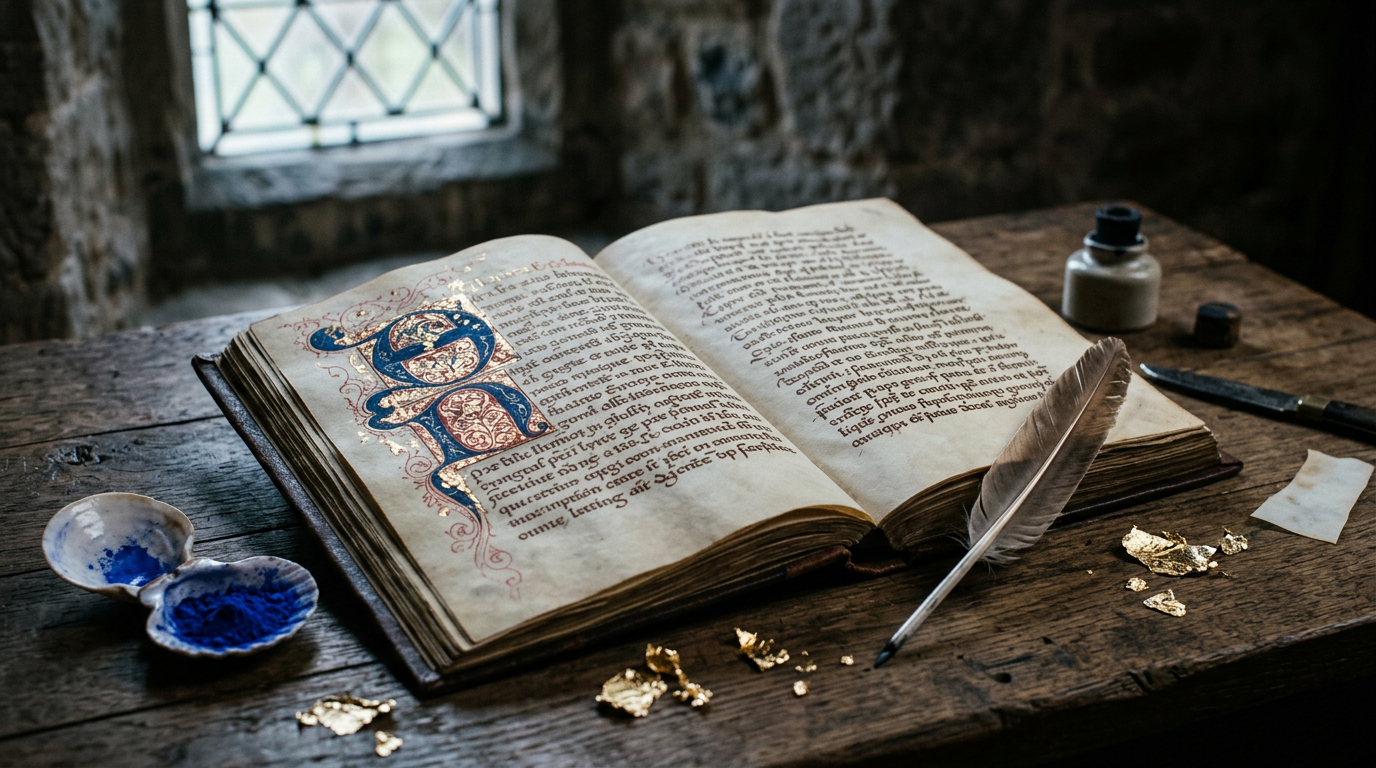
Manuscript illumination is the painting and gilding of handwritten Western Christian books: gospel books, psalters, missals, choir books, legal texts and, later, Books of Hours. Artists and scribes worked on parchment or vellum with ink, tempera pigments and metal leaf so that initials, borders and miniature scenes caught light as the pages turned. The Latin root illuminare (“to light up”) names that glow. Museum labels and student surveys use the term for European production from late antiquity through the early sixteenth century, when printed books took over most everyday reading while luxury handmade volumes still served courts and churches.
This essay stays inside that Western Christian fence. Islamic Qur’an calligraphy and Persian or Mughal painting schools belong elsewhere; see the planned Islamic manuscripts piece (pending) rather than treating them as a side chapter here. The wider medieval survey sits in Medieval art, explained. Orthodox panel icons are a different medium and brief; they belong with Icons and icon painting (pending). For the period map across styles, start at the art history periods series hub. Technique appears here as evidence of workshop practice, not as a gilding manual.
Conditions that made the illuminated book
Before printing, every Western book was labour. Patrons paid for skins, pigments, gold, months of scribal time and the prestige of owning a unique copy. Monasteries first concentrated that labour. From the sixth and seventh centuries onward, Benedictine and Insular houses copied scripture, liturgy and a thinner stream of classical texts. A gospel book on the altar announced orthodoxy and wealth. A psalter in a choir stall served daily prayer. Imperial courts under the Carolingians and Ottonians then used the same medium as policy: renovated scripts, classical motifs and gold lettering staged Christian kingship as heir to Rome.
Demand shifted again after about 1100. Cathedral schools and universities needed portable Bibles, law books and commentaries with wide margins for notes. Cities such as Paris, Bruges and Bologna grew professional book trades. By about 1200, secular artisans were selling manuscripts to students, merchants and lay women as well as to abbots and bishops. The Met’s overview of the medieval book stresses that princes still commissioned gold and silver gospel books, while ordinary readers bought smaller volumes once literacy and Marian devotion widened the market. Illumination followed the money: from cloister to street workshop without losing its sacred job.
Monasteries, empires and the sacred page
Insular monasteries on Iona, Lindisfarne and related houses fused Mediterranean Christian iconography with native metalwork ornament. Carpet pages, interlaced initials and evangelist symbols turned the gospel book into a shrine you could open. The Lindisfarne Gospels (British Library, Cotton MS Nero D.IV), associated with Bishop Eadfrith around the early eighth century, preserve that fusion at high polish. Further south and east, Carolingian reformers standardised script (Caroline minuscule) and revived antique models in ivory, metal and paint. Charlemagne’s circle treated monasteries as engines of correct text and correct image. Ottonian emperors continued the programme with gospel books that place rulers under Christ in majesty.
Romanesque centuries kept monastic centres busy while pilgrimage routes and Cluniac reform poured coin into large liturgical books. Choir books grew huge so that several singers could share a stand. Beatus manuscripts in Iberia pictured the Apocalypse for monastic communities living with both Christian and Islamic neighbours. Across these phases the brief stayed institutional: correct liturgy, orthodox teaching, and a visible claim that the house or dynasty deserved honour. You read those claims in gold, scale and the choice of saints, before you read the Latin.
Cities, universities and private prayer
From the thirteenth century the book trade professionalised. Stationers coordinated parchmenters, scribes, illuminators and binders. Paris became Europe’s densest market for Books of Hours, the lay prayer book built around the Hours of the Virgin. The Met dates the type’s boom from about 1250 and notes that, from the fourteenth to the mid-sixteenth century, more Books of Hours were made than any other book type in northern Europe. Patrons could order by the initial: more painted letters meant a higher price. Calendars, gospel lessons, Hours of the Cross and suffrages to favourite saints let buyers customise the volume.
Court collecting intensified the luxury end. Jeanne d’Évreux’s tiny Hours (Cloisters, Met) and Jean de Berry’s Belles Heures show how queens and dukes treated illumination as intimate diplomacy and connoisseurship. Italian courts and papal circles kept choir books and humanist texts painted deep into the age of print. Pia Palladino’s Met essay on Italian illumination from 1400 to 1600 tracks painters such as Lorenzo Monaco, Cosmè Tura and Giulio Clovio moving between altarpiece, choir book and private Hours. By then the craft had become a specialised luxury, not the default way to make a book.
What counts as an illuminated manuscript
Strict definitions differ. Some curators reserve “illuminated” for books that use gold or silver; others include any manuscript painted in rich colour with decorated initials, borders or miniatures. The V&A’s working definition is practical: a handwritten book whose decoration or illustration is painted in gold, silver and rich colours that make the page shimmer. Minneapolis Institute of Art teaching notes emphasise the Latin illuminare and the role of gold. For gallery walking, treat gold leaf, burnished grounds, painted initials, inhabited borders and narrative miniatures as the toolkit. A plain monastic cartulary with a few coloured capitals sits at the edge of the category; a gospel book with carpet pages sits at the centre.
Book type sets the job before style does. Gospel books and giant Bibles served altar and lectern. Psalters structured monastic and, later, lay prayer. Missals and graduals timed the Mass and the choir. University Bibles and Gratian’s Decretals carried glosses in the margins for students who argued in Latin all day. Books of Hours translated clerical hours into a portable lay routine built around praise of the Virgin. Chronicles, romances and scientific manuals prove the craft was never only liturgical, yet church and court budgets still explain why sacred books dominate what museums show.
The chronology table below is a map for labels, not a set of hard borders. Insular carpet pages overlap Carolingian classical revivals; Romanesque giants receive Gothic borders in later campaigns; Italian Renaissance choir books keep medieval liturgical jobs under new classicising ornament. Use the rows to orient a gallery visit, then read the object’s brief: who paid, who held it, and whether the images teach, navigate or display wealth.
| Phase (approx.) | Core centres | Typical book types | Visual cues | Landmark examples |
|---|---|---|---|---|
| Insular (c. 650-850) | Iona, Lindisfarne, Northumbria, Ireland | Gospel books | Carpet pages, interlace, evangelist symbols | Lindisfarne Gospels; Book of Kells |
| Carolingian & Ottonian (c. 780-1050) | Aachen, Tours, Reims, Ottonian monasteries | Imperial gospel books, psalters | Classical revival, gold scripts, dynamic ink drawing | Utrecht Psalter; Tours Bibles |
| Romanesque (c. 1000-1200) | Cluny network, Iberia, Germany, England | Giant Bibles, Beatus, liturgical books | Firm outlines, schematic space, large initials | Beatus leaves (Met); Winchester tradition |
| Gothic & Paris trade (c. 1200-1400) | Paris, northern France, England | Pocket Bibles, Books of Hours, law | Soft drapery, drolleries, grisaille options | Hours of Jeanne d’Évreux |
| International Gothic / Netherlandish edge (c. 1380-1450) | Berry, Burgundy, Flanders | Luxury Hours, chronicles | Court costume, calendar landscapes | Belles Heures; Très Riches Heures |
| Italian Renaissance book painting (c. 1400-1600) | Florence, Ferrara, Venice, Rome | Choir books, humanist texts, papal Hours | Classicising borders, panel-like miniatures | Lorenzo Monaco choir books; Farnese Hours (Clovio) |
Characteristics you meet on the page
Stand before a case and you are looking at a system of cues, not a single “medieval look.” Hierarchy of initials marks text structure the way a modern heading hierarchy does. A historiated initial (letter containing a scene) can open Genesis or Matins. A inhabited initial wraps foliage or animals through the letterform without telling a full story. Full-page miniatures and carpet pages halt reading altogether so that ornament itself becomes devotion. Borders range from spare frames to bas-de-page theatres of jokes, hunters and hybrids. Gold grounds flatten space; later calendars open into deep landscapes. Both choices are intentional rhetoric.
Format and function shape those cues. A lectern choir book needs large initials readable from metres away. A queen’s Hours can shrink to pocket size and pack hundreds of marginal inventions into the lower margin. Legal manuscripts favour diagrams and historiated initials that mark case openings. Humanist books of the Quattrocento often calm Gothic border riot into classicising wreaths and putti while keeping the painted capital as a prestige marker. Across types, the image does double duty: devotion or instruction on one hand, wayfinding on the other. Without page numbers, a full-page Annunciation told you that Matins of the Virgin had begun.
Materials, labour sequence and cost signals
Materials announce cost and network. Parchment or vellum (treated animal skin) dominated until paper spread in Europe around the mid-fifteenth century. Ultramarine from Afghan lapis, orpiment yellow, organic reds, copper greens and lead whites appear under modern analysis. Trinity College Dublin’s pigment work on the Book of Kells has argued for indigo or woad blues rather than the lapis once assumed. Gold leaf stuck to bole or gum, then burnished, created the flash museum lighting still chases. Silver tarnishes; many “silver” effects survive as darkened stains. Ruling lines in plummet or ink remain visible on careful looking and prove the page was an engineered grid before it was a picture.
The Getty’s “Making of a Medieval Book” exhibition framed production as four linked stages: parchment making, writing, illumination, binding. That sequence explains collaboration better than the myth of a lone monk inventing every page in silence. Skins soaked in lime, scraped and stretched; quires nested and pricked; text copied from an exemplar; designs outlined; leaf laid; pigments bound in egg white or gum; gatherings sewn onto cords and laced into wooden boards. Failure modes were ordinary: cockled skin, flaking paint, copper green eating through the page, bindings that crushed thick paint. Conservators now read those scars as evidence of process.
Ornament languages from Insular to International Gothic
Insular pages prize dense interlace, trumpet spirals and animal knots that behave like prestige metalwork. Carolingian and Ottonian books revive acanthus, architectural frames and imperial purple or gold scripts that claim Roman inheritance. Romanesque initials harden into clear silhouettes suited to giant lectern volumes. Gothic Paris softens drapery, multiplies drolleries and experiments with grisaille so draughtsmanship can outshine leaf. International Gothic and early Netherlandish edges push costume, weather and landscape until the miniature rivals small panel painting. Italian Renaissance borders swap ivy for candelabra and putti while choir-book saints keep speaking to monks across a stall.
You can test a page in five minutes. Ask whether gold creates a sacred ground or a highlight on drapery. Ask whether the border comments on the main scene or runs a separate comic plot. Ask whether the figures share the scale of sculpture on a portal or the intimacy of a private diptych. Those questions travel from Lindisfarne to Clovio without forcing every century into one adjective.
Workshops, patrons and named makers
Most illuminated pages are team products. A parchmenter prepared skins; a scribe ruled and wrote; an illuminator or several specialised hands painted initials, borders and miniatures; a binder sewed gatherings onto boards. Jonathan J. G. Alexander’s Medieval Illuminators and Their Methods of Work and Christopher de Hamel’s surveys of scribes and illuminators remain standard maps of that division of labour. Signatures are rare before the later Middle Ages. When names survive, they often come from colophons, payment records or later inventories rather than from a painter’s flourish in the margin.
Patronage set the brief more than personal expression did. An abbot wanted a correct text for the altar. A queen wanted a portable Hours sized for private devotion and dynastic memory. A duke wanted calendar scenes that advertised his castles. Artists answered inside workshop styles that clients could recognise: Insular interlace, Reims pen drawing, Parisian grisaille, Ferrarese wiry contour. Modern scholarship still debates how far one hand equals one name. The Book of Kells, Trinity College argues, shows about three major artists and four main scribes working inside a house style. The Limbourg brothers, by contrast, enter documents as a named team tied to Jean de Berry. Model books and traced patterns let shops repeat border modules across commissions; unfinished leaves in other volumes show underdrawings left when a campaign stopped mid-quire.
From anonymous houses to Parisian brands
Early medieval fame attaches to places and saints more than to painters. Lindisfarne’s later colophon credits Eadfrith as scribe (and by extension designer) of the Gospels in honour of St Cuthbert; Billfrith and others enter the story as binders and jewellers of the (lost) original covers. Carolingian and Ottonian gospel books circulate under monastery or court labels: Tours, Reims, Reichenau. The Utrecht Psalter’s makers stay nameless even as their Reims-school style becomes a textbook category. Romanesque giants such as the Winchester Bible likewise gather “Master of…” labels invented by modern cataloguers when documents fail.
Paris in the fourteenth century changes the credit culture. Jean Pucelle appears in Jeanne d’Évreux’s testament as the man who illuminated her Hours; inventories later call the book the “Heures de Pucelle.” Master Honoré and other Parisian names surface in tax and guild contexts. By 1400 the Limbourg brothers (Paul, Johan and Herman) work as household artists for Burgundy and then Berry. Italian painters who already ran altarpiece workshops (Lorenzo Monaco, Sano di Pietro, Cosmè Tura) took choir-book commissions as extension of their brands. The shift from house style to named illuminator tracks the same late medieval market that produced donor portraits on panels.
Courts, women patrons and the Hours boom
Women patrons shaped the Hours market with force. Queens and noblewomen ordered volumes they could hold, annotate and bequeath. Jeanne d’Évreux’s Hours includes a Life of Saint Louis, her great-grandfather, so Capetian sanctity sits beside the Virgin’s Hours. Bourgeois buyers later entered the same market with thinner borders and fewer full-page miniatures. Wendy Stein’s Met essay stresses rising lay literacy, Marian devotion and the move from clerical control of bookmaking to professional scribes and artists as the conditions behind that boom.
Courts also mixed languages and artists. Franco-Flemish painters served French dukes; Italianate figure styles entered northern miniatures through travel and portable drawings. Jean de Berry owned some fifteen Books of Hours, including both the Belles Heures and, for a time, Jeanne d’Évreux’s earlier treasure. Collecting itself became part of the art history: inventories, valuations and gifts moved books between dynasties, which is how modern museums can still name chains of ownership for a few star volumes.
Four manuscripts to read closely
Survey tables sort styles; open books teach jobs. The four works below sample Insular gospel splendour, Carolingian psalm imagination, Gothic royal intimacy and International Gothic court narrative. Each sits in a public collection you can plan around via museum catalogues and, where available, digitised openings. None stands for every region. Read them as briefs answered under constraint: honour a saint, animate a psalm line, fit a queen’s hand, please a duke who already owned a library.
The Book of Kells at Trinity College Dublin remains the tourist touchstone for Insular fame; its Chi-rho opening (folio 34r) and disputed Iona/Kells origin deserve a visit. The Lindisfarne case below already carries the Insular argument with a named colophon tradition, so Kells sits here as a parallel peak rather than a fifth close reading. Taken together with the chronology table, these four books show how Western Christian workshops answered different briefs across four centuries without collapsing into one style label.
Lindisfarne Gospels (early eighth century)
The Lindisfarne Gospels were made on the Northumbrian island of Lindisfarne. Most scholars place the campaign in the first decades of the eighth century under Bishop Eadfrith (d. c. 721). The British Library holds the manuscript (Cotton MS Nero D.IV). A tenth-century colophon by Aldred, who also added an Old English gloss, names Eadfrith as scribe, Ethelwald as binder and Billfrith as the jeweller who ornamented the covers. The original metalwork cover is lost; the painted book survives with carpet pages, evangelist portraits, decorated incipits and a famous Chi-rho opening.
Insular design treats the page as metalwork translated into pigment. Interlace locks animal and geometric forms into fields that stop the eye before the Latin begins. The evangelist miniatures combine Mediterranean author-portrait tradition with local pattern density. For a modern viewer the book explains why Insular “abstraction” is intentional rhetoric: complexity itself glorifies the Word. Canon tables and prefatory matter organise the four Gospels for liturgical finding, so ornament and scholarship share one binding. Aldred’s gloss also makes the volume a bilingual teaching object centuries after the first campaign, proof that illumination’s life extended through use, not only through making.
Utrecht Psalter (c. 820-830)
Utrecht University Library MS 32 was written and drawn at Reims or the nearby abbey of Hautvillers. Most experts date it about 820-830, with a link scholars often tie to Archbishop Ebbo’s circle; some catalogue descriptions stretch the window toward the mid-ninth century. Each psalm and canticle receives a wide pen-and-ink frieze that turns metaphors into crowds: the blessed man, the chaff of the wicked, personified winds, the mouth of Hell. About six artists share a nervous, classical-looking line that scholars compare to late antique illusionism remade for Carolingian eyes. UNESCO added the Psalter to its Memory of the World register in 2015.
The book’s later life is part of its art history. Around the year 1000 it was in Canterbury, where English artists copied its cycle into the Harley, Eadwine and related psalters. That chain shows how one inventive visual programme could mutate across two centuries of English manuscript culture. Gold-heavy “illumination” is scarce here; the radiance comes from draughtsmanship. The example widens the definition for students who equate the craft only with lapis and leaf. A first-psalm opening that fills the page with simultaneous metaphors also trains you to read medieval images as layered commentary rather than single-moment illustration.
Hours of Jeanne d’Évreux (c. 1324-28)
Jean Pucelle illuminated this Book of Hours in Paris for Jeanne d’Évreux, queen of France, about 1324-28. The Cloisters (Metropolitan Museum of Art, 54.1.2) keeps the tiny volume: folios about 9.2 × 6.2 cm, grisaille figures with tinted grounds, almost no gold, yet extraordinary finish. Twenty-five full-page paintings pair Infancy and Passion subjects; a cycle of Saint Louis serves Capetian memory; close to seven hundred marginal scenes fill the borders with Parisian street life, animals and inventions. Jeanne’s testament names Pucelle; the book later entered Jean de Berry’s collection and appears in inventories as the “Heures de Pucelle,” “enlumine de blanc et noir.”
Pucelle’s grisaille answers a queen’s brief for private looking. Sculpture-like modelling replaces the expected blaze of leaf, so the object reads as precious draughtsmanship rather than treasury flash. Facing Passion and Infancy pages train the owner to hold joy and suffering in one opening. The margins keep the sacred programme from sealing shut: beggars, musicians and apes share the visual field with Christ and the Virgin. If you want Gothic illumination at court scale without cathedral glass, start here. The book also proves that Western manuscript illumination can renounce gold and still meet every curator’s working definition through colour, line and labour.
Belles Heures of Jean de France, duc de Berry (1405-1408/9)
The Limbourg brothers (Paul, Johan, Herman) completed the Belles Heures for Jean de Berry about 1405-1408/9, most scholars place the campaign in Paris. The Cloisters holds the manuscript (Met 54.1.1). It is the only book the brothers finished in full. Beyond the standard Hours cycles, seven picture-book sequences narrate saints’ lives with humour and violence; over 150 miniatures mix northern nature observation with Italianate figure articulation. Timothy Husband’s Met catalogue remains the standard close guide. The same patrons later began the unfinished Très Riches Heures (Musée Condé, Chantilly), whose calendar pages often stand in popular memory for the whole craft.
The Belles Heures shows illumination at the edge of panel painting. Landscape, costume and emotional gesture push toward the clarity Jan van Eyck’s generation would pursue in oil, while the book format keeps the images sequential and intimate. Berry’s appetite (fifteen Hours in one lifetime) reminds you that style change rode on collectors who could fund teams of young virtuosi. When you stand at the Cloisters case, you are looking at court competition as much as at piety. Compare a Belles Heures saint cycle with a Pucelle opening and you see how far French court taste moved in three generations: from grisaille intimacy to saturated narrative spectacle.
How the craft spread and mutated
Insular ornament travelled with missionaries and gifts; Carolingian models moved with court libraries; Gothic Paris exported Hours layouts across northern Europe. English workshops adapted French border fashions; Flemish painters carried calendar realism into Burgundian books; Italian centres translated choir-book initials into Renaissance colour. Iberian Christian kingdoms kept Beatus traditions alive beside imported French and Flemish luxuries. Mutation also meant medium transfer: compositions invented for parchment reappear in stained glass, ivory and panel painting, then return to books as workshop drawings circulate. Portable books were diplomatic gifts; a painted Hours could travel farther than a portal sculpture.
Regional schools kept local accents inside shared jobs. English illumination after the Norman Conquest absorbed continental layouts while retaining Insular memories in initials. Bohemian and German courts funded luxury Bibles and law books that spoke imperial politics. Netherlandish shops in Bruges and Ghent sold finished Hours to foreign merchants who wanted Bruges polish without a Paris address. Italian cartolai such as Vespasiano da Bisticci organised humanist libraries for Federigo da Montefeltro and other princes, farming decoration out to painters who already knew fresco and panel. Spread looks like trade routes once you stop treating each manuscript as an isolated miracle.
Print reorganised the market without killing the luxury handmade book overnight. From the later fifteenth century, presses multiplied Books of Hours with woodcut or metalcut borders; the Hardouyn shop in Paris, represented in the Met’s collection, shows how printers chased the look of illumination at scale. Wealthy patrons still ordered painted manuscripts from specialists such as Simon Bening in Bruges or Giulio Clovio in Rome. Palladino notes that by 1500 Italian illumination had narrowed to papal and aristocratic commissions even as painting on panel and canvas took the main stage. The craft mutated into a prestige niche, then into cuttings when eighteenth- and nineteenth-century dealers sliced initials from choir books for album collectors. The V&A’s holdings of more than two thousand cuttings document that market and its losses.
Islamic and Byzantine book arts ran parallel circuits of luxury script and sacred text. Western Christian illuminators sometimes borrowed ornamental ideas through trade and diplomacy, yet the institutional briefs differed. Keep those traditions in their own essays rather than flattening them into one “medieval manuscript” story. For Byzantine sacred panels as a separate practice, use the icons sibling article; for Qur’an and Persian book painting, use the Islamic manuscripts brief.
Critics, cataloguers and modern scholarship
Medieval viewers praised splendour and orthodoxy more than individual genius. Abbot Suger’s twelfth-century writings on Saint-Denis defend luminous materials as aids to contemplation; that argument covers metal and glass first, yet it helps explain why gold books mattered. Inventories of Charles V and Jean de Berry treat named volumes as treasure, listing sizes, subjects and even the presence of black-and-white painting as identifying marks. Giorgio Vasari, writing in the sixteenth century, could still single out Giulio Clovio as a marvel of miniature painting while framing the “Gothic” centuries as a trough between antiquity and Renaissance clarity. That prejudice shaped early modern collecting and left many medieval books unbound, rebound or cut.
Nineteenth-century taste reversed the insult. Antiquaries, the Gothic Revival and new national libraries turned Insular and Gothic books into cultural monuments. The British government’s 1873 photographic facsimile of the Utrecht Psalter, driven by a theological dispute over the Athanasian Creed’s antiquity, also founded habits of palaeographical comparison and helped spur the Palaeographical Society in London. Dealers and museums bought cuttings to teach ornament to designers; the V&A’s early acquisitions follow that industrial-education logic. John Ruskin and later Arts and Crafts practitioners treated medieval books as proof that hand labour could still instruct modern makers.
Twentieth- and twenty-first-century scholarship shifted again toward workshop method, patronage documents and pigment science. Alexander, de Hamel, Otto Pächt, Robert Calkins and exhibition catalogues from the Met, Getty and British Library replaced romantic monk myths with labour history. Infrared and X-ray study now reveal underdrawings; dendrochronology dates board bindings; spectrometry challenges pigment lore. Disputes remain active: dating and origin of the Book of Kells (Iona, Kells, or both), the exact brief and political messages of the Utrecht Psalter, and how far “Pucelle” names a single hand versus a shop. Honest labels still say “workshop of” when the documents stop.
Afterlife: museums, facsimiles and what the pages left behind
Illumination’s afterlife is institutional. Trinity College Dublin displays the Book of Kells to hundreds of thousands of visitors a year; the British Library’s Lindisfarne openings anchor Insular galleries when on view; the Cloisters stages Pucelle and the Limbourgs as twin peaks of French Gothic book painting; Chantilly’s Très Riches Heures calendar pages feed countless reproductions. Digitisation projects now let you compare carpet pages and calendar months without handling skin. Facsimiles from the nineteenth century onward created a second, democratic life for books too fragile for constant display. Online viewers inherit both access and a flattened sense of scale: a pocket Hours and a lectern gradual look similar on a phone.
Design inheritance runs into print, type and illustration. Carpet-page logic informs later decorative arts; calendar labours feed genre painting; grisaille modelling trains a taste for monochrome elegance that reappears in Northern panels. Victorian and Arts and Crafts illuminators revived the hand-painted book as craft protest against industrial print; the V&A preserves that revival beside the medieval cuttings that taught it. Heraldic patents and addresses kept formal illumination alive as civic ceremony. Conservation labs now limit light exposure, replace damaging Victorian bindings and reunite cuttings with parent volumes when evidence allows. For a planner building an itinerary across collections, start from the museums directory and then check each library’s display rotations; parchment prefers darkness and short shifts under light.
The durable lesson is portable splendour. Western manuscript illumination concentrated theology, patronage and workshop skill into an object you could hold, gift, swear on or bury with a saint’s cult. Painting on walls and glass spoke to crowds; the illuminated book spoke to the person who turned the leaf. That intimacy still explains the queues at Dublin and the Cloisters.
FAQ
These questions track classroom and search demand around manuscript illumination: definitions, famous books, workshop sequence and the Western fence against Islamic book arts. Answers stay short. For monastery-to-court chronology, return to the close readings above rather than treating this list as a substitute survey.
What is manuscript illumination?
Manuscript illumination is the decoration of handwritten books with paint and, often, gold or silver leaf. In Western Christian Europe the term covers initials, borders and miniature scenes on parchment from the early Middle Ages into the Renaissance. The glow of metal and saturated colour as pages turn is the point of the name.
What is an example of manuscript illumination?
The Hours of Jeanne d’Évreux (Cloisters, Met), painted by Jean Pucelle about 1324-28, is a clear Gothic example: a queen’s tiny prayer book with grisaille miniatures and dense marginal scenes. For an earlier Insular example, open digitised carpet pages from the Lindisfarne Gospels in the British Library.
What are the stages of making an illuminated manuscript?
Museum teaching, including the Getty’s “Making of a Medieval Book,” groups the work into parchment preparation, scribal writing on ruled lines, painted and gilded illumination, then sewing and binding onto boards. Teams often split those tasks; gold leaf was laid and burnished before final colour in many shops.
What is the most famous illuminated manuscript?
Fame depends on audience. The Book of Kells at Trinity College Dublin draws the largest tourist crowds among Insular gospel books. Art historians also point to the Lindisfarne Gospels, the Utrecht Psalter and Jean de Berry’s Hours (Belles Heures; Très Riches Heures) as touchstones. “Most famous” is a popularity contest, not a scholarly ranking.
Were illuminated manuscripts only religious?
Sacred texts dominate survival: Bibles, gospel books, psalters, missals, choir books and Books of Hours. Workshops also painted chronicles, romances, scientific and legal manuscripts from the thirteenth century onward. Church and court budgets still explain why religious books take most gallery space.
How is Western illumination different from Islamic book arts?
Western Christian illumination developed around figural gospel, psalm and Hours cycles inside Latin and vernacular church culture. Islamic sacred books privilege calligraphy and non-figural ornament in Qur’an contexts, with rich figural traditions in other genres and regions. Treat Islamic manuscripts in their own survey rather than as a footnote to Gothic Hours.
When did manuscript illumination decline?
Moveable-type printing from the mid-fifteenth century undercut the market for ordinary handmade books. Illuminators kept working for courts, popes and wealthy lay patrons into the sixteenth century, and painted decoration sometimes entered printed books. As a default technology of the page, illumination yielded to print; as luxury art, it narrowed and then became an object of revival and collecting.
Related reading
Van Lévé: Sovereign Caribbean Visions Take Shape at Harvard
A transnational survey charts twenty-five years of Creole and Maroon artistic practice across the French Caribbean and Amazonia.
Harvard's Alain Locke Gallery presents a landmark survey tracing contemporary production from Guadeloupe, Martinique, Guyane, and Haiti since two thousand and one.
Gustave Fayet: Collector—Artist Designer
A comprehensive survey at the Fondation Louis Vuitton reuniting collected masterpieces with the designer's own studio practice.
The Paris institution expands its patronage series with a dual-focused examination of Gustave Fayet, bringing together hundreds of acquired works and restored creations to chart his impact on early modernism.

Mohammad Alfaraj: The Heart Is a Bird's Nest, the Brain Is a Spider Web
First European institutional solo explores cross-species kinship and domestic ecologies
Mohammad Alfaraj's latest showcase at the Delfina Foundation merges multimedia installations with regional folklore to reimagine shared habitats.