
Borås · Sweden
Warps and Waves in the Fabric of Time: Borås Art Biennial 2026
Textile legacies and temporal entanglements at Sweden's ninth biennial
Industrial Threads Through Time
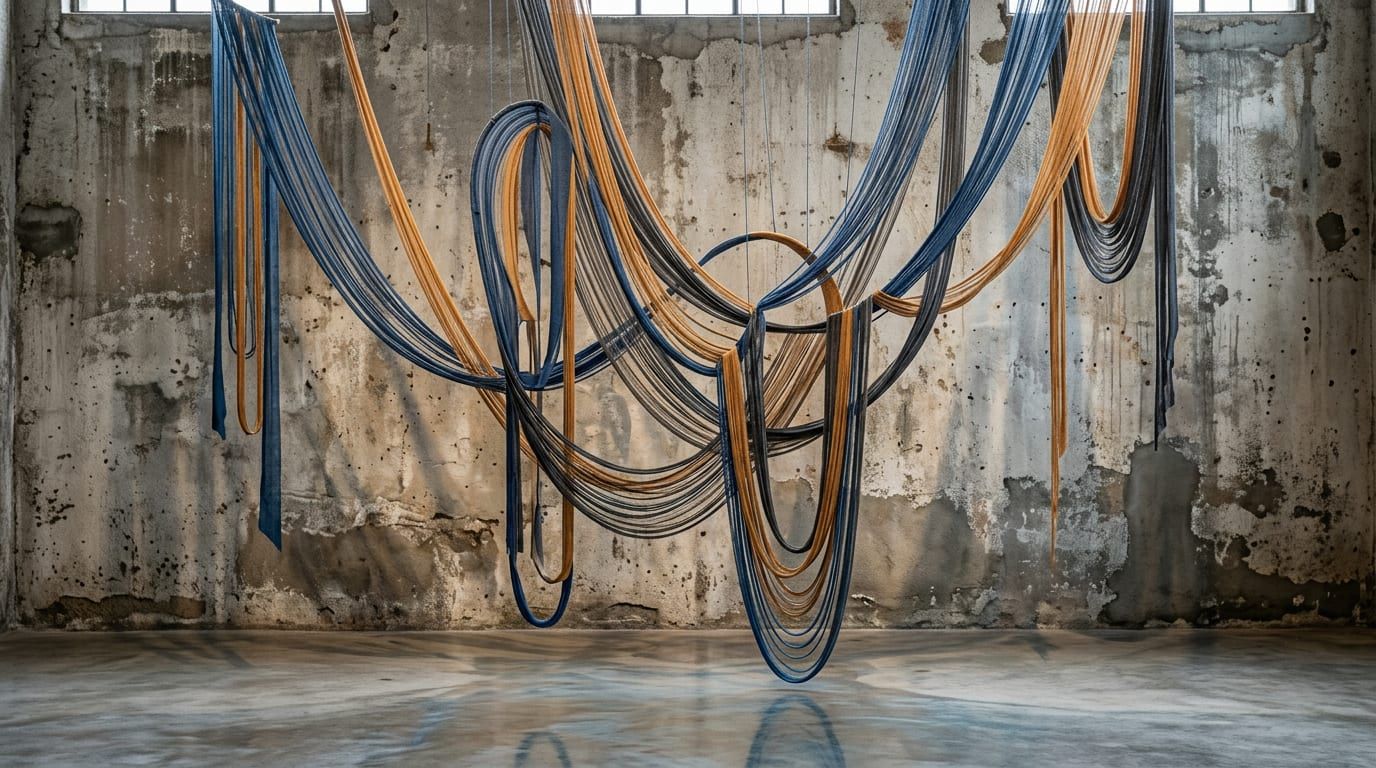
The forthcoming Borås Art Biennial takes as its focus the profound ways industrialisation altered humanity's relationship with temporality. Running from 30 May to 27 September 2026, the exhibition 'Warps and Waves in the Fabric of Time' unfolds across the city centre and at both the Borås Art Museum and Swedish Museum of Textiles.
Curator Taru Elfving brings her research-based approach to bear on questions of ecological transformation and social justice, drawing connections between the mechanised rhythms of factory production and the lived experiences of those whose labour built modern economies. The show's title evokes both the literal processes of weaving and the metaphorical entanglements that bind past, present and future.
A City Woven by Water and Wind
Borås carries a distinctive industrial heritage. In the early nineteenth century, some of Sweden's earliest weaving mills emerged here, building upon generations of domestic textile production. The River Viskan supplied essential water power, while proximity to Gothenburg's port connected local manufacturers to international trade networks. The humid climate, shaped by prevailing westerlies, created conditions conducive to cloth production that would define the city's character for centuries.
These geographical and historical specifics inform the biennial's investigation into what Elfving terms 'fluid coordinates' – the circulation of materials, people and knowledge that constitutes industrial modernity's lasting imprint. Rather than celebrating technological progress in isolation, the exhibition foregrounds the human and environmental costs embedded within textile histories.
Artists Mapping Temporal Currents
Twelve practitioners contribute works that traverse multiple continents and temporal registers. Sampson Addae negotiates between Ghanaian and Norwegian contexts, while Petra Bauer examines Swedish social structures. Nanna Debois Buhl and Michelle Eistrup trace connections between Denmark and Jamaica, and Terike Haapoja alongside Kalle Hamm explore Finnish perspectives on ecological relationships. Marcia Harvey Isaksson bridges Sweden and Zimbabwe, and Dzamil Kamanger draws upon Finnish-Iranian dialogues.
Maria Kapajeva represents Estonian concerns, Sohorab Rabbey connects Bangladesh and Germany, Yasmin Smith brings Australian viewpoints, and Paola Torres Núñez del Prado weaves Swedish-Peruvian narratives. Together, their practices span the Nordic-Baltic region, the Atlantic, the Middle East, West Africa and Southeast Asia, reflecting both colonial legacies and contemporary economic disparities.
Mending the Present
As artificial intelligence threatens employment and environmental degradation accelerates, the biennial asks urgent questions about matter's circulation and work's value. Rather than succumbing to either dystopian fatalism or technophilic optimism, Elfving's curatorial framework seeks alternative futures grounded in cross-temporal alliances.
The deterministic linearity of industrial time gives way to what the exhibition describes as 'alternative imaginaries' – speculative visions that acknowledge historical injustices while imagining more equitable configurations. These artistic interventions function as what Elfving calls 'ghosts in the machine', haunting dominant narratives with traces of suppressed knowledge and forgotten labours.
By attending to the 'more-than-human labourers' that enable production systems, the biennial expands traditional definitions of work to include ecological processes often rendered invisible by technological rhetoric. Women's contributions to textile production, alongside migratory movements of skill and craft, emerge as central themes in this reimagining of industrial temporality.
The ninth edition represents a collaboration between Borås Art Museum and the Swedish Museum of Textiles, institutions uniquely positioned to examine these material and conceptual intersections. Elfving, who holds a PhD in Philosophy from Goldsmiths and previously curated Finland's Venice Biennale pavilion in 2015, brings substantial international experience to this site-sensitive investigation.
Galleries mentioned
Museums mentioned

Related reading
Kiasma Outlines a Robust 2027 Season Featuring Major Surveys and Prize Showcase
Helsinki's Museum of Contemporary Art Kiasma unveils a comprehensive schedule balancing institutional retrospectives, immersive solo projects, and regional award programmes.
The 2027 calendar at Kiasma positions spatial experimentation and critical historiography at the forefront of Nordic contemporary practice.

Ana Vaz: The Camera is the Body at Mudam Luxembourg
Mudam stages the inaugural major institutional survey of the Brazilian filmmaker's interdisciplinary practice
An immersive exhibition reimagines cinematic perception through embodied filmmaking, ecological inquiry, and postcolonial critique.
Lovis Corinth: Then Came Berlin!
How a mid-life relocation ignited a German modernist revolution
An expansive survey at the Berlinische Galerie traces how Lovis Corinth's 1901 move transformed him into a cornerstone of early twentieth-century avant-garde practice.