
Berlin · Germany
Seba Calfuqueo's CAUTÍN Maps Riverine Memory in Berlin
The Mapuche artist's European debut reimagines hydrology through ancestral philosophy and hybrid media.
Mapping a Living Territory
TBA21 Thyssen-Bornemisza Art Contemporary, alongside the Museo Nacional Thyssen-Bornemisza, opens Seba Calfuqueo's CAUTÍN on 6 October 2026. Running until 17 January 2027, this landmark European debut arrives under the curatorial guidance of Marina Avia Estrada, with institutional support from Santiago's Centro Cultural La Moneda. The presentation centres on the Cautín River, positioning it not as a passive landscape but as an active participant within Mapuche epistemology.
Within Indigenous frameworks, the lewfü functions as a sentient force that binds memory, ecological balance, and spiritual understanding across the land. Calfuqueo treats the waterway as a dynamic network where flora, fauna, human settlements, geological formations, and ancestral spirits continuously reshape one another. This worldview, grounded in the principle of itrofill mongen, assigns equal agency to every entity inhabiting the basin. Historically, Spanish conquest and subsequent state expansion reduced the watershed to a commodity, yet these relational ties persist, adapting rather than disappearing amid political and environmental strain.
Counter-Current Methodologies
Rejecting colonial expectations of stylistic purity, the practitioner employs what she terms travesti materials to construct a dense visual vocabulary. The gallery space unfolds across textiles, sculptural ceramics, three-dimensional animation, durational performance, hair installations, and video works. Rather than following a chronological sequence, the layout mirrors an upstream navigation, beginning at the estuary where freshwater merges with the ocean and concluding near the volcanic headwaters. This deliberate inversion operates as a methodological choice, reflecting a cyclical understanding of temporality where origins and terminations remain fluid. By moving against the natural flow, the display keeps historical traumas and ongoing resistance narratives in perpetual motion.
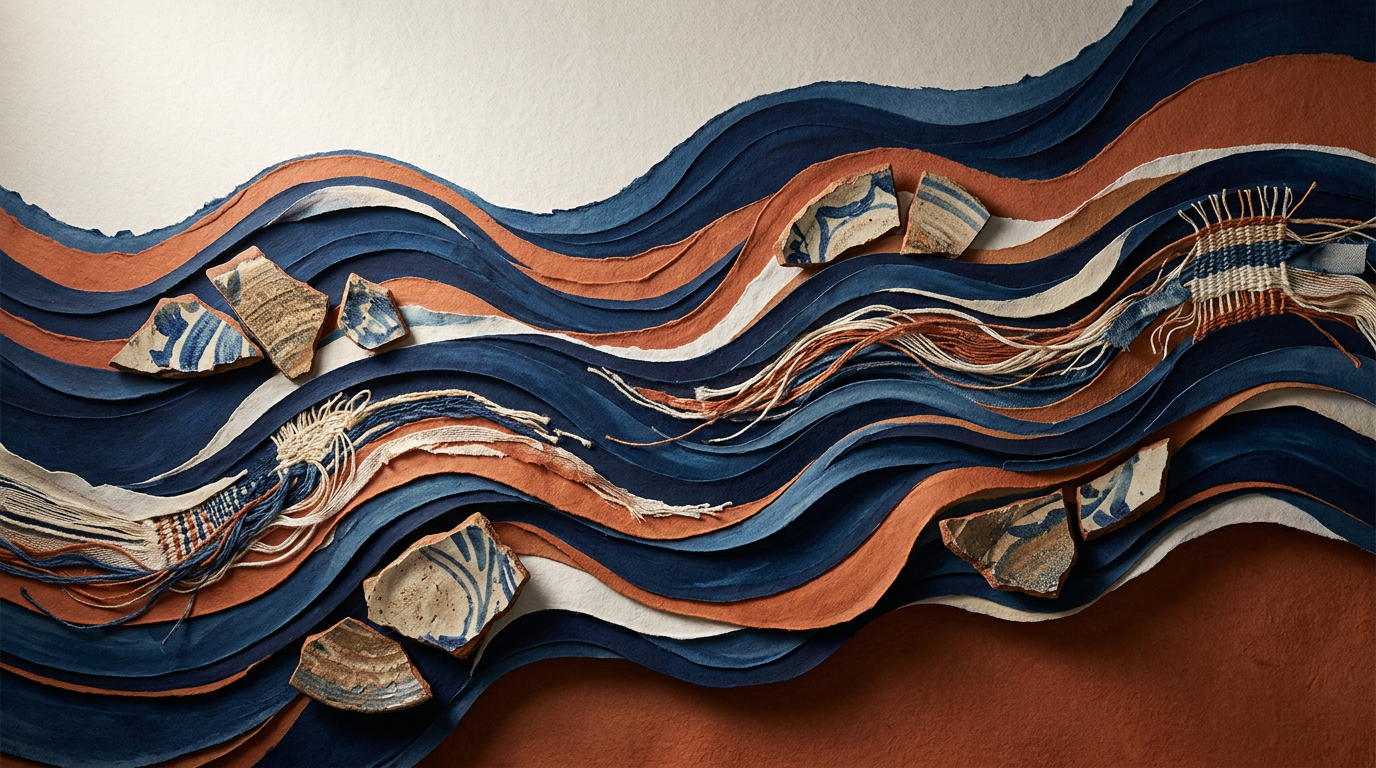
The spatial arrangement deliberately disrupts conventional museum pacing, encouraging visitors to trace ecological and historical fractures rather than consume a linear narrative. Textile compositions interweave natural pigments with synthetic fibres, mirroring the hybrid identities that emerge when traditional practices encounter modern infrastructure. Ceramic pieces reference both ancient vessel-making techniques and contemporary industrial moulds, further destabilising boundaries between craft and fine art. Through these layered approaches, the artist constructs a visual lexicon that refuses categorisation, instead offering a tactile archive of resilience.
Hydro-Political Urgency
The presentation arrives during a period when water management dominates international discourse. Chile continues to navigate the aftermath of its 1981 Water Code, despite legislative adjustments introduced in 2022, while international bodies have recently urged greater protections for Indigenous communities facing scarcity. Calfuqueo's work directly challenges frameworks that fragment ecosystems into administrable assets, instead presenting the watershed as an interconnected knowledge system. As major cultural institutions increasingly centre Indigenous authorship and ecological reciprocity, this project positions Mapuche cosmology at the forefront of contemporary debates regarding non-human agency.
Institutional Lineages and Future Horizons
Developed over more than twenty-four months of fieldwork and creative production, the showcase features entirely new commissions. It also extends TBA21's longstanding investigation into place-based knowledge systems and aquatic environments, building upon initiatives launched through the institution's academy programmes. Calfuqueo, born in Santiago in 1991, has spent years examining the friction between heritage and contemporary reality, deliberately avoiding romanticised depictions of ancestral lands. Her practice, which spans multiple mediums, now resides in major public holdings including the Tate Modern and Centre Pompidou, and gained further recognition after securing the Focus Stand Prize at Frieze New York earlier this year. Following her Venice Biennale appearance, this Berlin presentation marks a significant milestone in her evolving career.
Related reading
One Thousand and One Nights as a Visual Network
The book that taught Europe to picture the East arrived with no pictures at all. Three centuries of illustrators — Dutch, Egyptian, Persian, French, German, Iraqi — each gave it a face, and every face was a self-portrait.
Lovis Corinth: Then Came Berlin!
How a mid-life relocation ignited a German modernist revolution
Maurizio Cattelan: NIGHT at Berlin's Neue Nationalgalerie
A new exhibition transforms Mies van der Rohe's pavilion into a secular sanctuary of contemplation and historical reflection.