
Berlin · Germany
Maurizio Cattelan: NIGHT at Berlin's Neue Nationalgalerie
A new exhibition transforms Mies van der Rohe's pavilion into a secular sanctuary of contemplation and historical reflection.
A Ritual Space Reimagined
The Preis der Nationalgalerie returns this autumn with NIGHT, a landmark solo presentation by Maurizio Cattelan (born in Padua in 1960) at the Neue Nationalgalerie in Berlin. Running from 10 September 2026 through 7 March 2027, the show marks the Italian sculptor's first substantial German survey since his emergence in the late twentieth century. Situated within Ludwig Mies van der Rohe's celebrated glass-and-steel pavilion, the installation deliberately transforms the gallery into a secular sanctuary, where architectural symmetry and quietude take precedence over conventional display logic. Rather than treating the historic structure merely as a backdrop, the arrangement leverages its vast proportions to generate a sense of ceremonial gravity.
Architectural Dialogue and New Commissions
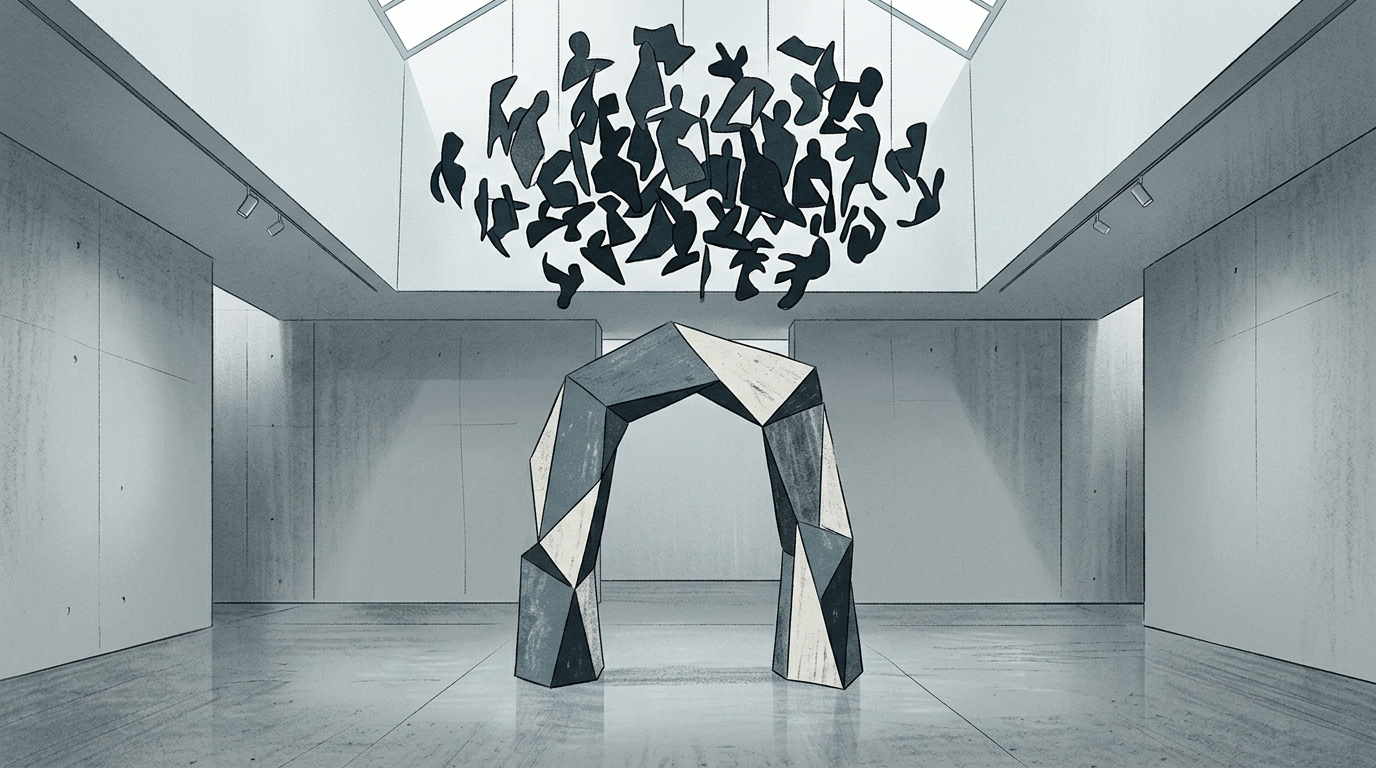
Central to the layout is a newly commissioned piece titled Purgatory. Here, a miniature replica of the Brandenburg Gate occupies the central floor area, functioning less as a national symbol than as a threshold for contemplation. Suspended above, thousands of preserved birds comprise People, casting a shadowy canopy that redefines the roofline while suggesting communal vigilance. These interventions anchor a careful choreography of established sculptures alongside fresh commissions. Kneeling male and female figures, originally crafted in 2001 and 2007 respectively, are aligned to form a stark vertical axis, emphasising themes of devotion and physical exposure. Meanwhile, earlier pieces such as Novecento, La Rivoluzione Siamo Noi, and Never continue to interrogate cultural narratives around authority, collective identity, and historical trauma. Familiar motifs are deliberately displaced, prompting viewers to navigate the tension between satire and genuine emotional resonance. The deliberate spacing between these objects forces a slower pace of engagement, allowing the architectural volume to dictate the rhythm of observation rather than traditional wall labels or linear chronologies.
Historical Echoes and Altered Perception
The exhibition's nomenclature points toward a specific mode of viewing rather than literal darkness. By stripping away visual certainty, the arrangement encourages visitors to notice marginal details and reconsider familiar iconography. This perceptual shift resonates particularly strongly in Berlin, a metropolis defined by complex layers of remembrance and political reckoning. Cattelan's return to the capital two decades after participating in the fourth Berlin Biennale allows his practice to converse directly with local historiography without resorting to didacticism. The resulting atmosphere operates much like a modern place of worship, yet explicitly avoids doctrinal messaging. Instead, it invites secular reflection on how societies construct memory and assign value to public monuments.
Curatorial Framework
Curated by Lisa Botti and Klaus Biesenbach, working closely with the artist, the presentation treats the museum environment as an active participant rather than a passive container. The architects' original vision of structural clarity merges with Cattelan's penchant for subversion, resulting in a sequence of encounters that oscillate between irony and solemnity. Institutional backing from FREUNDE der Nationalgalerie and BMW facilitates this expanded chapter of the prize series, which was established in 2000 to highlight pivotal contemporary voices. Through deliberate spatial manipulation and thematic cohesion, NIGHT demonstrates how institutional architecture can be temporarily repurposed to foster introspection, proving that contemporary sculpture remains capable of generating profound, albeit unsettling, dialogue.
Galleries mentioned
Museums mentioned
Related reading

Seba Calfuqueo's CAUTÍN Maps Riverine Memory in Berlin
The Mapuche artist's European debut reimagines hydrology through ancestral philosophy and hybrid media.
A landmark solo presentation tracing the Cautín River's course while challenging colonial resource extraction through Mapuche cosmology.
The 36th São Paulo Biennial Arrives at Berlin's HKW
A condensed international roster explores listening, care, and decolonial practice
The thirty-sixth São Paulo Biennial takes residence at Haus der Kulturen der Welt this autumn, presenting a focused collection of works that treat humanism as an active methodology.
Open Call: Curator of the 2028 transmediale Festival in Berlin
Applications now open for the artistic direction of Berlin's premier digital culture festival
transmediale e.V. seeks a new festival curator for the 2028 edition, inviting critical engagements with art, technology, and politics ahead of a 30 September 2026 deadline.