
Exhibo Editorial
Auction highs mask a fractured gallery sector
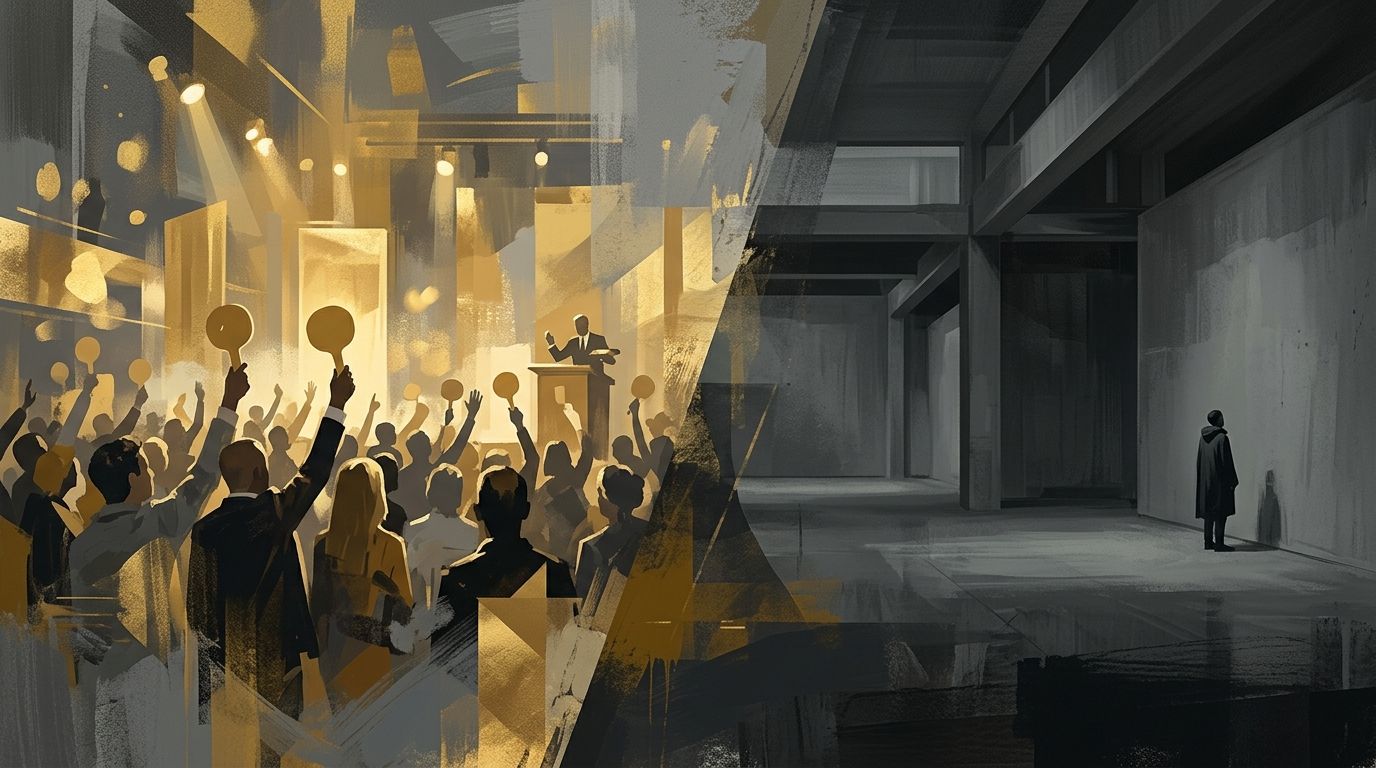
Record-breaking sales at Sotheby's and Christie's tell only half the story of a market increasingly split between top-tier auctions and struggling dealerships.
A market of two halves
The May marquee auction series in New York, followed by Sotheby's record £296.3m sale of 20th-century masterworks from the collection of Bahamas-based billionaire Joe Lewis in June, prompted a wave of bullish commentary from market insiders. Sotheby's two-part modern and contemporary evening sale in London achieved £393.4m with fees — the highest single-night total ever recorded at auction in Europe. "The spirit is different from before," said the London-based Russian collector Alex Lachmann. "People are spending money to put together good collections."
Across the three major houses, Sotheby's, Christie's and Phillips, New York evening and day sales generated an aggregate $2.5bn with fees — nearly double the $1.3bn recorded the previous May and the strongest collective performance since November 2022, when the $1.5bn Paul Allen sale at Christie's helped push totals to $3.2bn.
Thierry Ehrmann, head of the auction database Artprice, described a "trend reversal" in which the market has returned to "solid health without runaway enthusiasm." Much of the headline-grabbing material came from Christie's evening sale of 20th-century art, where 16 works from the S.I. Newhouse collection brought $630.8m. Jackson Pollock's 1948 Number 7A led proceedings at $181.2m, followed by Constantin Brâncuși's Danae at $107.6m and Mark Rothko's No. 15 (Two Greens and Red Stripe) at $98.4m — all three setting new auction records for their respective artists.
The trickle-down myth
The familiar narrative holds that renewed confidence at the top cascades through every level of the market. Yet events in early June offered a stark counterpoint. Pace, one of the four mega-dealerships that dominate the international gallery landscape, laid off 50 staff and 50 artists. Its chief executive, Marc Glimcher, told The New York Times: "The whole art gallery art system became too big, too commercial, too impersonal and too corporate."
The pressures on bricks-and-mortar galleries have been building since the pandemic. Soaring rents, increased shipping costs and the ever-expanding calendar of art fairs have squeezed dealerships at every level. In June alone, Dépendance in Brussels and Tiwani Contemporary in London joined a lengthening list of closures. The east London dealer Kate MacGarry spoke candidly of how "so many challenges continue to bash small businesses like galleries."
Marc Straus, a New York gallerist who runs two Manhattan spaces, was blunter still: "It's the worst business model on the planet." He pointed to the collapse of the ultra-contemporary speculation boom of the early 2020s, noting that "pretty much all of that has collapsed" and that older collectors are "on pause."
Guarantees and dragons
A closer look at the auction figures reveals a market that increasingly resembles a financial instrument. According to data from the London-based auction analysts Pi-eX, a record 79% of turnover at the May New York evening sales was generated by lots backed by third-party guarantees. Sales are predictable, but few lots sell above estimate.
Christine Bourron, founder of Pi-eX, observed that the art market is "increasingly behaving like the stock market, with performance at the top end appearing disconnected from wider economic indicators." She also noted that despite being the highest totals in three years, the May 2026 figures remained well below the levels achieved in 2014, 2015 and 2019 — a period during which the S&P 500 rose by over 280%.
At the Lewis sale, the spending patterns of ultra-wealthy clients told their own story. Sotheby's auctioneer Oliver Barker spent fifteen minutes taking split bids on an Egon Schiele painting that eventually sold for a within-estimate £17.9m. Billionaires on telephones were taking a minute or two to commit an extra £50,000 or £100,000. The dragons, it seems, are minding their gold.
Art Basel and the shifting centre of gravity
At this year's Art Basel in Switzerland, Hauser & Wirth's sale of a 1963 Picasso canvas for $35m on the first VIP preview day was held up as evidence of continued vitality. Yet attendance thinned noticeably on day two, and even the fair's famously popular wurst stalls had few queues. Anecdotally, an increasing number of American collectors now favour Art Basel Paris in October over the Swiss fixture in June.
James Holland-Hibbert, director of Hazlitt Holland-Hibbert in London, captured the mood: "I can't remember a greater moment of uncertainty, what with wars, the state of the economy and generational shifts. We're experiencing a sea change." He cited the proliferation of fairs, advisers and online platforms such as Artnet as factors reducing footfall through his St James's gallery.
Adaptation at the sharp end
Some dealers are finding ways to adapt. Lehmann Maupin, which operates from Frieze's gallery hub at No. 9 Cork Street rather than maintaining a standalone London space, showed recent paintings by the Royal College of Art-trained artist Anna Freeman Bentley during London Gallery Weekend. At least half the works had found buyers or reserves by Friday morning, priced between £10,000 and £70,000 — a bracket that has become a reliable sweet spot for emerging artists.
London Gallery Weekend, now in its sixth edition with more than 120 participants, offered a welcome focus on physical dealerships at a time when media attention is overwhelmingly directed towards auctions and fairs. But the broader question lingers: in an era of forever wars, social media-fuelled anxiety and a waning belief in trickle-down economics, is the virtuously cyclical story the art trade tells itself just another convenient fiction?
As one seasoned observer put it, the art trade is not one market but several. A single season of strong auction results does not transform the entire business.
Galleries mentioned
Related reading

Ana Vaz: The Camera is the Body at Mudam Luxembourg
Mudam stages the inaugural major institutional survey of the Brazilian filmmaker's interdisciplinary practice
An immersive exhibition reimagines cinematic perception through embodied filmmaking, ecological inquiry, and postcolonial critique.

Lovis Corinth: Then Came Berlin!
How a mid-life relocation ignited a German modernist revolution
An expansive survey at the Berlinische Galerie traces how Lovis Corinth's 1901 move transformed him into a cornerstone of early twentieth-century avant-garde practice.

Bridging Japanese Craftsmanship and Contemporary Design
How international makers engage with Tokai's industrial heritage at the V&A
An exploration of how global designers collaborate with Japanese artisans to fuse ancestral techniques with modern conceptual frameworks.