
Shenzhen · China
Shenzhen's First Art and Technology Biennial Opens with a Quantum Proposition
Over fifty artists and researchers gather at SIMoA to explore how observation collapses reality into fleeting certainty
A New Biennial for a City of Innovation
Shenzhen has long been synonymous with technological ambition. Now, the city stakes a claim in the cultural sphere with the launch of the Shenzhen Art and Technology Biennial (SATB), opening on 30 May 2026 at the Shenzhen International Museum of Art (SIMoA) and running through 30 April 2027. Titled A Glimpse of the Infinite, the inaugural edition is directed by Zikang Zhang and curated by Naiyi Wang and Mónica Bello. It assembles more than fifty international artists, scientists, and researchers around a single, deceptively simple question: what happens to reality when we look at it?
The curatorial framework borrows from quantum mechanics, proposing that observation is never a neutral act. Instead, it intervenes—collapsing a field of possibilities into one transient moment of appearance. Every definition, the curators suggest, casts a shadow; what remains unspoken recedes into darkness. Existence becomes a perpetual deferral of full manifestation, and certainty is merely the accidental condensation of probabilities, arrested by the gaze.
Portals to the Uncollapsed
Rather than offering didactic explanations, the exhibition functions as a series of portals into states that resist direct perception. Semiconductor's Light-in-Flight slows the speed of light to human-visible frame rates, revealing how a pulse travelling toward the viewer arrives in reverse order due to the geometry of photon paths—a direct challenge to intuitive temporal sequence. Perry-James Sugden and Daria Jelonek's Quantum Lens employs mixed reality as a symbolic optical device, rendering visible three quantum phenomena—entanglement, probability, and tunneling—that otherwise elude the senses.
Ralf Baecker's Floating Codes exposes the inner aesthetics of artificial neural networks, where signals loop and mutate in an unsupervised computational ecology, mirroring the probabilistic dynamics of quantum systems. Libby Heaney's Shadowscapes (Wilderness Within) is a generative four-channel sound installation unfolding in infinite time, never repeating. It entangles Jung's concept of the shadow with quantum physics—where observation alters systems—using IBM quantum entanglement data in custom software. The work stages a sonic field where knowledge emerges relationally, through interference rather than direct access.
New Commissions and the Quantum Gaze
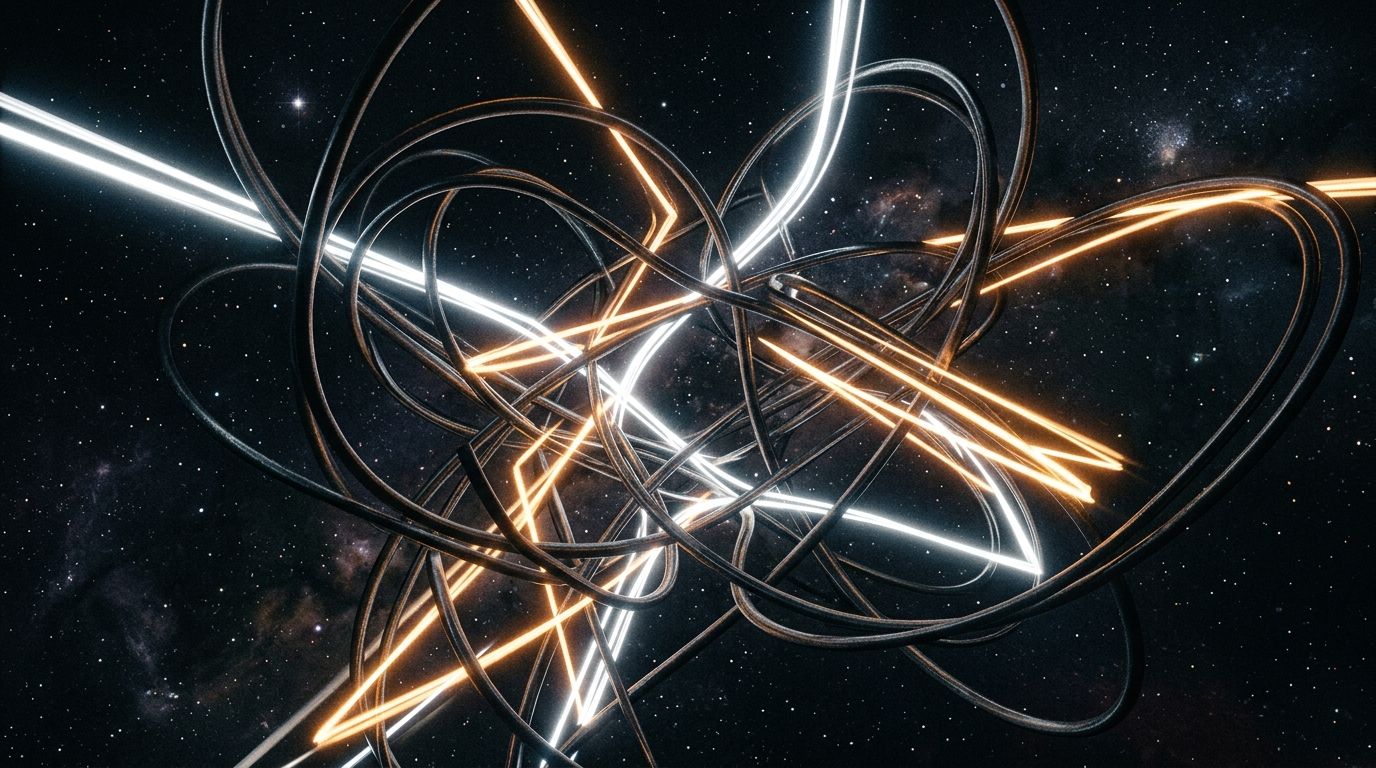
A constellation of newly commissioned works engages directly with what the curators call the quantum gaze. Chen Baoyang's Mechanism and Wave stages a philosophical theatre in which a multi-armed machine dissolves into a probability wave under strobe lighting, only to collapse into a single posture the moment a viewer gazes upon it—a visceral metaphor for measurement and the loss of agency in AI. Yang Song's Photon and π weaves steel wire into interlocking loops where light traces infinite refractive paths, turning the unmeasurable nature of pi into a sculptural condition—a structure that sustains continuity precisely by evading total capture, echoing quantum reality where observation collapses one possibility while others persist.
Seph Li's The Light Named You stages the ruins of a dead universe where only quantum fluctuations persist. Viewers' gravity resonates, and the first light after silence is born from them. Its shape follows the hand—an infinity symbol or a circling band—bringing light and new life to a spacetime that held nothing. Tim Yip's Existential Doubt constructs four spaces representing four dimensions in an eternal cycle, each illuminated by a guiding light, inviting participants to question the purpose of existence within a multidimensional frame.
Visitors as Participants
As the curatorial statement reads: "Perhaps true manifestation always lies on the other side of appearance—the unobserved still adrift." This awareness of incompleteness pervades the exhibition, which treasures decoherence and disturbance over pure coherent states. Visitors are not passive observers but participants in a delayed-choice experiment, where each decision retroactively rewrites the work's past and future.
The biennial presents a plurality of voices—from Victor Vasarely and Qiu Zhijie to Kate Crawford and Vladan Joler, from Tania Candiani and Yael Bartana to Zhang Ding and Miao Xiaochun—probing the entanglement between observation and reality. The aim is not to fix meaning but to keep it in suspension, offering Shenzhen a new model for how art and technology might co-investigate the nature of being.
Galleries mentioned
Exhibitions mentioned
Related reading
Shenzhen's First Art and Technology Biennial Opens
A Glimpse of the Infinite brings together over fifty artists and scientists to probe the quantum nature of observation
The inaugural Shenzhen Art and Technology Biennial, directed by Zikang Zhang and curated by Naiyi Wang and Mónica Bello, opens at SIMoA on 30 May 2026, running for an entire year.
Hockney and Wu Guanzhong in Dialogue at Christie's Hong Kong
A pioneering non-selling exhibition explores shared landscapes and cross-cultural influences
Christie's Hong Kong presents the first joint showing of David Hockney and Wu Guanzhong, exploring shared landscapes and cross-cultural visual traditions.
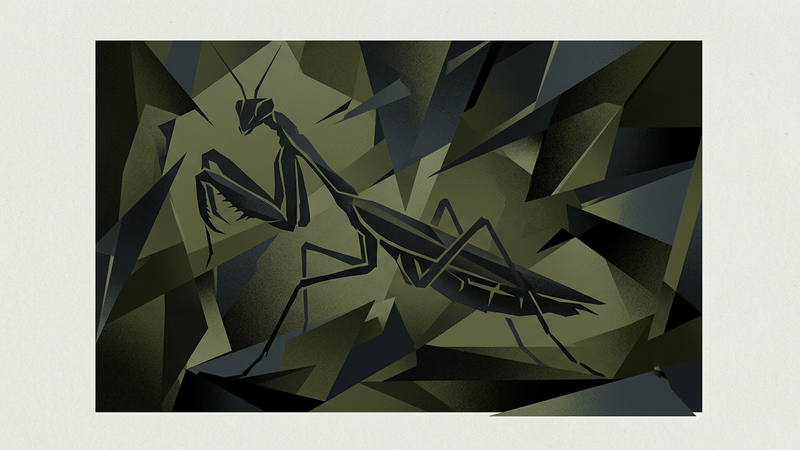
M+M: The Day of the Mantis at the 16th Gwangju Biennale
Luxembourg Pavilion's immersive insect-centric film trilogy explores ecological anxiety and non-human perspectives
A new cinematic installation by Marc Weis and Martin De Mattia refracts contemporary unease through the eyes of arthropods at South Korea's premier contemporary art festival.