
Los Angeles · United States
MPA's Reimagining of Yoko Ono's Cut Piece Tests Boundaries in Los Angeles
The Broad commissions a fresh take on the seminal feminist work during Ono's retrospective
A Trust Fall in Disguise
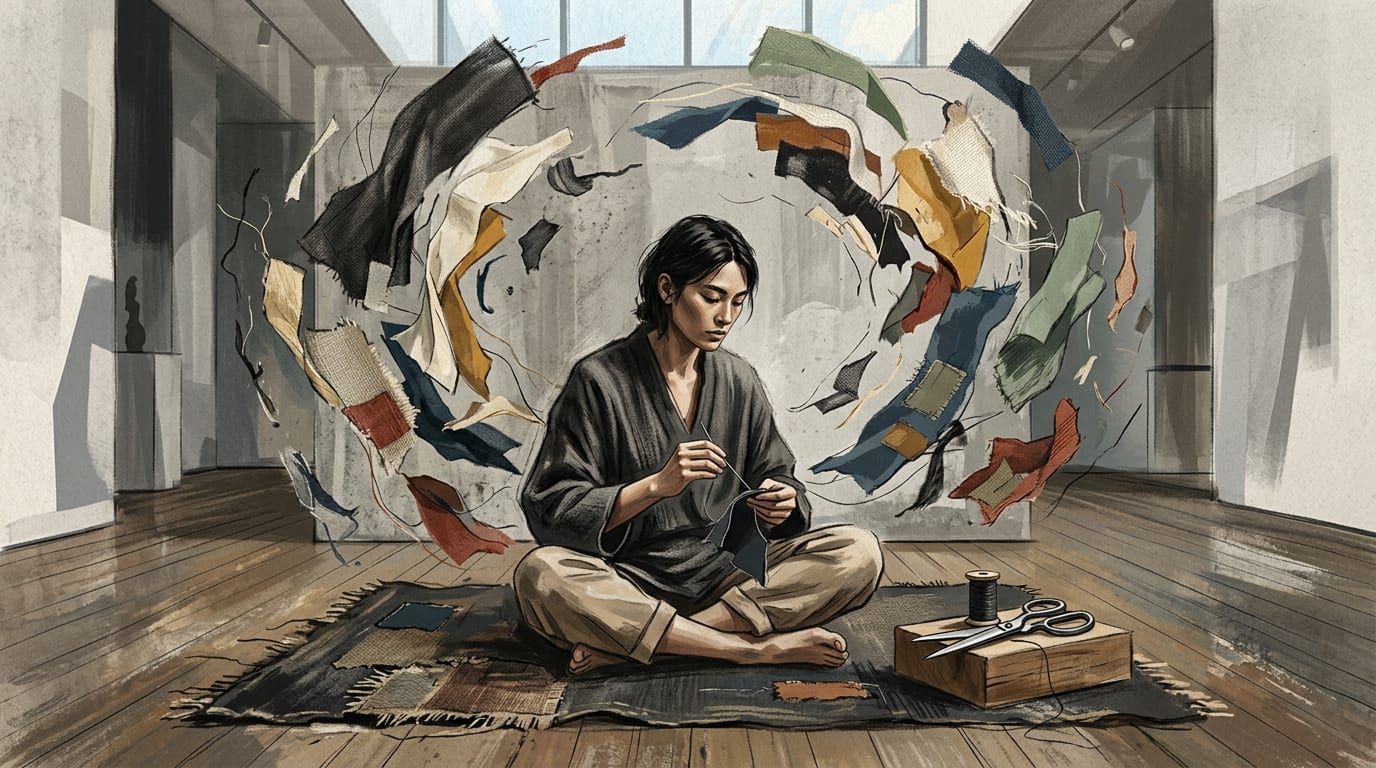
When MPA performed Yoko Ono's Cut Piece at Redcat on 19 July, the downtown Los Angeles venue became a laboratory for examining collective responsibility. The artist sat cross-legged on stage in a sculptural black gown by Aliona Kononova, its asymmetric halter design and United Nude heels creating an imposing silhouette that would gradually be dismantled by willing hands.
Originally staged in 1965, Cut Piece remains a touchstone of feminist performance art, asking audiences to confront their own agency through the simple act of cutting away an artist's clothing. The Broad, currently presenting Ono's travelling retrospective Music of the Mind through 11 October, commissioned MPA to reinterpret this challenging work.
The Anatomy of Care
What unfolded defied expectations of aggression or exploitation. Instead of the hostile energy that had characterised some historical performances—including Ono's own experience at Carnegie Hall where male audience members aggressively sliced at her undergarments—the Los Angeles crowd approached the task with remarkable tenderness. Participants knelt or crouched to meet MPA at eye level, handling the scissors with deliberate care and returning them parallel to the floor rather than pointing toward her body.
This wasn't merely politeness; it was something closer to ritualised protection. One woman even cut a small corner from her own button-down shirt, leaving the white scrap beside MPA as an offering of solidarity. The performance became less about undressing than about the careful negotiation of vulnerability between strangers.
Binary-Breaking Performance
MPA, whose practice centres on collaboration and queer identity, opened the piece with a gesture that captured its central tension. Holding up her right hand in a peace sign, she rotated it to form scissors before returning to the "V"—a visual metaphor for how easily protection can become threat, and vice versa.
The 64-minute duration allowed for extended contemplation of these shifts. Most cuts began at the hem, small and exploratory, building gradually toward more intimate exposure. Even when the strapless bra finally gave way to the scissors, the moment carried less erotic charge than psychological release. The performance's rhythm of tension and relief became almost meditative.
Danger and Dissolution
Yet danger remained present, particularly when a sharply-dressed man approached with percussive footsteps that seemed to signal threat. His efficient cuts, while not invasive, reminded observers that the performance's power lies in its unpredictability. Anything could happen when strangers are invited to alter another person's physical boundaries.
When MPA finally stood, holding up the mat on which she'd sat to reveal Ono's declaration—"My body is the scar of my mind"—the audience witnessed both culmination and transformation. Flipping the sign to display her own text—"My body is made of (g)rapes&vines"—MPA demonstrated how meaning shifts through reinterpretation, how trauma can become growth, how violation might transform into nourishment.
The Politics of Tenderness
The timing added resonance: this audience had chosen performance art over the World Cup final, suggesting a particular commitment to witnessing rather than consuming spectacle. Their collective gentleness felt like a rebuke to more aggressive modes of engagement, both artistic and political.
In an era of relentless media assault and governmental recklessness, MPA's Cut Piece offered something quietly revolutionary: proof that strangers can choose care over harm, that vulnerability need not invite violation, and that art's most enduring power lies in its ability to model alternative ways of being together.
Galleries mentioned
Museums mentioned
Exhibitions mentioned
Related reading

Navigating the Lucas Museum's Narrative Visions
Inside Los Angeles' ambitious yet contradictory institution celebrating illustrated storytelling
Flesh Witness: Militarism, Memory, and the Pacific Archive
REDCAT's latest group exhibition interrogates imperial control across Asia-Pacific through archival intervention and Indigenous knowledge
Why Disney Made the Genie Blue
The long material and colonial history behind the most recognizable blue body in popular culture.