
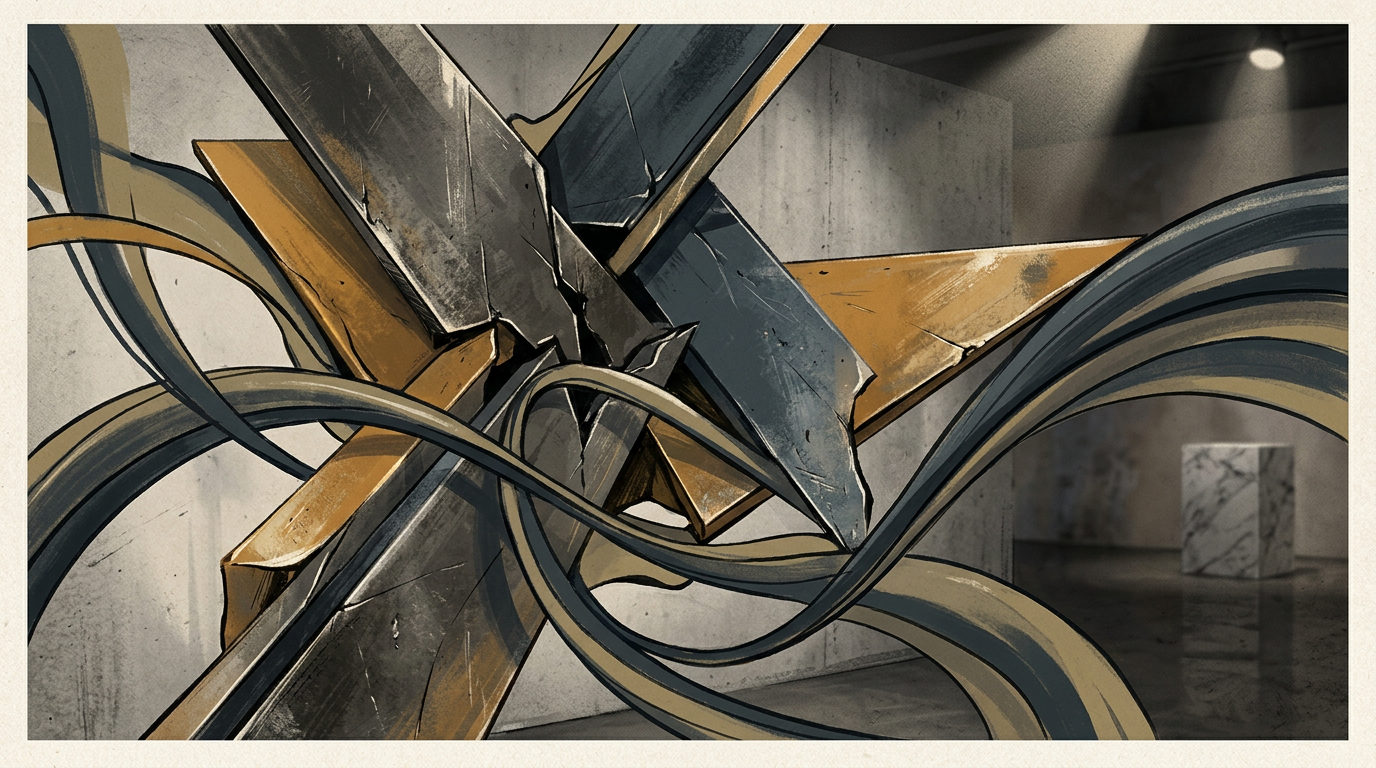
Chicago · United States
Karimah Ashadu: Tendered at Chicago's Renaissance Society
A transnational inquiry into labour, form, and diasporic economies
A Transnational Inquiry into Labour and Form
The Renaissance Society at the University of Chicago, collaborating with Fondazione In Between Art Film, presents Karimah Ashadu: Tendered. Scheduled to run from 12 September through 1 November 2026, this solo presentation constitutes the artist's first major showing in the United States. Ashadu's multidisciplinary practice consistently examines how physical presence becomes measurable within contemporary economic frameworks, frequently drawing upon Nigerian environments and their diasporic extensions. Rather than adopting detached observation, she cultivates sustained relationships with individuals navigating informal markets and resource limitations, revealing how ambition adapts under pressure.
MUSCLE and Material Echoes
The exhibition pivots around MUSCLE, a newly commissioned video installation that documents strength athletes practising within Lagos's densely populated districts. Instead of treating physical conditioning solely as leisure, the work reframes muscular development as a mechanism for daily endurance, personal autonomy, and self-definition. Supporting the cinematic component is Pure Rugged Water (2025), a trio of sculptural pieces directly derived from the film's surrounding architecture. These three-dimensional objects translate urban textures into tangible forms, grounding the narrative in concrete reality while extending the investigation into spatial and material conditions.
Curatorial Context and Ongoing Research
Ashadu's creative methodology emerges from a lifetime of moving between British and Nigerian cultural spaces. This hybrid background shapes her filming technique, which favours empathetic proximity over journalistic detachment. The current display extends earlier investigations such as Plateau (2022), Red Gold (2016), and Machine Boys (2024), which recently appeared at the Art Institute of Chicago. Tendered functions within Unison, a recurring programme established by Fondazione In Between Art Film to foster cross-border partnerships focused on moving-image production. The project initially developed alongside Camden Art Centre in London, reflecting a coordinated European strategy before reaching America.
Publications and Institutional Support
Alongside the gallery presentation, Mousse Publishing issues a definitive scholarly volume tracing Ashadu's career. Edited by Bianca Stoppani, the publication assembles critical perspectives from Myriam Ben Salah, Leonardo Bigazzi, Gina Buenfeld-Murley, Martin Clark, Dr Clive Chijioke Nwonka, Alessandro Rabottini, Bettina Steinbrügge, and Arese Uwuoruya. The installation was curated by Rabottini and Bigazzi, working closely with Myriam Ben Salah and Karsten Lund at the Renaissance Society. Operational funding originates from the Teiger Foundation, the Andy Warhol Foundation for the Visual Arts, Sadie Coles HQ, and the Alexander Tutsek-Stiftung. Born in London in 1985, the artist now splits her residence between Hamburg and Lagos following recognition at the sixty-first Venice Biennale, where she received the Silver Lion.
Related reading

Reimagining Emmett Till: A Photographic Monument in Chicago
A new installation explores the trajectory of a life interrupted by racial violence
São Paulo's MAM Returns With Landmark Art Survey After Renovation
The 39th Panorama of Brazilian Art opens the renovated pavilion, exploring representation through contemporary practice.
Ukrainian Museum Celebrates Half-Century With Community-Led Lobby Project
Molly Gochman transforms archive fragments into a projected collage marking five decades of cultural preservation