Red Monastery (Deir Anba Bishoy)
A late-antique church near Sohag whose sanctuary is painted from floor to dome — one of the great surviving ensembles of early Christian art.
A monastery of red brick
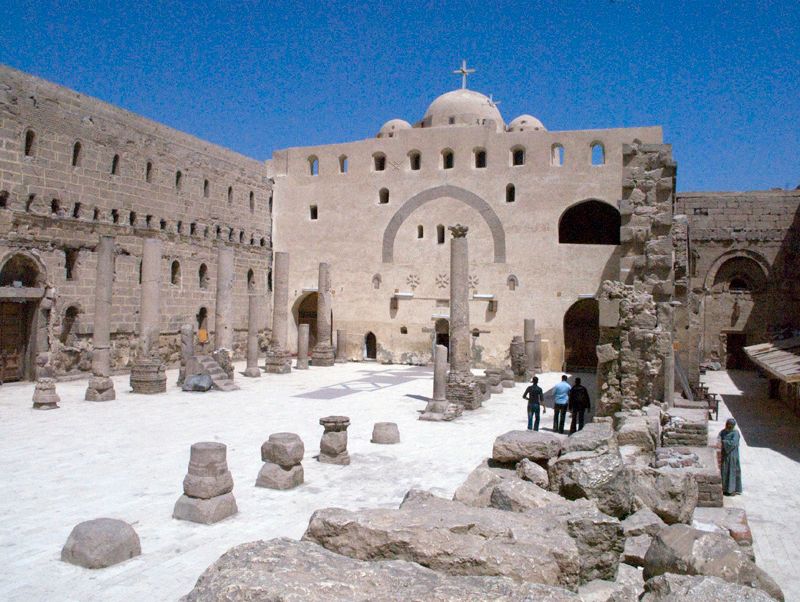
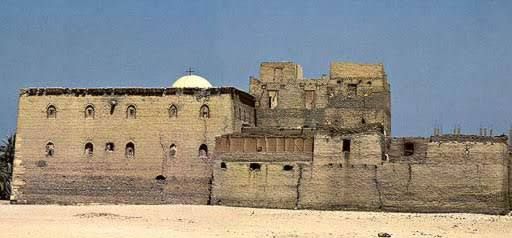
The Red Monastery, Deir Anba Bishoy, stands on the desert edge west of Sohag, a few kilometres from the White Monastery. Its popular name comes from the reddish burnt brick of its walls. Its early history is poorly documented — it may correspond to the monastery of Pshoi known from Coptic sources and was associated with the federation of monasteries led by Shenoute of Atripe — but its church, built in the late fifth century, has been described as the most important surviving early Byzantine church in Egypt.
The painted sanctuary
The church's triconch sanctuary — three apses arranged in a trefoil — is covered from floor to semi-dome with paintings: figures of Christ, the Virgin nursing the Child, prophets, apostles, saints and monastic founders, set among painted architecture — columns, niches, cornices and imitation marble — and dense ornamental patterns. The paintings were made in several Byzantine phases, probably within about a century of each other, between the sixth and seventh centuries, with additional medieval paintings from the tenth to thirteenth centuries. They are among the finest late antique wall paintings to survive anywhere in the Mediterranean world.
Conservation
By the late twentieth century, the paintings were almost invisible beneath layers of soot from lamps and incense. Between 2002 and the 2010s, a conservation project directed by the art historian Elizabeth Bolman, with Italian conservators and funded by the American Research Center in Egypt and USAID, cleaned and conserved them, revealing their original brilliance. The project's findings were published in The Red Monastery Church: Beauty and Asceticism in Upper Egypt (Yale University Press, 2016). The monastery remains an active Coptic monastic community.
Exhibo editorial
The outside gives nothing away: a plain brick block among fields and sand. Then you step into the sanctuary and every surface is alive — painted columns that seem to stand in front of the walls, saints and monks looking down from niches, ribbons of pattern in red, gold and green climbing towards the semi-domes. It is like walking into a jewel box of the sixth century.
Take your time and let your eyes adjust; the closer you look, the more you see — a nursing Virgin, a band of braided ornament, a painted peacock. It is one of the most beautiful rooms in Egypt, and one of the least known. Combine it with the White Monastery, a short drive away.
How to find it
The Red Monastery lies about 7 km west of Sohag on the desert edge, a few kilometres north of the White Monastery; taxis from Sohag know it as Deir al-Ahmar or Deir Anba Bishoy. Enter the monastery compound and ask a monk or caretaker to open the old church; the painted sanctuary is at its eastern end.