
6 May 2026 — 9 May 2027
Light and Stone: Revisiting Noguchi’s 1986 Venice Biennale
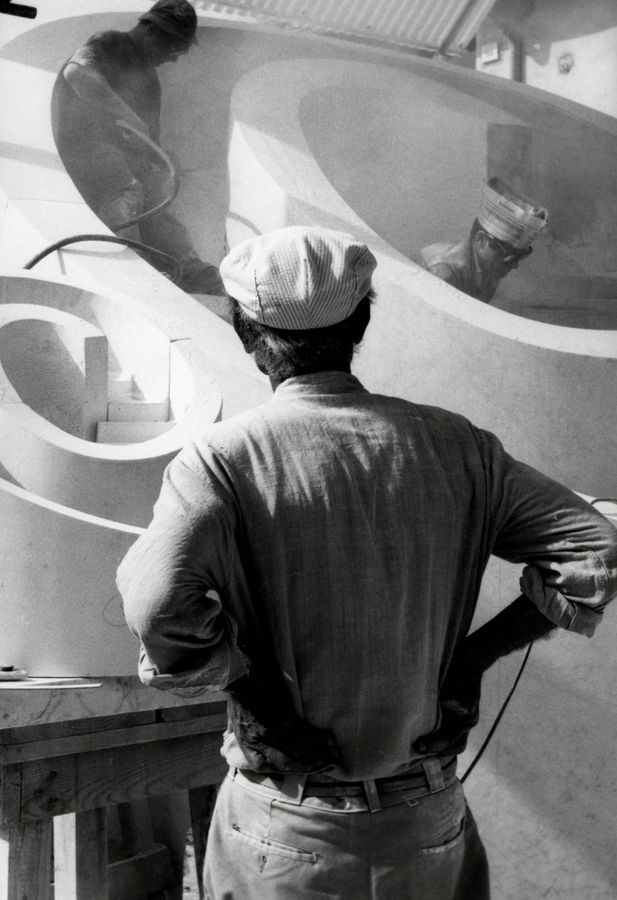
Marking the fortieth anniversary of Isamu Noguchi’s U.S. Pavilion at the 1986 Venice Biennale, “Light and Stone” revisits one of the artist’s most provocative exhibitions through material from The Noguchi Museum’s collection and archive. It is a single-gallery archival presentation in Area 5 on the museum’s first floor. In 1986 Noguchi became the first solo artist to represent the United States at the Venice Biennale, with the exhibition What Is Sculpture?. Selected by commissioner Alanna Heiss, founder and director of MoMA PS1, and curated by Henry Geldzahler, former curator at the Metropolitan Museum of Art, it was Noguchi’s first major European presentation and confounded critics by blurring the distinctions between art, design and environment. At its centre was Slide Mantra, a ten-foot marble spiral slide installed in the pavilion’s courtyard. The monumental sculpture embodied Noguchi’s decades-long commitment to play as an essential human experience, underlined by its display alongside cast-bronze models of unrealised playground proposals dating from the 1930s onwards. Other works included large stone and steel sculptures and prominently featured Akari light sculptures, which Noguchi included despite strong reservations from Geldzahler and other close peers who feared their commercial associations would draw criticism. The exhibition did not win the Golden Lion. Against the prevailing anti-craft and anti-design climate, Noguchi set up a series of dialectics – monumentality and lightness, tradition and technology, abstraction and function. His movement between East and West appeared less as a question of identity than as a sculptural method, and the exhibition embraced a continuum between organic form, architectural logic, material presence and social experience, affirming his expansive idea of sculpture. Forty years later, “Light and Stone” revisits this visionary practice through archival photographs, architectural sketches, a model for Slide Mantra and Akari. A selection of the unrealised playground and earthwork models shown in Venice in 1986 is also on view in Noguchi’s New York in the second-floor galleries. The exhibition coincides with the 2026 Venice Biennale, where The Noguchi Museum is partnering with The Japan Foundation to include selected works in Grass Babies, Moon Babies, a participatory exhibition by Japanese American artist Ei Arakawa-Nash at the Japan Pavilion that uses customised baby dolls, poetry and sound to explore vulnerability, hybridity and care. Arakawa-Nash will also lead a children’s workshop centred on works by Noguchi, including Akari originally designed for the 1986 Biennale. 2026 marks the 75th anniversary of Akari. In 1951 the mayor of Gifu invited Noguchi to help revive the city’s lantern industry, known for its mulberry-bark paper and spiral-wound bamboo. Noguchi designed the first of his lamps made with traditional Gifu techniques, lit by an electric bulb and with radically new sculptural forms, and went on inventing new shapes for three decades – around 200 models in all. He saw Akari as an egalitarian art form, a way “to bring sculpture into a more direct involvement with the common experience of living.” “Light and Stone” is part of a year of exhibitions and programmes celebrating the history of Akari. Curated by Hitomi Iwasaki, Head Curator and Director of Curatorial Affairs.
Tickets
Included with museum admission
Check the museum profile for general admission details.