
Tunis · 11/09/2026
Fatma Charfi: Human being, Being human
A survey of the late Tunisian-Swiss artist across two venues in Sidi Bou Saïd
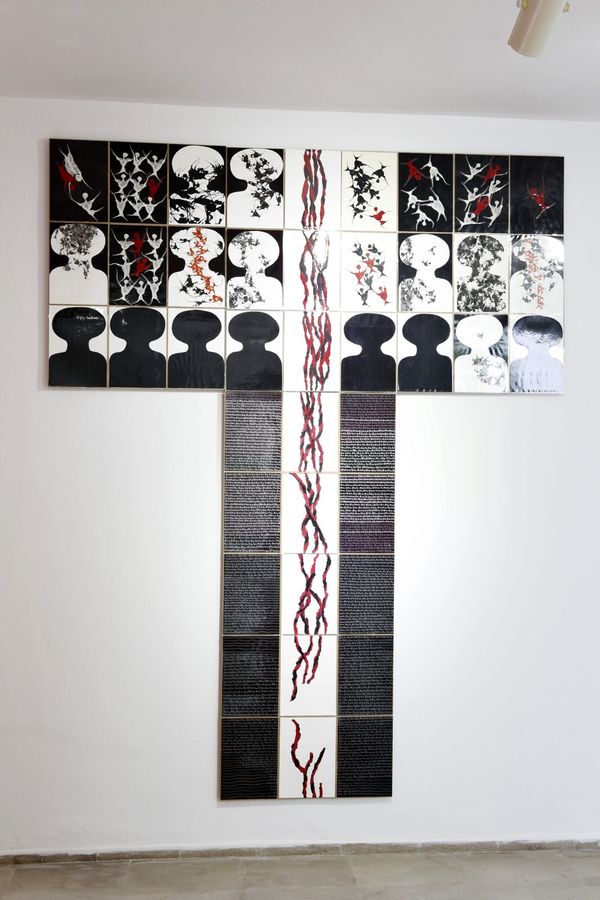
Fatma Charfi once cried in front of television footage of the Gulf War. When she dried her eyes she found her hands had been kneading little figures. She called them Abrouc, a word from Sfax for "the cunning one", and in the plural Aberics. Each is a few centimetres of tissue paper soaked in black ink, then dried, cut and rolled. For the rest of her life they filled her boxes, tubes, veils and tulle curtains, sometimes sheltered and sometimes trapped. Human being, Being human was a survey of nearly three decades of her work, from the installations of the early 1990s to pieces made shortly before her death. It ran in September and October 2026 across two spaces in Sidi Bou Saïd and closed on 25 October. At A. Gorgi the first part gathered installations born from watching the world: power, fragility and the contradictions of society. At Blue Wind Project the second part turned to performance, with Cry of a Child (2002–2009), the work that led to her long project Laboratoire de paix (2002–2014). The curator Beya Othmani came to Charfi while researching African art at the Museum of Modern Art in New York. She noticed that Charfi was missing from its collection, although most artists who had won the same prize at the Dakar biennale were there. The title comes from one of Charfi's own works. It plays on the French être humain: a human being, and being human as a way of living with others. Charfi was born in Sfax in 1955. She studied at the Tunis fine arts institute and at the Sorbonne, then settled in Bern. She died in Vevey in 2018.