
Paris · 19/10/2026
Nick Mauss: In This Time
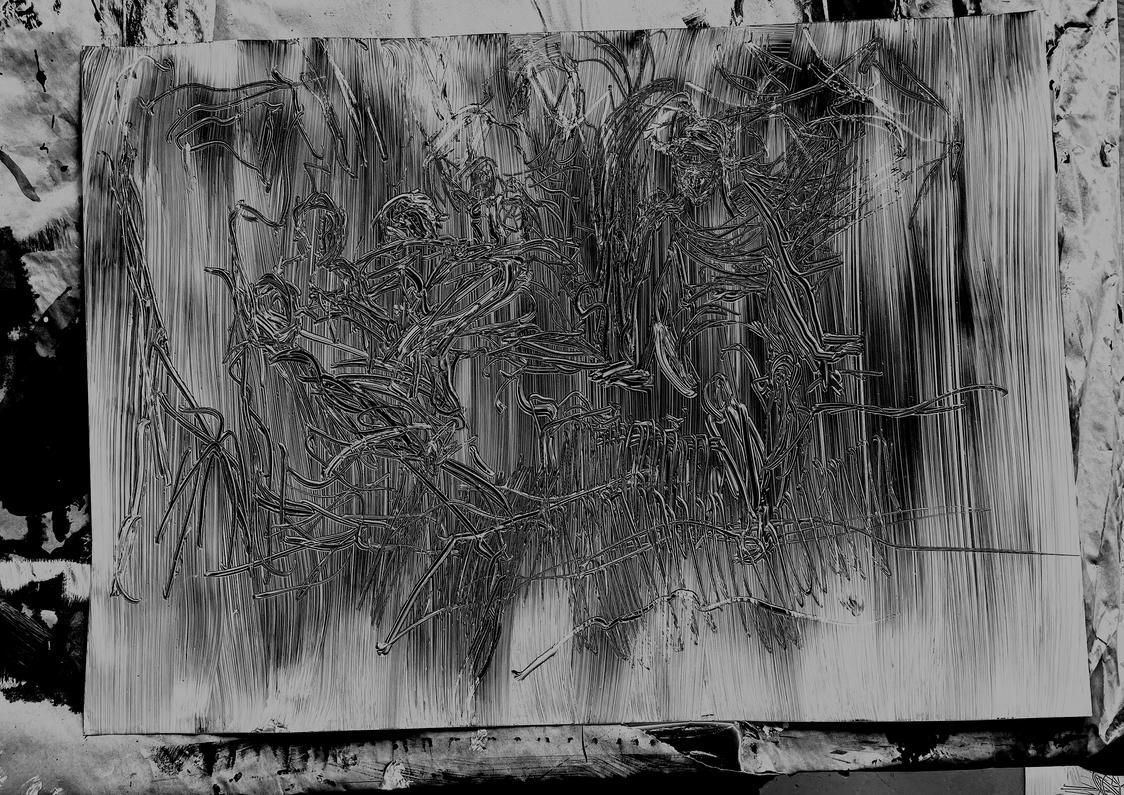
For his second exhibition at the gallery, Nick Mauss presents a new body of work on the second floor of 10 rue Charlot. Over the past two decades Mauss has developed a practice that resists categorisation and refuses any hierarchy between media, connecting painting, gesture, memory and the implications of space with writing, performance and display. Here Mauss concentrates on reverse-painted mirrors scaled to the viewer’s gaze and folded onto closed volumes, which act as devices that reflect oblique slivers of space and social performance. Painted “behind the mirror”, these objects are in dialogue with a series of works in etched, double-dyed silk velvet made through chemical subtraction, in which traces of figures and painted marks are literally “unwoven” into the textile. Among these reverse-painted and “devoured” motifs, Mauss introduces hollow, wall-mounted figurative heads in sheet aluminium. These fragile negative moulds are formed on enlarged replicas of modernist-archaic heads made in the 1920s by Eyre de Lanux – an artist, writer and designer who has featured in several of Mauss’s previous exhibitions and who returns here, in estranged form, to Paris, where she lived and worked alongside Eileen Gray and Evelyn Wyld, among others. In her accompanying essay, “Overlays, cancellations, overflows”, Aurélie Verdier reads the exhibition through Roland Barthes’s 1976–77 Collège de France seminar How to Live Together and his notion of “idiorrhythmy” – small, flexible groups living in proximity while each keeps its own rhythm. For Verdier, every Mauss exhibition is a kind of proscenium, a space of social, aesthetic and political desire, and the same question runs through all of them: how do we live with our communities, whether bodily, spiritual or political? Mauss’s work – painted, drawn, staged, choreographed – constantly brings other works and other artists into play, sustained by the idea of transmission. Drawing is the ground and method from which he builds relationships of intensity, whether on mirror, aluminium, ceramic, velvet or paper. For nearly twenty years his projects have set archives and artworks in motion as testimony to the eccentric sociabilities that form the fabric of modernism, against the grain of hegemonic narratives of a singular modernity. Overlooked historical figures and their networks, collections and archives, architecture and the “needs, uses and feelings” of an interior are constants of his work, and each of his materials – ceramic, glass and mirror, gauze, tulle, velvet – is profoundly relational. “I am always looking for a support that does not already signify, or rest within itself,” the artist says. The unpredictability of dévoré velvet, of a stain or of the solarisation of a reverse painting on glass makes these works labile, experimental objects: nothing is settled in advance, yet everything holds, provided the accident is allowed to happen. The light of these reverse-painted mirrors is not that of Narcissus; it is an act of suspension, pure contingency. Painting on glass is a process of inversion – the mirrored layer is applied only after the underside has been painted, trapping traces incised in depth rather than on the surface – so that each mirror becomes a block of memory that also contains its opposite, forgetting. Strewn with fetishisable fragments, like the Gradiva that Barthes invokes, Mauss’s drawing is profoundly choreographic: both opulent and undone, brought to a point of maximum tension and release. Verdier closes with Barthes’s idea that a form is subverted not by its opposite but by “a set of overlays, cancellations and overflows”, and with Natalie Clifford Barney’s 1930 sketch “Temple à l’Amitié”, a latticework of overlapping names mapping the friendships of her Paris salon. In the same way, drawing insinuates itself everywhere in Mauss’s work as a force of idiorrhythmic interaction – a suggestion of how to live together.