Berlin · 11/09/2026
Kerstin Brätsch: Die Sein: Para Psychics Expanded (Excerpt)
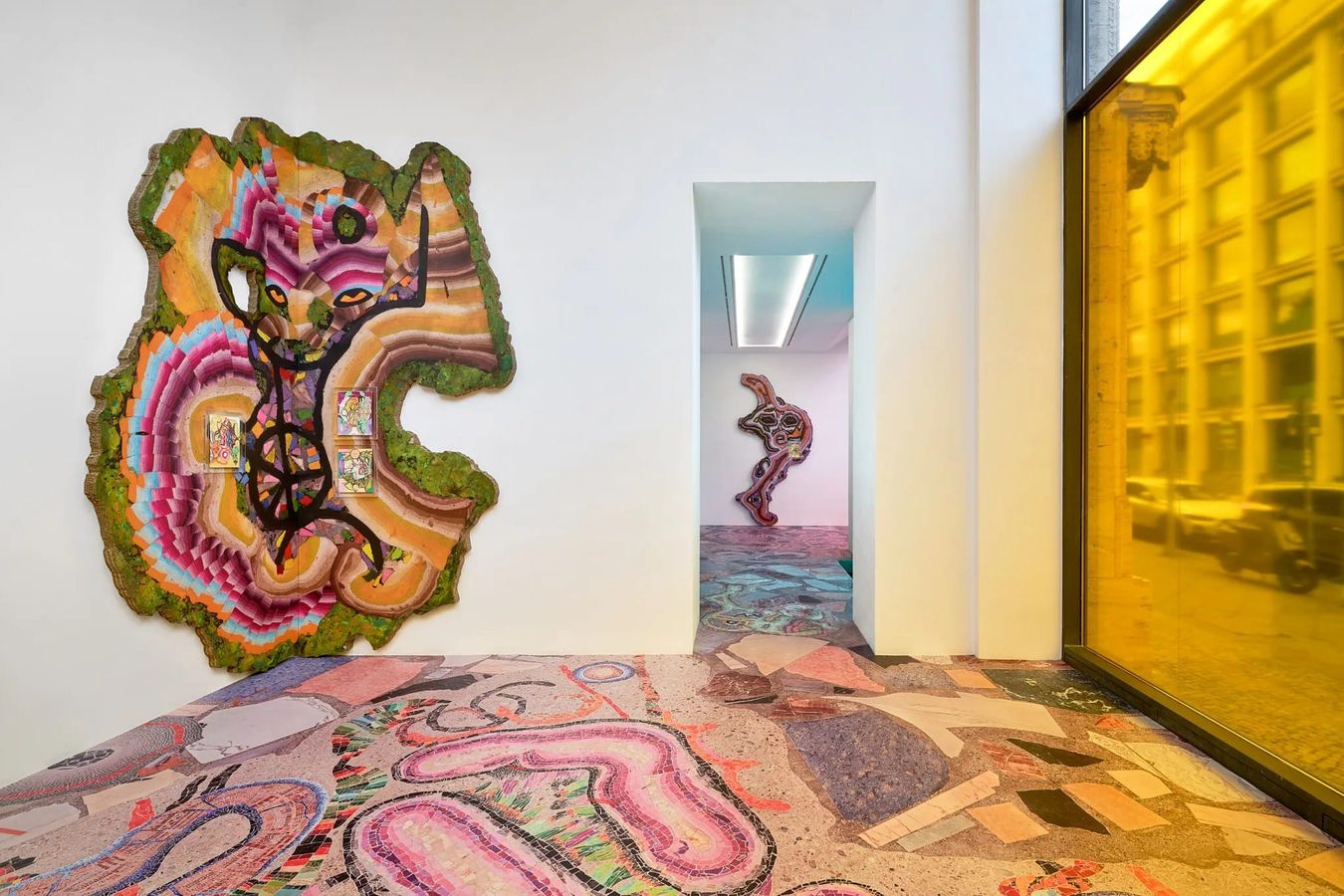
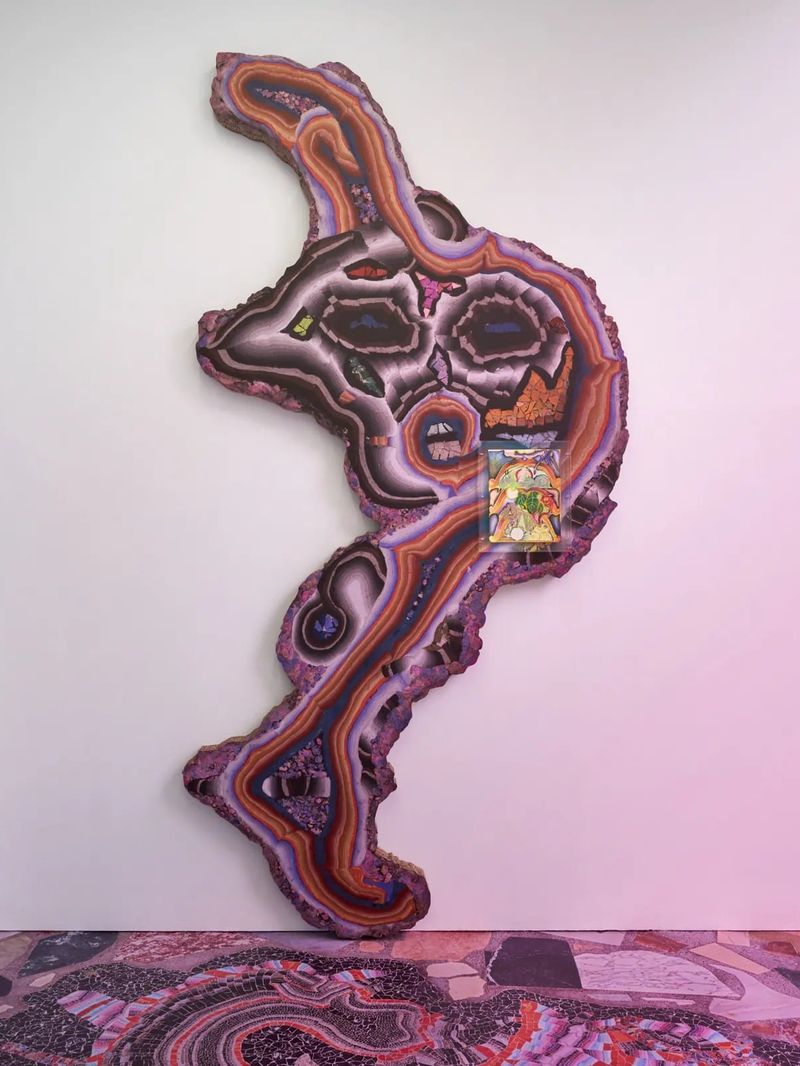
For this year's Berlin Art Week, Galerie Thomas Schulte presents Die Sein: Para Psychics Expanded (Excerpt), Kerstin Brätsch's first solo exhibition with the gallery. The Corner Space and the adjoining window front are transformed by an expansion out of painting – as if out of living matter – into a cosmos, or organism, of its own. The site-specific installation creates an immersive environment: a shared yet ever-fluctuating encounter, rooted in the body and yet reaching beyond material conditions. Brätsch's works not only look as though they are shaped by recursion and constant transformation – very often they are. Installations first conceived for other exhibitions and spaces are adapted or re-staged at different scales and in different materials, resurfacing elsewhere in new constellations. Through further translations, and through the imitation of one medium by another, the works shown here also refer back to, or grow out of, another source – painting – whose traces remain. This is reflected in the properties and materiality not only of the medium itself, which Brätsch repeatedly dismantles and reassembles, but also of its essential components: light and colour. With their ever-changing nature, their differing energies and their inherent element of chance, these are treated almost as primal forces or living entities in their own right. As if through alchemical processes, this often unfolds in the transmutations between painting and stone that run through Brätsch's various bodies of work, for which she draws on ancient and artisanal techniques. Her works in stucco marmo, for instance, imitate stone through the sheer accumulation of sculptural brushstrokes, while her mosaics translate painting into stone, freezing brushstrokes as minute painterly gestures. Energy seems to pass between liquid and solid states of matter, through a medium that is itself in between – like the apparently fluid patterns of a stable marble surface. In both the mosaics and the stucco marmo works, individual brushstrokes made of separate particles seem to coalesce and crystallise, like geological layers of time. In this exhibition, such works are only alluded to: their motifs and stony textures appear almost as traces on surfaces of other kinds, becoming temporary spatial structures and modes of display. The intricate pattern of the vinyl floor, for example, derives from one Brätsch originally made in stone mosaic. It is composed of enlarged forms that have passed through a series of material transfers – based on her stucco marmo works, which in turn follow the logic of her oil paintings on transparent Mylar. A kind of metamorphosis takes place: from painting to imitation stone, to stone itself, and back to a two-dimensional image. Seen from above, its forms recall living cells growing, flowing or mutating under a microscope – or else strange, oversized creatures. Described by Brätsch as a painting that faces the sky, the floor's fluid forms act as a connective element between the works and the visitors who walk across it, between the gallery's two adjacent window spaces and, by extension, between inside and outside. In the Corner Space's tall windows, coloured films further alter the appearance of daylight. The floor responds to light as it changes – with the time of day and the weather, and as it passes from outside to inside and from one space to the next. What appears to be set in stone remains open to change. In dialogue with this dynamic floor, three large-format cardboard panels hover along the walls, tucked into corners or extending beyond their edges. They carry enlarged motifs taken from Brätsch's stucco marmo works, which are usually made on a smaller scale from plaster, pigment and glue, materialising like bodies of paint. Through layers of time and material that harden to transformed effect, this centuries-old technique has long been used to imitate marble and stone as decorative surfaces inside and outside buildings. The cardboard reproductions can be reconfigured and integrated into different spaces, serving as display surfaces for other works – a kind of exhibition architecture. Their organic shapes, bold colours and expressive patterns resemble the formations of agate geodes, smooth yet irregular, with multicoloured striations and unpredictable fault lines. They also begin to morph into faces with distinctive, wide-open eyes that seem to emerge from and dissolve back into abstract pattern like psychedelic pareidolia – both structuring the space and inhabiting it as eerie, otherworldly beings. Against this shifting backdrop hangs a small selection from Brätsch's titular Para Psychics series: small drawings in coloured pencil whose almost mandala-like yet asymmetrical patterns appear as living, ever-changing systems. The complete series is expansive – an accumulation of one hundred drawings, each marked by a slow unfolding through layering and erasure, defined by an intimate sense of space and time. Fields of colour, often bordered by darker, heavier lines like stained glass, suggest a sensitivity to changes in light and opacity. Their kaleidoscopic intersections, never fully geometric, at times recall mirrored Rorschach blots, many-faced entities or tangled vegetation, opening themselves to a multiplicity of experiences and interpretations. This invitation to manifold readings is extended by a loose formal association with tarot cards and other systems of divination, one of many sources Brätsch draws on for the series. Entering the depths of the mental body and tracing its hidden networks and connections, the transformations in these works are characterised by a movement ever inward. In some, prism-like reflections give the sense of looking into crystal; in others, entwined strands like DNA open into portals, or translucent orbs glow from an inner light. Yet the drawings' internal structures and rhythms always unfold simultaneously in reverse, or in several directions at once. There is a continual turning over, slipping away, recombining and resettling, like sediment on a surface – a kind of extrasensory mapping of what lies beyond. As the parenthesis at the end of its title suggests, Die Sein: Para Psychics Expanded (Excerpt) presents a microcosm – a mirror of something larger than, or other than, itself. And yet it is also an accumulation: of internal references and external influences; of non-linear exchanges; of recurrences and the subtle shifts they bring; of one fluid body flowing into many. Here, layers of time, like parallel existences, seem both to stretch open infinitely and to condense into spectral traces, as though fossilised in stone.