
Exhibo Editorial
Mike Bode and Audrey Wozniak: Playing the Legend
Tracing metallurgical myths and diasporic histories through the Zildjian cymbal at Bohusläns Museum
Interrogating Metallurgical Myth
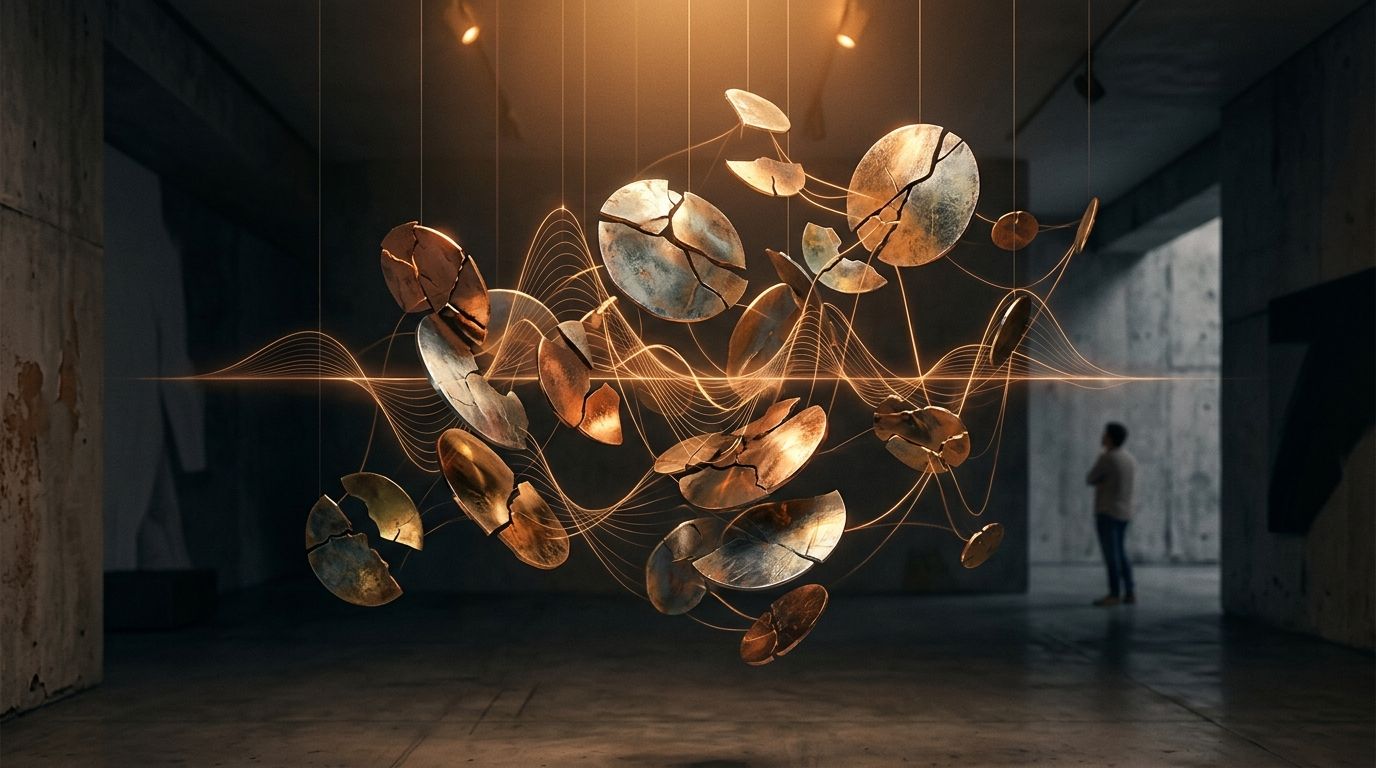
At Bohusläns Museum, running from twenty-nine August until eight November two thousand twenty-six, a new multimedia presentation invites viewers to reconsider the cultural weight carried by a single percussion instrument. Conceived by visual practitioner Mike Bode alongside ethnomusicologist and violinist Audrey Wozniak, the project operates under the direction of curator Jonatan Habib Engqvist. Rather than presenting a straightforward historical survey, the show positions itself as an experimental inquiry into how material artefacts accumulate narrative power across generations. By centring the production techniques and familial lore surrounding a celebrated brand of cymbals, the collaborators construct a layered environment that refuses passive consumption. Instead, visitors encounter a space where sound, archival fragments, and sculptural elements intersect to provoke critical reflection on heritage and craftsmanship.
Circulation and Kinship
The narrative trajectory begins in the early seventeenth century, when Ottoman-Armenian artisan Avedis Zildjian allegedly forged a distinctive metallic blend for imperial patronage around sixteen hundred and twenty-three. According to enduring accounts, the precise composition remained guarded within the family, transmitted orally through fourteen successive generations before eventually establishing a manufacturing hub in Massachusetts. Often celebrated as the longest continuously operated family enterprise in North America, the operation has simultaneously navigated complex geopolitical transformations. Its journey mirrors broader patterns of displacement and adaptation, tracing routes from imperial military ensembles through continental concert halls and ultimately into twentieth-century jazz scenes. Such geographical mobility underscores how artistic tools function as vessels of cultural negotiation, carrying with them shifting definitions of belonging and professional identity.
Fragmented Histories and Resonant Objects
Visually and sonically, the installation deliberately avoids chronological linearity. Engqvist’s curatorial framework embraces disjunction and overlapping references, mirroring the way collective memory actually functions rather than conforming to tidy museum narratives. This methodological choice actively resists smoothing over the tensions inherent in global trade networks, labour practices, and the romanticisation of dynastic skill. Within this arrangement, the metallic disc ceases to operate merely as a historical relic. It becomes an active medium that absorbs and amplifies the ideological projections placed upon it by performers, collectors, and historians alike. By refusing to anchor the object within a singular timeline, the presentation highlights how instruments continually reshape our understanding of temporal boundaries and communal affiliation.
Exhibition as Alternative Sensibility
The underlying inquiry extends beyond the artwork itself, challenging conventional frameworks of display. If material culture both clarifies and complicates our grasp of ancestral legacies, what possibilities emerge when institutional presentation adopts equally fluid structures? The collaborators suggest that curatorial practice might function as a laboratory for exploring complex intersections between craft, commerce, and diaspora. Through deliberate spatial choreography and acoustic layering, the environment encourages audiences to navigate uncertainty rather than seek definitive conclusions. Ultimately, the project proposes that museums and galleries can transcend traditional documentation, offering instead immersive conditions where viewers confront the ongoing construction of cultural value. In doing so, they reveal how everyday objects continue to resonate long after their initial forging.
Related reading
Kiasma Outlines a Robust 2027 Season Featuring Major Surveys and Prize Showcase
Helsinki's Museum of Contemporary Art Kiasma unveils a comprehensive schedule balancing institutional retrospectives, immersive solo projects, and regional award programmes.
The 2027 calendar at Kiasma positions spatial experimentation and critical historiography at the forefront of Nordic contemporary practice.
Ana Vaz: The Camera is the Body at Mudam Luxembourg
Mudam stages the inaugural major institutional survey of the Brazilian filmmaker's interdisciplinary practice
An immersive exhibition reimagines cinematic perception through embodied filmmaking, ecological inquiry, and postcolonial critique.
Lovis Corinth: Then Came Berlin!
How a mid-life relocation ignited a German modernist revolution
An expansive survey at the Berlinische Galerie traces how Lovis Corinth's 1901 move transformed him into a cornerstone of early twentieth-century avant-garde practice.