
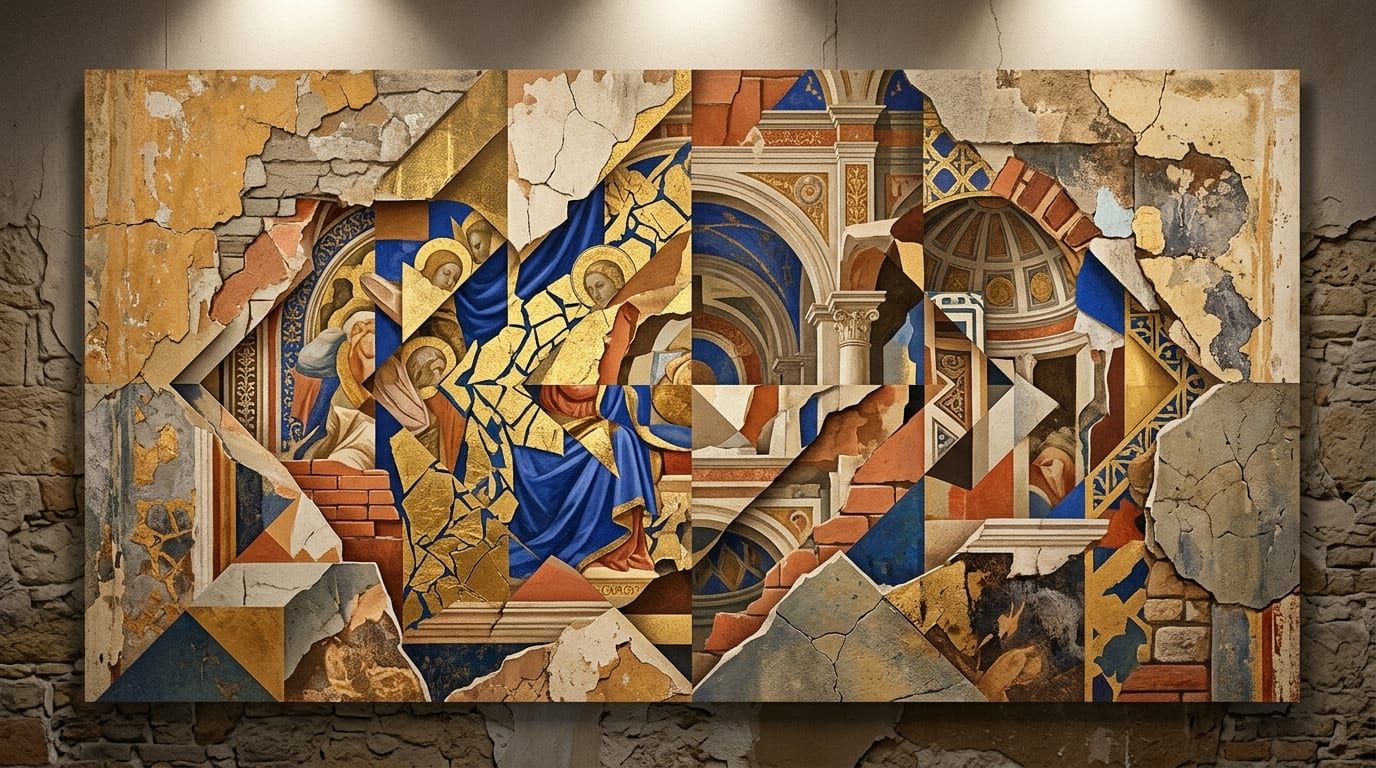
Tuscan · Italy
Fra Angelico's Earliest Altarpiece Returns to Fiesole Following Major Conservation
Conservation reveals hidden architectural designs and clarifies Renaissance interventions
A Sacred Canvas Restored
The Fiesole Altarpiece has finally returned to the Tuscan municipality that inspired its creation. Following an extensive conservation campaign, Fra Angelico's earliest preserved polyptych now occupies its original ecclesiastical setting once more. The meticulous intervention successfully stripped away centuries of discolouration, uncovering the artist's masterful manipulation of pigment and form while clarifying the distinct contributions of later hands.
Commissioned between 1420 and 1423 for the San Domenico convent where the painter took his vows, the panel originally functioned as a late Gothic triptych set against a luminous gold field. Its central composition features the Virgin Mary draped in azure and ochre, cradling the infant Jesus as he tentatively grasps blossoms. Eight celestial figures flank the holy pair, accompanied by four canonised individuals: Barnabas, Thomas Aquinas, Dominic, and Peter Martyr.
More than half a century after the creator's passing, the piece underwent a significant transformation. In 1501, Lorenzo di Credi received instructions to adapt the work for emerging aesthetic preferences. Rather than altering the sacred figures, he flattened the structure into a single canvas, obscuring the gilded backdrop with a finely woven textile motif. Flanking this central element, he introduced arched openings framing a sun-drenched woodland vista. The original lower register and lateral supports were subsequently dispersed, with the predella eventually finding a home in London.
Prior to the recent conservation efforts, the surface suffered from heavily oxidised varnish and accumulated grime. Lead conservator Daniele Rossi oversaw a campaign designed to restore clarity without compromising historical integrity. By carefully eliminating aged coatings and earlier inpainting, the team recovered the original palette's subtlety. Specialised techniques proved essential for certain areas; a mixture of purified beeswax and milk-based solvents gradually lifted stubborn discolouration from the atmospheric sky, exposing its initial cerulean brilliance.
Diagnostic imaging played a crucial role in deciphering the painting's stratigraphy. Infrared reflectography penetrated the upper layers to expose a concealed architectural element beneath Di Credi's lapis lazuli application. This hidden structure appears to be an early conception of a marble-effect throne, echoing the sculptural approach seen in contemporary works by Masaccio. Gothic mouldings, supporting brackets, and ceramic vessels containing floral arrangements originally surrounded this design before being overwritten.
Structural stability presented another priority. The historic poplar backing had deteriorated, causing vertical fractures that compromised the paint layer and even damaged facial features. Working alongside Roberto Buda, Rossi's team substituted unstable historical reinforcements with a contemporary chestwood framework incorporating tension springs. This flexible mechanism accommodates environmental fluctuations, effectively halting further degradation. Surface fissures were stabilised using traditional stucco, followed by precise retouching executed through hatching methods and protective glazes.
The project coincided with a substantial survey dedicated to the Quattrocento master, which traversed Florentine institutions between late 2025 and early 2026. Financial backing emerged primarily from the Friends of Florence organisation, supplemented by private patrons drawn to the artist's enduring legacy. According to society president Simonetta Brandolini, the intervention sharpens our comprehension of a youthful creator still refining his visual vocabulary, while simultaneously distinguishing his brushwork from subsequent modifications.
Today, the panel stands as a testament to both medieval devotion and Renaissance innovation. The careful separation of original genius from later embellishments allows viewers to appreciate the evolution of devotional imagery across two distinct artistic epochs. As climate-controlled environments and advanced preservation strategies ensure its survival, the altarpiece continues to anchor scholarly discourse surrounding early Italian painting.
Related reading
Gustave Fayet: Collector—Artist Designer
A comprehensive survey at the Fondation Louis Vuitton reuniting collected masterpieces with the designer's own studio practice.
The Paris institution expands its patronage series with a dual-focused examination of Gustave Fayet, bringing together hundreds of acquired works and restored creations to chart his impact on early modernism.

Mohammad Alfaraj: The Heart Is a Bird's Nest, the Brain Is a Spider Web
First European institutional solo explores cross-species kinship and domestic ecologies
Mohammad Alfaraj's latest showcase at the Delfina Foundation merges multimedia installations with regional folklore to reimagine shared habitats.

Marlow Moss Steps Out of Mondrian's Shadow in New London Retrospective
The pioneering Constructivist receives her first major UK showcase since the 1970s.
A landmark exhibition at Ward Moretti reclaims the legacy of the overlooked Neoplasticist, whose radical ideas quietly shaped modernism while history credited others.