
Exhibo Editorial
Conserving Time-Based Media
How conservators keep video, film, software and installation playback working as tapes fail and display equipment goes out of production
Time-based media conservation is the specialised care of artworks that unfold over a duration and depend on technology to be seen or heard: video, film, audio, slide projection, software, and installations built around playback equipment. Conservators treat the work as a system. The carrier (a U-matic cassette, a hard drive, a reel of 16mm), the device that reads it, the display that renders it, and the artist's instructions for how those parts occupy a room all belong to the object of care. You can store a painting in a rack. A video installation exists only when someone can still play it.
Museums built this specialism because analogue tape, cathode-ray tubes and operating systems fail on a clock that oil paintings do not. Conservators decide which changes keep the work's identity: migrate a signal to a new file, or emulate old software on new hardware. This article stays on that conservation practice. The history of video art as a movement belongs with a separate survey. For the lab methods that sit beside this specialism, start with the art conservation science series. Climate, light and packing for stable objects belong with preventive conservation (pending).
Duration, Systems and Authenticity
Tate's conservation pages define time-based media as works that depend on technology and have duration as a dimension. The Met's Photograph and Time-Based Media Conservation department names film, video, audio, software, slide projectors and other durational technologies. New York University's Institute of Fine Arts adds performance, light and movement that unfold for a viewer through those same channels. The shared point is duration plus a technical system. A single-channel tape on a monitor counts. So does a room of synchronised projectors, a software piece that scrapes the web, or a slide carousel timed to a soundtrack.
Pip Laurenson, writing in Tate Papers in 2006 while she was Tate's sculpture conservator for electronic media, argued that authenticity for these installations cannot rest on a unique material object in the way a panel painting can. She borrowed from the philosophy of music, in particular Stephen Davies, and treated the work as something specified by a cluster of work-defining properties: the artist's instructions, the intended behaviour of image and sound, the role of particular equipment. A performance of the work is authentic to the degree that those properties hold. Change is then a managed fact. Joanna Phillips, later senior conservator of time-based media at the Guggenheim, put the same idea in operational language: the conservator's task is to determine and monitor the acceptable degree of short-, mid- and long-term change.
That framework separates time-based media conservation from two neighbours. Moving-image archives digitise tape and film as documents. Media conservators do that work too, then add a second question the archive can skip: which parts of the system are the artwork. A Nam June Paik sculpture that uses cathode-ray tubes as physical bodies is not the same object as a single-channel tape the artist allowed to be shown on any decent monitor. Conservators record that distinction before they touch a deck.
The specialism also sits next to preventive conservation (pending) without collapsing into it. Cool, dry storage slows binder hydrolysis on magnetic tape and vinegar syndrome on acetate film. It does not keep a 1998 Flash animation running. Time-based media conservation therefore mixes environmental control with active technical intervention: ingest, documentation, migration, emulation, and the staging of installations so curators and artists can see what a substitution does to the image.
Formats, Carriers and Playback Equipment
Conservators inherit the consumer and broadcast industries' leftovers. Artists used whatever was current in the studio: open-reel video in the 1970s, U-matic and VHS through the 1980s and 1990s, MiniDV and optical discs around 2000, then files on artist laptops and custom computers. Each generation left a different failure mode. The Met's time-based media lab keeps a study collection of analogue tapes, optical media and floppy disks for training and testing. MoMA's 2015 account of its analogue video project named two-inch quadruplex reels, hundreds of U-matic cassettes and thousands of VHS tapes among more than 6,000 tapes attached to a video collection then already past 1,600 works.
Playback equipment is part of the material. Tate notes that artists make precise decisions about media and presentation. A particular projector, speaker or cathode-ray tube may matter because of the quality of image or sound it produces, or because the artist tied that device to the meaning of the work. Phillips's 2010 paper for the American Institute for Conservation's Electronic Media Group showed how that significance can shift. Equipment the artist once treated as interchangeable can become dedicated once the type leaves production. The reverse also happens: an artist can later declare a computer or display replaceable.
| Format or component | Years common in art collections | Main failure | Conservation response |
|---|---|---|---|
| 2-inch quadruplex / ½-inch open-reel video | 1950s-1970s | Decks almost gone; oxide loss | Specialist transfer while a machine and engineer still exist |
| U-matic (¾-inch) | 1970s-1990s | Binder hydrolysis; deck scarcity | Inspect, clean or bake if indicated, then digital ingest |
| Betacam / Betacam SP | 1980s-2000s | Binder problems; parts drought | Broadcast-quality transfer to preservation files |
| VHS / S-VHS | 1970s-2000s | Tracking error; oxide shed | Transfer when the cassette is the best surviving generation |
| MiniDV / Digital Betacam | 1990s-2000s | Tape and codec obsolescence | File extraction or transcode under QC |
| 16mm / 35mm film | Throughout | Colour fade; vinegar syndrome | Cold storage; photochemical or high-resolution scan |
| 35mm slides and carousels | 1960s-1990s | Dye fade; lamp and projector death | Scan masters; stockpile projectors if the artist requires them |
| CRT monitors and televisions | 1960s-2000s | Tube death; manufacture ended | Rebuild, stockpile, or documented substitution |
| Optical discs (CD, DVD, Video CD) | 1990s-2010s | Disc rot; drive scarcity | Disk image and file extraction |
| Software, OS and custom code | 1980s-present | Dependency chain breaks | Disk image, emulation, or source-code migration |
| VR / immersive systems | 2010s-present | Headset and engine churn | Case-by-case research (Tate's Preserving Immersive Media project) |
Bay Area Video Coalition (BAVC), whose preservation department has worked with museums and artists since 1994, ranks ½-inch and 2-inch open-reel video as extreme risk, U-matic and MiniDV as high risk, and VHS and Betacam as lower relative risk among common tapes. IASA and UNESCO still treat the whole magnetic-tape family as a closing window.
Magnetic tape, film and slides
Magnetic tape is a sandwich: a polyester base, a binder, and magnetic pigment. From the mid-1970s, conservators and engineers have met sticky-shed or sticky-tape behaviour: the binder hydrolyses, pigment gums the heads, the tape squeals, and the video signal collapses. IASA's technical literature treats hydrolysis as partly reversible for a transfer window. Technicians expose the tape to low humidity and moderate heat (IASA notes that video is more vulnerable to heat distortion than audio, so operators keep temperatures as low as they still work), then clean and play it once into a digital file. The treatment opens a transfer window. It does not return the cassette to exhibition use.
Film brings a different chemistry. Acetate stock can produce vinegar syndrome: acetic acid off-gassing that accelerates as it starts. Colour dyes fade. Conservators store film cold, inspect it, and decide between photochemical duplication and a scan. Slide-based installations add the projector as a sculptural and optical part of the work. A digital projection of the same images may be a legitimate migration if the artist specified the pictures and the timing. It is a different work if the clack of the carousel and the heat of the lamp belong to the piece.
You do not play unique masters for the public. Tate's time-based media team produces display copies so exhibition wear hits a surrogate. The master stays in storage and in the digital repository. Frame rate, aspect ratio, sound sync and, where the artist cares, the texture of a particular display all have to match.
Digital files, software and display hardware
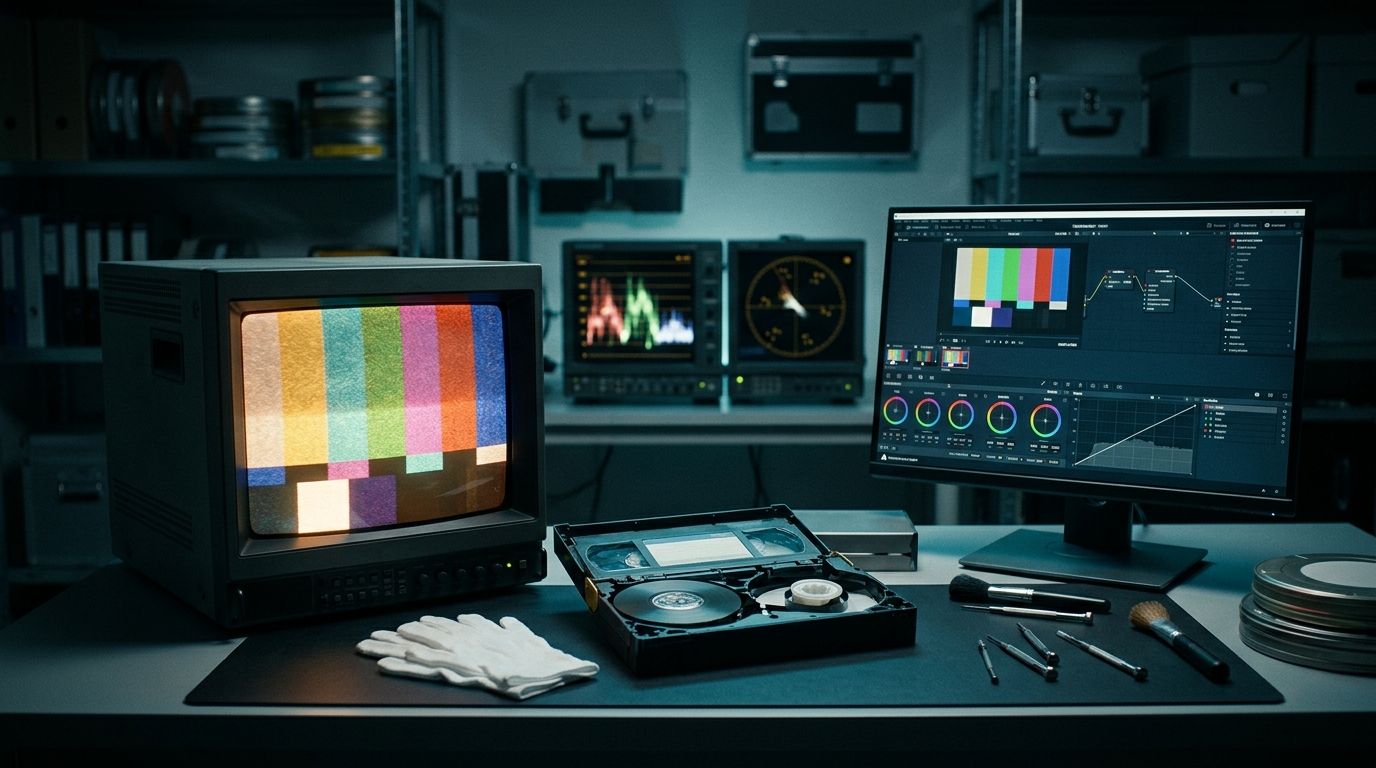
Once the signal lives as a file, the conservation problem shifts from binder chemistry to integrity and dependencies. The Met's lab uses write-blockers so that examination does not alter the artist's disk, a RAID volume for working storage, calibrated monitors for SD, HD, 2K and 4K, a waveform monitor and vectorscope, and a Linux machine running BitCurator for disk imaging. After examination, staff sync the digital components into long-term storage. Checksums detect bit rot. Multiple copies in more than one location cover disk failure and building-level disaster.
Software-based works add an operating system, codecs, plugins, network calls and, in some cases, live data. The Guggenheim's Conserving Computer-based Art initiative, developed with New York University's Courant Institute from 2014 and named as a formal project in 2016, surveyed works that used Flash, virtual reality, internet-connected installations, custom robotics and artist-modified computers. Conservators disk-image the artist's machine, annotate source code with computer scientists, and test whether the work can migrate to a new environment or must run inside an emulator that fools the old code into believing it still has its original hardware.
Display hardware sits at the ugly intersection of sculpture and electronics. Cathode-ray tubes produce a specific glow, scan-line structure and curvature. Manufacturers stopped making them for the consumer market. Christian Saueracker, writing for AIC's Electronic Media Group, described a workshop that rebuilds picture tubes because the industrial chain for new tubes has vanished. Museums that own Paik-scale CRT installations now budget for second-hand chassis, specialist rebuilders, and the day a flat panel has to stand in. That decision belongs in the documentation, not in an unrecorded swap on install day.
Ingest, Documentation and Artist Interviews
Time-based media conservation is a paperwork specialism as much as a bench specialism. The physical treatment (cleaning a tape, imaging a drive, soldering a board) occupies hours. The decisions that make that treatment legitimate occupy the rest of the year: what the artist will allow, which file is the master, which projector is dedicated, how the work should look in a room that is never the same twice. Matters in Media Art, the consortium resource built by the New Art Trust with MoMA, SFMOMA and Tate, exists because those decisions failed when each museum improvised alone. The site publishes workflows and forms for acquisition, loan and digital-video stewardship that registrars, conservators and collectors can reuse.
Glenn Wharton, who put MoMA's media conservation programme on a professional footing, treats artist interviews as a conservation method. Memory is constructed. An oral historian at an INCCA-NA workshop Wharton cites, Richard Cándida Smith, warned that repeated tellings harden into a story that may drift from the studio facts. Conservators therefore try to take the artist back to making: the room, the deck, the reason for a particular monitor. Smithsonian Portrait Gallery conservator Rosemary Fallon puts the same advice in acquisition language: the best time to gather interviews, schematics, old install notes and software identifications is before the museum commits.
Ingest and condition assessment
Ingest is the controlled passage of a work from the artist's or gallery's carrier into the museum's custody in a form the museum can still read. For tape, that means inspection (odour, packing, mould, popped strands, sticky binder), a decision about cleaning or heat treatment, playback on a maintained deck, and capture to a preservation file plus an access copy. BAVC tells collection holders to inventory and describe tapes before a vendor quote: duration drives both cost and storage. Conservators, unlike a high-street transfer shop, also reconstruct generation history. MoMA's 2015 digitisation account describes staff tracing which cassette sits closest to the artist master when a work exists on several formats. Labels lie. Exhibition copies get mistaken for masters. The artist may remember a different tape than the crate contains.
For computers and disks, ingest means write-blocked imaging. A disk image captures the file system, hidden directories, and the environment the software expects. Copying a visible folder misses that environment. The Guggenheim's CCBA papers treat that image as an archival object. Met staff have removed artist hard drives from computers in order to back them up, a physical intervention that looks like electronics repair and functions as conservation.
Condition assessment for an installation cannot stop at the crate. Phillips described the Guggenheim lab's staging area, expanded after the 2009 lab opened, as a place to install the work with alternative playback and display equipment before the exhibition clock starts. Curators, designers, technicians and conservators compare output quality, invite the artist to judge substitutions, and agree the iteration that will go on the floor. That rehearsal is the condition report.
Documentation, iteration reports and artist interviews
A time-based work changes each time staff install it. Room dimensions, throw distances, ambient light and available equipment all shift. Conservators therefore document iterations: which files, which devices, which settings, which compromises, and whether the artist approved them. Those reports become the score for the next performance of the work. Laurenson's 2006 paper is the theory under that habit. The identity of the work is "everything that must be preserved in order to avoid the loss of something of value." The iteration report is where staff write that list in equipment serial numbers.
Artist interviews feed the report but do not replace it. Artists contradict themselves across decades. Phillips's case studies include a young work whose creator later reclassified dedicated technology as variable. Conservators contextualise the statement against exhibition history, surviving equipment, and conservation ethics. For a living artist, decision-making still sits with the studio in a way it does not for a fifteenth-century panel. For an estate, the interview archive and the iteration history have to stand in.
Matters in Media Art's acquisition and loan templates force the conversation into fields a registrar can file: media inventory, equipment specifications, display parameters, insurance values for dedicated devices, and what the borrower may substitute. Private collectors can use the same forms. A gallery invoice that says "video, edition of 3" without a master-file checksum, a codec list and an install protocol is an incomplete object.
Migration, Emulation and Other Strategies
The Variable Media Network, developed at the Guggenheim from a concept Jon Ippolito framed in 1998 and later advanced with the Daniel Langlois Foundation, gave the field a shared vocabulary for those choices. The approach describes works by medium-independent behaviours rather than by a single carrier. The Variable Media Questionnaire asks artists, and later conservators, curators and even viewers, how the work should be recast once the original medium expires. Permanence Through Change: The Variable Media Approach, edited by Alain Depocas, Ippolito and Caitlin Jones, appeared in 2003. The questionnaire's third generation, built by the Forging the Future alliance, treats components, environments and interactions as the units of description.
Four strategies sit in that toolkit. Storage is the museum default: keep the tape, the deck, the bulbs, the artist's computer. Storage buys time and then fails when the last head wears out. Migration upgrades the carrier or the equipment: analogue signal to digital file, CRT to a later display if the artist allows it. The look will change. Emulation imitates the original behaviour by other means: a software emulator that runs old code on a new machine, or a custom-built tube that matches a dead consumer set. The Guggenheim tested that promise in public with Seeing Double: Emulation in Theory and Practice (19 March to 16 May 2004), pairing works with emulated versions. Grahame Weinbren and Roberta Friedman's interactive video The Erl King (1982-85) appeared in its original hardware and in emulation so visitors could judge the difference. Reinterpretation is the most aggressive move: recast the work in a contemporary medium that carries the same function. Variable Media authors call it dangerous without the artist's warrant, and sometimes the only way to keep a networked or performed work alive.
Conservators mix these strategies on one object. A museum may store the artist master, migrate a display copy, emulate the playback software, and refuse to reinterpret the sculptural housing. Phillips's ethics paper on computer-based art, written with Deena Engel and others, insists that those choices still answer conservation codes: document, prefer reversible steps, respect the work's identity. Emulation is a treatment. So is leaving a work unshowable because the dedicated equipment has not yet been solved.
Tate's ongoing Software-based Art Preservation project and its Preserving Immersive Media research extend the same logic into virtual and mixed reality, where headsets and game engines turn over faster than U-matic ever did. The Met's treatment of Jennifer and Kevin McCoy's Every Shot, Every Episode (2001), a custom playback installation with 277 video compact discs, took years of interdepartmental work before the piece returned to exhibition.
The Specialism Takes Shape
Time-based media conservation did not arrive as a university department. Museums acquired video, film and computer works through the 1970s, 1980s and 1990s, then discovered that audiovisual technicians, registrars and paintings conservators were sharing an unowned problem. SFMOMA formed a Media Arts curatorial department in 1987 and had been acquiring such works since the 1970s. Jill Sterrett has described an early "Team Media" of curator, media technician and conservator asking artists the questions that later became forms. Pam and Dick Kramlich, collectors of media art, funded the New Art Trust and pushed those questions into a consortium.
Ippolito's variable-media work at the Guggenheim in 1998, the 2001 Preserving the Immaterial conference, and the 2004 Seeing Double exhibition made the theoretical argument in public. Pip Laurenson was already building a practice at Tate; her 2006 Tate Papers essay remains the most cited statement of authenticity for installations that must be performed. On the American museum side, Jim Coddington, then chief conservator at MoMA, hired Glenn Wharton in 2005 on a part-time grant to survey media in the collection (62 works with digital media, about 500 GB). In 2007 Wharton became MoMA's first titled time-based media conservator. Coddington chose a conservator who would learn the technology. Wharton founded INCCA-NA in 2006. The museum began a concentrated analogue-video digitisation effort in 2011 because exhibition-driven transfers were not going to beat binder failure. The table below records the lab and training dates that followed.
| Year | Event | Who |
|---|---|---|
| 1994 | BAVC Preservation Department established with the Getty | BAVC, San Francisco |
| 1998 | Variable media concept framed | Jon Ippolito, Guggenheim |
| 2001 | Preserving the Immaterial conference | Guggenheim |
| 2003 | Permanence Through Change published; New Art Trust convenes partner museums | Guggenheim, Langlois Foundation, NAT |
| 2004 | Seeing Double: Emulation in Theory and Practice | Guggenheim (19 March to 16 May) |
| 2005-2008 | Matters in Media Art public phases on loans and acquisitions (dating differs by institution; see below) | Tate, MoMA, SFMOMA, NAT |
| 2006 | "Authenticity, Change and Loss" in Tate Papers; INCCA-NA founded | Pip Laurenson; Glenn Wharton |
| 2005 / 2007 | Wharton hired part-time (2005); first MoMA TBM conservator title (2007) | MoMA |
| 2009 | First Guggenheim time-based media lab | Joanna Phillips |
| 2011 | Large-scale analogue video digitisation | MoMA |
| 2014 / 2016 | NYU computer-science collaboration; Conserving Computer-based Art named | Guggenheim, NYU Courant |
| 2016-2018 | Collection-wide TBM assessment | Met (Wharton and colleagues) |
| 2016-2021 | Media Conservation Initiative | MoMA, Mellon Foundation |
| 2018 | First US TBM conservation specialisation | NYU Institute of Fine Arts |
| 2019 / 2024 | First Met TBM associate conservator; post made permanent | Jonathan Farbowitz |
Tate dates the Matters in Media Art public launch to 2005, with acquisitions and loans phases online in 2005 and 2008. MoMA's project page dates the consortium to 2003, a loans phase to 2004 and an acquisitions phase to 2007. SFMOMA's Jill Sterrett places the Kramlich-sponsored start in 2003 with a two-day meeting at Tate. The three accounts describe the same collaboration on slightly different calendars. Treat 2003 as the consortium's formation and 2005 as the first widely cited public resource date, and cite MoMA if you need the 2004/2007 phase split.
Labs and Consortia That Set Practice
A handful of museum labs and one consortium still write the playbook smaller institutions copy. Their collection sizes and founding dates differ. The methods rhyme: dedicated staff, a room that can play and stage works, a relationship with audiovisual and IT departments, and a habit of publishing templates. You can browse those museums as institutions in Exhibo's museums directory. The conservation argument below is about what their labs do.
Mellon money has shaped the last decade: MoMA's Media Conservation Initiative, NYU's curriculum, BAVC's Preservation Access Program renewal in 2017. Practice still concentrates in New York, London and San Francisco, then travels. National Gallery of Australia conservation pages describe the same short-, medium- and long-term change problem. Smithsonian units, including the National Portrait Gallery, run digital-arts teams on acquisition and storage even without a standalone TBM department.
Tate, MoMA and Matters in Media Art
Tate's time-based media collection runs from the 1960s to the present and, the department says, focuses on artists' installations rather than single-channel works. Staff assess risk, write a preservation strategy per artwork, make display copies, and work with the artist at acquisition and install. Discontinued projectors and tape formats, installations that fail as a whole when one part fails, and rooms that never match the last install remain the daily problems. Research strands now include software-based art, immersive media, and the documentation of performance.
MoMA's media conservators in the David Booth Conservation Department care for more than 4,000 time-based works across several curatorial departments. The 2007 post, the 2011 tape project, and the 2016-2021 Mellon initiative turned an ad hoc practice into a lab that publishes. Peter Oleksik's 2015 Inside/Out essay on digitising the video collection remains the clearest public account of sticky-shed risk inside a major holding.
Matters in Media Art is the shared operating system. New Art Trust (Pam and Dick Kramlich) convened MoMA, SFMOMA and Tate so that three museums would agree procedures, then publish them for artists, dealers and collectors. Phase three, Sustaining Digital Video Art, aimed at collections of all sizes. The website's code and content sit on GitHub under MIT and Creative Commons licences. Pip Laurenson, Jill Sterrett and Glenn Wharton led the project for their institutions. If you collect video and lack a conservator, those forms are the cheapest serious advice in the field.
Guggenheim, the Met and training programmes
The Guggenheim's contribution is conceptual and technical at once: Variable Media, Seeing Double, the 2009 lab, and Conserving Computer-based Art with NYU. Phillips's papers on equipment significance and on lab design (staging as a decision space) are how many other museums now justify a dedicated room rather than a cart of decks. The CCBA collaboration with Deena Engel's computer-science students showed that source-code annotation can be a conservation examination, the way infrared reflectography is an examination of a painting.
The Met published its catch-up in public. Time-based works entered from 1999. A cross-departmental working group carried the load until the 2016-2018 survey. Farbowitz's hire in 2019, a lab inside Imaging from 2021, a larger lab in 2024, and a permanent post in 2024 are the institutional facts. The department has released sample documentation templates for artists, organisations and collectors. Recent treatments on the departmental page include works by Nam June Paik, Ho Tzu Nyen, Jim Campbell, Pipilotti Rist, Amar Kanwar and William Kentridge (The Refusal of Time, 2012). Those names are collection facts here.
NYU's four-year MA/MS specialisation embeds TBM inside a full conservation degree: materials science, ethics, electronics ("Art With A Plug"), programming, audiovisual conservation, and capstone placements at the Met, Guggenheim, MoMA and Whitney. The Whitney's Media Preservation Initiative is one of the New York resources those students use. The US bottleneck was the absence of a graduate track until 2018.
Obsolescence: How These Works Fail
Obsolescence is the characteristic failure of time-based media. Paintings darken. These works become unplayable. IASA and UNESCO's Magnetic Tape Alert Project told archives that spare parts, service and operable replay equipment for magnetic audio and video were fading so fast that routine transfer would end around 2025. IASA-TC 03, in its 2016 framing, gave the community ten to fifteen years to digitally preserve carrier-based audiovisual content, and warned that by around 2030 even common magnetic formats may sit beyond most archives. Some formats (MII video is the example IASA names) were already practically unreadable. For many holdings, the IASA authors argue, obsolescence of the machine arrives before chemical death of the tape.
That deadline is a planning figure. Museums that stockpiled decks, manuals and engineers can still transfer. Museums that did not now pay specialist vendors, if a vendor still accepts the format. BAVC maintains endangered analogue equipment for museum-quality transfers; its client list has included SFMOMA, the Walker, Berkeley Art Museum and Pacific Film Archive, and Smithsonian film archives. One university library working group, reported in IASA Journal 43, estimated about $9.3 million to digitise and store a selected corpus by 2028, on the order of $148 per selected item in that model. Those numbers are a library case. They still show why delay has a loss rate.
Cathode-ray tubes follow a harsher curve because the image is the object. Korea's National Museum of Modern and Contemporary Art shut Nam June Paik's The More, The Better (1988), a tower of 1,003 CRT monitors, in 2018 when primary components failed. After consulting specialists, the museum announced a three-year restoration with a budget of 3 billion to 3.7 billion won (about $2.5 to $2.7 million at the rates journalists used in 2019-2022). Technicians repaired 737 CRTs with second-hand panels and replaced 266 upper-section monitors with LCD screens behind the original look. The museum expected ten to fifteen more years, then another round. The New York Times in 2023 profiled CTL Electronics in New York, a shop Paik himself used, as one of the last places that can rebuild his sets from spare parts.
Software fails in silence. A work can sit on a shelf, files intact, and refuse to run because a licensing server died, a browser engine moved, or a GPU driver changed. Flash's end of life stranded a generation of web works. Emulation and code migration are the treatments. They require computer scientists on the conservation team, which is why the Guggenheim went to NYU Courant.
The failure you cannot see in a crate is knowledge loss. Aligning a U-matic deck, rebuilding a picture tube, and reading an artist's Max patch are skills held by few people, many of them near retirement. Conservators now treat that expertise as a collection asset: hire it, film it, write it into the iteration report.
Costs Today
Costs split into four ledgers: transfer, storage, equipment, and people. Consumer VHS-to-file services advertise about $12 to $35 per cassette. That price buys a viewing file. Archival transfer includes inspection, possible binder treatment, calibrated capture, preservation and access files, checksums and metadata. Professional U-matic and Betacam work sits far above home-movie pricing; high-street shops that still advertise those formats quote around $75 per tape for a basic transfer, still without conservation QC. BAVC and similar non-profits price by project, tape condition and whether the client qualifies for subsidised programmes. Ask for a sample file and a statement of preservation format before you compare unit prices.
Storage is the bill that never ends. Preservation files are large (BAVC's 2019 figure of about 130 GB per hour is a planning hint). You need at least two copies, geographic separation, integrity checks, and a migration plan for the storage system itself. Cloud quotes in that 2019 guide ran from a few dollars to nearly $200 per terabyte per year. On-premise RAID or tape libraries trade licence fees for staff time. Matters in Media Art's digital-video phase exists because collectors who paid for a transfer then left a single drive on a shelf had bought delay.
Equipment and spare parts are a capital problem. A dedicated CRT, a working U-matic deck, or a stock of artist-specified projectors can exceed the purchase price of the edition. Paik's Seoul tower is the upper bound: millions of dollars, years of work, a hybrid of repaired tubes and new panels. A single-channel video with variable display equipment costs a fraction of that, provided the files are already ingested. Software emulation can look cheap until you count the computer-science time to make it faithful.
People dominate institutional budgets. A TBM conservator post, a media technician, and access to an AV crew for install are the real line items. Mellon, Keighley, and similar foundations have paid to create those posts (the Met's first four and a half years of TBM conservation were gift-funded before the museum made the job permanent). Private collectors who cannot hire a conservator still pay for an artist interview or questionnaire, a condition and media inventory, a vendor transfer of unique analogue masters, checksummed storage, and an install protocol. Matters in Media Art's templates keep that package from being invented twice.
FAQ
Searchers mix three questions: what the category includes, how conservation of these works differs from paintings conservation, and whether a private collection can follow museum method without a lab. The answers below stay inside that conservation brief. Career training for conservators belongs with the art-careers guides. Video art as a movement belongs with its own history. Accessibility guidelines use "time-based media" for captions on websites; that is a different vocabulary. Costs, formats and lab names in the answers match the sections above. If a cassette in your crate is unique, the magnetic-tape window is the urgent one.
What counts as time-based media?
Museums use the term for artworks that have duration as a dimension and depend on technology to be experienced: video, film, audio, slide projection, software, and installations that combine those elements with specific playback and display equipment. NYU's conservation programme also includes performance, light and movement delivered through those systems. The phrase appears in web-accessibility guidelines (WCAG) with a different meaning: captions and audio description for video on websites. This article uses the museum conservation sense.
What is an example of a time-based artwork in conservation terms?
Jennifer and Kevin McCoy's Every Shot, Every Episode (2001) at the Met is a custom digital-video playback installation with 277 video compact discs. Conservators had to treat every disc and the playback system before the work could return to exhibition after more than a decade. Nam June Paik's The More, The Better (1988) in Gwacheon is a tower of 1,003 CRT monitors whose repair has become a public case of display obsolescence.
How does time-based media conservation differ from restoring a painting?
A paintings conservator stabilises a physical surface and documents material change. A time-based media conservator also does that for tapes, disks and devices, then keeps a behaviour available: the work as it unfolds in time in a specified setup. Laurenson's 2006 framework measures authenticity against work-defining properties rather than against an untouched original object. Migration and emulation are legitimate treatments when they protect those properties. Overpaint on a canvas is a different ethical argument.
Do conservators always migrate old video to new files?
They migrate unique analogue masters while playback is still possible, because the alternative is a silent cassette. They do not automatically replace dedicated display equipment. Tate's guidance is that the stronger the link between meaning and a particular technology, the greater the loss if that technology goes. Display copies protect masters. The artist interview and the iteration history decide whether a new projector is a conservation treatment or a different work.
What is the difference between migration and emulation?
Migration moves the work onto a newer carrier or device: tape to file, old laptop to new computer, in some cases CRT to another display. Emulation keeps the original code or signal behaviour and imitates the old environment, so the work believes it is still running on period hardware. Variable Media adds storage (keep the original parts) and reinterpretation (recast the work). Conservators store the master, migrate an access copy, and emulate the software that plays it.
Can a private collector do this without a museum lab?
You can complete a serious minimum: inventory carriers, interview the artist or fill a Variable Media / Matters in Media Art questionnaire, send unique analogue masters to a preservation vendor (not a high-street DVD shop), store checksummed preservation files in two locations, and keep dedicated equipment with the work. You cannot safely bake sticky tape or align a U-matic deck from a blog post. BAVC's Preservation Access Program exists to subsidise museum-quality transfers for artists and smaller organisations. Hire a media conservator for install decisions on sculptural playback.
Is magnetic tape already unplayable?
Some formats are. IASA treated routine transfer of magnetic tape as likely to end around 2025 and warned that by around 2030 even common formats may exceed most archives' reach. Museums and vendors that maintained decks still transfer U-matic, Betacam and VHS in 2026, at rising cost. Waiting for prices to fall is the wrong model: the machines leave the market. If you hold unique artist masters on tape, treat ingest as overdue.
Related reading
Diego Rivera's Monumental Stadium Relief Set for Conservation in Mexico City
A multi-institutional campaign targets the artist's unfinished stone facade at UNAM alongside works by Siqueiros and O'Gorman
Local conservators will lead a phased preservation effort for Diego Rivera's volcanic stone relief at Mexico City's Olympic stadium, supported by the World Monuments Fund and US diplomatic grants.
Van Lévé: Sovereign Caribbean Visions Take Shape at Harvard
A transnational survey charts twenty-five years of Creole and Maroon artistic practice across the French Caribbean and Amazonia.
Harvard's Alain Locke Gallery presents a landmark survey tracing contemporary production from Guadeloupe, Martinique, Guyane, and Haiti since two thousand and one.
Gustave Fayet: Collector—Artist Designer
A comprehensive survey at the Fondation Louis Vuitton reuniting collected masterpieces with the designer's own studio practice.
The Paris institution expands its patronage series with a dual-focused examination of Gustave Fayet, bringing together hundreds of acquired works and restored creations to chart his impact on early modernism.