
Seoul · South Korea
Jae-Eun Choi: Where Beings Be
An exploration of ecological solidarity and pre-civilisational coexistence through sculpture, archive, and environmental intervention
Ecological Resonance in Seoul
The Seoul Museum of Art prepares to host a comprehensive survey of Jae-Eun Choi's career, running from 23 December 2025 through 5 April 2026. Born in 1953, the artist has spent decades probing the intersections of human activity and natural systems. Her creative output traverses sculptural forms, moving images, spatial installations, and architectural interventions to map how life persists across shifting temporal and spatial frameworks. Rather than treating the environment as a passive backdrop, Choi positions it as an active participant in every composition.
A decisive turning point arrived when Choi relocated to Japan in 1975. There, she engaged deeply with the avant-garde wing of Sogetsu ikebana under the guidance of Sofu and Hiroshi Teshigahara. Witnessing how traditional floral arrangement evolved into land-based experimentation fundamentally altered her trajectory. This period cemented her commitment to site-responsive creation, paving the way for subsequent milestones such as representing Japan at the 1995 Venice Biennale, appearing at the São Paulo Biennial in 1991, and contributing to the 2016 Venice Architecture Biennale. Earlier collaborations, including a teahouse project alongside Charlotte Perriand and Ettore Sottsass at UNESCO's Garden of Peace in Paris, further established her global footprint.
Within South Korea, Choi's commissions have consistently addressed place and collective memory. Notable interventions include Synchronous at Kyungdong Presbyterian Church, the sarira stupa Seon Space at Haeinsa Temple, and Direction of Time at Samsung Medical Center. More recently, her long-running ecological engagements have focused on the demilitarised zone. Initiatives such as Dreaming of Earth and its successor Nature Rules examine how abandoned conflict zones inadvertently become sanctuaries for biodiversity. These projects challenge conventional narratives of territorial control by highlighting how vegetation flourishes precisely because human presence has receded.
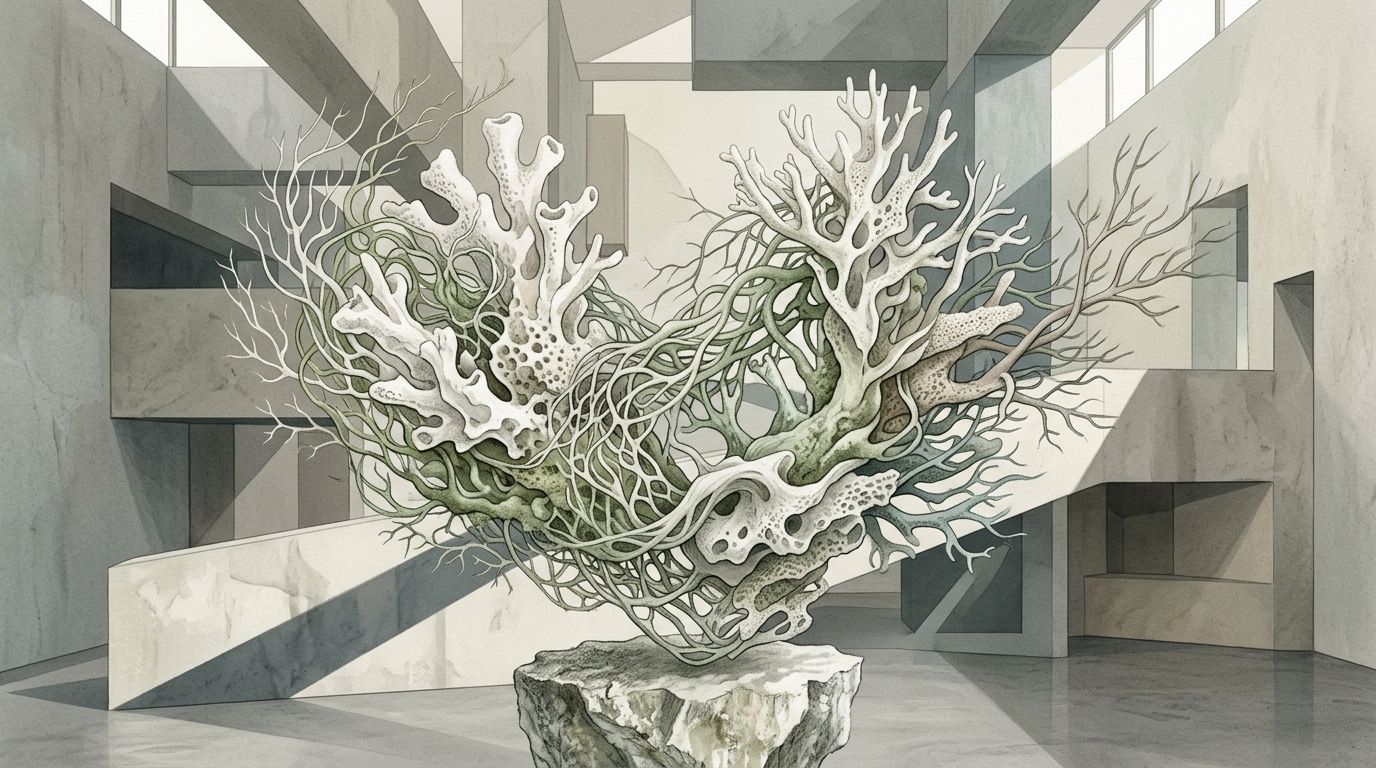
The upcoming presentation, titled Where Beings Be, centres on what Choi describes as a pact of co-living. Drawing upon linguistic roots that merge concepts of binding and promising, the framework suggests a pre-civilisational state where organisms exist in continuous mutual dependence. Organised into five distinct chapters—Lucy, Tolling Bell, Microcosmos, Names of the Unseen, and Nature Rules—the show also incorporates a substantial historical archive. Together, these components trace the development of her philosophical outlook while confronting contemporary viewers with the consequences of environmental degradation. Materials ranging from bleached coral specimens to documentation of vanishing flora underscore the fragility of ecosystems, particularly those thriving within the DMZ's restricted borders. An accompanying Seedbomb Workshop, funded through external partnerships, extends this botanical engagement beyond the gallery walls.
Curated by Seungah Helen Lee, the exhibition operates as both retrospective and urgent inquiry. By highlighting how nature reclaims territories once scarred by warfare, Choi invites audiences to reconsider humanity's role within broader ecological networks. The display runs until 5 April 2026 at the Seoul Museum of Art, with additional curatorial initiatives supported by institutions including the Korea National Arboretum and various cultural sponsors. A dedicated publication accompanies the run, offering critical essays and visual records that complement the physical experience.
Museums mentioned
Related reading
Koo Jeong A: OUSSSMOS Redefines Institutional Space Through Ephemeral Phenomena
Ephemeral forces and spatial fluidity converge in a landmark survey at Seoul's premier contemporary art institution
The Leeum Museum of Art hosts the artist's largest Korean solo show, dispersing installations across unconventional zones to challenge linear viewing habits.
Five Essential Exhibitions During Seoul Art Week
From Martin Parr's photographic archives to Do Ho Suh's textile architectures, a guide to the capital's defining cultural moments.
A curated overview of the key gallery presentations, museum surveys, and cinematic programmes defining this year's Seoul Art Week.
Christine Sun Kim: Have Many Dumb Fights Against Rock
Reframing digital discourse through immersive OLED installations at MMCA Seoul
The Korean American artist explores communication barriers and digital polarisation in a new site-specific commission for the national museum.