
Busan · South Korea
Body, Under Experiment: Three Laboratories of Becoming at Busan MoCA
Geumhyung Jeong, Hoonida Kim and Kwon Byungjun explore the unresolved tension between performance and exhibition across a three-month unfolding
A Temporal Architecture of Uncertainty
What happens when an exhibition refuses to announce itself fully at the outset? At Busan Museum of Contemporary Art, a new project unfolds across three months, with each laboratory activating only when the previous one has already begun to gather traces of its own becoming.
The Problem of Presence
Performance art has long struggled with its own documentation. The assumption that capturing live work somehow betrays its essence has created an enduring friction between what happens in the moment and what remains afterwards. Rather than resolving this tension, Body, Under Experiment makes it foundational. Each space functions simultaneously as archive and event, holding the imprint of what came before while gesturing toward what is yet to arrive.
The exhibition's structure mirrors the very problem it examines: how to exhibit that which exists only in the present. By opening sequentially, the show embeds incompleteness as its governing principle. Nothing is ever quite finished; everything remains in process.
Geumhyung Jeong's Archive of Becoming
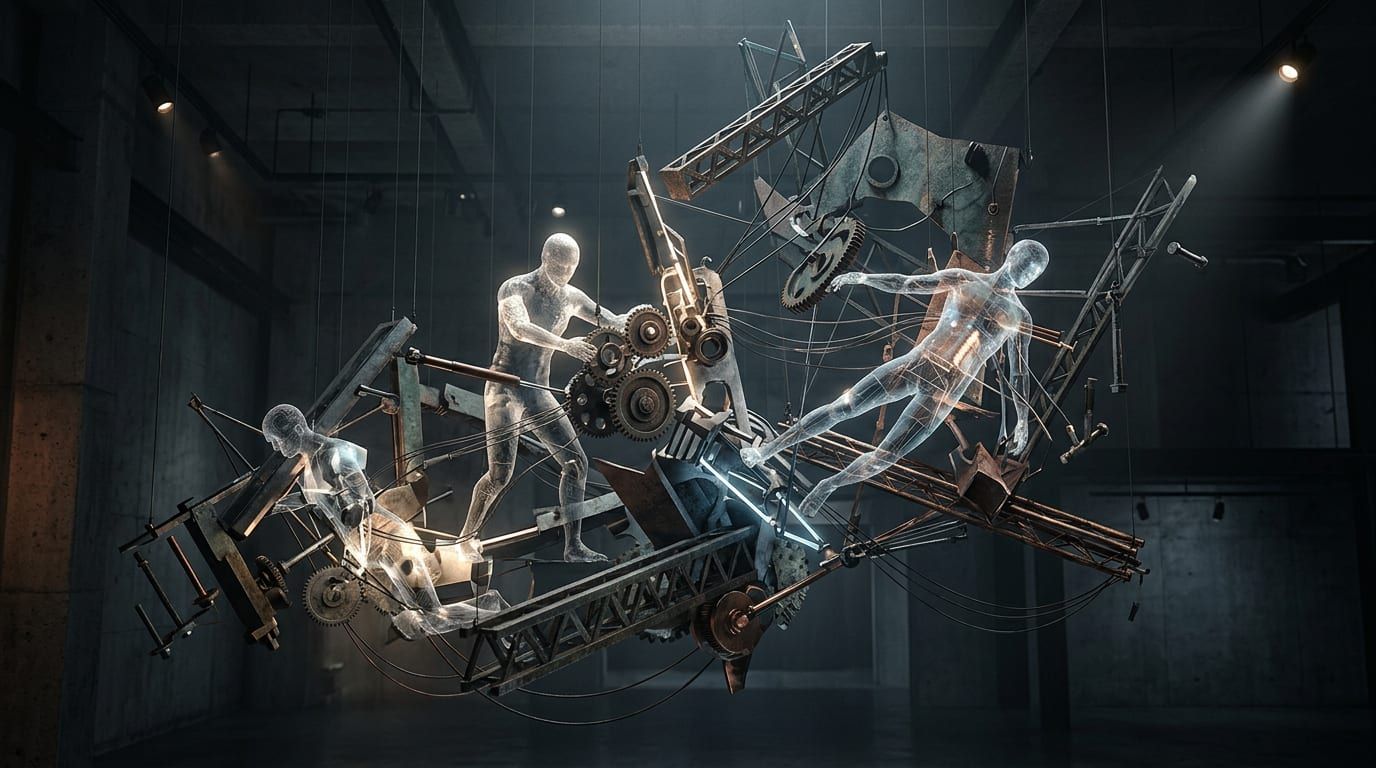
The first laboratory introduces Geumhyung Jeong's Studio/Storage, where disassembled robots share space with anatomical models and salvaged components. These DIY machines, constructed from reclaimed parts and self-taught programming, require constant maintenance—not as failure, but as integral to their meaning. Past performances, remnants awaiting reuse, and forms yet to be activated coexist on the same work surfaces, collapsing the distinction between archive and studio.
Jeong's contribution suggests that documentation might not be betrayal but continuation: a field of possibilities perpetually reconfigured from existing fragments.
Hoonida Kim's Training in Uncertainty
Hoonida Kim's Fine-Tuning Training Room occupies the second space, examining technology's infiltration into human experience and its ecological consequences. Rather than bridging the divide between body and machine, Kim proposes a different approach: learning to inhabit the gap itself.
Visitors encounter prosthetic devices designed to sharpen perception—tools that connect directly or indirectly to the body's sensory apparatus. Works like Fine-Tuning Human Sense 2.1 and Soma Patch 0.5 invite participation in an ongoing inquiry into posthuman sensibility, treating technological entanglement not as something to overcome but as a condition to navigate.
Kwon Byungjun's Collective Construction
The final laboratory belongs to Kwon Byungjun's Robotic Sound Workshop, where twenty collaborators assemble robots by hand. These builders function simultaneously as researchers and performers, their collective labour becoming the work itself. Visitors observe as machines mimicking human dance gestures emerge through movement, sound and light—a shadow theatre populated by marginal figures.
Kwon's installation considers craft and making in technological contexts, asking what hand-built objects might offer when they emulate rather than replace human movement.
Incomplete Futures
When all three laboratories are illuminated, the exhibition achieves its complete form for the first time. Yet the bodies assembled here resist perfection. They move uncertainly, require continual reassembly, and refuse final resolution.
This refusal of completion becomes its own kind of conclusion—an opening rather than an ending. What persists is the presence of bodies mid-process, together, unfinished. In their halting movements and perpetual reconstruction, perhaps we glimpse the most human version of whatever future lies ahead.
Related reading
Hockney and Wu Guanzhong in Dialogue at Christie's Hong Kong
A pioneering non-selling exhibition explores shared landscapes and cross-cultural influences
Christie's Hong Kong presents the first joint showing of David Hockney and Wu Guanzhong, exploring shared landscapes and cross-cultural visual traditions.
M+M: The Day of the Mantis at the 16th Gwangju Biennale
Luxembourg Pavilion's immersive insect-centric film trilogy explores ecological anxiety and non-human perspectives
A new cinematic installation by Marc Weis and Martin De Mattia refracts contemporary unease through the eyes of arthropods at South Korea's premier contemporary art festival.
Birke Gorm: the evening and the morning and the night at the Gwangju Biennale
Austria's national pavilion reimagines a museum loft as a living archive of repurposed sculpture and hidden histories.
The Austrian Pavilion transforms an upper-floor gallery into a tactile attic, exploring material memory and marginalised narratives through sculpture and sound.