
New York · United States
New York Society Library completes major renovation of historic Upper East Side home
The city’s oldest library has expanded its stacks, added member spaces and opened a conservation lab while staying open throughout the works.
A 272-year-old institution gets a careful update
Founded in 1754, the New York Society Library predates taxpayer-funded public libraries and has long served as a quiet engine of intellectual life in Manhattan. Its early members included George Washington, John Adams, Alexander Hamilton, John Jay and Aaron Burr, all of whom borrowed from its shelves after the library reopened in 1789 following the British occupation during the Revolutionary War.
That sense of access remains central. Although only members can check out materials, anyone may use the collection for reading and research. The library now holds roughly 300,000 volumes, many of them long since weeded out of other institutions.
“We have a lot of stuff that has long since been weeded out of other collections, so we may have one of the only copies, and certainly one of the only circulating copies,” director and head librarian Carolyn Waters explains. “You would have to request them at the New York Public Library or Princeton University. We let you check them out. That’s another reason why some of our books are in such bad shape, because they have been loved to death. But what’s the use of a pristine book, right?”
Stacks under strain
The library has occupied its Italianate townhouse on 79th Street since 1937, having moved steadily northward as the city grew. Over time the 12-level stacks became packed and some volumes were relocated to off-site storage.
“We moved as the city was moving northward, and we kept outgrowing all of our locations,” Waters says. “It was important for us to figure out how to work with this building. We were bursting at the seams, but we really didn’t want to move. We serve people from all over the city and beyond, but we’re primarily a neighbourhood library.”
When the first building-wide renovation since the 1980s began in 2024, the priority was to bring more material back on site while improving conditions for readers and researchers. The library remained open throughout the phased works.
Reconfiguring a tight urban footprint
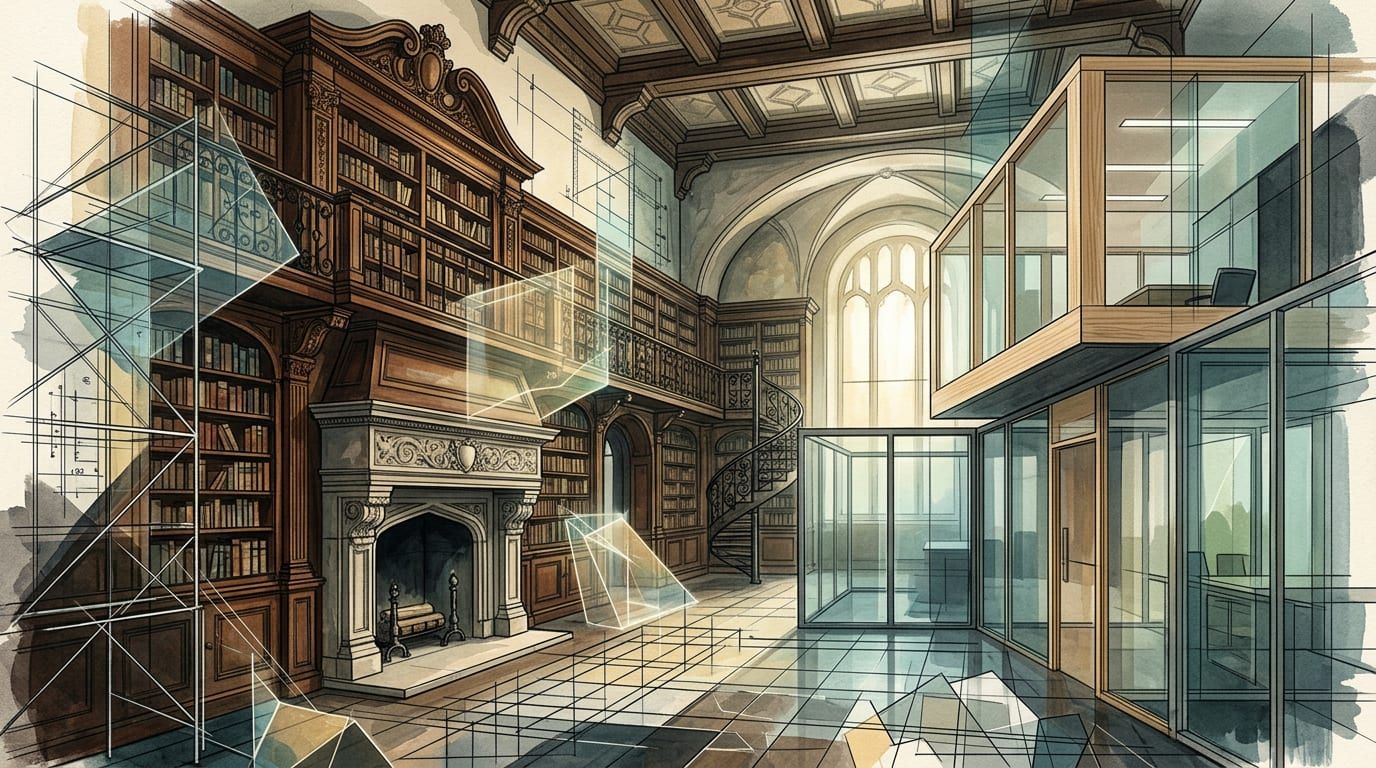
The project, led by Larson Architecture Works, rethought circulation and space use within a constrained townhouse. New staff offices were created on a lower level, freeing up a lobby-level stacks area. An unused rear yard was transformed into storage for folios and semi-rare books, and the previously staff-only fourth floor was reconfigured to include a study and events space, a rare-books reading room and a new conservation lab.
“Carolyn kept saying: ‘My biggest problem is space for people,’” architect Douglas E. Larson recalls. “People join because they want to come here and work in a quiet environment. Some don’t even go to the stacks. They just go there and write. So, people were really using it as a community space.”
Larson likens the planning process to a sliding puzzle. “You make one empty space, and you slide another part into it,” he says. The interventions are deliberately understated: glass offices sit alongside walnut panelling and sculpted fireplace mantels, while new bookcases match historical designs.
Conservation for a working collection
The conservation studio is already in use. Book conservator Werner Haun was preparing a first edition of Thomas Paine’s Common Sense for the exhibition Collective Witness: A Library for a Young Country, which opened on 18 June and spotlights the library’s 18th-century holdings. Volumes that require treatment are often repaired and returned to the shelves rather than locked away.
The library’s identity as a largely circulating collection, rather than a sealed archive, shapes its approach to preservation. Many of its books are handled regularly, and the renovation aims to support that pattern rather than restrict it.
An understated urban haven
Despite its long history and central role in New York’s cultural life, the library remains relatively low-profile.
“Despite the fact that we’ve been around for 272 years, we’re still under the radar,” Waters observes.
The completed work does not announce itself with dramatic gestures. Instead, it quietly expands capacity, improves access and secures conservation expertise on site, allowing the institution to continue adding to its collection and functioning as a calm refuge in the city.
Related reading
Mourning Keepsakes: Victorian Hairwork Arrives in Brooklyn
From Missouri to Brooklyn: preserving Victorian mourning crafts
A curated selection of commemorative hair artefacts opens at Brooklyn's Morbid Anatomy Library, exploring nineteenth-century grief rituals and the legacy of Leila's Hair Museum.
New York's Museum Building Boom Continues
How institutional expansions are reshaping the city's cultural geography
From avant-garde venues in the Lower East Side to historic collections scaling up across Manhattan, New York's architectural ambitions are fundamentally altering how audiences experience visual culture.
Taking Back Our Space: MoMA's Photographic Survey on Body Politics
How a 1970s feminist archive inspires contemporary photographers to rethink spatial inequality
A new exhibition at MoMA pairs Marianne Wex's pioneering street photography with seven modern creators exploring gender, race, and Indigenous sovereignty through the lens.