
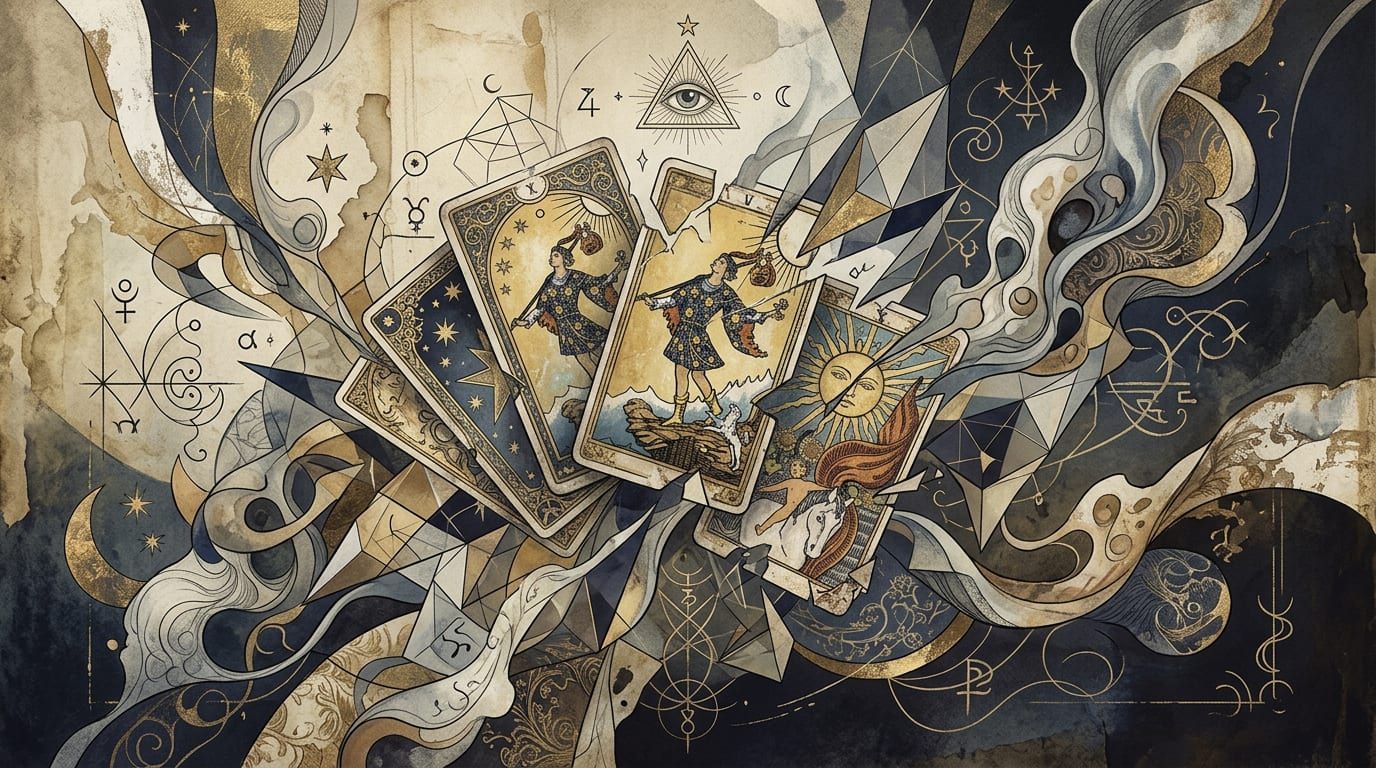
New York · United States
Morgan Library maps tarot's journey from Renaissance courts to Surrealist dreams
A two-part exhibition in New York brings together 380 works tracing the cards' evolution across five centuries
A collector's obsession meets curatorial ambition
J.P. Morgan was many things—a formidable financier, a voracious art collector—but he was also deeply superstitious. A believer in astrology and an obsessive solitaire player, his esoteric leanings led him, in 1911, to acquire dozens of cards from a fabled 15th-century tarot deck produced for Milan's ruling Visconti-Sforza dynasty by the northern Italian painter Bonifacio Bembo.
That partial deck has long counted among the signature holdings of the Morgan Library & Museum in New York. Now its 35 cards form the nucleus of an ambitious two-part exhibition, Tarot! Renaissance Symbols, Modern Visions, which opens this month and runs through 4 October. Featuring approximately 380 works, the show arcs from the refined court culture of 15th-century Lombardy to the New York of 2026, where visitors can even receive on-site tarot readings.
Reuniting a Renaissance masterpiece
The exhibition's first section centres on the Morgan's original Visconti-Sforza cards, dating to around 1456–58. Crucially, these are supplemented by a loan from the Accademia Carrara in Bergamo, meaning the majority of the deck's surviving cards will be displayed together in North America for the first time.
Though certain cards—notably the one depicting Death—evoke medieval iconography, co-curator Joshua O'Driscoll stresses that they were the product of a Renaissance artist. The Middle Ages and the Renaissance overlapped, he notes, and the earlier Visconti di Modrone deck, attributed to a painter recently identified as Andrea Bembo of Bonifacio's workshop, still feels anchored in the late Gothic imagination. The Italian art historian Anna Delle Foglie, writing in the exhibition catalogue, describes the "fairytale-like character" of the Modrone deck's Fortitude card, which shows a woman playfully grappling with a lion, dating to roughly 1441–42.
From parlour game to occult icon
The show traces tarot's remarkable metamorphosis from an aristocratic Italian card game into an international emblem of the mystical. In the late 18th century, French occultists began investing the cards with supernatural significance, laying the groundwork for a dramatic 20th-century revival.
The modern half of the exhibition opens with the British visionary artist Pamela Colman Smith and her illustrations for the influential 1909 Rider-Waite-Smith deck, designed explicitly for esoteric readings. Alongside Smith's cards—including the haunting, whimsical Fool—the show presents a striking 1908 watercolour on paper, Sketch for Glass, depicting a cloaked figure transfixed by a moon that glows like a sun, offering insight into her creative development.
The Surrealist fascination with tarot also receives sustained attention. In the early 1940s, André Breton, joined by figures including the Romanian artist Victor Brauner and the Dadaist-turned-Surrealist Max Ernst, produced a radically reimagined deck, several cards of which are on loan from Marseille. Breton's otherwise enigmatic octopus card serves as a tribute to Paracelsus, the 16th-century alchemist.
The result is a richly layered exhibition that treats tarot neither as mere curiosity nor as fortune-telling kitsch, but as a living visual tradition whose symbolic vocabulary has been reinvented by successive generations of artists and thinkers.
Related reading
Mourning Keepsakes: Victorian Hairwork Arrives in Brooklyn
From Missouri to Brooklyn: preserving Victorian mourning crafts
A curated selection of commemorative hair artefacts opens at Brooklyn's Morbid Anatomy Library, exploring nineteenth-century grief rituals and the legacy of Leila's Hair Museum.
New York's Museum Building Boom Continues
How institutional expansions are reshaping the city's cultural geography
From avant-garde venues in the Lower East Side to historic collections scaling up across Manhattan, New York's architectural ambitions are fundamentally altering how audiences experience visual culture.

Taking Back Our Space: MoMA's Photographic Survey on Body Politics
How a 1970s feminist archive inspires contemporary photographers to rethink spatial inequality
A new exhibition at MoMA pairs Marianne Wex's pioneering street photography with seven modern creators exploring gender, race, and Indigenous sovereignty through the lens.