
Los Angeles · United States
Refik Anadol's Dataland: Where AI Meets the Amazon in Downtown LA
The world's first AI art museum opens on Grand Avenue, blending biodata, scent, and immersive storytelling
On a bright California afternoon, stepping through the doors of Dataland feels less like entering a gallery and more like crossing a threshold into another ecosystem entirely. The 25,000 sq ft space, nestled within Frank Gehry's Grand LA development on Downtown Los Angeles's Grand Avenue, directly opposite the architect's Walt Disney Concert Hall, is the world's first museum dedicated entirely to AI art. Its creator, the Turkish-American artist Refik Anadol, has spent a decade pioneering the intersection of machine learning and visual culture. Now, with Dataland, he has built what he calls a "laboratory of imagination"—part science experiment, part reverent art institution, part immersive theme park.
Anadol sees a distinct responsibility for artists in the ongoing discourse around artificial intelligence.
"As an artist pioneering this field for ten years, I felt that we should have a kind of responsibility," he says.
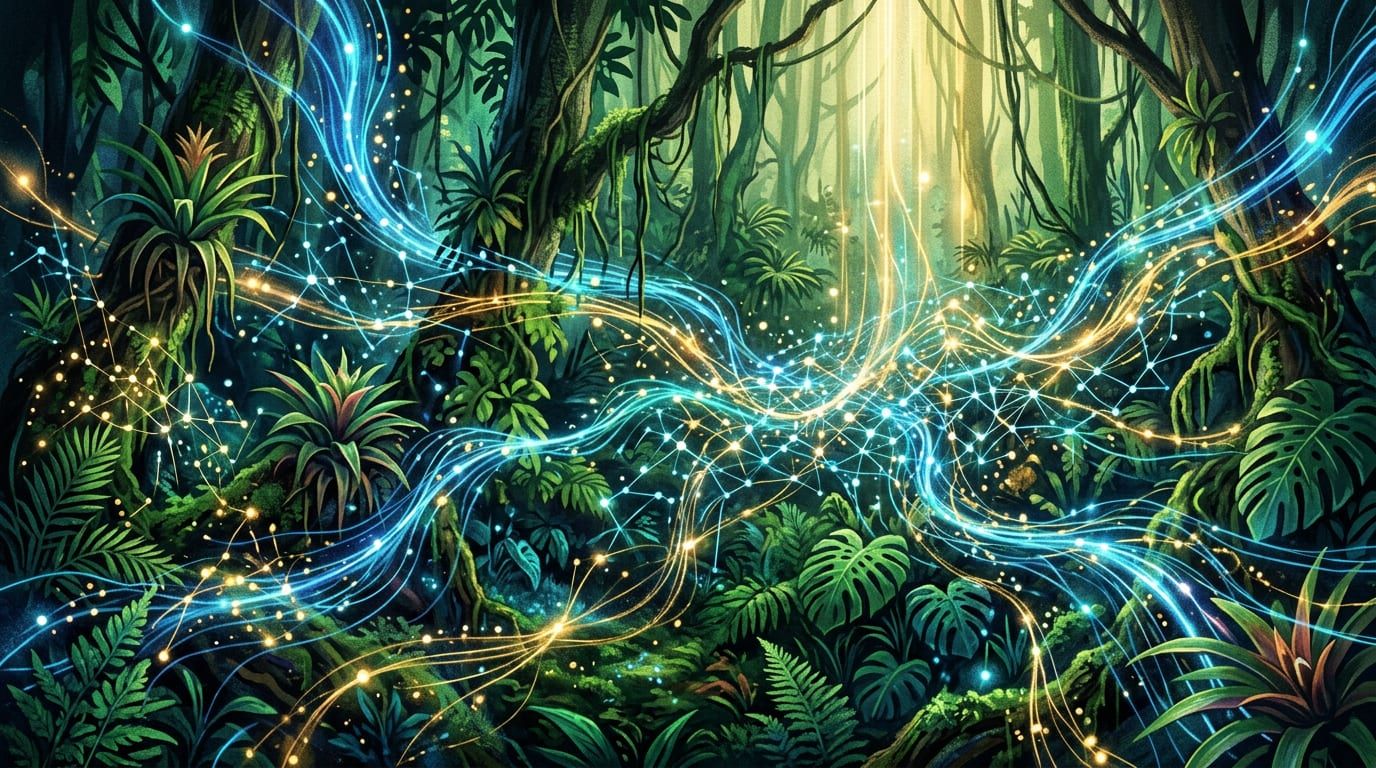
The result is an environment that uses over half a billion pixels to render rooms reflecting the natural world, drawing on datasets developed in collaboration with institutions including the Smithsonian and the Getty. But the technology extends well beyond the visual. Each visitor is fitted with a wristband that monitors heartbeat and physical responses, feeding live biodata directly into the evolving artwork. Around the neck goes a device delivering rotating combinations of twelve bespoke scents, created with the olfactory team at L'Oréal Luxe and triggered by that same biodata in real time.
The centrepiece of the opening programme is Machine Dreams: Rainforest, inspired by Anadol's visit to the Amazon and his conversations with Indigenous leaders of the Yawanawá community, a group largely disconnected from modern technology. The work follows a narrative that came to Anadol in a dream about a hummingbird in the forest, using his proprietary Large Nature Model to weave together data, memory, and storytelling.
"This bird symbolises a focus and attention to nature," Anadol explains, "but it also reminds us of real data from the real world and a real memory of nature."
The Yawanawá chief granted permission for the dream to be visualised.
The Infinity Room gallery, a concept Anadol has presented in more than 35 cities since 2015, asks visitors to surrender to the possibilities of technology. A large mirrored space with audiovisual elements intentionally echoes the work of Dan Flavin, Yayoi Kusama, and James Turrell—figures Anadol counts among his heroes.
"I have huge respect for the Light and Space movement," he says.
Scents shift every few minutes, and the effect is communal: visitors audibly react, sharing the experience rather than reaching for their phones.
That deliberate disconnection from social media distinguishes Dataland from the wave of Instagram-oriented immersive experiences that have proliferated in recent years. Anadol's partner in the studio and in life, the artist and producer Efsun Erkiliç, frames the project as an attempt to visualise the invisible.
"The funny thing is, nature itself is magical," she says. "Not in the sense of an enchanted forest, but the forest itself is quite magical. We just want to show it—you can still have a childlike feeling."
Dataland is a for-profit enterprise, with tickets starting at $49. For Anadol, the commercial model is part of the point.
"For 5,000 years, we looked at artworks and we felt something, right?" he says. "Now, my challenge question is: 'Can the artwork feel us back?'"
The museum's Sanctuary area takes this literally, aggregating visitor data to construct a unique sculpture in real time.
Looking ahead, Anadol's studio is partnering with Google Art & Culture to open access to its AI models, and with the Los Angeles Philharmonic for much of the featured music. The ambition is to attract innovators from film and music—artists like David Byrne, Björk, and Ryoji Ikeda—to create projects for the space.
Melissa Yunk of the Los Angeles Tourism and Convention Board sees Dataland as the leading edge of a broader shift. "Dataland is the epicentre of this larger shift in the museum experience," she says, pointing to the forthcoming Lucas Museum of Narrative Art, an immersive experience at the Holocaust Museum LA, and the expansion of Meow Wolf to the city. The opening on 20 June, alongside the expansion of The Broad, is central to the revitalisation of Grand Avenue.
"It is further establishing downtown as an arts and culture hub, which is how it began," Yunk says.
For Anadol, the project is also a tribute to his mentor, Frank Gehry, who died in December 2025.
"He's one of the most important architects for human history," Anadol says. "He left these concrete shells for dreamers. And I think we are following this."
Galleries mentioned
Museums mentioned
Exhibitions mentioned
Related reading
Navigating the Lucas Museum's Narrative Visions
Inside Los Angeles' ambitious yet contradictory institution celebrating illustrated storytelling
A critical look at George Lucas's new cultural venue, where blockbuster imagery meets a sprawling collection of narrative art.
Flesh Witness: Militarism, Memory, and the Pacific Archive
REDCAT's latest group exhibition interrogates imperial control across Asia-Pacific through archival intervention and Indigenous knowledge
A curated survey spanning five decades of artistic practice, Flesh Witness maps how military infrastructure has physically and culturally marked landscapes, bodies, and historical records throughout the Pacific.
Why Disney Made the Genie Blue
The long material and colonial history behind the most recognizable blue body in popular culture.
Almost everyone remembers that Disney's genie is blue. Fewer ask why. The answer runs backward through five thousand years — Egyptian blue standing in for lapis, cobalt on a Mongol palace, the eye that guards against envy, the last color most languages learned to name, and a layout artist photographing Isfahan just before a war — to a color that was rarely, in this part of the world, quite what it claimed to be.