
Altos · Paraguay
San Lorenzo Mártir church restoration concludes after eight-year effort
Conservation of Paraguay’s colonial Franciscan church reveals long-hidden Baroque altarpiece and reaffirms Altos as a centre of woodcarving heritage
Eight-year project concludes at Paraguay’s San Lorenzo Mártir church
The restoration of the San Lorenzo Mártir church in Altos, among Paraguay’s most significant colonial religious sites, has been formally brought to a close after a phased conservation effort spanning nearly eight years. Situated roughly 60km from Asunción, the Franciscan church remained in continuous use throughout the work, allowing liturgical and community life to carry on alongside the interventions.
Listed as a National Cultural Heritage Site in 2017, the building’s earlier appearance gradually emerged as the project advanced. Initiated in 2018, the process has underscored the historical importance of a site tied to the early Franciscan presence in Paraguay, when Asunción was still a fledgling colonial outpost on the edge of Guaraní territories.
The most recent phase, focused on the church’s wooden doors and windows, has now been completed, according to Ana Butlerov, the new head of the Historical Heritage Unit at Paraguay’s Ministry of Public Works and Communications (MOPC). She notes that the main and side altarpieces were addressed in earlier stages of the project.
“During work on the doors and windows, religious services continued without interruption,” Butlerov explains.
Baroque altarpiece at the heart of the project
Central to the initiative was the conservation of the main altarpiece, regarded as one of the foremost examples of Paraguayan colonial Baroque. Early in the process, Myrian Mármol, Butlerov’s predecessor, warned of the precarious state of both church and altarpiece. Speaking to local media, Mármol described the altarpiece as “in a state of disrepair and completely eaten away by termites”, stressing that the team had arrived just in time as the wood was crumbling.
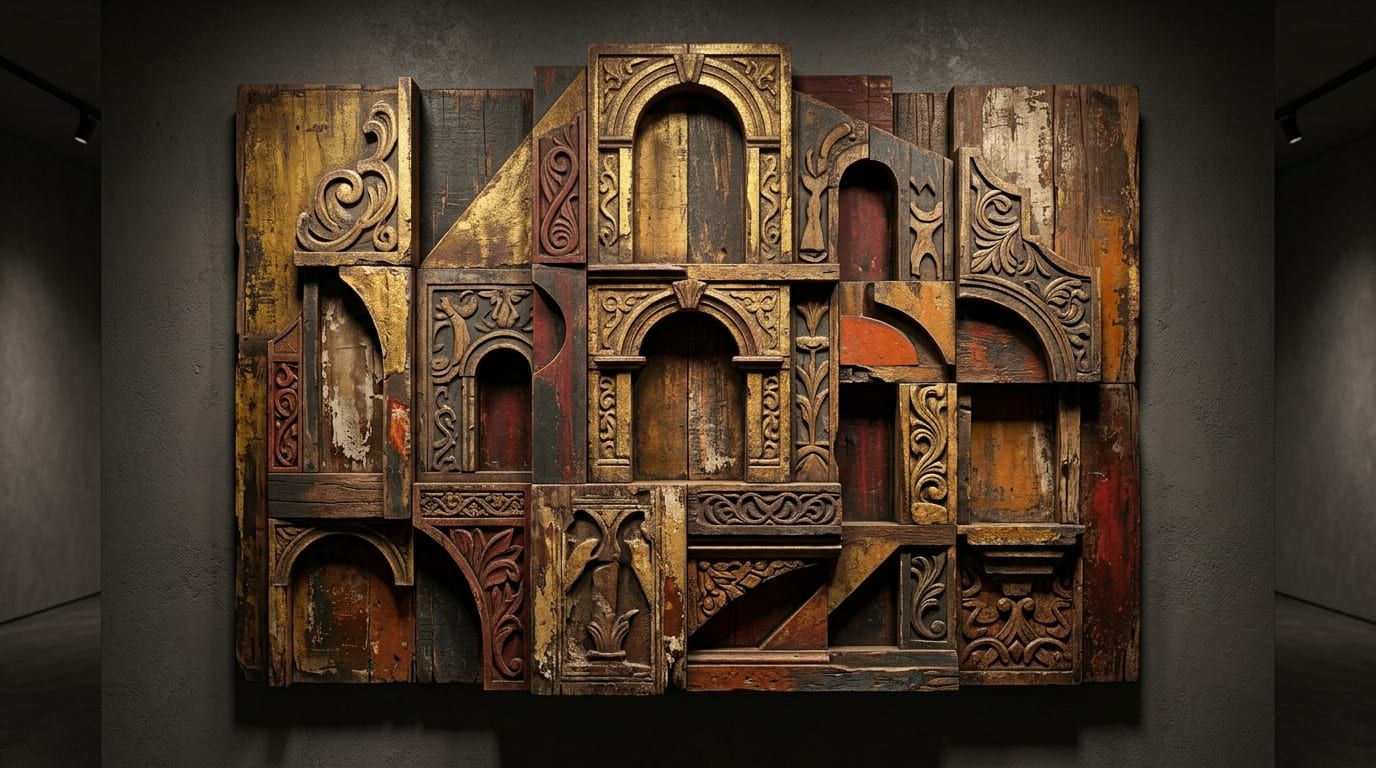
Standing 5.5m high and 3.75m wide, the altarpiece had not undergone comprehensive restoration for over a century. Conservators dismantled it into more than 300 components to enable targeted treatment against termites and moisture, the principal threats to wooden heritage in the region. The three-year effort stabilised the structure and recovered elements of its original polychromy, long concealed beneath degraded varnish, overpainting and later interventions. As cleaning progressed, colours, ornamental motifs and patterns obscured by time resurfaced.
The work has repositioned the altarpiece as an object shaped by Franciscan tradition, colonial Baroque aesthetics and the output of local workshops historically linked to woodcarving.
Phased interventions across the church
During the initial phase, attention also turned to the predella and upper section of the altarpiece, where depictions of Saints Joseph, Lawrence and Roch appear alongside the Assumption of Mary. A second phase extended the project to wall niches housing religious imagery and the pulpit, broadening the scope to other liturgical and historic features within the church.
The final phase, launched in 2024, targeted the church’s wooden doors, side entrances and windows, whose original surfaces had been masked for decades by successive layers of paint. Prior to treatment, specialists carried out photographic documentation, technical assessments and scientific analyses to identify repainting, cracks, structural damage and infestations. Following conservation, expert craftspeople introduced wood grafts where necessary to replace missing or compromised sections.
Colonial history and post-war rebuilding
Founded in the 16th century, the San Lorenzo Mártir church was rebuilt after the Paraguayan War (1864–70), a conflict that reshaped the nation and left a lasting imprint on its built heritage. The recent conservation forms part of a wider initiative to acknowledge Paraguay’s colonial religious patrimony, particularly churches preserving altarpieces, carvings, adobe walls and timber elements associated with early evangelisation and settlement.
“The intervention reaffirms the historical value of Altos as the birthplace of Paraguayan woodcarving and sets a precedent for future restoration projects in the region, including the planned work on the Virgen de las Mercedes church,” an MOPC spokesperson stated, signalling the continuation of heritage efforts in the area.
Related reading

Rupture and Waterways Define the Fourth Toronto Biennial
Allison Glenn's curatorial vision transforms the city into a transnational network of installations and performances
The 2026 edition explores structural fracture and aquatic connectivity through a sprawling, multi-site programme.

Mourning Keepsakes: Victorian Hairwork Arrives in Brooklyn
From Missouri to Brooklyn: preserving Victorian mourning crafts
A curated selection of commemorative hair artefacts opens at Brooklyn's Morbid Anatomy Library, exploring nineteenth-century grief rituals and the legacy of Leila's Hair Museum.

Diego Rivera's Monumental Stadium Relief Set for Conservation in Mexico City
A multi-institutional campaign targets the artist's unfinished stone facade at UNAM alongside works by Siqueiros and O'Gorman
Local conservators will lead a phased preservation effort for Diego Rivera's volcanic stone relief at Mexico City's Olympic stadium, supported by the World Monuments Fund and US diplomatic grants.