
Winnipeg · Canada
Palestine Uprooted: A Long-Awaited Exhibition Opens in Winnipeg
The Canadian Museum for Human Rights presents a nuanced exploration of displacement, memory and cultural resilience despite fierce opposition
A Show Years in the Making
When the doors open tomorrow (27 June) at the Canadian Museum for Human Rights (CMHR) in Winnipeg, visitors will encounter something the institution has never staged before: a dedicated exhibition examining Palestinian displacement. Palestine Uprooted: Nakba Past and Present arrives after years of community advocacy, months of curatorial research and a storm of opposition that included legal threats, public criticism and the resignation of the museum's sole Jewish board member.
Yet the show itself is notably restrained in tone. Rather than leaning into polemic, curator Isabelle Masson has assembled a layered, intimate presentation spanning two walls on the museum's fifth floor — one that balances historical documentation with the textures of everyday Palestinian life.
"What I say to the critics is 'come and see it first'," Masson tells.
Poetry as Entry Point
Visitors are met by three panels bearing verses from Mahmoud Darwish, rendered in English, French and Arabic. These double as projection screens, weaving the poet's words together with images of women, children and protests against the bombing of Gaza. One line reads: "As you think of others far away, think of yourself / (say: 'If only I were a candle in the dark')." Translated flyers are available for visitors to take away.
The choice is deliberate. Darwish's poetry functions as both aesthetic frame and emotional anchor, setting an expectation of reflection rather than confrontation.
Objects That Carry Memory
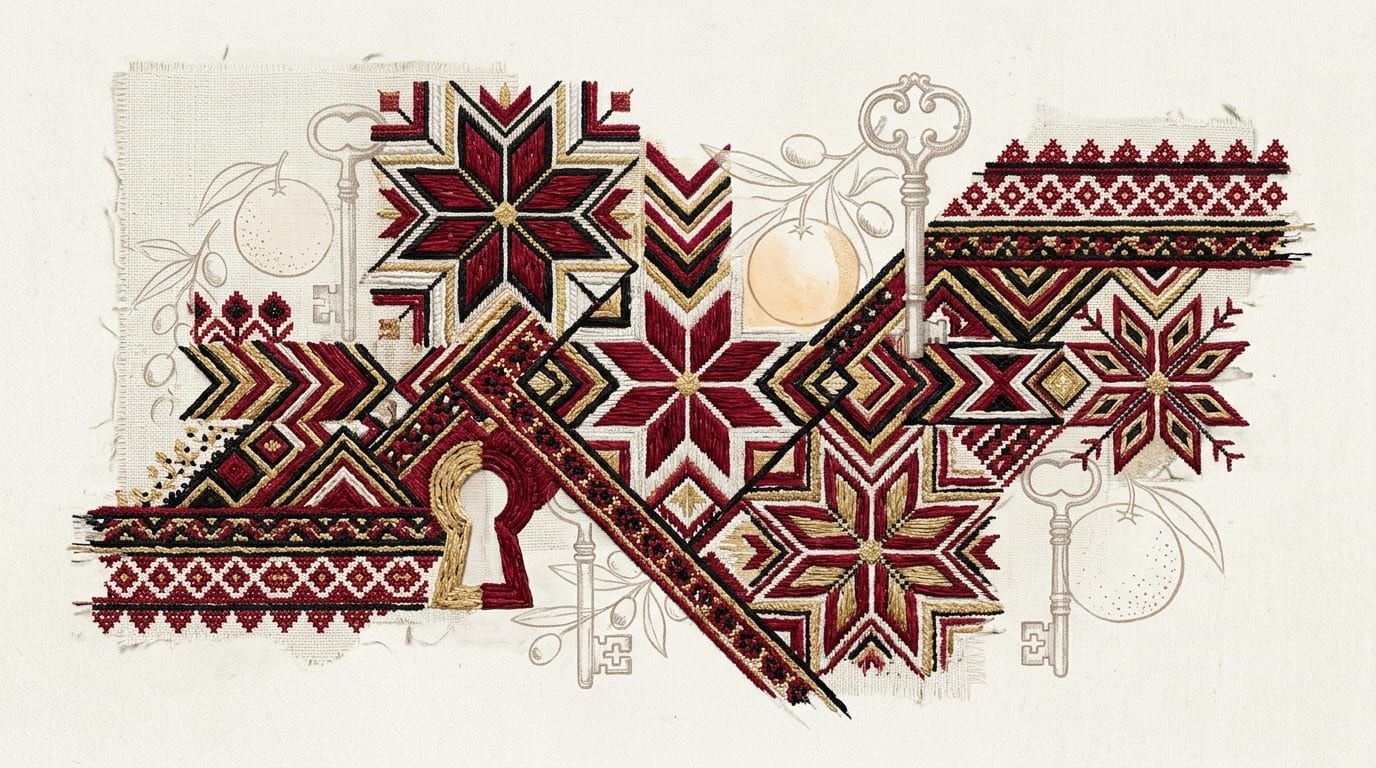
The exhibition's most affecting section revolves around memory boxes — display cases that merge digital media with physical artefacts. Among them: a paper wrapper for citrus fruits from the Al Taji family's orchard in Wadi Hunayn (now within the Israeli city of Ramle), preserved by a grandmother for decades as a token of both loss and pride. Nearby hangs a print of Gazan tatreez, the traditional embroidery encoding clan and village identity in its patterns.
Also on view is a Gazan thobe — the embroidered Palestinian dress that, like tatreez, threads narratives of belonging into its fabric — loaned by a Palestinian woman in Winnipeg. Beside it rest keys to her grandparents' house, which visitors are invited to hold. Adjacent monitors play video interviews with Palestinian Canadians speaking about what they have lost and what they still love.
Contemporary Art and Historical Context
The show incorporates contemporary Palestinian art, including a print of Malak Mattar's 2020 painting Bound Together in Gaza. An introductory panel juxtaposes a large-format photograph of Gazans fleeing Khan Yunis in 2024 with didactic material explaining the historical and ongoing Nakba — the Arabic term for "catastrophe" used to describe the killing, dispossession and displacement that followed Israel's founding in 1948.
Rajie Cook's 2002 sculpture Curfews and Closures, on loan from the Arab American National Museum in Dearborn, Michigan, offers a striking visual metaphor: a keffiyeh trapped inside a birdcage, balanced atop two chipped legs of a figurine. It resonates powerfully alongside the nearby video testimonies.
Centring Marginalised Voices
Masson is candid about the project's intentions.
"We came into this project quite aware that Islamophobia and anti-Palestinian racism influences who is heard and whose suffering is seen as important," she says. "We wanted to humanise Palestinians not just by focussing on their trauma but on the richness of their culture."
Community consultation shaped the exhibition from the start. Members of Winnipeg and Montreal's Palestinian communities were interviewed beginning in 2021, and their stories — described by Masson as "moving" — form the backbone of the show.
Ramsey Zeid, part of the Palestinian community advisory network, attended a preview with his parents, both Nakba survivors.
"Seeing the exhibition brought tears to my parents' eyes," he says — not only because it revived painful memories but because "for the first time, in an internationally recognised museum, our stories — which have been silenced for so long — were told and seen and heard and validated."
He adds: "No matter what we go through, our culture lives on — passed from generation to generation. That's how we keep the Palestinian spirit alive."
A Quiet Act of Institutional Courage
That the CMHR has proceeded with Palestine Uprooted at all is noteworthy. The museum faced pressure from multiple directions — accusations of bias before any content was public, legal action from an Israeli organisation and internal governance strain. The exhibition does not attempt to resolve these tensions. Instead, it offers something arguably more valuable: a space in which Palestinian Canadians see their history treated with the institutional seriousness it has long been denied.
Whether critics accept Masson's invitation to "come and see it first" remains to be seen. The exhibition, at the very least, deserves to be encountered on its own terms.
Related reading
Asper Family Halts Funding Over Canadian Human Rights Museum Exhibit
Donor withdrawal sparks debate over curatorial independence and historical narrative in Canadian cultural sector
Financial backing from the Asper family has been withdrawn from Winnipeg's human rights museum following criticism of its Nakba-focused display.
Diego Rivera's Monumental Stadium Relief Set for Conservation in Mexico City
A multi-institutional campaign targets the artist's unfinished stone facade at UNAM alongside works by Siqueiros and O'Gorman
Local conservators will lead a phased preservation effort for Diego Rivera's volcanic stone relief at Mexico City's Olympic stadium, supported by the World Monuments Fund and US diplomatic grants.
Van Lévé: Sovereign Caribbean Visions Take Shape at Harvard
A transnational survey charts twenty-five years of Creole and Maroon artistic practice across the French Caribbean and Amazonia.
Harvard's Alain Locke Gallery presents a landmark survey tracing contemporary production from Guadeloupe, Martinique, Guyane, and Haiti since two thousand and one.