Umm Ubayda (Temple of Amun of Nectanebo II)
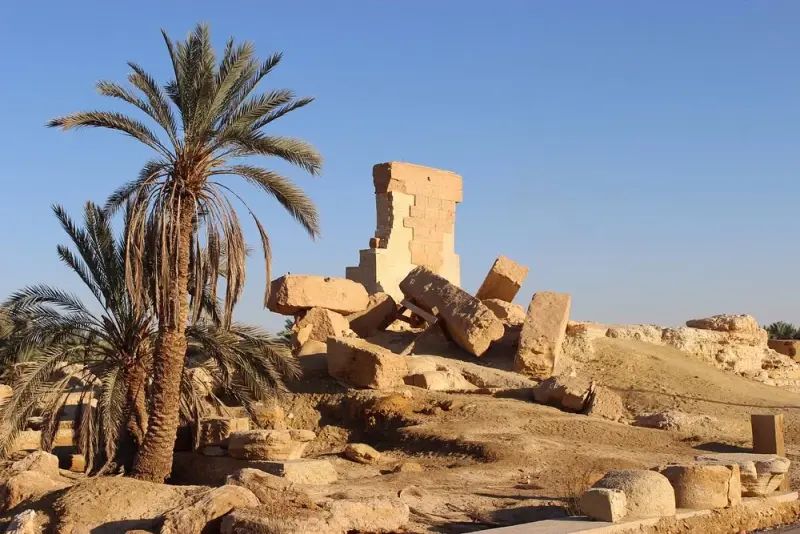
A single carved wall in the palm groves — all that remains of a temple of Amun built by Egypt's last native pharaoh.
A temple of the last pharaoh
Umm Ubayda lies in the palm groves a short distance south of the rock of Aghurmi, in Siwa Oasis. Here stood a second temple of Amun, built in the fourth century BC by Nectanebo II, the last native Egyptian pharaoh before the Persian reconquest and, later, Alexander's arrival. It was linked to the oracle temple on Aghurmi by a processional way, along which the image of the god may have been carried during festivals.
Destruction
The temple remained largely standing into the nineteenth century, when European travellers described it. It was badly damaged by an earthquake in 1811, and in 1897 a local governor had much of the remaining structure blown up with explosives to reuse its stones for buildings in Siwa town. Today, only one section of wall survives, standing alone among the palms.
The surviving wall
The surviving wall preserves carved reliefs and hieroglyphic inscriptions showing Nectanebo II and a local Siwan ruler making offerings to Amun and other gods, with long columns of religious texts. Though fragmentary, it is one of the few monuments of Egypt's last native dynasty in the Western Desert and a moving reminder of what has been lost.
Exhibo editorial
There is something poignant about Umm Ubayda: one carved wall standing alone in a palm grove, the rest of the temple gone into the foundations of nineteenth-century houses. The reliefs are still crisp, the hieroglyphs clear, the figures of the last native pharaoh still offering to his god.
It takes ten minutes, and it's best on the way back from Aghurmi, by bicycle or tuk-tuk through the palms. Stand in front of the wall in the slanting afternoon light and imagine the temple whole, the procession coming down from the oracle on the hill.
How to find it
Umm Ubayda lies in the palm groves a few hundred metres south of the rock of Aghurmi, along the track towards Cleopatra's Bath. Ask your tuk-tuk driver or cycle there after visiting the Temple of the Oracle.