
Tanis (San el-Hagar)
The Delta capital of the Twenty-first and Twenty-second Dynasties, where the silver coffins and gold masks of the Tanite kings were found intact.
A forgotten capital
Tanis, at the village of San el-Hagar in the north-eastern Nile Delta, was the capital of Egypt under the kings of the Twenty-first and Twenty-second Dynasties, from around 1070 to the eighth century BC, when the country was divided between rulers in the Delta and the priests of Amun at Thebes. Its kings built a great temple of Amun at the centre of the city, using enormous quantities of stone — obelisks, colossal statues, columns and blocks — brought from earlier monuments, especially from Pi-Ramesses, the abandoned Delta capital of Ramesses II. As a result, Tanis is full of monuments inscribed with Ramesses' name, which led early archaeologists to identify it wrongly with his city.
The royal tombs
In 1939–1940, the French archaeologist Pierre Montet discovered within the temple enclosure a group of royal tombs of the Twenty-first and Twenty-second Dynasties, several of them intact — one of the most important finds in Egyptian archaeology after Tutankhamun's tomb, overshadowed at the time by the outbreak of the Second World War. They contained the burials of kings such as Psusennes I, Amenemope and Sheshonq II, with a silver coffin with a falcon's head, gold funerary masks, jewellery and vessels of gold and silver. These treasures are now displayed in Cairo.
The site today
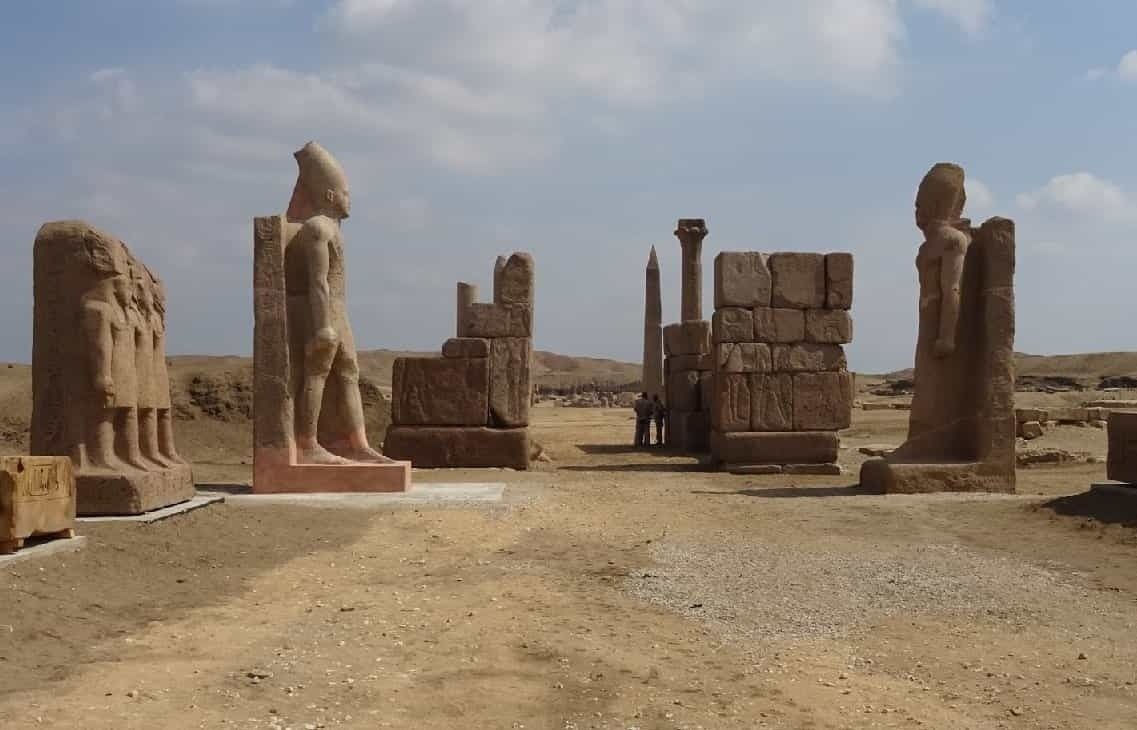
The vast site, a great mound rising above the surrounding fields, is strewn with fallen obelisks, fragments of colossi, columns and inscribed blocks, together with the remains of the temples of Amun, Mut and Khonsu, a sacred lake and the royal tombs, which can be visited. Excavations by a French mission continue.
Exhibo editorial
Tanis looks like a giant's playground after a storm: fallen obelisks lying in the grass, colossal heads and feet of Ramesses II scattered across a huge mound in the middle of the Delta fields, and almost no one else there. The scale is overwhelming, and the silence complete.
Then go down into the royal tombs, small stone chambers where the kings of a forgotten dynasty were found in 1939 with their silver coffins and gold masks. It's one of the great archaeological stories, and one of the least visited sites in Egypt. Combine it with Tell Basta on a day trip from Cairo or Ismailia.
How to find it
Tanis lies at the village of San el-Hagar in the north-eastern Delta, about 3 hours by car from Cairo and about 1.5 hours from Ismailia or Zagazig. From the ticket office, walk up onto the mound; the fallen obelisks and colossi lie along the main axis of the Temple of Amun, and the royal tombs are within the temple enclosure, signposted on site.