Wadi Hammamat
An ancient desert road between the Nile and the Red Sea, lined with quarries of bekhen stone and thousands of years of inscriptions.
The road to the sea
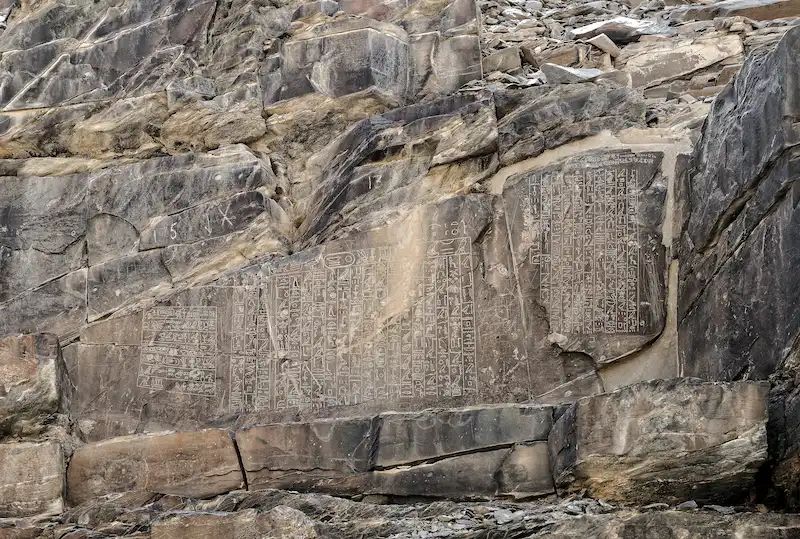
Wadi Hammamat is a dry valley in the Eastern Desert, on the main route between Qift (ancient Coptos) on the Nile and Quseir on the Red Sea, followed today by the modern road. Since prehistoric times it has been one of the principal corridors across the desert, used by traders, miners, soldiers and pilgrims, and its rocks bear one of the richest collections of inscriptions and rock art in Egypt, from predynastic drawings of boats and animals to texts of the pharaohs, Persian kings and Roman travellers.
The bekhen quarries
The wadi is famous for its quarries of bekhen stone, a hard dark greywacke prized by Egyptian sculptors for statues, sarcophagi and objects such as the Narmer Palette. Expeditions sent by the pharaohs to cut stone left inscriptions recording their missions, the number of men involved and the blocks extracted. One of the most celebrated records a large Middle Kingdom expedition in the reign of Mentuhotep IV, led by the vizier Amenemhat, and describes miraculous signs, including a gazelle that gave birth on the very stone chosen for the king's sarcophagus.
Gold and maps
Nearby, at Bir Umm Fawakhir, are the remains of a gold-mining settlement of the Roman and Byzantine periods. The region is also depicted on the Turin Papyrus Map, drawn around 1150 BC for an expedition under Ramesses IV, which shows the wadi, its quarries and gold mines and is often described as the oldest surviving geological map.
Exhibo editorial
The road from Quseir to the Nile is a spectacular drive through mountains of dark rock — and halfway along, beside the asphalt, the cliffs of Wadi Hammamat are covered with hieroglyphs, cartouches, boats and animals, left by people who passed this way over five thousand years. You can pull over and read pharaohs' names a few metres from passing trucks.
Stop for half an hour, walk along the rock faces, and look for the old quarry cuts where the stone for royal statues was taken. It's one of the great open-air archives of Egypt, and almost nobody stops.
Gallery
How to find it
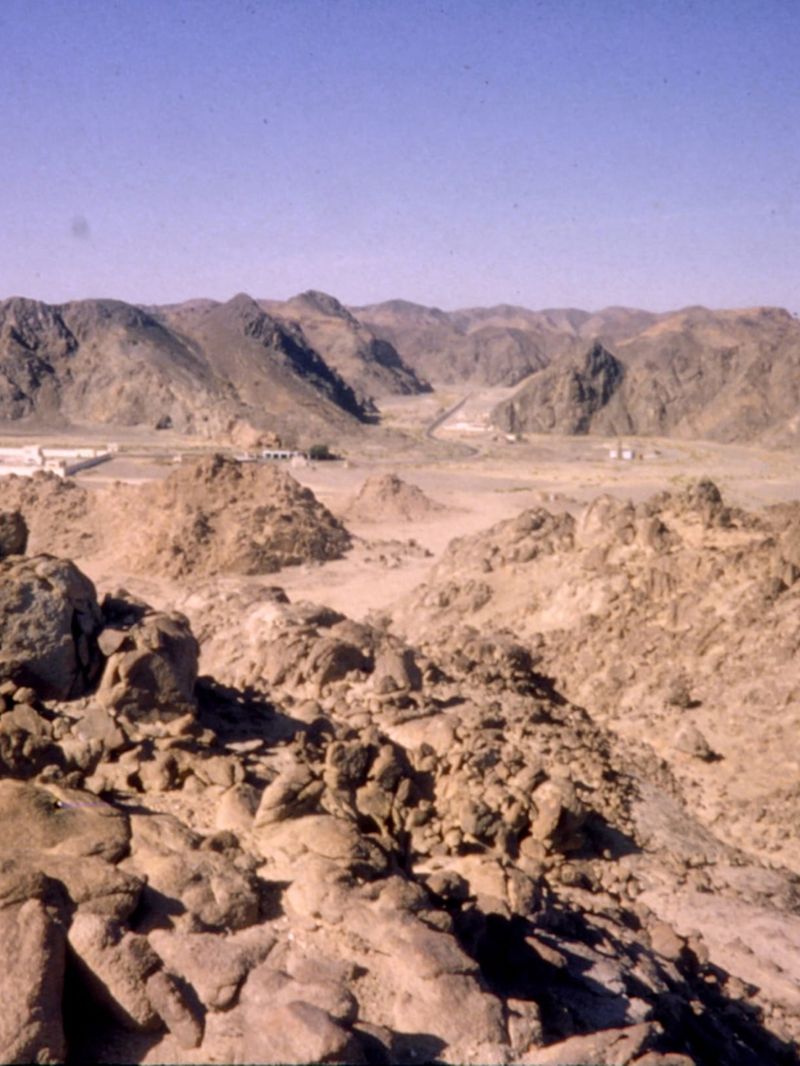
Wadi Hammamat lies on the road between Quseir on the Red Sea and Qift on the Nile, about 90 km west of Quseir. The main inscribed rock faces and quarries are beside the road; ask a driver who knows the route to stop at the inscriptions.