Dendera Temple Complex (Temple of Hathor)
One of Egypt's best-preserved temples — restored colour ceilings, painted crypts and rooftop chapels with a copy of the famous zodiac.
The house of Hathor
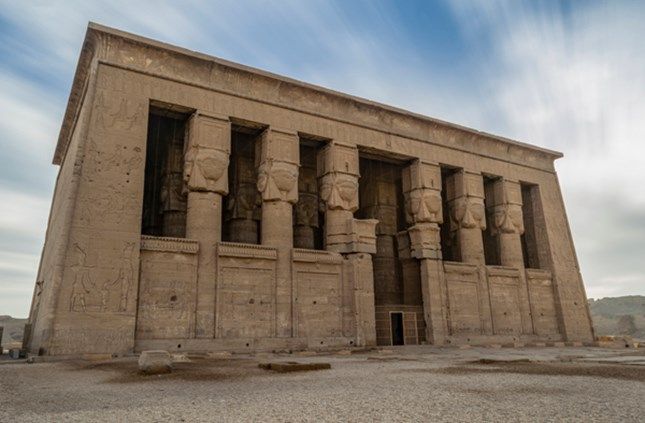
The Temple of Hathor at Dendera, on the west bank of the Nile near the city of Qena, about 60 kilometres north of Luxor, is one of the most complete and best-preserved temples in Egypt. Dendera had been a sacred site of Hathor — goddess of love, music, joy and motherhood — since the Old Kingdom, but the temple seen today was built mostly in the late Ptolemaic and early Roman periods, from the first century BC into the first century AD. Its decoration names Ptolemaic rulers, including Cleopatra VII, who appears with her son Caesarion in a great relief on the rear wall, as well as Roman emperors.
The hypostyle hall and its ceilings
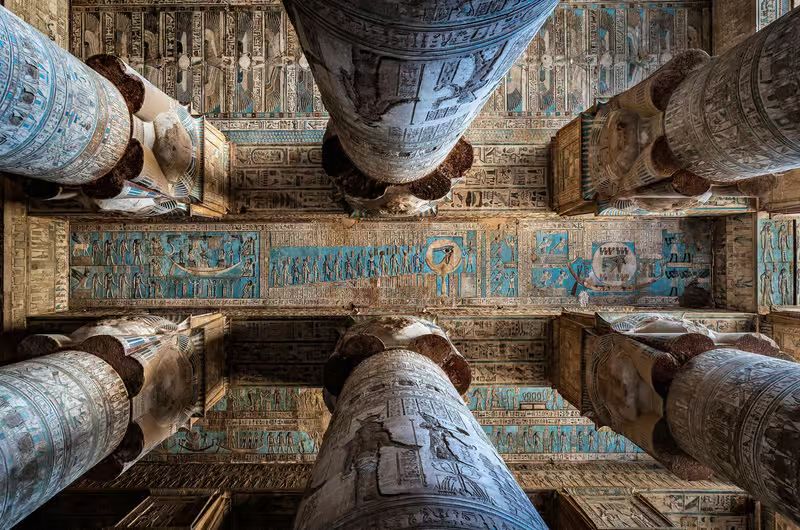
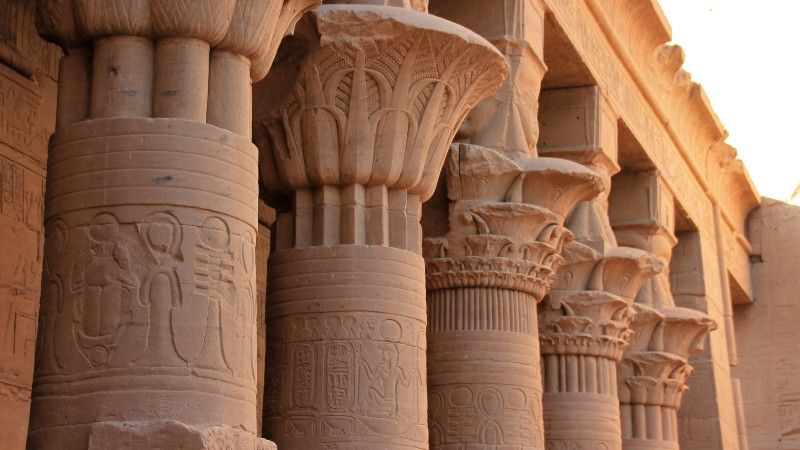
The façade opens onto a great hypostyle hall whose twenty-four columns are crowned with capitals in the form of the face of Hathor, many later defaced. Its ceiling is decorated with astronomical scenes — the sky goddess Nut, the sun's journey, decans and constellations — whose deep blues and golds were revealed in a major cleaning project completed in the 2010s, removing centuries of soot. Beyond lie halls, offering chambers and the sanctuary of the sacred barque, and a series of crypts built into the walls, decorated with exceptionally fine reliefs, including the famous scenes sometimes popularly called the "Dendera light".
The roof
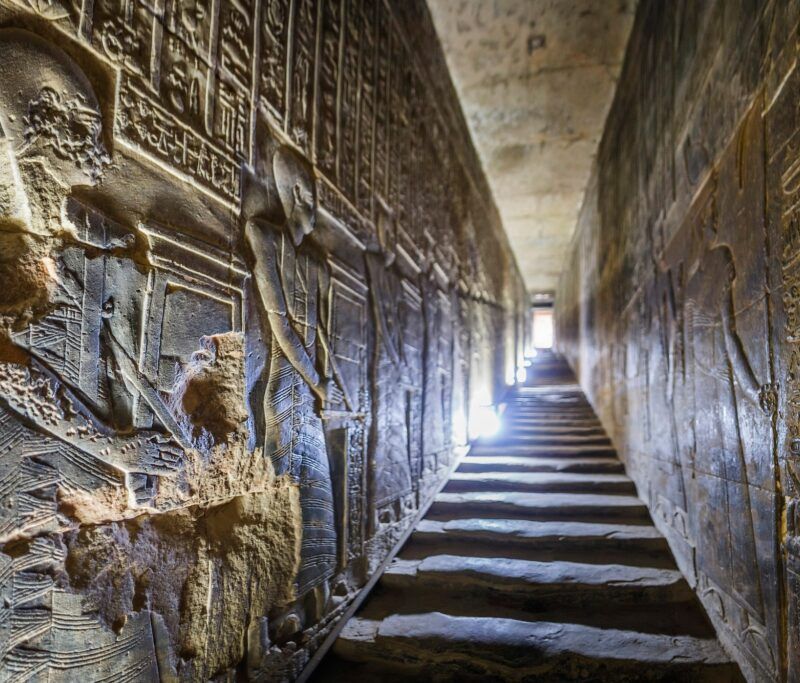
A staircase decorated with processions of priests leads up to the roof, where chapels were dedicated to the mysteries of Osiris. One of them held the Dendera zodiac, a circular map of the sky carved in relief, removed in 1821 and now in the Louvre; a cast stands in its place. From the roof there are wide views over the temple enclosure and the fields of the Nile valley.
Around the temple
The enclosure also contains two birth houses (mammisi) — one Roman and one from the time of Nectanebo I — the remains of an early Christian basilica built between them, a sacred lake and a sanatorium where pilgrims sought healing. Dendera is a classic day trip from Luxor, often combined with Abydos further north.
Exhibo editorial
Dendera is the temple to visit if you want to see what an Egyptian temple actually felt like: the roof is still on, the halls are still dark, and when you look up in the hypostyle hall, the ceiling is blue and gold again after centuries under black soot. It's like stepping into the original colour film.
Take your time with the crypts — narrow, low and carved with astonishing precision — and climb to the roof for the Osiris chapels and the wide view over the valley. Then walk round to the back wall and find Cleopatra, standing with her son Caesarion, one of the very few certain portraits of the last queen of Egypt.
Gallery
How to find it
Dendera lies about 5 km from the centre of Qena, across the Nile on the west bank, and about 1.5 hours by car from Luxor; most visitors come by private car or as part of a day trip. From the entrance, walk through the gateway into the enclosure: the main temple is straight ahead, the birth houses and the Christian basilica to the right, and the sacred lake behind the temple. The staircase to the roof starts inside the temple, near the inner halls.